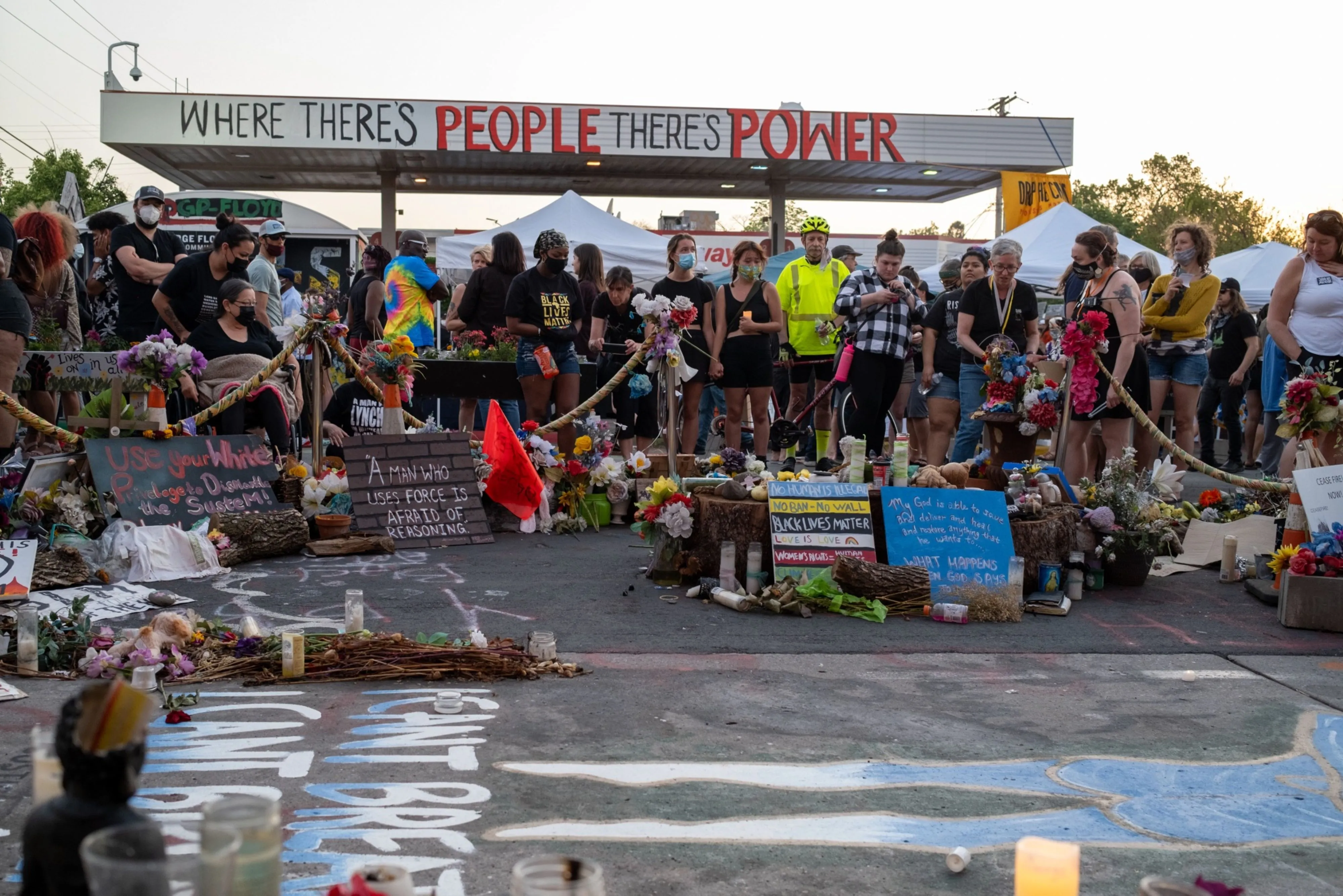
Under an abandoned gas station, activists meet twice daily at George Floyd Square.
Photographer: Tim Evans/BloombergWho Decides the Future of George Floyd Square?
The Minneapolis intersection near where George Floyd was killed has become a different kind of car-free zone. Will it stay that way?
In the Minneapolis semi-autonomous zone now known as George Floyd Square, the one-year anniversary of George Floyd’s death was not just a memorial, or a dance party. It was another day of occupation.
For the past year, the area around the intersection of East 38th Street and Chicago Avenue, the site of Floyd’s killing in May 2020, has been off-limits to cars, and, for the most part, free of cops. A multiracial community group led by Black women that has been meeting twice daily at the square for a year has said that they will continue to occupy the square until the city meets a list of 24 demands for justice, but many would like to make the memorial and pedestrian access permanent. One of the demands is to keep the zone until the trials of all four officers involved in Floyd’s murder are complete, with the last three starting in August; others focus on investing in jobs and businesses in the neighborhood and providing transparency in past police killing cases. “That’s the bare minimum of what we could have possibly asked,” said Mileesha Smith, an organizer, as she laid “F*ck the Police” pins out on a table.