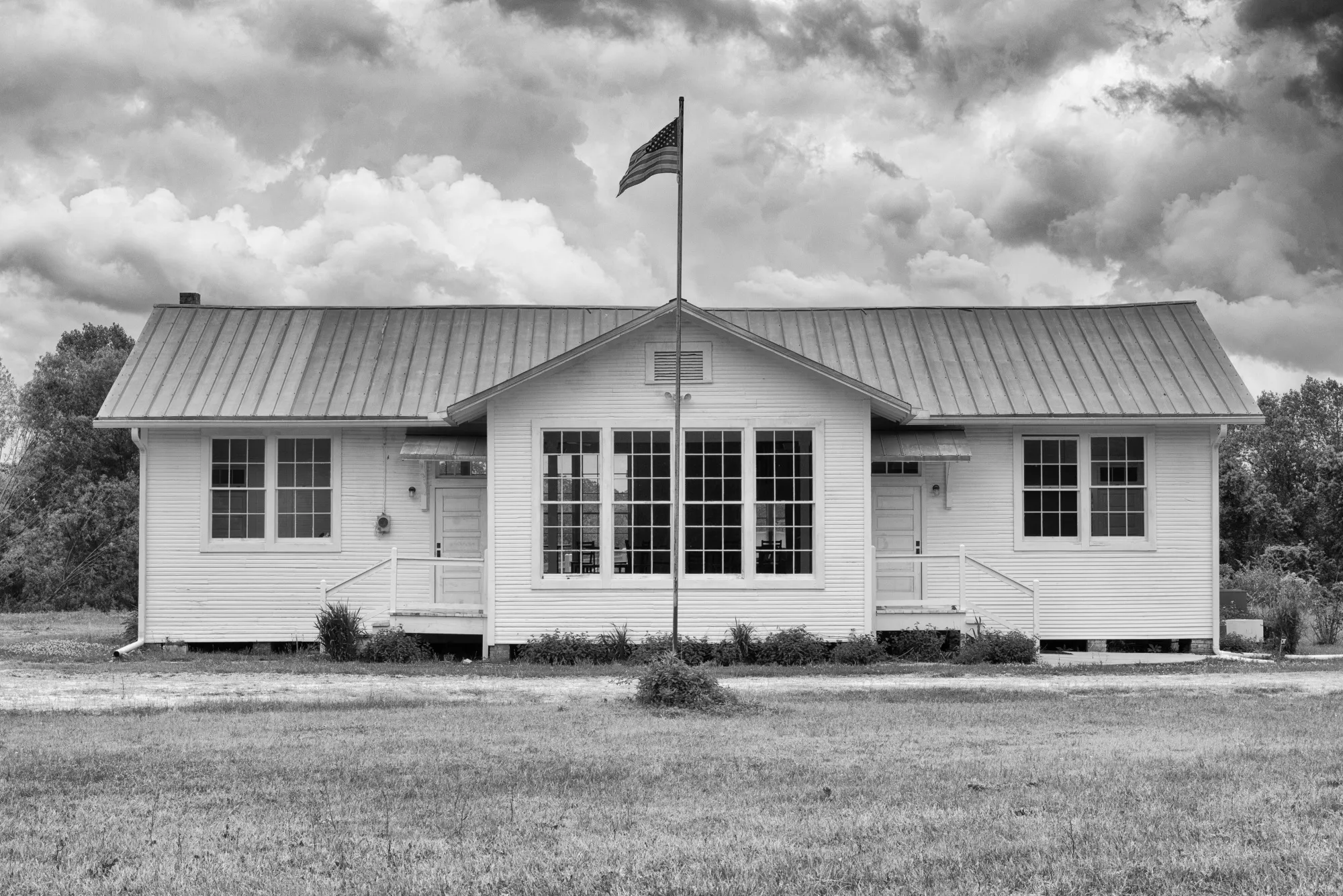
A fully restored Rosenwald School building for rural Black students in Forrest County, Mississippi, serves today as a community center.
Photographer: Andrew FeilerA Monument to Black Education, the Rosenwald Schools Are Still Standing
Advocates are pushing for recognition of hundreds of segregation-era schools built by Booker T. Washington and Sears owner Julius Rosenwald.
When Marian Coleman started first grade at Noble Hill School in Bartow County, Georgia, in the early 1950s, she was too excited to notice it only had two classrooms and two teachers for grades one through seven. “I was so small, it was roomy,” she says. “It was fun for me to go to be with other kids.” It wasn’t until later, after studying at larger schools in Atlanta, that she came to realize she had been part of one of the largest educational experiments in US history — and that her family had played a key role in its execution and preservation.
Noble Hill School was a Rosenwald School, one of approximately 5,000 rural schools built across 15 Southern states between 1917 and 1937, serving Black children at a time when the segregated white school systems would not. They owe their existence to the productive collaboration between one of America’s foremost businessmen, Julius Rosenwald of Sears, Roebuck and Company, and one of America’s foremost educators, Booker T. Washington. With the help of hundreds of Black community organizers, Rosenwald Schools persisted, in all their simplicity, educating approximately 600,000 Black children through 1954, when the US Supreme Court’s ruling in Brown v. Board of Education ordered desegregation of American public education.