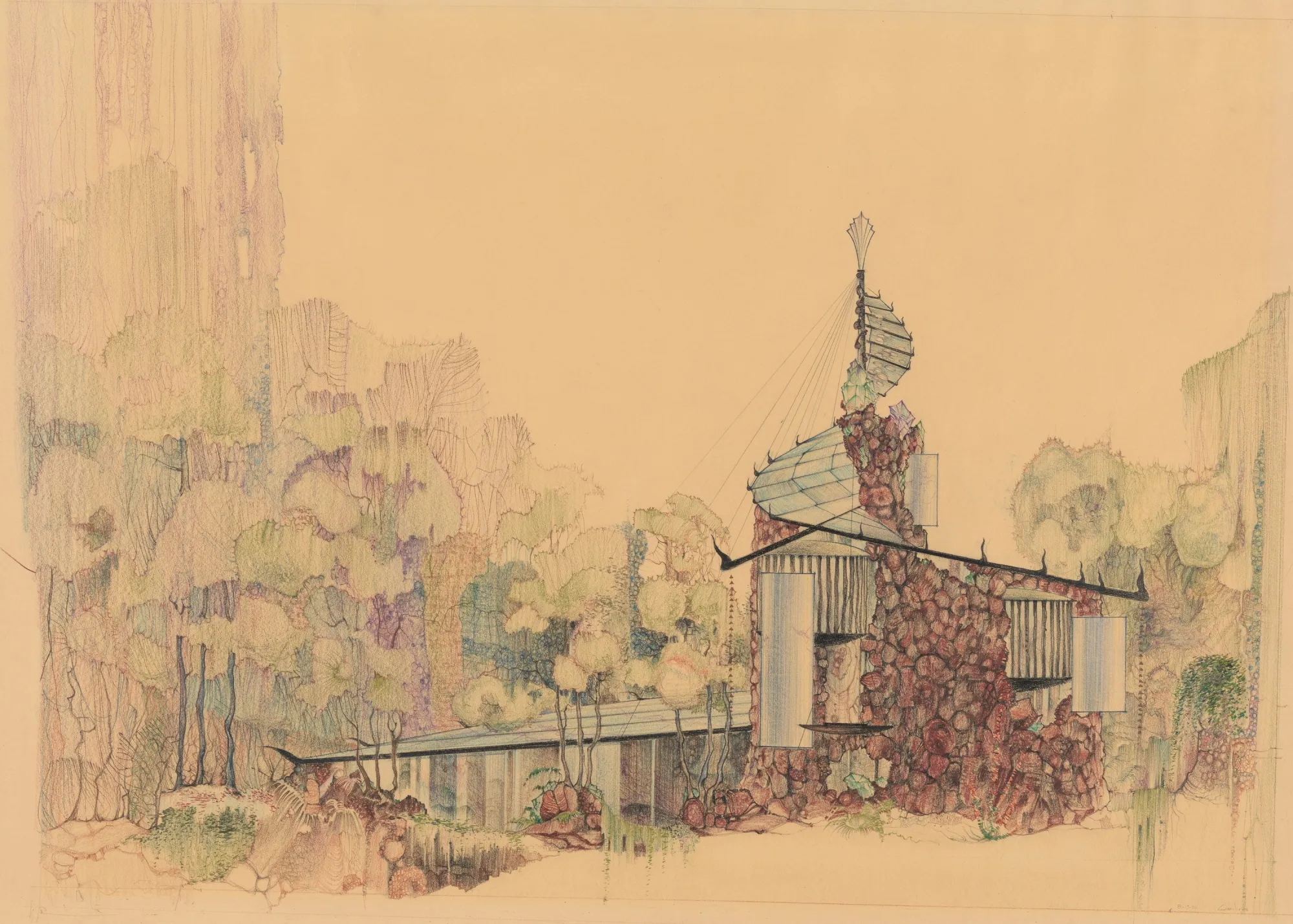
A drawing for the Eugene and Nancy Bavinger House, a landmarked home in Norman, Oklahoma, that was demolished in 2016.
Courtesy of the Art Institute of Chicago
The Oklahoma Architect Who Turned Kitsch Into Art
With radical shapes and materials, Bruce Goff channeled the exuberance of postwar Americana into home designs, as an exhibit at the Art Institute of Chicago reveals.
Toward the end of his career in the late 1970s, the architect Bruce Goff lived with his mother and a tuxedo-hued cat named Chiaroscuro in the small city of Tyler, Texas. He stopped work promptly at 4:30 p.m. each day to watch Star Trek. His favorite meal was roast beef and potatoes. Over the preceding four decades he had moved his peripatetic practice all over the nation, mostly keeping to small cities and towns of the Great Plains, never interested in paying the toll of cultural supplication on either coast.
Goff designed houses at every price point: mostly for artists, bankers and farmers but also for an Oklahoma oil dynasty. He designed a church made from pipeline components, and oilfield roughneck congregants built it. He loved stuff. He entered his professional prime just as World War II wound down, but the epochal machine of industrial production made to win it kept spinning, flooding the US with a factory-stamped cornucopia of consumer goods. They all found their way into Goff’s work: AstroTurf, sequins, plastic coasters, turkey inseminators (one client was a turkey farmer). He made chandeliers of out of cake pans and used pink fiberglass insulation as a decorative element.