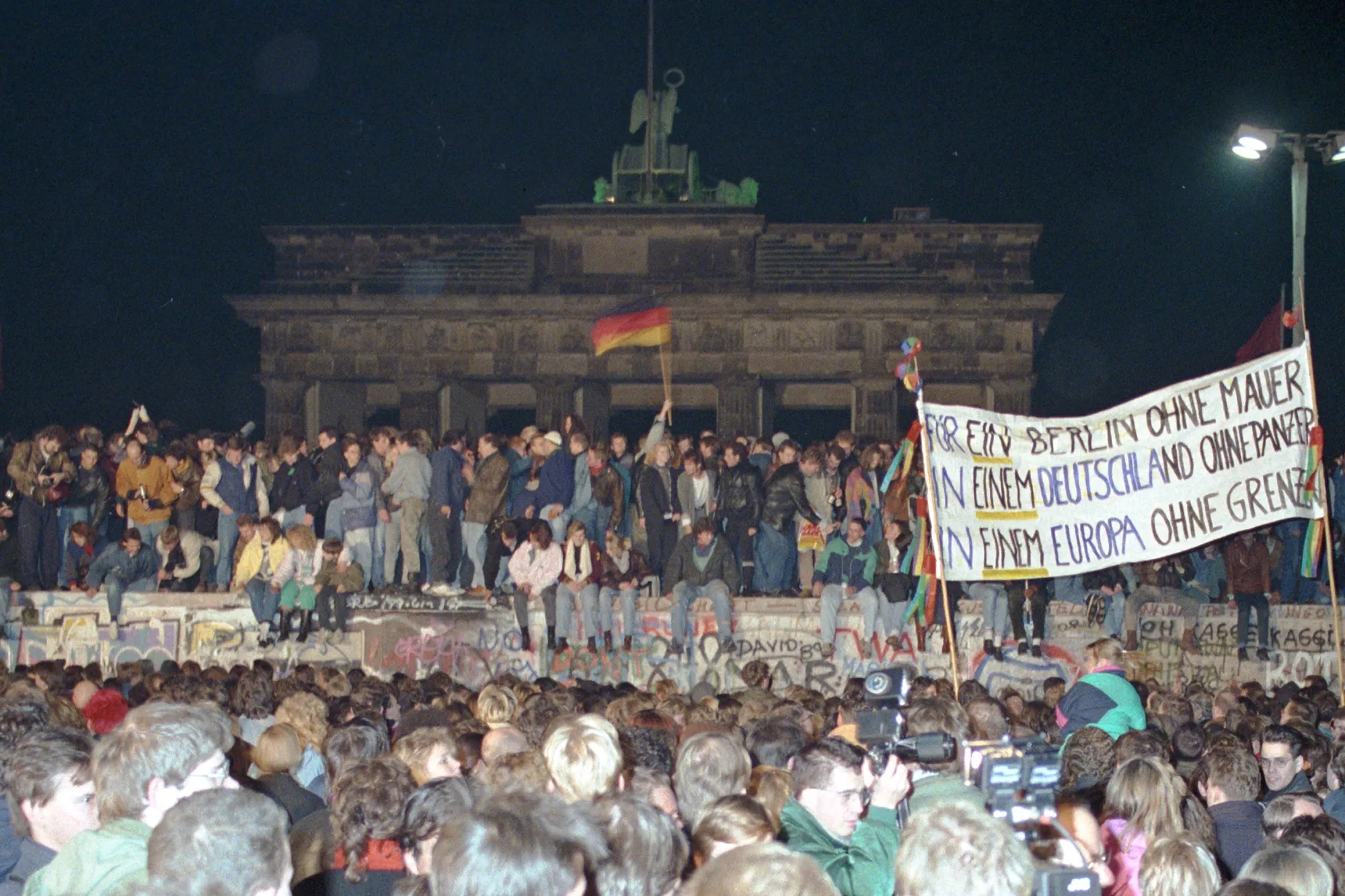
The opening up of the Berlin Wall prompted mass celebration on and around the barrier on Nov. 10, 1989.
Photographer: Peter Zimmermann/picture-alliance/dpa/AP Photo
Europe Never Recovered From the Fall of the Berlin Wall
The high point of 1989 kickstarted a prolonged crisis that left the continent vulnerable to Donald Trump and Vladimir Putin, a new book argues.
In the years before the Berlin Wall crumbled, I specialized in asking well-known Germans when they thought their nation would be reunited. Many — including Helmut Kohl, West Germany’s chancellor — told me they didn’t expect it in their lifetime. As Germany correspondent for the Financial Times, I forged a theory that if anyone had been prepared for German unification, it wouldn’t have happened. Plans would have leaked and been sabotaged by people and states not keen to see a greater Germany.
When the Wall was breached, Kohl himself was poleaxed. He heard the news while on a visit to Warsaw — a supremely uncomfortable moment, given Polish anxiety about the country’s large, historically oppressive western neighbor becoming decisively larger. “Mr. Chancellor, the Wall is falling,” an aide told Kohl when he telephoned on the evening of Nov. 9, 1989. “Ackermann,” Kohl asked, “are you sure?”