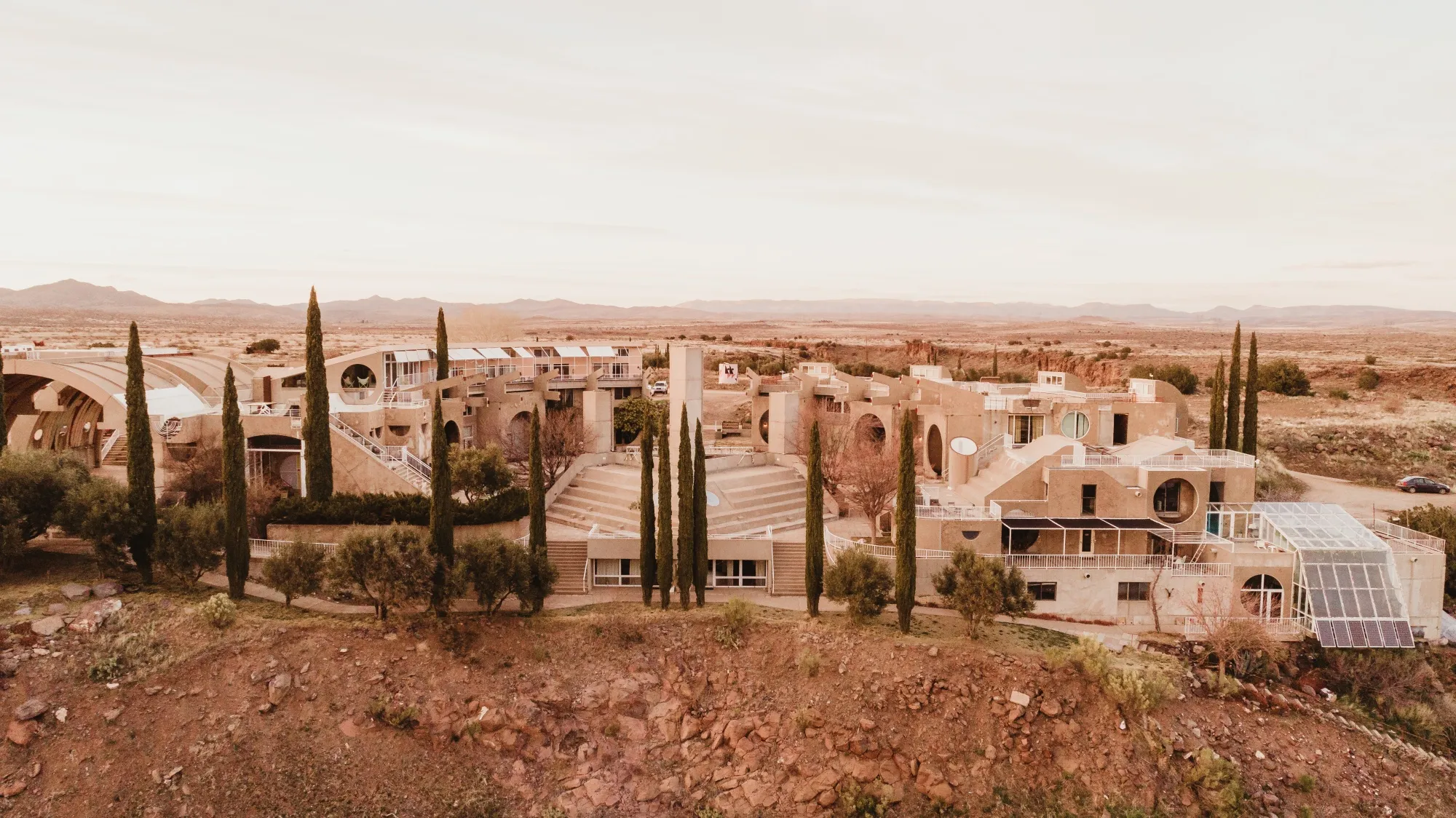
Arcosanti today: With its compact size and secluded location in the Sonoran Desert, about an hour from Phoenix, it was designed as a rebuke to that city’s postwar sprawl.
Photographer: Jessica JamesonWhat a 1970s Commune in Arizona Got Right About Desert Urbanism
Architect Paolo Soleri’s experimental city, Arcosanti, was planned for 5,000 people; 50 years later, it holds just a fraction of that figure. But it still has lessons for living in extreme heat.
It was 105F (40C) on the day I visited Arcosanti, the secluded Sonoran Desert outpost that architect Paolo Soleri began building in the 1970s. In a lucky turn, a breeze swirled through the site’s passive architecture — south-facing concrete forms shaped by swooping apses and geometric portals that channel shade in summer and bank the sun’s heat in winter. It could pass for a science-fiction set: a sunbaked settlement engineered for survival on a hostile world.
Located about 70 miles north of Phoenix, Arcosanti is the only “arcology” — Soleri’s portmanteau for compact, self-sufficient communities that fuse architecture and ecology — to materialize in the real world. Of the 30 different climate-specific designs in his 1969 book, The City in the Image of Man, this prototype shows how arcology’s core principles play out in the high desert. They include “bounded density,” which conserves land and resources; “elegant frugality,” or doing more with less; and integrated systems for food, energy and water — priorities in arid climates. On paper, the logic is airtight. On land, the reality is messier.