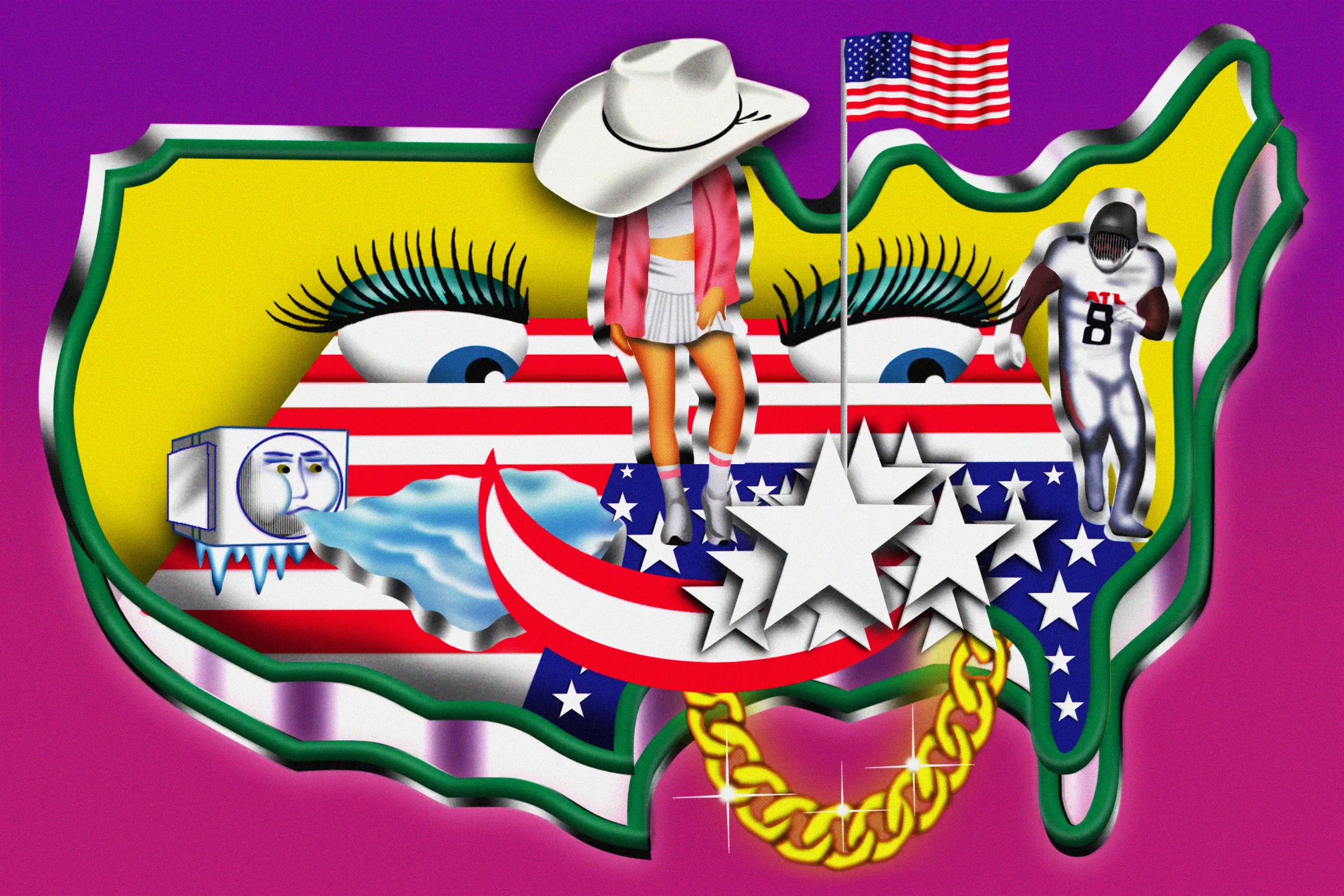
Illustration: Luca Schenardi for Bloomberg
The United States Is Southern Now
From booming metros to culture-defining exports, the South has quietly become a demographic powerhouse and a battleground for the country’s identity.
At the 1995 Source Awards, André Benjamin — you may know him as the rapper André 3000 — got up on a stage and spoke the future into existence. While accepting the award for best new rap group alongside Antwan “Big Boi” Patton, his collaborator in the Atlanta duo OutKast, André looked out at a crowd full of jeering East and West Coast hip-hop partisans, leaned over the mic and uttered a phrase that would go down as one of the greatest called shots since Babe Ruth: “The South got something to say.”
André, of course, was right about the future of hip-hop. Within a few years, the gravitational pull of the music industry would be yanked southward, producing an absurd list of stars that includes Beyoncé, Lil Wayne, Migos, Pharrell Williams and Travis Scott. But three decades later, it looks like he was also prescient about the trajectory of America as a whole. When OutKast accepted its award, the signs of a changing country were already there in the duo’s hometown: The metropolitan Atlanta area would see its population increase by 43% from 1990 to 2000, a growth rate that meant that an average of 360 new people put down roots in the Southeast’s most populous metro area every day for 10 years.