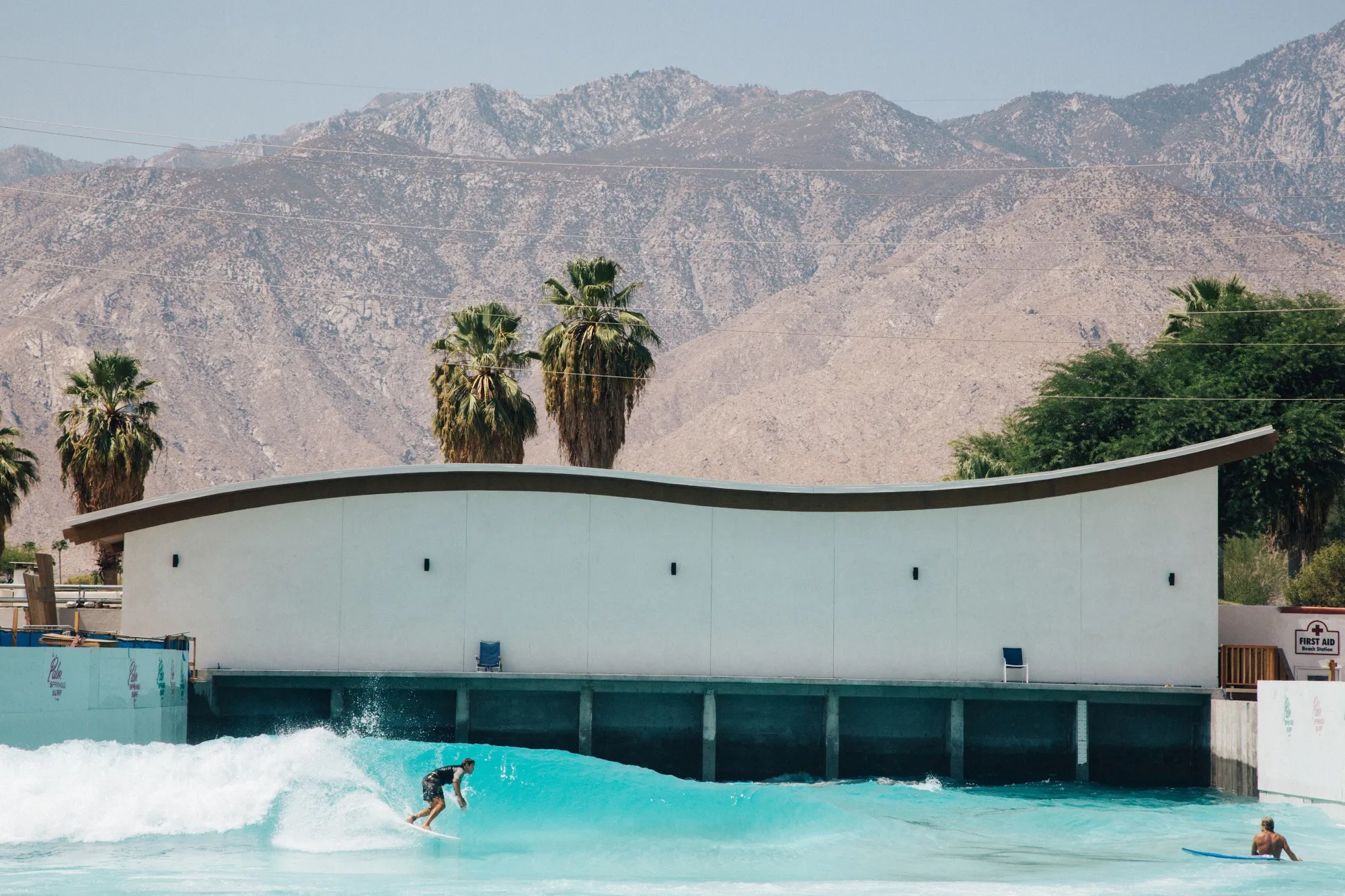
The test pool at the Palm Springs Surf Club before its 2024 opening in Palm Springs, California.
Photographer: Akasha Rabut/Redux Stock
Surfing in the Desert Comes With a Climate Cost
As artificial wave pools proliferate around the world, surf park developers aim to go green to counter criticism over energy and water use.
Pickup trucks and SUVs pull into a parking lot, surfboards stashed in the back. Not an unusual sight in Southern California on a hot blue-sky morning in May, except this is the Coachella Valley, about 100 miles inland from the nearest beach. The would-be surfers trek over to an expanse of desert dirt surrounded by a verdant golf course and framed by the snow-capped San Jacinto mountains. Their surfboards are just props for a groundbreaking ceremony, but the spot is set to be submerged under nearly seven million gallons of water. The five-acre lagoon will generate artificial but ocean-like waves shaped by software.
The $236 million project, called DSRT Surf, will also include a hotel, restaurants and private villas. It’s among dozens of similar surf parks either currently operating or under development around the world. Thanks to advances in computational fluid dynamics — the science of how water flows — and the rapidly declining cost of computing power, surfer-entrepreneurs have cracked the code on how to replicate the complex physics of breaking ocean waves.