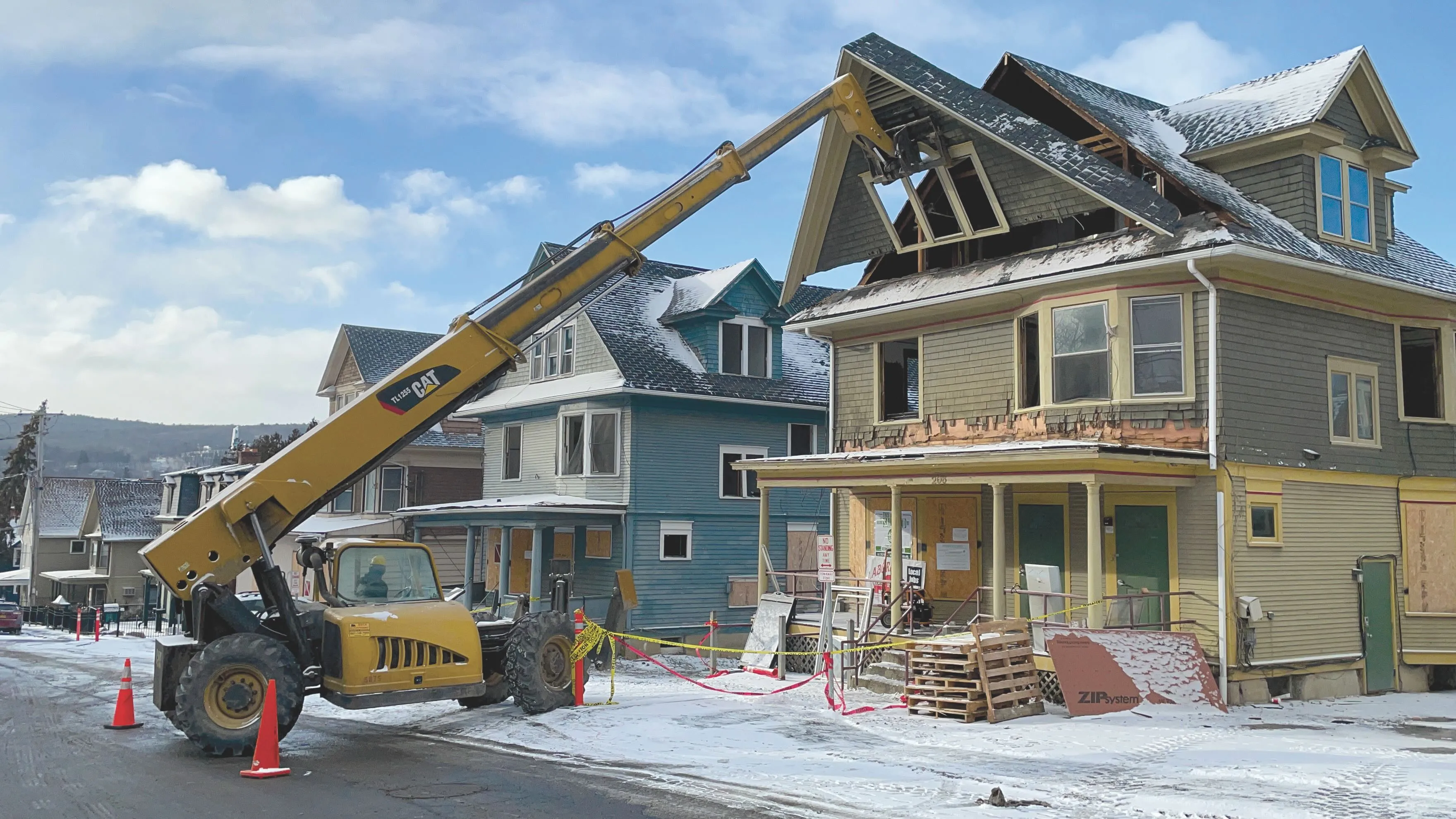
This apartment building in Ithaca, New York, is being deconstructed, piece by piece, as part of a pilot project in sustainable demolition from Cornell’s Circular Construction Lab.
Photo: Felix Heisel
Appetite for Deconstruction
To reduce carbon emissions and building waste, architectural salvage and reuse advocates across the US are racing to reform the $8.7 billion demolition industry.
The death of 206 College Avenue was slow and painstaking. Over several days in January 2022, dozens of bundled-up volunteers swarmed over the three-story property, a tired wooden boarding house built in the early 1900s in Ithaca, New York. Long used as rental apartments for Cornell University students, the 13-bedroom house was set to be demolished, along with several neighboring stuctures of the same vintage, to make room for a new multi-use complex. But while those buildings were quickly reduced to rubble by trackhoes, the house at 206 was deconstructed, piece by piece, so that its elements could be used again.
The Catherine Commons Deconstruction Project, an effort by Cornell’s Circular Construction Lab, was a large-scale pilot designed to show how building waste can be kept out of landfills. As volunteers pulled nails out of fir, oak, and walnut boards and hauled lumber off to be sorted and redistributed, a team of eight workers with heavy machinery began meticulously sawing, slicing and removing 8-by-18-foot panels of the old building. These were trucked off to a warehouse, where they’d be taken apart and recycled.