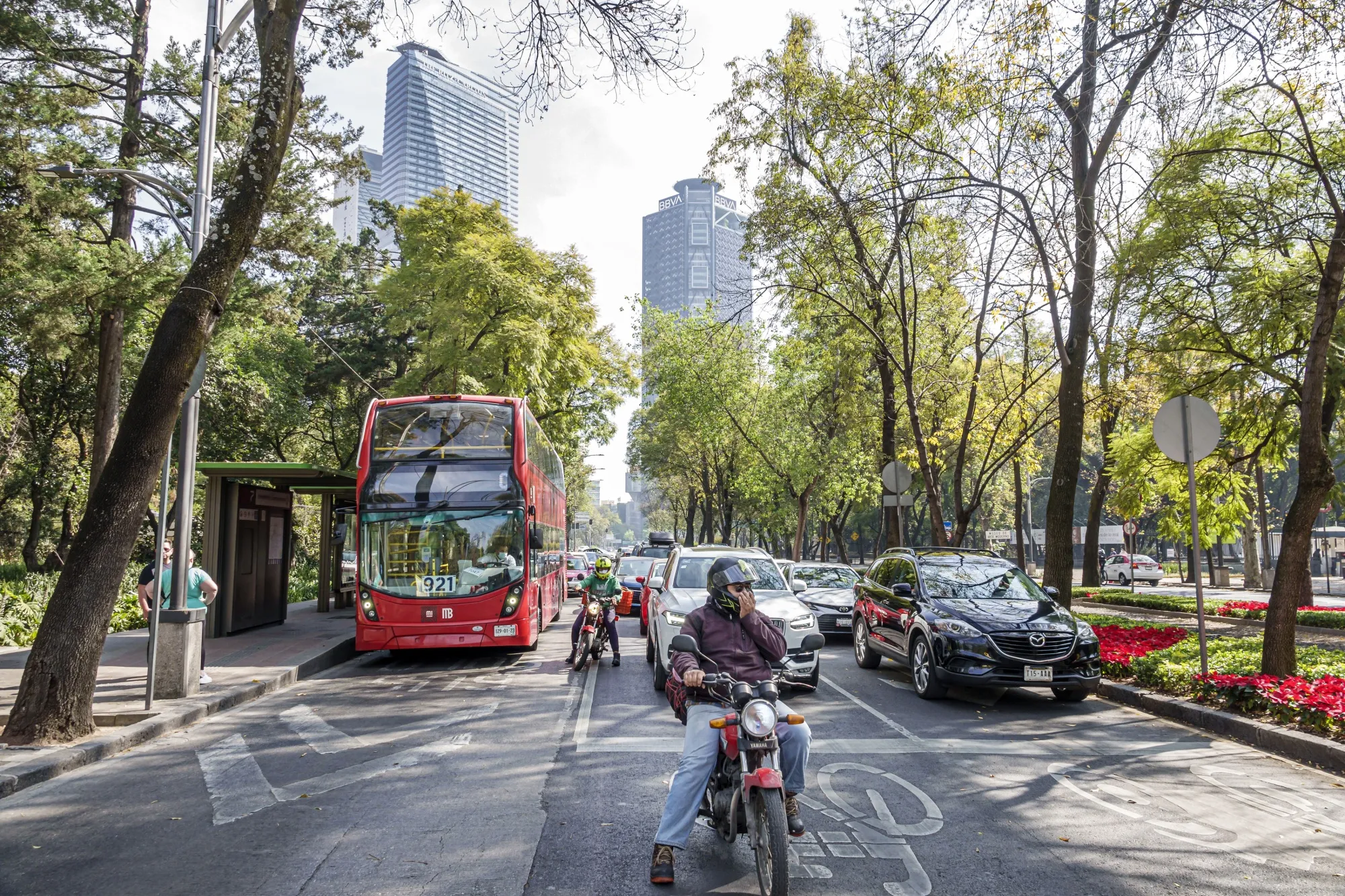
The tree-lined Avenida Paseo de la Reforma in Mexico City — a city whose scale and environmental precarity have made it a rich source of urban solutions.
Photographer: Jeff Greenberg/Universal Images Group Editorial via Getty Images
Also Migrating From Latin America: A Wave of Urban Innovation
For US cities, grassroots solutions from metros south of the border can be more useful than better-known urban practices from Europe.
Over the last few years, a first-of-its-kind sanctuary neighborhood for migrants opened in a canyon next to the San Diego-Tijuana border wall. The UCSD-Alacrán Community Station, created through a partnership with the University of California San Diego Center on Global Justice, houses around 1,800 people; the three-acre site also features a health care clinic, food hub, school and outdoor plaza. More than an emergency shelter, Alacrán is designed to help those fleeing violence in their countries of origin participate actively in shaping the social, cultural and economic life of the ad-hoc city that they now call home.
UCSD-Alacrán is one of four cross-border community stations — two in Tijuana, two in San Diego — that the Center on Global Justice launched with local nonprofits and school districts. But their inspiration comes from the Colombian cities of Bogotá and Medellín, says Teddy Cruz, the center’s director of urban research. As they emerged from years of drug cartel violence in the 1990s and early 2000s, those cities implemented a variety of experimental social policies to improve urban life, from hiring mimes to direct traffic to building a network of library parks in high-poverty neighborhoods.