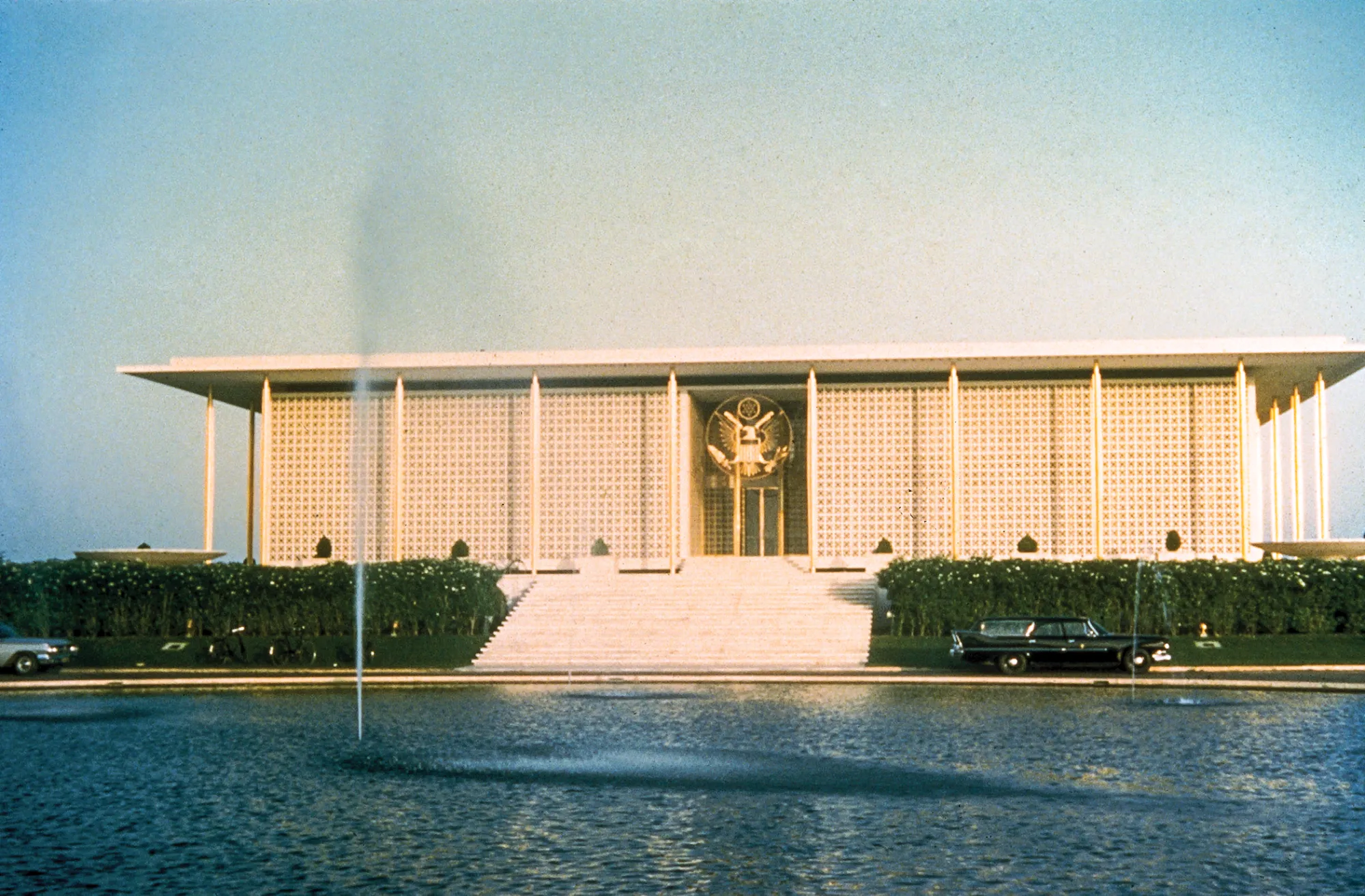
The US embassy in New Delhi, designed by Ed Durell Stone, opened in 1959 as part of a wave of ambitious State Department facilities.
Credit: Onera Publishing
Saving the Architecture of Cold War-Era Diplomacy
US embassies built after World War II were designed to showcase American values and combat communism. But the future of these modernist landmarks is uncertain.
When Eero Saarinen’s US embassy in Oslo, Norway, recently reopened as office space after a careful and costly restoration process, the building’s rebirth represented an uncommon historic preservation victory. Many other decommissioned embassies built in the early years of the Cold War face very uncertain futures. Created in support of soft diplomacy during a time where spies, not terrorists, were keeping US officials on edge, these impressive complexes now find themselves out of step with the post-9/11 security landscape.
A new book by David B. Peterson, US Embassies of the Cold War: The Architecture of Democracy, Diplomacy, and Defense, provides fresh insight into how the US State Department sought to use modernism as a tool of statecraft immediately following World War II. Building off of Jane Loeffler’s trailblazing 1998 book The Architecture of Diplomacy, Peterson tells the story of the Office of Foreign Buildings Operations, which launched a series of ambitious architectural commissions between 1945 and 1961. During that period, the FBO (now known as the Bureau of Overseas Buildings Operations), commissioned more than 25 embassies, built to be “billboards for democracy” in countries seen as susceptible to the influence of communism.