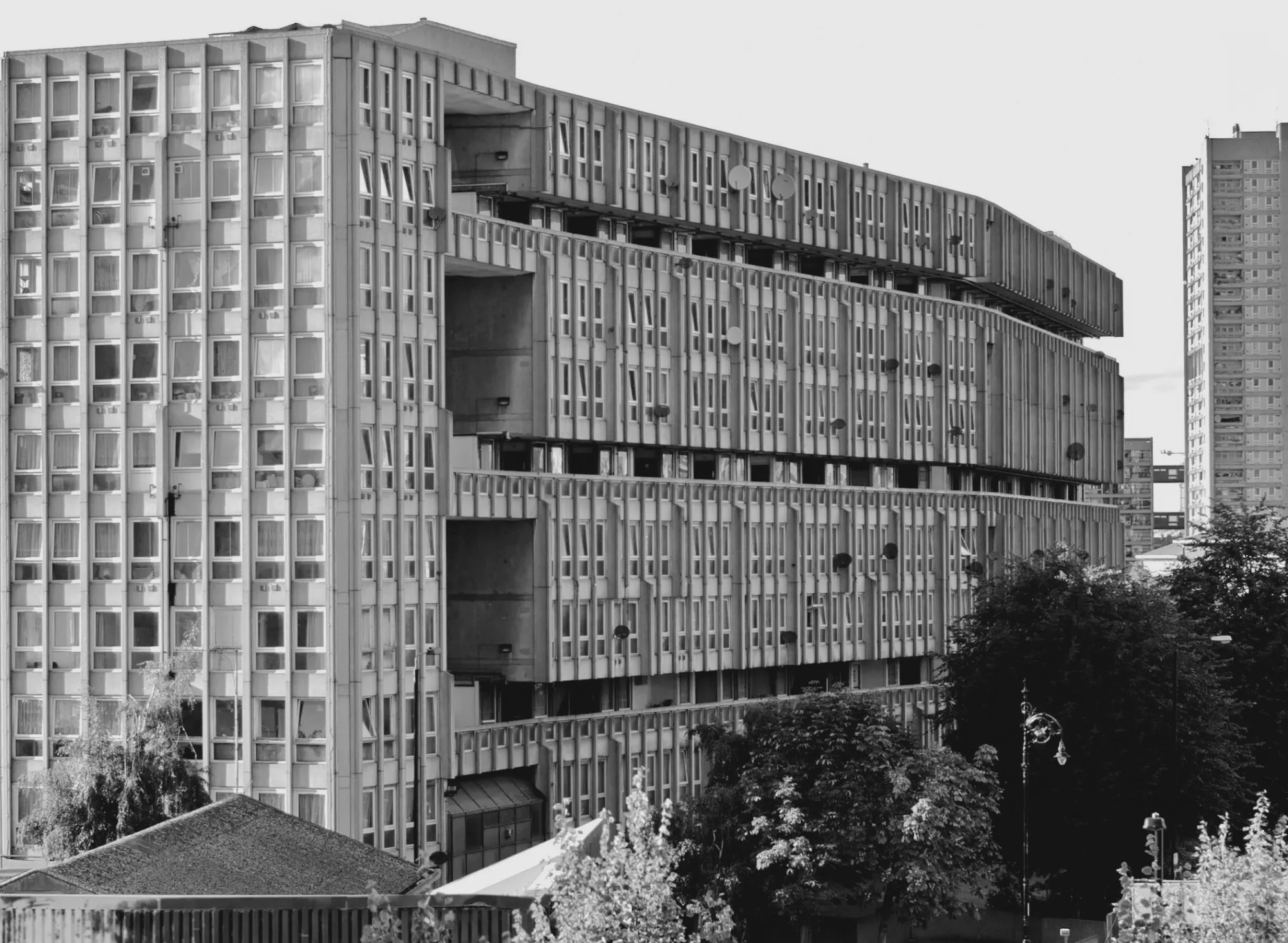
Robin Hood Gardens, a housing complex in east London designed by Alison and Peter Smithson, opened in 1972. It has since been partially demolished.
Photo: Neil Clasper/Phaidon
A Celebration of Brutalism, in Black and White
In The Brutalists, architecture historian Owen Hopkins chronicles the rise and fall of a divisive building style and the careers of the designers who defined it.
In the real world, Brutalism — that perennial punching bag of conservative lawmakers and Facebook architecture groups — is all but dead: The general appetite (or tolerance) for precast concrete buildings faded with the end of the 1970s, and many notable examples are now falling victim to the wrecking ball. But visual arts publishers continue to stylishly revisit the world’s most polarizing construction style.
Phaidon recently tapped architecture historian Owen Hopkins of Newcastle University in England to find his own way into the uniquely assertive architectural movement. The resulting book, The Brutalists, organizes more than 200 projects by their respective architects and rearranges those same projects into an easy-to-reference timeline. Familiar names like Le Corbusier and Zaha Hadid are given equal billing to lesser-known architects like Högna Sigurðardóttir and Igor Vasilevsky in an international survey filled with — as always for this subject — stark black-and-white photography.