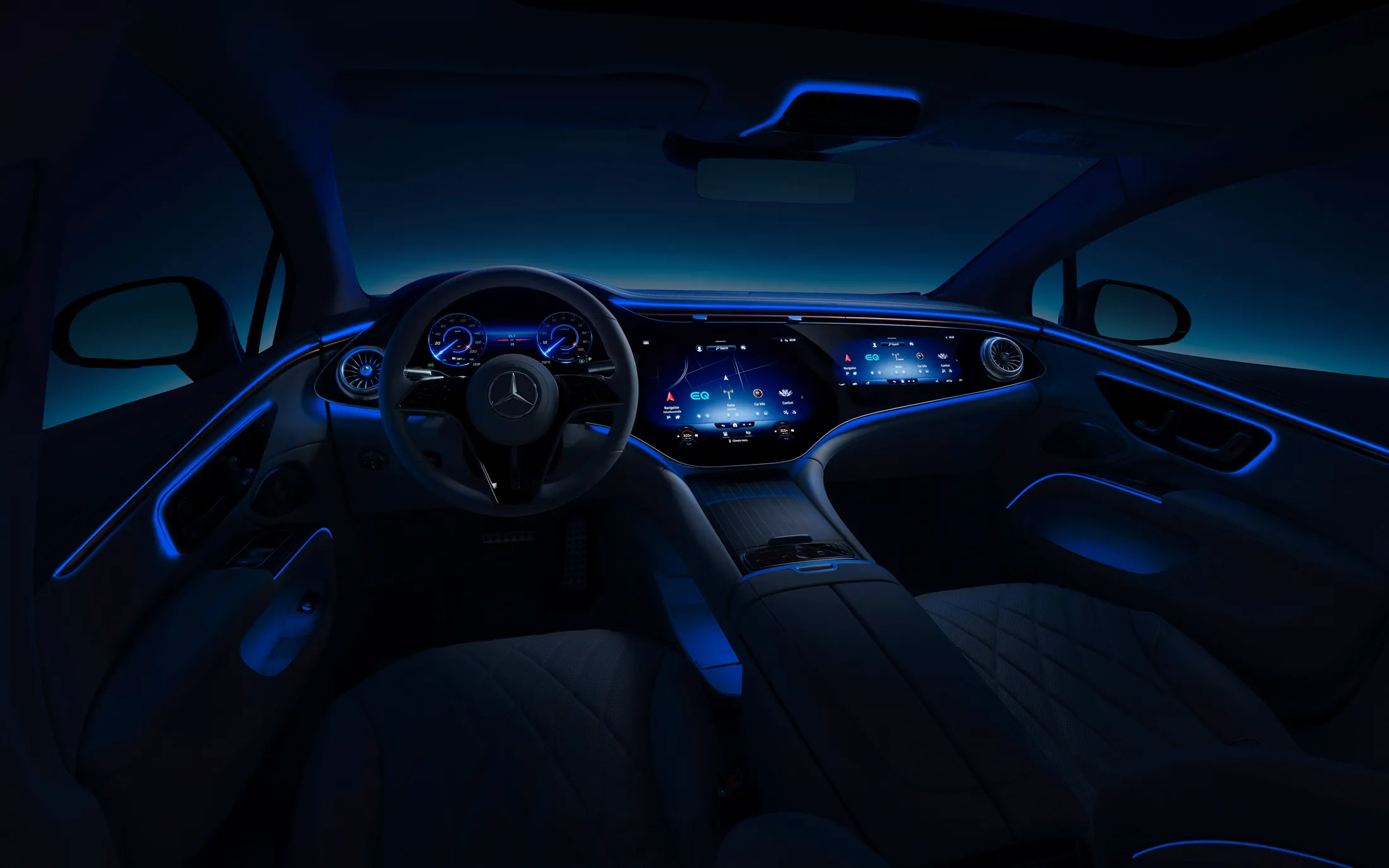
New EVs from Mercedes feature three separate touch-screen displays.
Source: Mercedes-Benz AG
Are Car Touch Screens Getting Out of Control?
As electric cars commodify the driving experience, the center display offers a space to stand out. But the big-screen arms race may be accelerating too quickly.
As recently as 10 years ago, touch screens in cars were tiny — if they were there at all. Most were grudgingly added by automakers in anticipation of a US mandate on backup cameras, or an early response to Elon Musk, who dropped a 17-inch monitor into a Tesla in 2012. Destinations were largely DIY, mapped on a plugged-in GPS device or chirped from an iPhone jammed in the cupholder.
Fast forward a decade and touch screens are no longer a reluctant add-on or an innovative auto perk; they’re table stakes. Some 97% of new cars globally have at least one touch screen, and they are metastasizing quickly. Almost a quarter of US cars and trucks now have command displays spanning 11 inches or more, according to S&P Global Mobility; luxury brands are now normalizing a separate screen for passengers. And nowhere is this arms race more evident than in electric vehicles. As battery-powered motors commodify driving — giving sports car-level superpower to giant pickups and tiny hatchbacks alike — the center-stack display offers the biggest, brightest space to stand out. The only question is, at what cost?