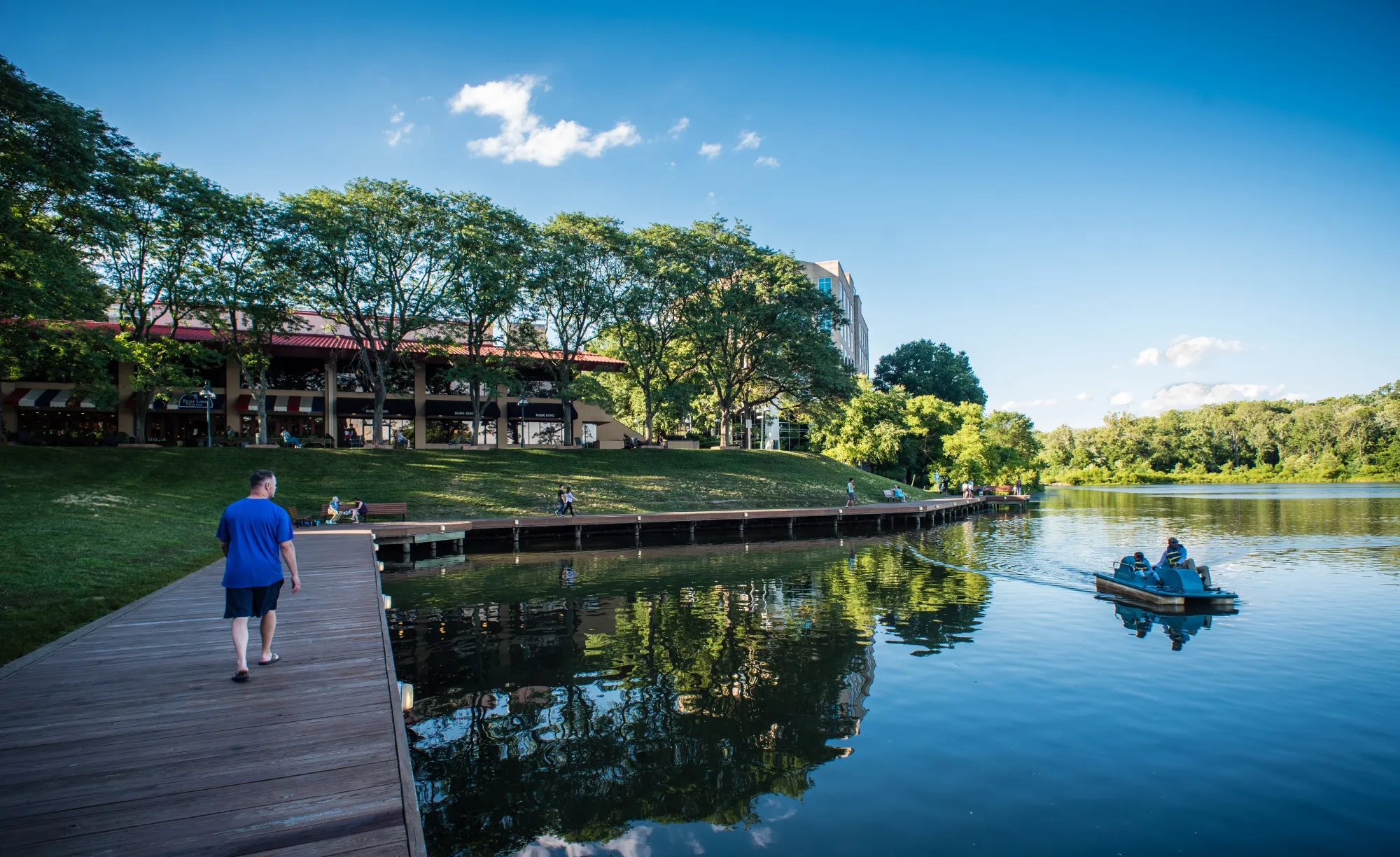
Lake Kittamaqundi in the heart of Columbia, Maryland — a planned community embarking on a long-term plan to build more housing and offices.
Photographer: Andre Chung for The Washington Post via Getty Images
A Garden City Gets Serious About Growth
The planned community of Columbia, Maryland, is trying to add urban-style density, without losing its suburban soul — or its founder's utopian ideals.
In 1969, when he was nine years old, David Stebenne moved with his family to the pioneering planned community of Columbia, Maryland. They settled into a leafy low-rise complex called The Cove, part of a newly built development called Wilde Lake — tight-knit, mixed-housing villages built around a nucleus of a shopping center, a high school and a nondenominational spiritual center, all connected via walking paths.
Stebenne, now a professor at Ohio State University and co-author of a 2007 book about Columbia’s history, New City Upon a Hill, fondly recalls wandering the woodsy paths by foot or bike to run errands and see friends. “It was a much more interesting small town than the typical small town,” said Stebenne. “The villages, the residential sections, by the conventions of suburban America, were very, very walking-friendly.”