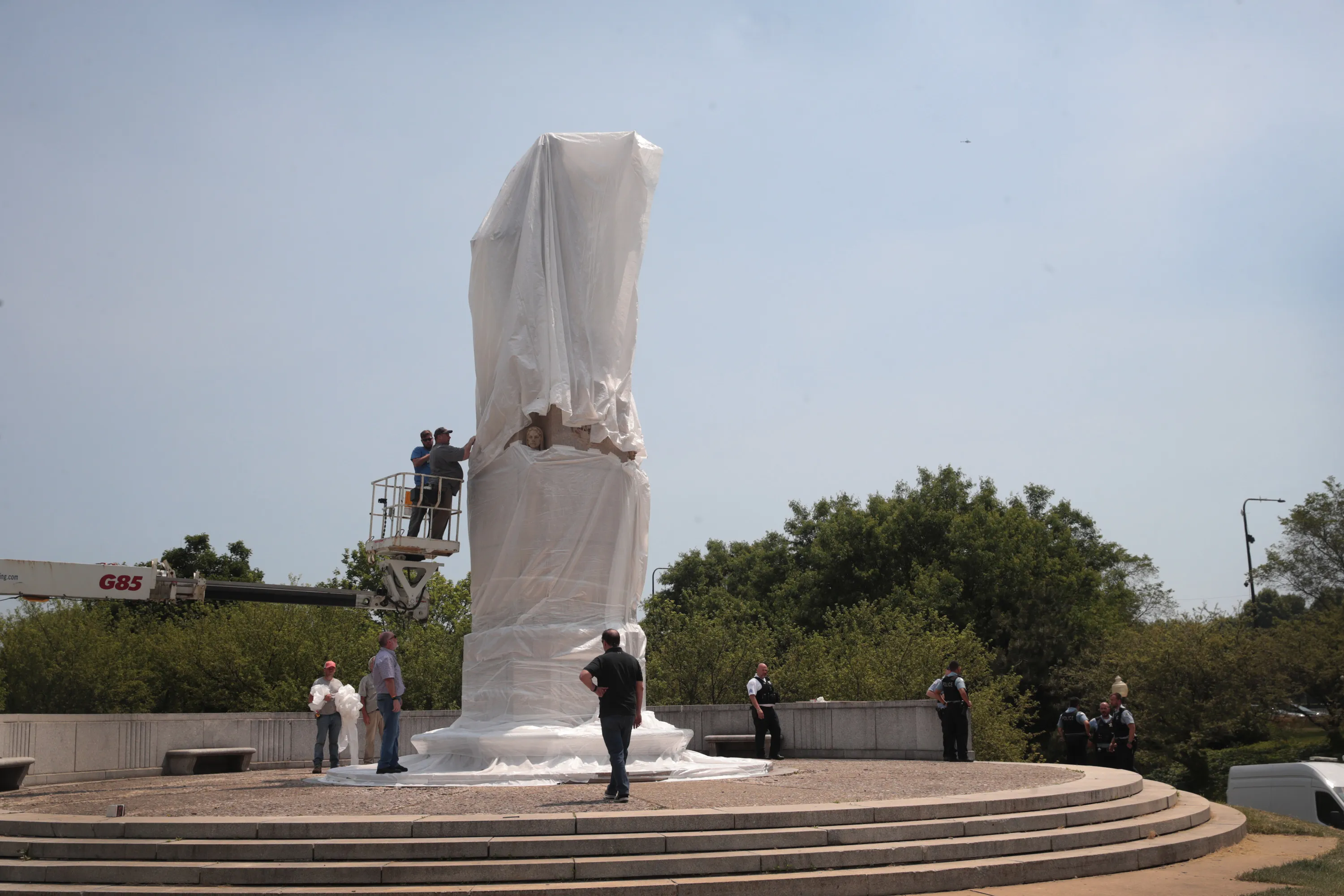
Workers cover a statue of Christopher Columbus in Chicago before the start of a Juneteenth march on June 19, 2020. The memorial was later removed.
Photographer: Scott Olson/Getty Images North America via Getty Images
When Monuments Go Bad
The Chicago Monuments Project is leading a city-wide dialogue in search of ways to resolve its landscape of problematic statues, and make room for a new, different kind of public memorial.
The stately eagle atop the 50-foot-tall fluted column of the Illinois Centennial Monument can be seen from blocks away. Located in the gentrifying Logan Square neighborhood on Chicago’s North Side, the memorial was designed by Henry Bacon and Evelyn Beatrice Longman and built in 1918 as an allegorical representation of the history of Illinois. Representational friezes line the column’s circular podium: On one side, the monument’s base offers abstract personifications of Chicago arts, agriculture and industry; the other side depicts an early contact between Indigenous people and Europeans. A Native American man wearing a feathered war bonnet stands while a woman looks back at a robed missionary clutching a cross. The look in her eyes is somewhere between a wary gaze and a confrontational glower.
It’s a vision of colonization that might be more nuanced than those you’ll find in many of the city’s monuments, but it’s still a source of controversy locally. For one, the Indigenous man pictured is “wearing the wrong headdress,” says X, an Indigenous artist and architect based in Chicago. (The strikethrough in his name is intentional.) “They’re wearing the wrong clothes.”