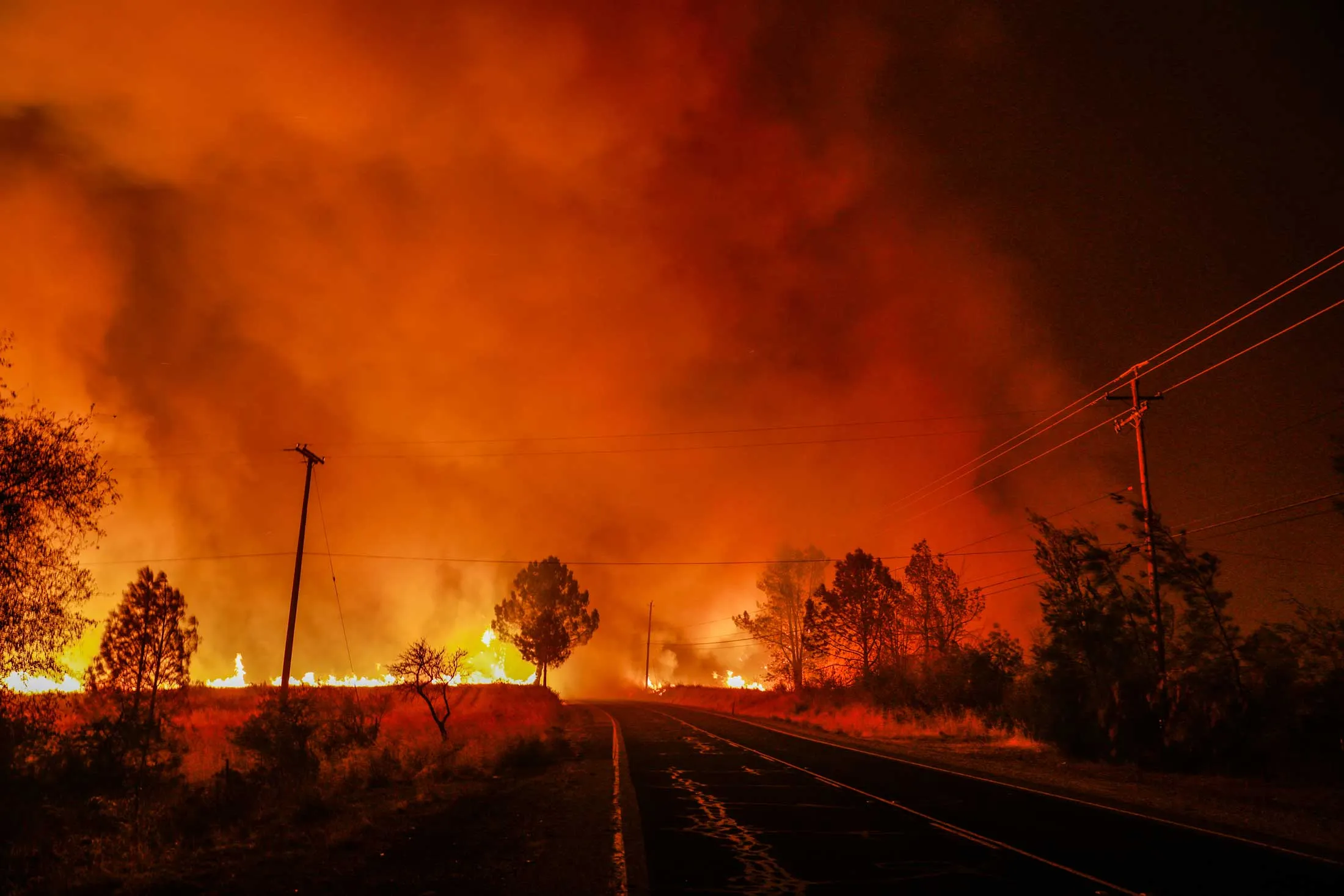
An escape route from the Camp Fire, south on Pentz Road in Paradise, Calif.
Photographer: Gabrielle Lurie/San Francisco Chronicle/PolarisCalifornia Is Stuck Fighting Climate Change With a Bankrupt, Distrusted Company
The utility that made the state burn is inextricably linked to its future—and survival.

Laine Mason arrived at work on Nov. 8 expecting a busy day: Strong winds were forecast, which meant falling branches and toppled trees, and with them the possibility of downed power lines. Mason, who lives in the Northern California town of Corning, works for Pacific Gas & Electric Co. as what’s known as a “troubleman.” A 50-year-old former logger, he drives a robin’s-egg-blue PG&E bucket truck and wields a chainsaw and a 6-foot-long fiberglass hot cutter that can sever live power lines. In his words, “If you call PG&E and say, ‘Hey, my lights are out,’ they send me out to figure out what’s going on.”
That morning, Mason and two fellow troublemen were waiting for assignments in the company’s yard in Chico. At around 6:45, the others were sent out to deal with an outage on nearby Flea Mountain. A little later, Mason’s boss called and told him to head to Paradise, a town in the Sierra Nevada foothills, where another of his co-workers needed help. Mason could already see smoke, and on the road he passed a steady stream of cars headed the other way. In the time it took to drive 15 miles, a small blaze that had been spotted a few miles from Paradise had exploded into a wind-whipped, galloping monster. He was just outside town when the inferno arrived. “I saw the treetops start swirling around,” Mason says, “and within five minutes it was like midnight—the fire was there, the smoke was there.”