What Will It Take to Fix the Mess in Zimbabwe?
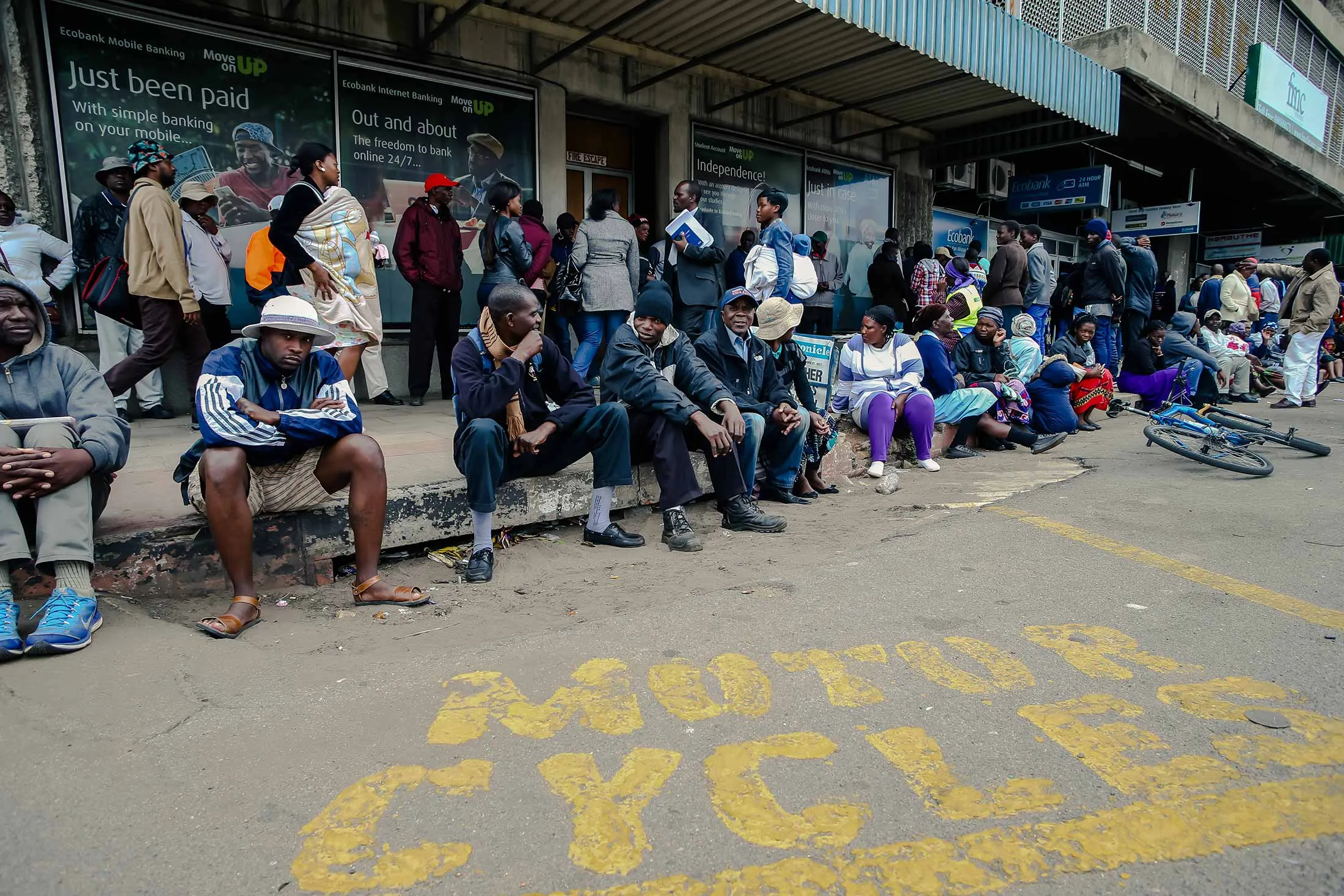
As a liquidity crisis continues, bank customers queue up in Bulawayo on Dec. 27. Zimbabweans must wait long hours to withdraw money from their accounts.
Photographer: Jekesai Njikizana for Bloomberg Businessweek
Busisa Moyo can’t wait to get out the door. It’s the middle of a Monday afternoon, and the chief executive officer of Zimbabwe’s United Refineries Ltd. is striding briskly out of his crushing plant—a vast rectangular structure with red brick walls and a corrugated metal roof. In theory, this is where millions of soybeans at a time can be cleaned, heated, cracked, and pulverized to extract vegetable oil. Except today, like most days, there are no soybeans and no workers; overhead, the steel catwalks are empty, and the line is silent apart from the clatter of Moyo’s footsteps on concrete. “I don’t like to be in there too long when it’s not running,” he says. “When you’re a factory man, you want to hear the machines pounding.”
Trim, 42, and dressed plant-manager casual in gray chinos and a short-sleeved button-down, Moyo exits into the pounding sunlight of Bulawayo, a decaying industrial city in southwest Zimbabwe. Since 2012 he’s kept United Refineries afloat in one of the world’s most unstable economies. Hyperinflation, corruption, and dereliction were hallmarks of President Robert Mugabe’s reign—which ended with the 93-year-old dictator’s sudden ouster in late November. Now, for the first time in almost four decades, Moyo and other Zimbabweans are daring to hope that their profoundly dysfunctional country can repair itself.