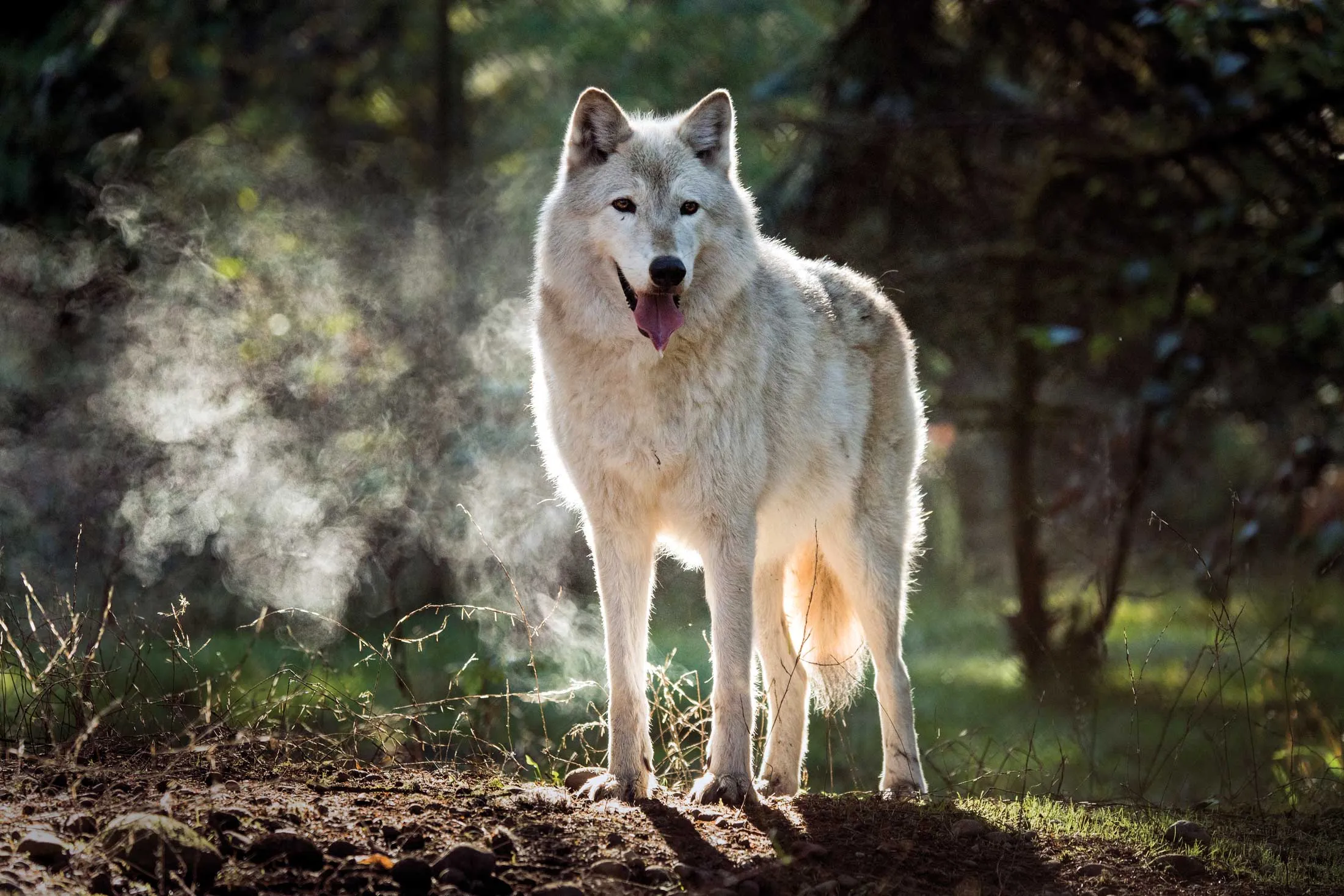
A resident of Wolf Haven, a sanctuary in Tenino, Wash.
Photographer: Ami Vitale for Bloomberg Businessweek
Delicate Dances With Those Who Save Wolves
A compromise between ranchers and conservationists to save wolves in Washington state is a real-life fable with a moral that might just solve America.
Arron Scotten wants to take the long route to the scene of the killings. He’s at the wheel of a steel-gray pickup truck winding down two-lane roads in the far northeast corner of Washington state, shotgun resting on the back seat, flip phone charging in the lighter, a pouch of Grizzly chewing tobacco in the cup holder. “See where those poplars are?” he asks, pointing down a valley ringed by rounded mountains and dotted with hayfields gently turning a golden fall yellow. “The caves up there are where my great-great-grandparents spent their first winter.” In the 1880s, Scotten’s forebears came by wagon to this area from Missouri, arriving too late to build a homestead before snow arrived.
Almost a century later, as a teenager, Scotten rode these hills on horseback. He left to join the Navy in 1996, and by 2012, when he returned to become part of the community of independent livestock ranchers, the area’s once-thriving mining and timber industries had collapsed. Scotten works as what’s called a range rider, under a new state program that hires horsemen to keep predators from devouring cattle on this mix of federal and private land.