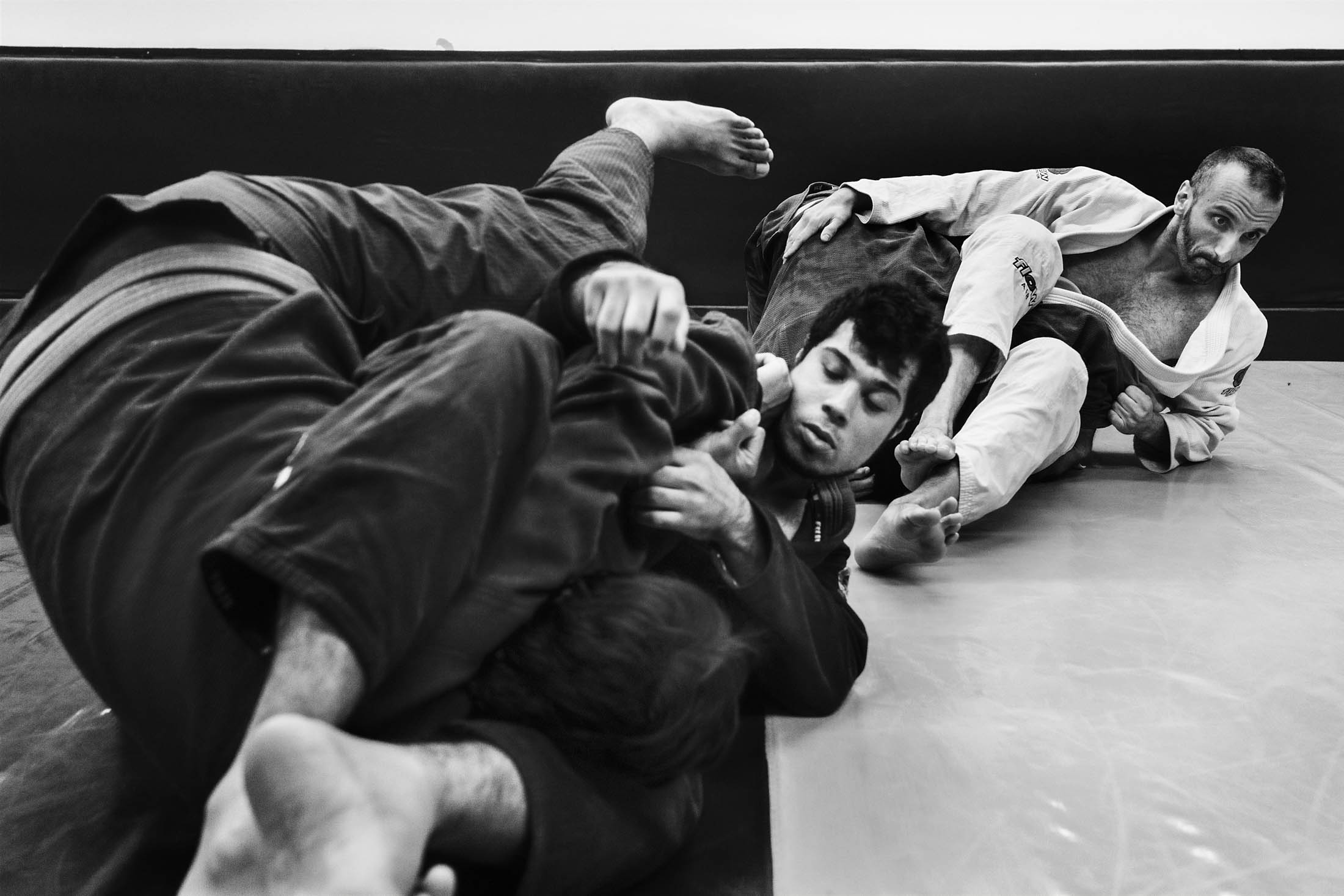
See the Intense Training Regimens of Brazilian Jiujitsu Academies
Forget the beach—for thousands of adventurous sportsmen, training in Rio de Janeiro is the ultimate vacation.

Rio de Janeiro, home to the Summer Olympics, is also the world capital of a different kind of sport: Brazilian jiujitsu. One of the fastest-growing activities on the planet and a core component of mixed martial arts, BJJ was developed by brothers Carlos and Helio Gracie at the turn of the 20th century as an adaptation of the Japanese sport of judo. The Gracies successfully marketed jiujitsu’s technique-conquers-strength value system to Brazilians, and their schools soon grew, creating a deep and complex lineage of instructors that still determines the sport’s hierarchy. Thousands of Gracie professors, as they’re officially designated, are proficient in teaching the techniques necessary to improve. And no place in the world has more thoroughbred professors than Rio de Janeiro.

Known as “the gentle art,” jiujitsu requires students to use leverage, creativity, flexibility, and strength to help secure match-winning joint locks and chokes. The grappling sport is more psychological than brutal, which means the best practitioners tend to be intelligent and successful. Bankers, writers, and businessmen journey to Brazil to take part in challenging training sessions followed by relaxed afternoons on white-sand beaches, recovering with cold bowls of fresh açaí.

They train with instructors at school networks such as Alliance, De la Riva, Gracie Barra Praia, and Nova União. Travelers choose their school based on a combination of the professor’s lineage and their preferred style of fighting, often finding on-the-mat creative inspirations. Each gym is set in a convenient location by the beach and in an upscale area of the city, such as Barra, Flamengo, Gávea, or Leblon, within range of five-star accommodations.


Exceptional year-round weather allows Gracie Barra Praia to host open-air training sessions under a palm-thatched tin roof. In 1980 the gym became the first to accommodate vacationing students at its facility—housing, feeding, and training them on-site for $50 per day. For those looking for a variety of classes and a more spartan setting, the nearby Connection Rio house charges students $200 per month for a shared room and access to training at a number of gyms. Schools without accommodations charge mat fees by the day, week, or month at $5 to $10 per day, depending on the length of stay.