Winding down with a soft drink and a smartphone as his train glides through the English Midlands, Luke Knight says all the talk on the construction site near Leeds where he works is about immigration. His co-workers plan to vote to leave the European Union when they get the chance on June 23, and he’s inclined to do the same.
“Small country, too many people,” 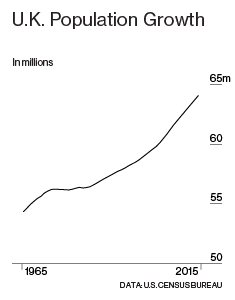 the 22-year-old says to describe their views as the train’s six cars trundle through Britain’s former industrial heartland. "They’re all ‘out,’ definitely.”
Zach Pritchard, Knight’s 18-year-old colleague, jumps in to say he’s undecided–partly, he says, because he wasn’t taught about the EU in school and so feels “kind of clueless.” Opposite, an older passenger en route to Bristol 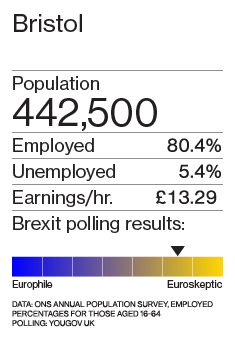 chimes in, saying he’s worried about immigration too,
  because the country needs to be protected from terrorists.
  He will vote to leave.
The three were among the commuters, day-trippers and vacationers encountered along Britain’s longest train route, 773 miles (1,244 kilometers). People from across the U.K.’s economic and social spectrum got on and off at 45 stations, from Aberdeen in northeast Scotland through Edinburgh; the former shipbuilding hub of Newcastle; 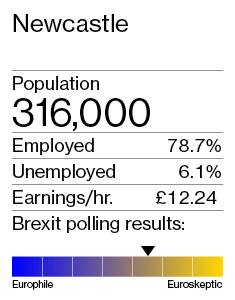 postindustrial cities in Yorkshire; the sprawl of Birmingham; the ports of Bristol and Plymouth and, finally, towns in Cornwall
 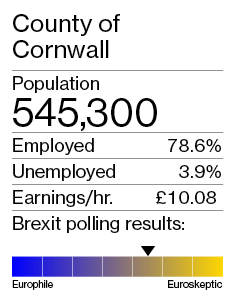 at the southern tip of England.
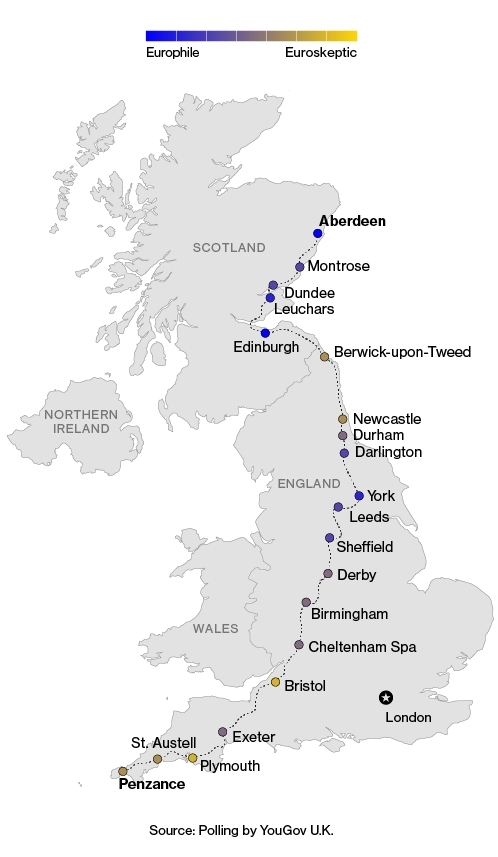
It’s a montage of a nation waking up to what Prime Minister David Cameron has called a once-in-a-generation decision. Speaking to a reporter and a video journalist who parked themselves in Coach B for the 13-hour trip, the passengers showed the kind of division that’s already splintered the government in London. At stake is a place in the world’s largest economic club, one that’s grown from six to 28 nations over six decades, and some polls suggest the result is going to be tight. 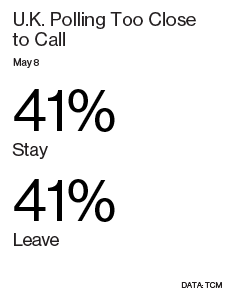
Luke Knight, 22, construction worker from Telford
The Cross Country train pulls out of the grey granite architecture of Aberdeen 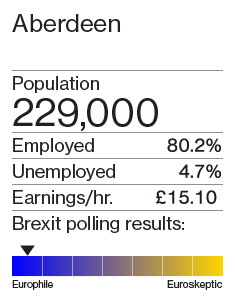 every weekday at 8:20 a.m., and finally passes a smattering of palm trees in the Cornish coastal town of Penzance at 9:43 p.m. It avoids London, the epicenter of the Brexit debate. But on this April day, those riding the Cross Country were happy to talk about it.
The diverse group of passengers had this in common: They all wanted more information. Knight said he knew more about Donald Trump and the U.S. election, while ancient-history student Olivia White from Leeds wanted to know more about potential disruption to European travel. Many said they still don’t fully understand what the EU does for the U.K., or why it might make sense to leave an alliance their country joined in 1973. At least four said they were relying on “gut feeling.”
David Proctor, who boarded at Montrose, 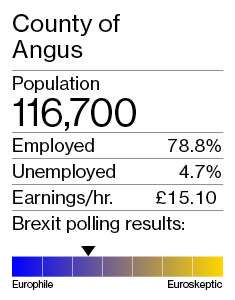 just south of Aberdeen, said he’s taking time to decide. The 31-year-old accounting student and part-time bar worker was more likely to vote to stay in, he said, based on the issues he cares about: unencumbered trade,
 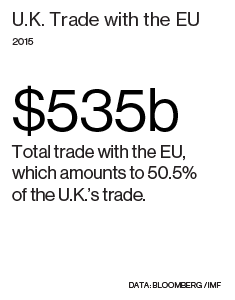 the economy
 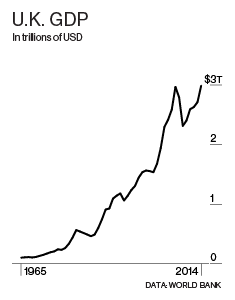 and the need to keep U.K. power in check. His vote for Scottish independence in the September 2014 referendum came much more easily, he said. His side lost.
“London doesn’t serve us best, but the EU is seen to look after our interests,” said Proctor. He was going to Edinburgh 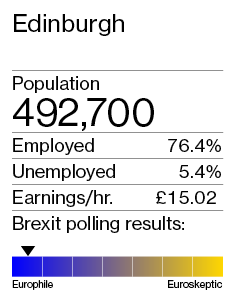 to visit his sister.
Olivia White, 20, student from Leeds
After the train passed through the Scottish National Party stronghold of Dundee, 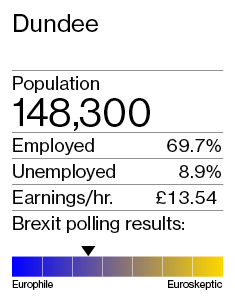 Sylvia Troon, 71, got on at Leuchars,
 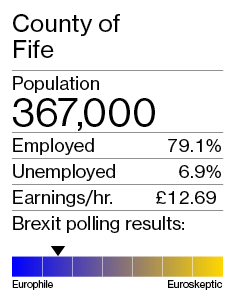 in the county of Fife. It’s near St. Andrews, home of Scotland’s oldest university and what locals fiercely claim is the birthplace of golf. Wearing a blue lapel badge on her jacket that displayed her "yes" vote for Scottish independence, Troon said she also wanted to stay in the EU.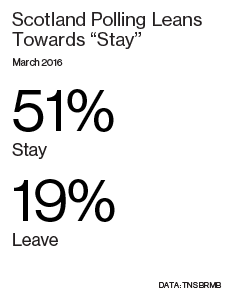
The mood began to change as the train moved south into the early afternoon. It crossed into England at Berwick, 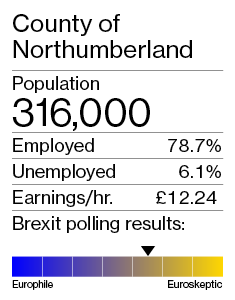 a town in the county of Northumberland that changed hands more than a dozen times between Scottish and English forces even before the 15th century.
Sylvia Troon, 71, pensioner from Leuchars
Emily Edwards was returning home from Berwick, after visiting her sister with her two children, aged eight and four. An archaeologist specializing in prehistoric pottery, she lives near Birmingham and was the first to mention how immigration dominated much of the local conversation.
“If you did a poll in our village, they’d want to leave,” said Edwards, 40, who said she would vote to remain in the EU, as the train passed through the cathedral city of Durham 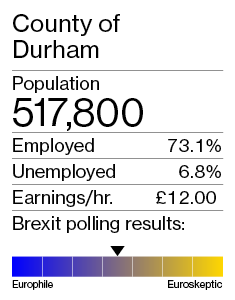 in the now-defunct mining area of the northeast. “But people aren’t aware of Europe. There’s not much thinking going on.”
The
train meandered south through Darlington, 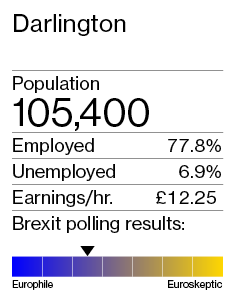 home of the world’s first steam-powered passenger railway. Then it was on to medieval
York
home of the world’s first steam-powered passenger railway. Then it was on to medieval
York 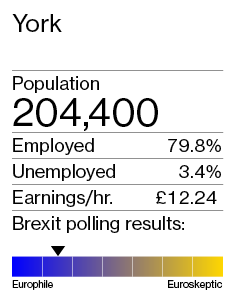 and the cities of Leeds
 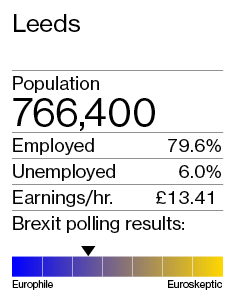 and Sheffield,
 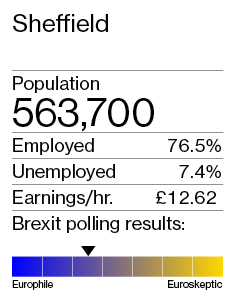 synonymous in Britain with the now-beleaguered steel industry,
and then Derby,
synonymous in Britain with the now-beleaguered steel industry,
and then Derby, 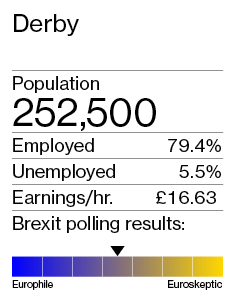 where Rolls-Royce jet engines are made.
Sarah Lewis, 39, town planner from Huddersfield in West Yorkshire, England
In Birmingham, 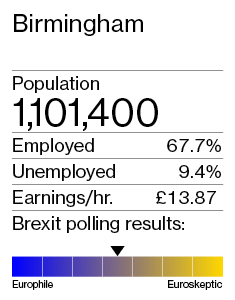 the next big city on the route and Britain’s second-largest city, 22 percent of the population
 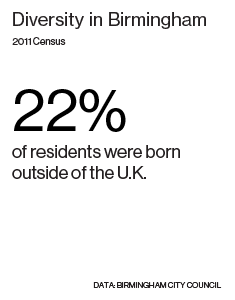 was born outside the U.K. A YouGov poll in March showed the region, the West Midlands, is one of three where support for leaving the EU, or Brexit, is strongest.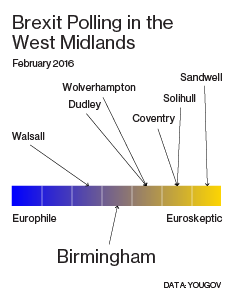
For John Charlton, 40, the upcoming vote was question of sovereignty. The software consultant in financial services, who was taking the 40-minute midafternoon ride home to Cheltenham Spa, 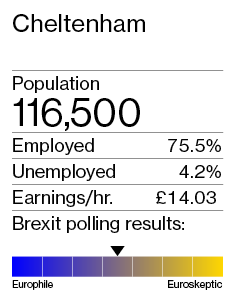 wanted the EU to go back to a simple trade agreement with its neighbors. What worries him most, he said, is the creation of what he calls the “European superstate,” a catchphrase of the Vote Leave campaign.
“There’s only one way it’s traveling and it’s towards a unified state,” Charlton said as the train passed just west of Stratford-upon-Avon, William Shakespeare’s birthplace. As for breaking from the EU after four decades, “If you don’t do it now you’d have to do it 10 years down the line. The definition of a country is sovereignty and control over your borders.”
John Charlton, 40, consultant from Cheltenham Spa
On to the port city of Bristol in the southwest, where sovereignty remained a common theme, one that Colin Brown said resonated in his community. The 51-year-old, who works in finance at a law firm, said he’s undecided at the moment, though he is leaning toward staying in the EU.
“The debate is superficial on both sides,” he said as the cars pushed through the green countryside toward Devon’s cathedral city of Exeter. 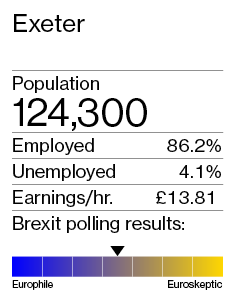 “‘Remain’ is about disruption and ‘leave’ is just very nationalistic.”
He praised the EU for unifying such things as accountancy standards and some business laws, and for negotiating trade agreements. Immigration, he said, makes the economy more competitive and ultimately boosts employment rather than taking away jobs.
The recent history of referendums shows the “undecideds” usually stick with the status quo in the end. In Scotland’s independence vote in September 2014, polls suggested it was too close to call before 55 percent backed staying in the U.K.
Nathan John Ritchie, 23, from Penzance and unemployed
Kerry Wills, 31, a dental nurse, had just received the government’s pamphlet setting out the case for staying in the EU, though she was also among the undecideds. She was traveling back to Redruth in Cornwall after some shopping with friends in Plymouth 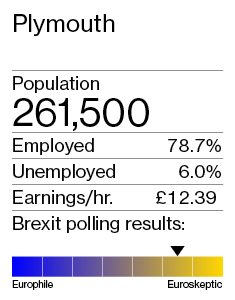 where the Mayflower set sail in 1620 and where she boarded the train.
Sitting in a now all-but-empty Coach B, she highlighted the isolation of Cornwall, which gets more EU aid than anywhere else in England.
“We just get on with life here, it’s like we’re cut off from the rest,” she said before the train completed the last leg of its trek to ease into Penzance station right on time. “I will vote but I need to know more about it. Otherwise it’s dangerous.”