Toph Tucker4:31 PM
Quick warm-up exercise: I'll post one of Keita Takahashi's "quick ideas" for Glitch, and I'm curious how you'd pivot it to a business productivity tool...
Stewart Butterfield4:33 PM
But, a way of viewing the corporate intranet and knowledge management tools so that you can see who was recently looking at specific files, and also who found them in their search results.
uploaded and commented on
an
image:
#96: Sleepwalking
"This is somnambulant skill. If you got this skill, your avatar will hanging around on world so freely while doing afk. They can do pet, jump, harvest and etc etc while sleeping. It might looks like they really alive."
https://www.glitchthegame.com/oddsandends/qis/page10#96
Stewart Butterfield4:35 PM
Hmmm — it’s like those old novelty glasses that had eyeballs printed on top of the lenses.
Stewart Butterfield4:35 PM
So, a bot that can take over for you in Slack — it reads all your message history and composes realistic sound messages from you to post into your regular channels.
Toph Tucker4:36 PM
or just where am i, and it could guess based on trust how much to reveal...
Toph Tucker4:37 PM
there's this eerie recurrence in your career of of building a microcosm, building a tool within that game world, and then spinning the tool out
Stewart Butterfield4:39 PM
Flickr was in fact something we came up with that we could build taking advantage of the technical infrastructure we had already created, but which we could finish (and bring to market) sooner.
Stewart Butterfield4:39 PM
And Slack was just a built-from-scratch version of the jury-rigger and hacked-together system for internal communication we built while working on Glitch.
Stewart Butterfield4:40 PM
So, the common thing in both cases was a desperate attempt to find something to salvage from a bunch of wasted work
:wink:
Toph Tucker4:40 PM
i wanted to ask — does it feel like a waste when people had fun for a while?
Toph Tucker4:41 PM
john ruskin said of architecture something like "when we build, let us think we build for ever" — but software is so ephemeral...
Stewart Butterfield4:42 PM
Reminds me of a point that Dan Savage is fond of making, with respect to romantic relationships …
Stewart Butterfield4:43 PM
… we think that the only “successful” relationship is one that ends in the death of one of the partners. Anything that ends before one party dies is a failure.
Stewart Butterfield4:44 PM
But, there can be successful relationships that conclude before either party dies. And it is much more healthy to think that.
Toph Tucker4:44 PM
i guess there's then a climate change imperative, for creative people to sustain the world...
Toph Tucker4:44 PM
um if Slack is sorta still a neverending MMO, and bots are NPCs etc etc, and the game world is everything people make with the help of Slack... then, what sort of world do you want to help build?
Toph Tucker4:49 PMare there particularly exciting uses you see people finding?
Toph Tucker4:49 PMand ... do you care about having a legacy through that?
Stewart Butterfield4:50 PM
I think the examples that I like best are ways in which people have altered the ways in which they work, even slightly. For example, eliminating the daily “stand up” meeting in favor of a round of messages in Slack.
Stewart Butterfield4:50 PM
And the vain part of me would like to have a legacy of some kind … I think most people want to make some kind of dent in the universe.
Stewart Butterfield4:52 PM
Well, let us not being an inquiry into the nature of happiness with 8 minutes to go
Toph Tucker4:53 PM
sure haha. altering modes of working — do you think that group chat as a mode of working can ever go too far? like i bet you saw that Jason Fried post
Stewart Butterfield4:55 PM
Except you happen to open them all individually and there’s a lot more overhead.
Stewart Butterfield4:55 PM
Most physical workspaces are all-day meetings with random participants and no agenda.
Toph Tucker4:55 PM
Email is batched at least, offices... maybe offices just have norms people are more accustomed to?
Stewart Butterfield4:56 PM
But, his ideal world there is some platonic ideal of Nietzschean übermenschen who just sit around thinking genius thoughts all day and don’t have any business talking to other people. Designers? I don’t know.
(edited)
Stewart Butterfield5:02 PM
That trivializes what people actually do. Workplace communication is important to its participants. But it already isn’t just people talking to one another. It is also giant flows of data & information and a window into the workflows and business processes around the company.
Stewart Butterfield5:02 PM
In our Slack instance (430 employees and a couple of hundred of active guest accounts) we do about 35k messages a day from humans.
Stewart Butterfield5:04 PM
• Every time we make a receive a help ticket
• Every time someone tweets at the company
• Every time there’s a mobile crash report
• Every time we file a bug
• Every time we deploy new code
• Every time someone reviews one of our apps
Toph Tucker5:04 PM
i.e. can they act on each other, like a transparent machine-to-machine api...
Stewart Butterfield5:04 PM
All of that flows into one place and is accessible to far more people than ever would have been possible otherwise. All of it is searchable. It is our system of record.
Stewart Butterfield5:05 PM
(That’s a totally different question and I’m still working on your last one!)
Stewart Butterfield5:06 PM
So, in 5 to 10 years, we will see more and more of that. It becomes what we said in the very beginning in a vague hand-waving but ambitiously metaphorical “an operating system for your team” … except now it is much more literal.
Stewart Butterfield5:06 PM
New kinds of applications will be built off of it. One’s that simply aren’t possible today because information is fragmented across so many different services.
Stewart Butterfield5:07 PM
And yes, some of them (many?) will be machines reading information from and interacting with other machines
:simple_smile:
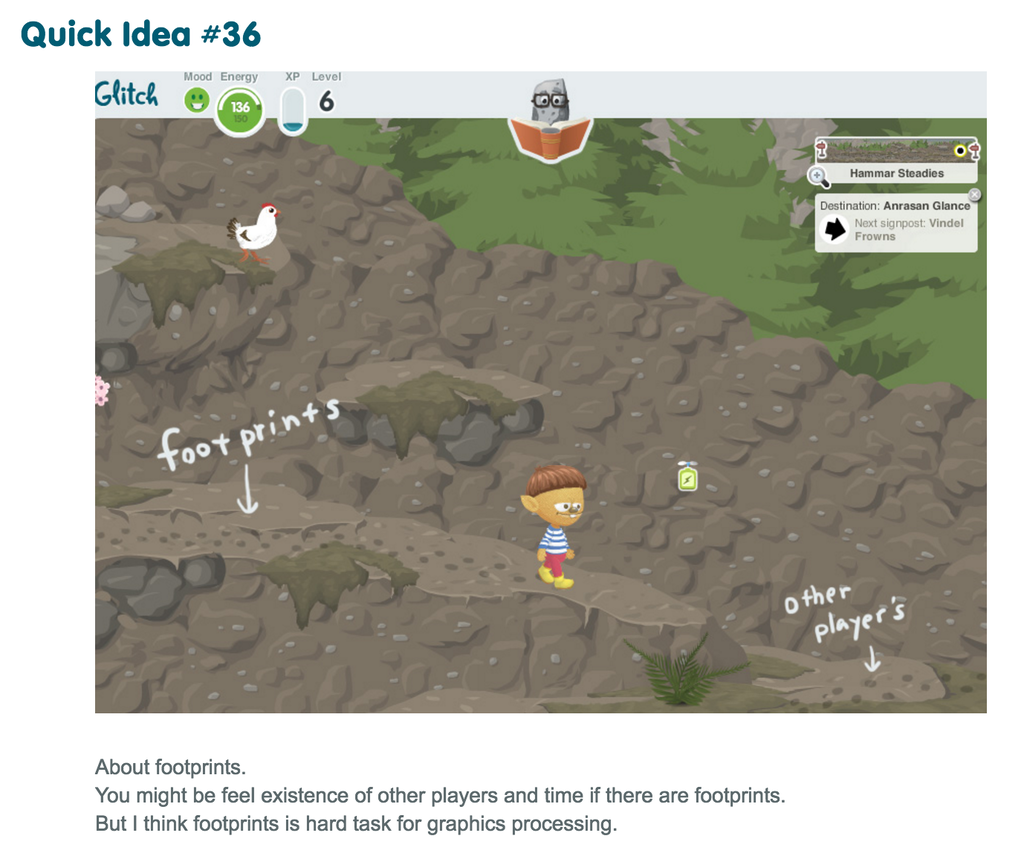

http://www.glitchthegame.com/oddsandends/qis/page4#36