Singapore’s Long-Awaited Moment May Have Arrived
If any place has been rehearsing for the moment when it overtakes Hong Kong as the economic capital of Asia, it’s Singapore.
The Southeast Asian city-state’s founding prime minister, Lee Kuan Yew, took Hong Kong as a direct model when trying to build a stable future for Singapore after its expulsion from the Malaysian federation in 1965. “I thought I would learn from Hong Kong, which had also been cut off from its hinterland, mainland China,” Lee said in a 1992 speech.
A Tale of Two Cities

Nominal GNI/capita
$58,770
Singapore
Hong Kong
$50,310
Top marginal income tax rate
22%
Singapore
Hong Kong
17%
Finance share of jobs
9%
Singapore
7%
Hong Kong
Population
Hong Kong
7.5M
Singapore
5.6M
Land area, sq. km
Hong Kong
1,107
Singapore
724
Foreign population share*
Singapore
13%
Hong Kong
8%
*Non-Chinese nationals in Hong Kong and share of permanent residents in Singapore.
The two ethnically Chinese, former British colonies have been transformed utterly since then, but still resemble each other closely as low-tax, affluent cities that compete to attract white-collar professionals from across the world.
That’s where the similarities end. For Asia’s cosmopolitan classes, Singapore and Hong Kong aren’t so much twins as opposites. Exploring the profound differences between the two is a favorite parlor game — and one Singapore traditionally loses.
The city-state’s tidy, controlling tendencies are often contrasted unfavorably with Hong Kong’s more freewheeling model of entrepot capitalism. It rarely escapes notice that while Hong Kong was a model for Lee, his Singapore in turn was a template for Deng Xiaoping’s vision of the Chinese state.
Hong Kong was traditionally so laissez-faire that the government resisted the official collection of economic and financial statistics until the 1980s, and didn’t have a central banking function until 1993. Singapore is far more interventionist, running its own singles events to support the fertility rate and accommodating 79% of the population in government-built homes.
Visiting Hong Kong in 1954, Lee was astonished to find that a local tailor was able to measure and fit a new suit for him in just 12 hours: “Singapore tailors do not work at that speed,” he said years later. His conclusion, that Hong Kongers were a “leaner and keener people,” isn’t so different from the popular view even now.
Those differences have helped engender a different model of capitalism in Singapore. For all its ambitions to turn itself into the London of Asia, it looks a lot more like the region’s Zurich — dominated by the discreet worlds of private banking and commodities trade, rather than the colorful chaos of capital markets and dealmaking found in its northern cousin.
Walled Garden

Temasek
Jardine Matheson
Lee family
Wee family
Other tycoons
Independent
$50B
DBS
CAPL
STE
KEP
SIA
ST
AREIT
CCT
MCT
CT
SATS
SCI
$43B
JM
JS
$18B
WIL
THBEV
GENS
CIT
HKL
JCNC
DFI
$7B
SGX
$40B
OCBC
$33B
UOB
CD
VMS
Temasek
Jardine Matheson
Other tycoons
Lee family
Wee family
Independent
$50B
DBS
CAPL
STE
KEP
SIA
AREIT
CCT
MCT
ST
CT
SATS
SCI
$18B
WIL
$43B
JM
JS
THBEV
CIT
GENS
HKL
JCNC
DFI
$40B
OCBC
$33B
UOB
$7B SGX
CD
VMS
Temasek
Jardine Matheson
Other tycoons
Lee family
Wee family
Independent
$50B
DBS
CAPL
STE
KEP
SIA
AREIT
CCT
MCT
ST
CT
SATS
SCI
$43B
JM
JS
$18B
WIL
THBEV
GENS
CIT
HKL
JCNC
DFI
YZJSGD
GGR
$7B
SGX
$40B
OCBC
$33B
UOB
CD
VMS
Note: Key shareholders defined as those in which named families, companies or individuals have effective control of at least 20% of voting shares.
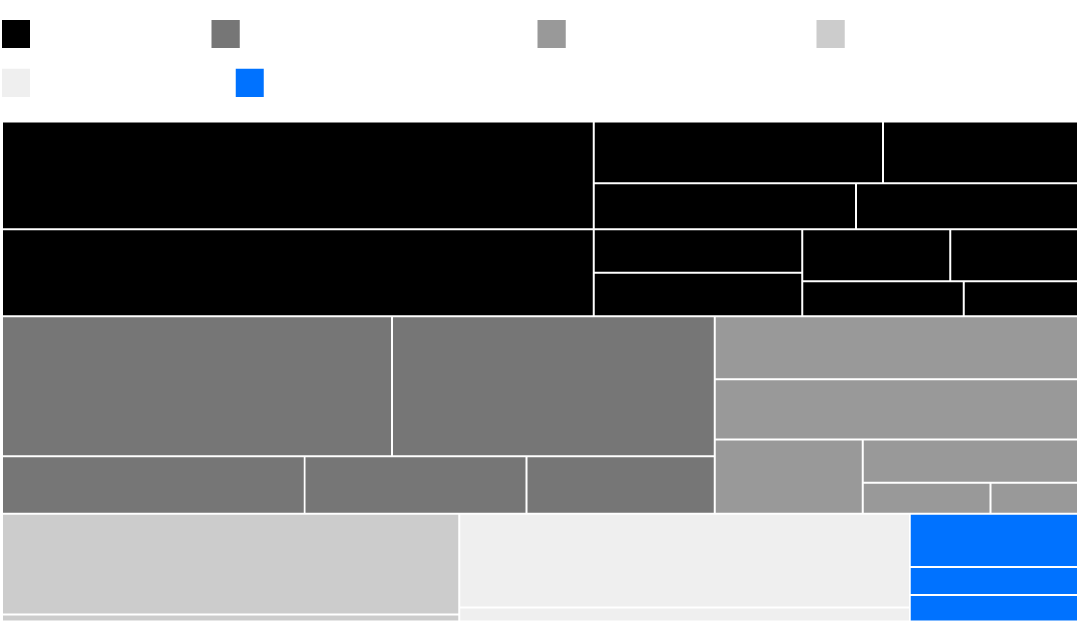
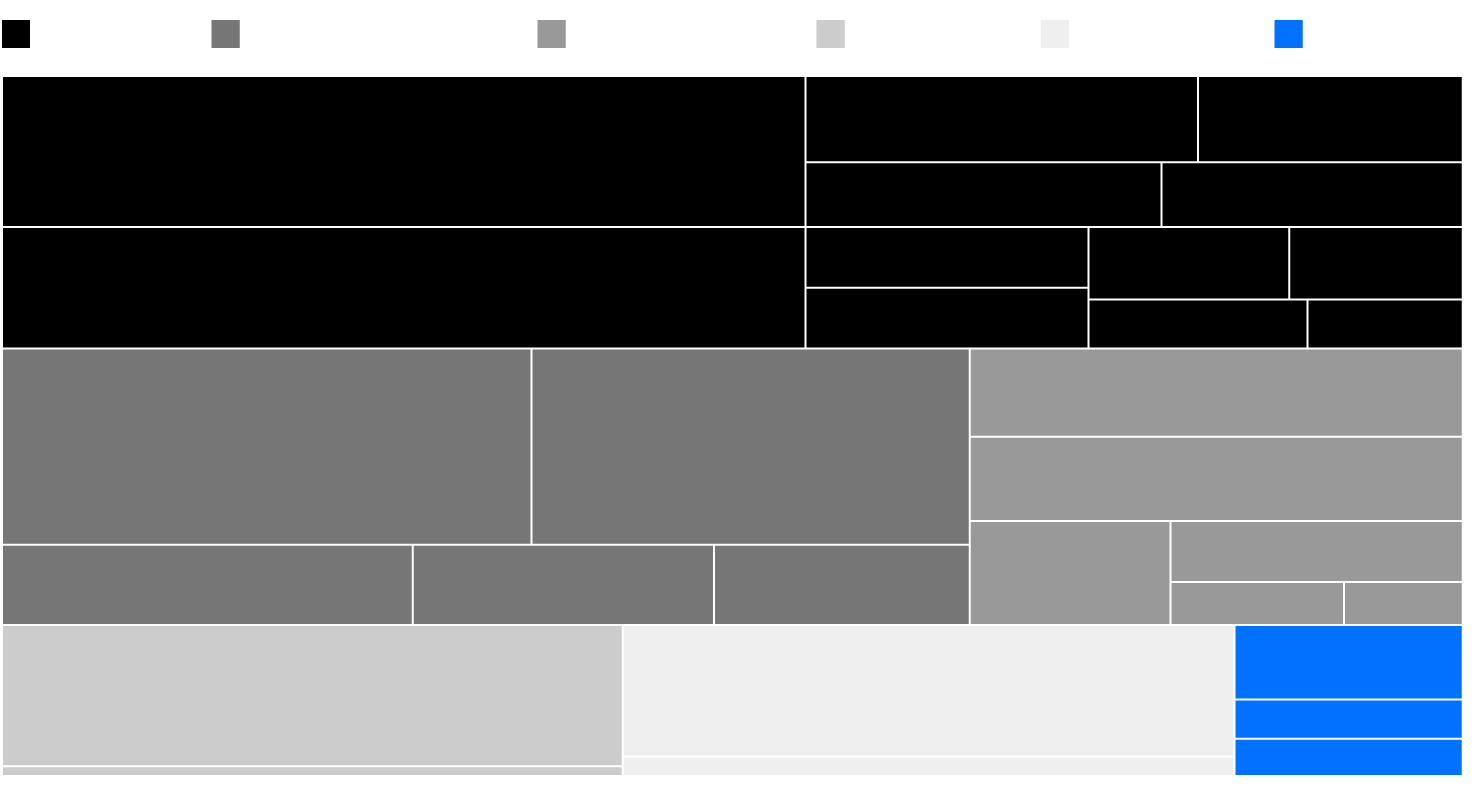
Of the 30 companies on the FTSE Straits Times index, all but three count as major shareholders either government-owned investment fund Temasek Holdings Pte. or a handful of Asian and British tycoons, led by Hong Kong’s Jardine Matheson Holdings Ltd. That leaves the exchange embarrassingly stunted by financial-center standards, with the total market capitalization of its primary listings slipping below near neighbors in Thailand and Indonesia.
Small Island

$32T
U.S.
China
Hong Kong
U.K.
France
Germany
India
South
Korea
Japan
Switz-
lerland
Taiwan
Canada
BR
TH
ID
AUS
$462B
Singapore
Note: Primary listings only. As of Oct. 7, 2019.
The stock market is less than one-tenth the size of Hong Kong’s, where blue-chip mainland Chinese companies such as Tencent Holdings Ltd. and PetroChina Co. make up about a third of the total. That’s a problem for Singapore, because share trading is a core component of a vibrant financial center.
“If your equity market is not efficient, it will not attract high quality firms,” said Meijun Qian, a professor of finance at Australian National University in Canberra. “The situation becomes a spiral, stuck in an inefficient equilibrium.”
This junior status has been a concern for many years. The response has been characteristically Singaporean — harnessing the powers of the state in a multi-decade campaign to compete with a city whose success is based, as much as anything, on its resistance to government intervention.
Over the past few decades, Singapore has built parks, theaters, concert halls, casinos and theme parks in an attempt to shake off the perception that it’s Hong Kong’s straitlaced relative. Six of the city’s 10 top-ranked attractions on TripAdvisor have been built since 2008 (not everything has changed: the number one place still goes to the city’s metro rail system). The Singapore Grand Prix, a major pull for private-banking clients, started the same year.
Not a Borrower or Lender

Singapore
Hong Kong
$800B
600
400
200
0
2005
2010
2015
2019
Note: Shows only claims on non-banks on an ultimate-risk basis.
Just a handful of Singapore’s major performance-arts venues existed 20 years ago, and the same goes for the the city’s main nightlife spot, the Clarke Quay district. Until the 1990s, most discos were run by community centers or the police, and weren’t allowed to serve alcohol.
Walking around the coffee shops of the downtown business district, the city now has a distinctly hipsterish vibe that couldn’t be more different from the stereotype. This transformation, combined with its lower cost of living and better-quality housing, appears to have done the trick in luring people to live there. The population of non-citizen permanent residents increased by about 235,000 between 2000 and 2018, outstripping the 199,000 rise in non-Chinese residents in Hong Kong over a comparable period. About 13% of the population are now non-citizens, up from 4.1% in 1990.
Despite all this, the vision from a decade ago that Singapore might finally cement a position as Asia’s pre-eminent financial capital has been thwarted so far by the sheer scale of mainland Chinese growth spilling over the border to Hong Kong.
On one measure of a city’s status as an international banking center — the value of claims that local branches of international banks have on foreign non-banks — Singapore seemed like it had a chance of catching up a decade ago. It’s since been comprehensively left behind.
Private Banking Dwindles

Singapore
Hong Kong
$800B
600
400
200
0
2010
2011
2012
2013
2014
2015
2016
2017

FPO
540PX

Temasek
Jardine Matheson
Lee family
Wee family
Other tycoons
Independent
United Overseas Bank
Wilmar International
Singapore Exchange
DBS
Jardine Matheson
OCBC
SingTel
Singapore Press
UOL
Thai Beverage
ComfortDelGro
Jardine Strategic
CapitalLand
Hongkong Land
Genting Singapore
Venture Corp
Singapore Tech
Jardine Cycle
City Developments
Keppel
Dairy Farm
Yangzijiang Shipbuilding
Singapore Airlines
Golden Agri-Resources
Ascendas
Capitaland Mall
Capitaland Commercial
Mapletree Commercial
SATS
Sembcorp
Even in private banking — in theory, one of Singapore’s strong suits — Hong Kong has won out, as the army of rich people minted by China’s boom have sought to stash their wealth over the border, but not too far away.
“We’re a center for Southeast Asia, Hong Kong is for China,” said Joseph Lim, an associate professor of finance at the Singapore University of Social Sciences.
For most of the 22 years since the Hong Kong handover, Singapore’s distance from China has been a disadvantage. Only the individuals and businesses most obsessed with keeping their assets out of Beijing’s reach have gone to the effort of moving their wealth so far from the dynamic engine of the world economy.
Now, that liability may gradually be turning into an asset. Mainland China is already in demographic decline, with the labor force shrinking by 1.4 million people in 2018 — more than three times the combined 436,000 lost by Japan and the European Union. Meanwhile, the trade war is diverting supply chains towards Singapore’s backyard in Southeast Asia, causing wealth to spring up in new locations.
Chasing China

China
India, Indonesia, Pakistan,
Philippines, Vietnam, Bangladesh,
Thailand, Malaysia
$80T
0
2016
2035
2050
After years of leading every other major economy, the growth rate of China’s gross domestic product is now falling behind the Philippines, Vietnam, and India. Even its vast size is subject to the law of gravity: By 2035, the eight largest economies in South and Southeast Asia will have pulled level in terms of aggregate output, according to forecasts by PricewaterhouseCoopers LLP. They’ll accelerate further after that.
Indeed, it’s possible that this weakening in the economy — with its violation of China’s unofficial social contract, where dramatic improvements in citizens’ material well-being were seen as compensating for the lack of civil liberties — is one factor that’s contributing to Beijing’s tightening political grip. Unable to placate the population with wealth, China’s government is resorting to harsher methods to keep control. That’s an alarming prospect even for rival financial centers.
“It’s not in anybody’s interest to have an unstable greater China,” said Yougesh Khatri, a Singapore-based fellow with British foreign-policy think tank Chatham House. “We all would like to see a stable and prosperous Hong Kong economy.”
If Singapore takes over from Hong Kong as Asia’s pre-eminent financial center, it won’t be because it’s become a better place for global capital to shake hands with China. Instead, it will be because global capital may one day come to regard China the same way it now regards Japan — as a vast but challenging market overshadowed by faster-growing rivals.