How Germans Re-Elected Merkel While Boosting Her Opponents
Angela Merkel’s bloc may have underperformed in Sunday’s election, but she still won a fourth term as chancellor. Her Christian Democratic Union/Christian Social Union (CDU/CSU) alliance garnered 33 percent of the national party vote and about 37 percent of the direct ballots that elect local representatives for each of Germany’s 299 districts.
Merkel’s victory, which will be followed by negotiations on forming a governing coalition, came despite a significant political shift: the hollowing out of Germany’s political center. It was shown by the CDU/CSU’s worst performance since 1949, the historic rout of the Social Democratic Party, or SPD, and the accession of the populist Alternative for Germany (AfD) to the Bundestag, the lower house of parliament, for the first time.
The Rise of the Far Right?
All over Europe, the populist far right has made significant gains over the past two years. Such movements placed second in parliamentary elections in the Netherlands, easily qualified for the presidential runoff in France in May, finished second in presidential voting in Austria and arguably forced last year’s Brexit vote in the U.K. In Germany, the AfD advanced by holding its power base in the east, targeting former industrial cities in the west that are seeing high unemployment and exploiting anti-immigrant sentiment in a country that has taken in more than 1 million refugees in about two years.
Unemployed

4
5
7
9%+
Stralsund
Gelsenkirchen

0
6
10
14
18+
Stralsund
Recklinghausen
Dortmund
Gelsenkirchen
Dusseldorf
Foreign-born population

6
10
14
18%+
Dresden
Stuttgart

6
10
14
18+
Berlin
Stuttgart
With 12.6 percent of the national party vote, the AfD is on track to get nearly 100 seats in the Bundestag, out of more than 700 total, making it the third-largest party. It even managed to win the direct vote in three constituencies, something it wasn’t predicted to do, all of them in the eastern state of Saxony. (Click here for a primer on Germany’s complex election process.)
Notably, the AfD’s populist message appears to have had more resonance with voters than its anti-immigration stance would have predicted. As the maps above show, the AfD’s strongest showings were often in more economically challenged areas, where GDP per capita is lower and unemployment higher than the country on average, rather than regions characterized by a large foreign-born population. The party’s power base in eastern Germany also indicates the areas that have benefited least from the country’s export-driven economic miracle.
The SPD’s Black Eye
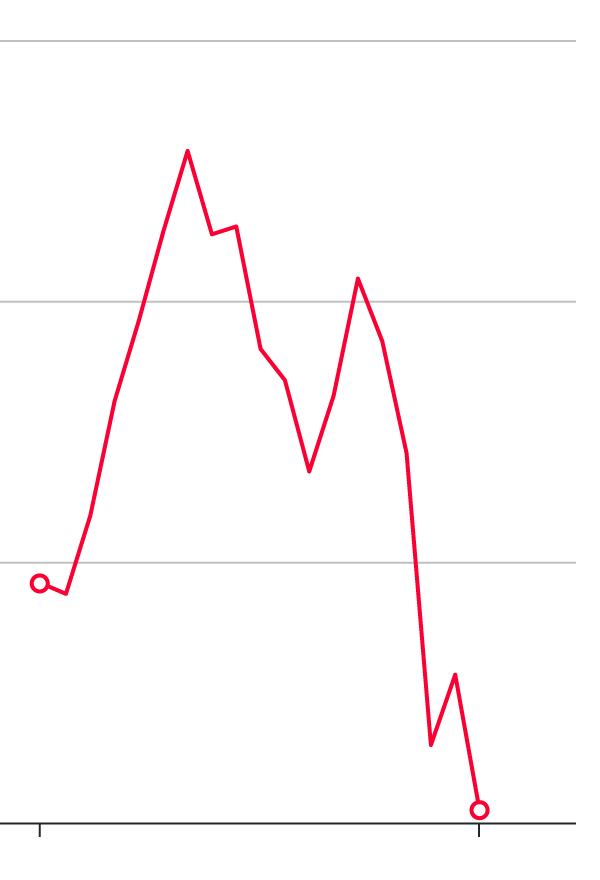
As predicted by the polls, the center-left SPD had its worst showing since World War II, despite leader Martin Schulz’s efforts at distancing the party from its recent role as junior coalition partner to Merkel’s CDU/CSU. While still the second-largest party in the Bundestag, its members may be tiring of junior status, hence Schulz’s decision to lead the opposition rather than enter into another so-called grand coalition with Merkel as chancellor.
SPD second vote loss between 2013 and 2017
SPD’s worker support
50%
Blue-collar
40
White-collar
30
20
1990
2017
SPD’s historical vote share
50%
40
30
20
1949
2017
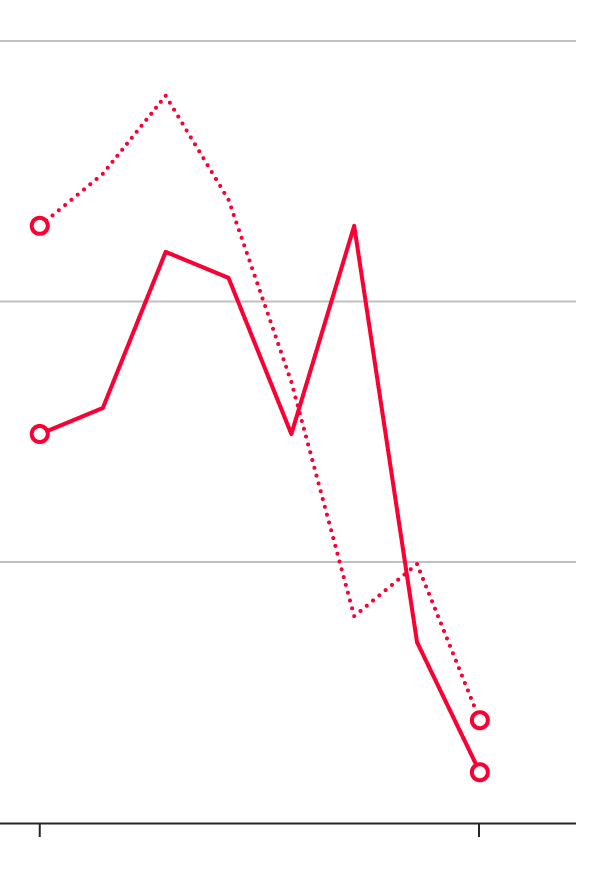
Behind the party’s meager performance is a worrying trend: its declining support among blue-collar workers. According to exit polls from Infratest and FG Wahlen, the SPD saw its share of the vote among this group fall by three to six points, and to as little as half its 48-percent showing in 1998. This means that the CDU/CSU is now leading among this group of voters, once a reliable part of the SPD’s core base
Warning Signs for the CDU/CSU
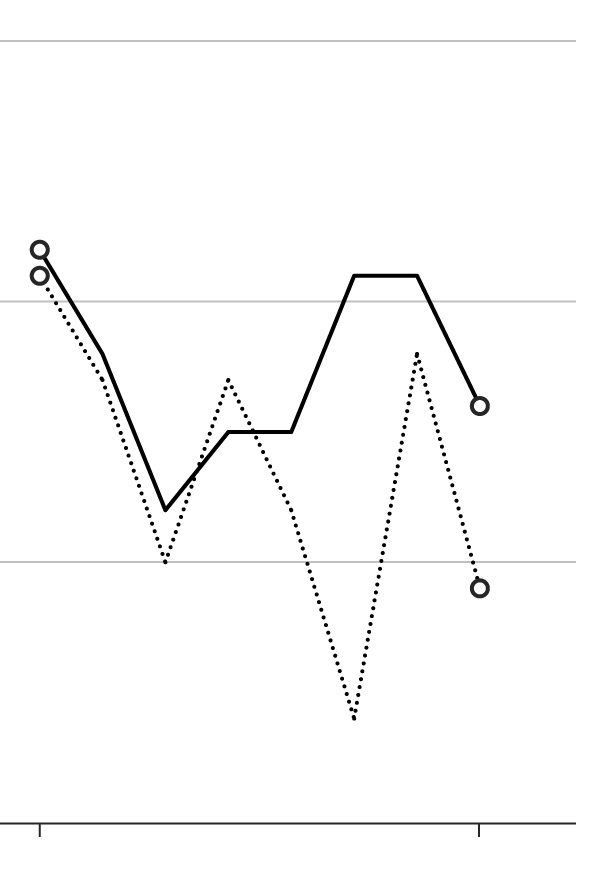
Merkel’s party may have won the election, but this marks the 16th federal vote in a row where no party in Germany has won a majority. It too did worse among workers. The CDU/CSU, in fact, put in one of the lowest showings in its roughly 60-year history. The SPD’s lackluster performance thus makes 2017 the worst year ever for Germany’s two main centrist parties. Combined, they had only 53.4 percent of the national party vote, down from 67.2 percent four years ago and from more than 90 percent in the 1970s.
CDU second vote loss between 2013 and 2017
CDU’s worker support
50%
White-collar
40
30
Blue-collar
20
1990
2017
CDU’s historical vote share

50%
40
30
20
1949
2017
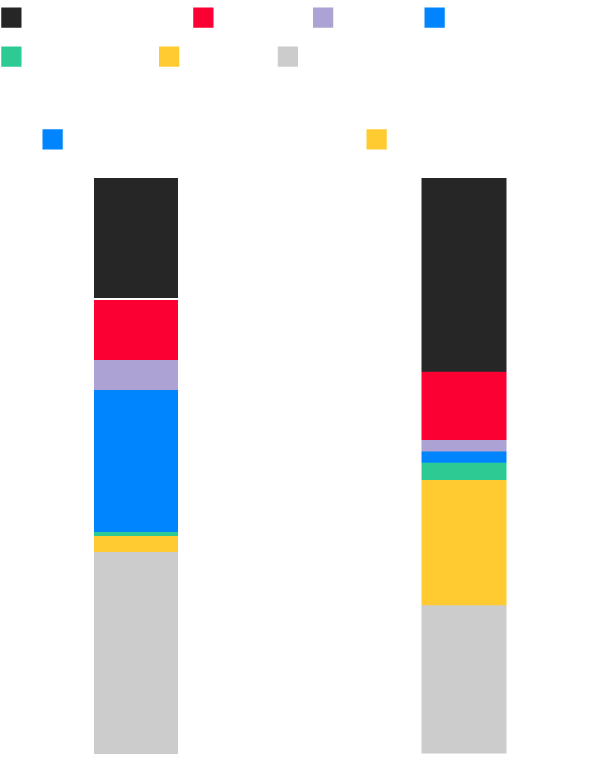
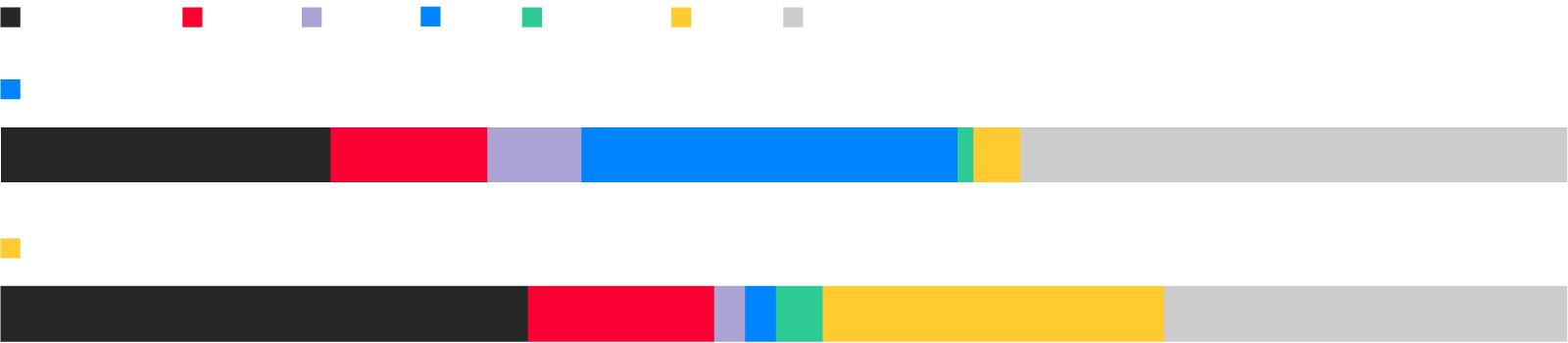
Arguably more alarming for the CDU/CSU: the prospect of even more erosion in party support. As the map above shows, its share of the national party vote fell fairly uniformly all across the country, even in areas where it ultimately came in first. Also, its one-time supporters in 2013 turned out to be the group most likely to defect to either the AfD or pro-business Free Democratic Party (FDP) this time around, presenting a challenge to Merkel over how to win back their votes.
Which parties lost vote share to AfD and FDP this election
CDU/CSU
SPD
Left
AfD
Greens
FDP
Other/Non-voters
AfD gains
FDP gains
21%
34%
10
6
12
24
22
35
26
CDU/CSU
SPD
Left
AfD
Greens
FDP
Other/Non-voters
AfD gains
21%
10
6
24
1
3
35
FDP gains
34%
12
2
2
3
22
26
What About Merkel’s Likely Coalition Partners?
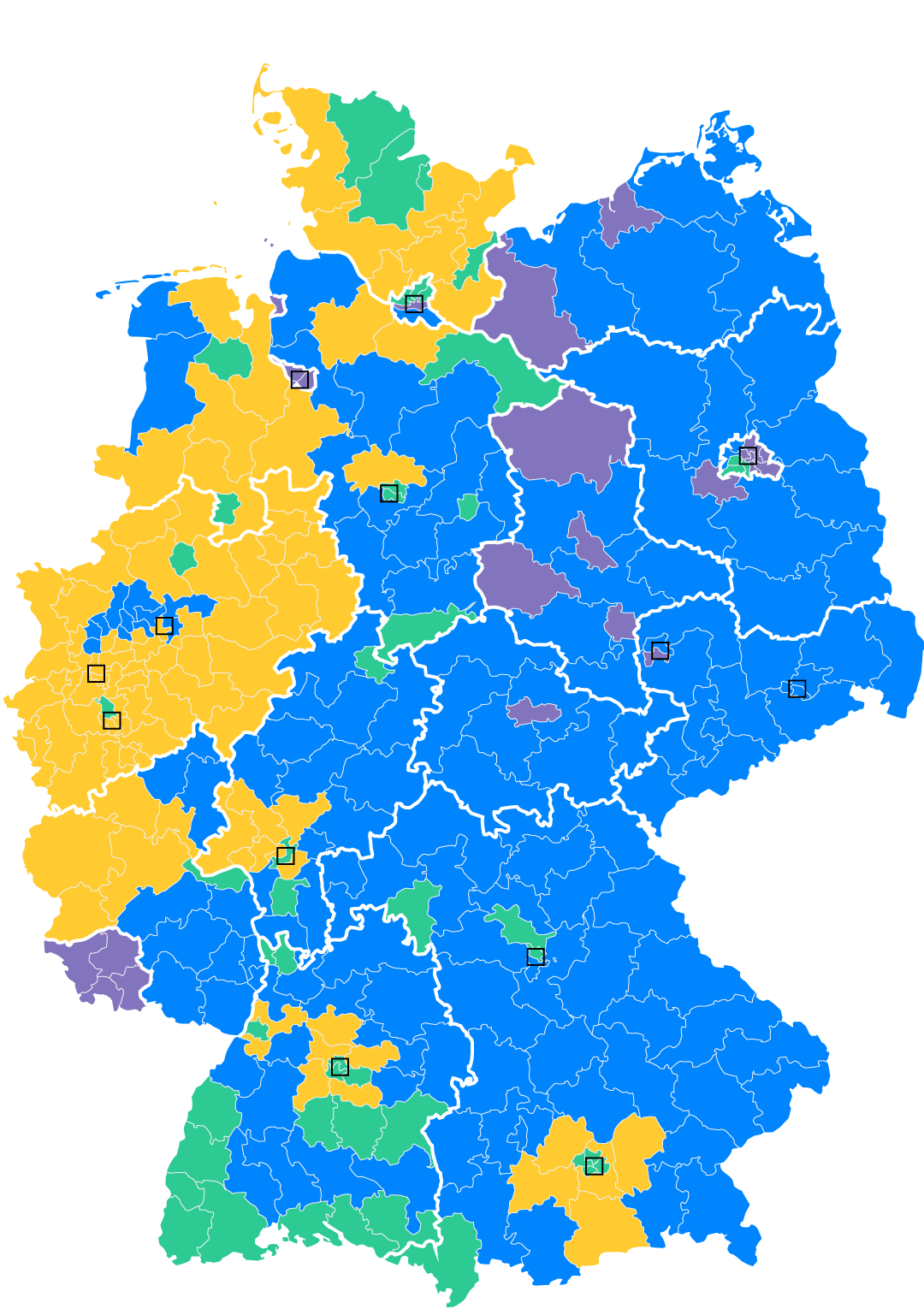
After dropping out of the Bundestag in 2013 with a 4.7 percent national vote share, the FDP came roaring back this year. It narrowly trailed the AfD to become Germany’s fourth-largest political party. Unfortunately for Merkel, a two-way coalition with the FDP would be 29 seats less than a workable majority. Such an alliance, the most frequent in post-World-War-II Germany, was seen as the most effective in terms of managing the economy, according to a Bloomberg survey earlier this month.
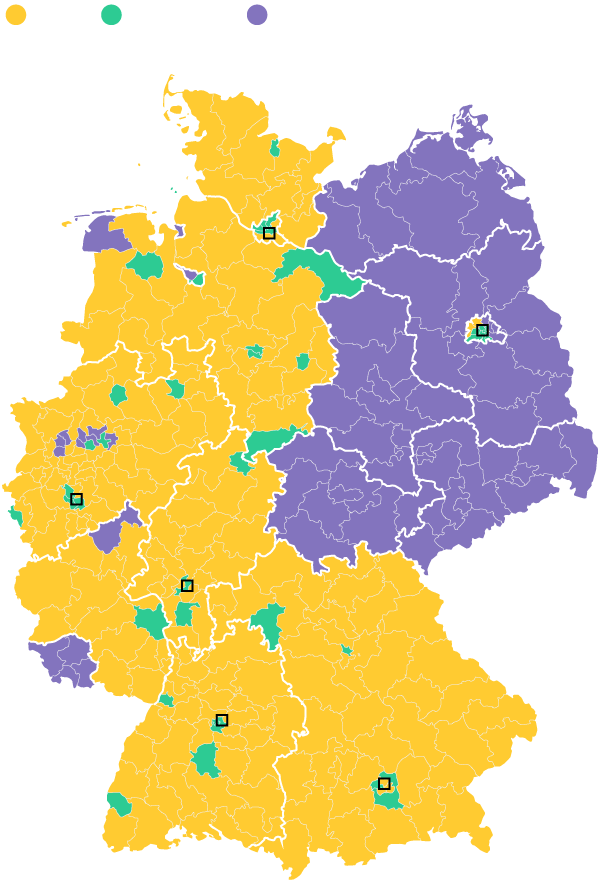
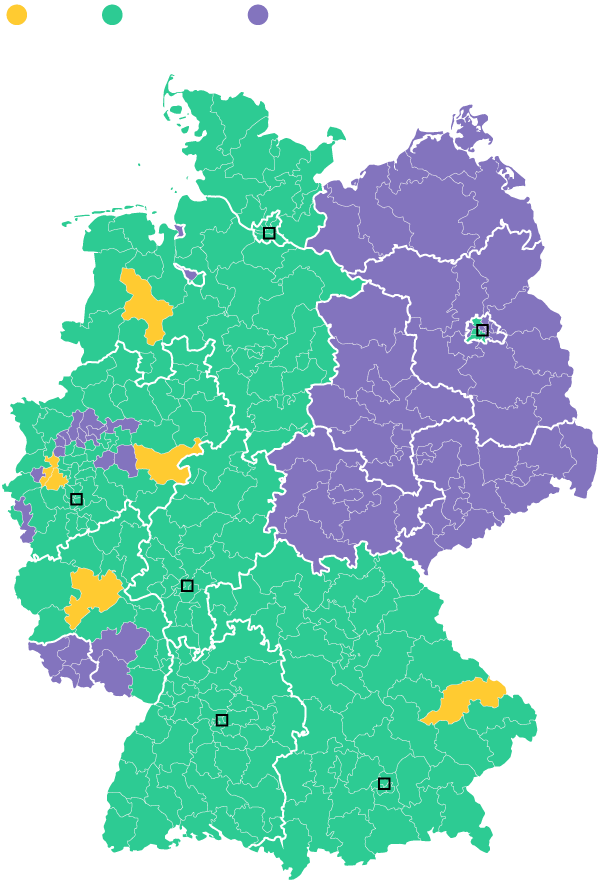
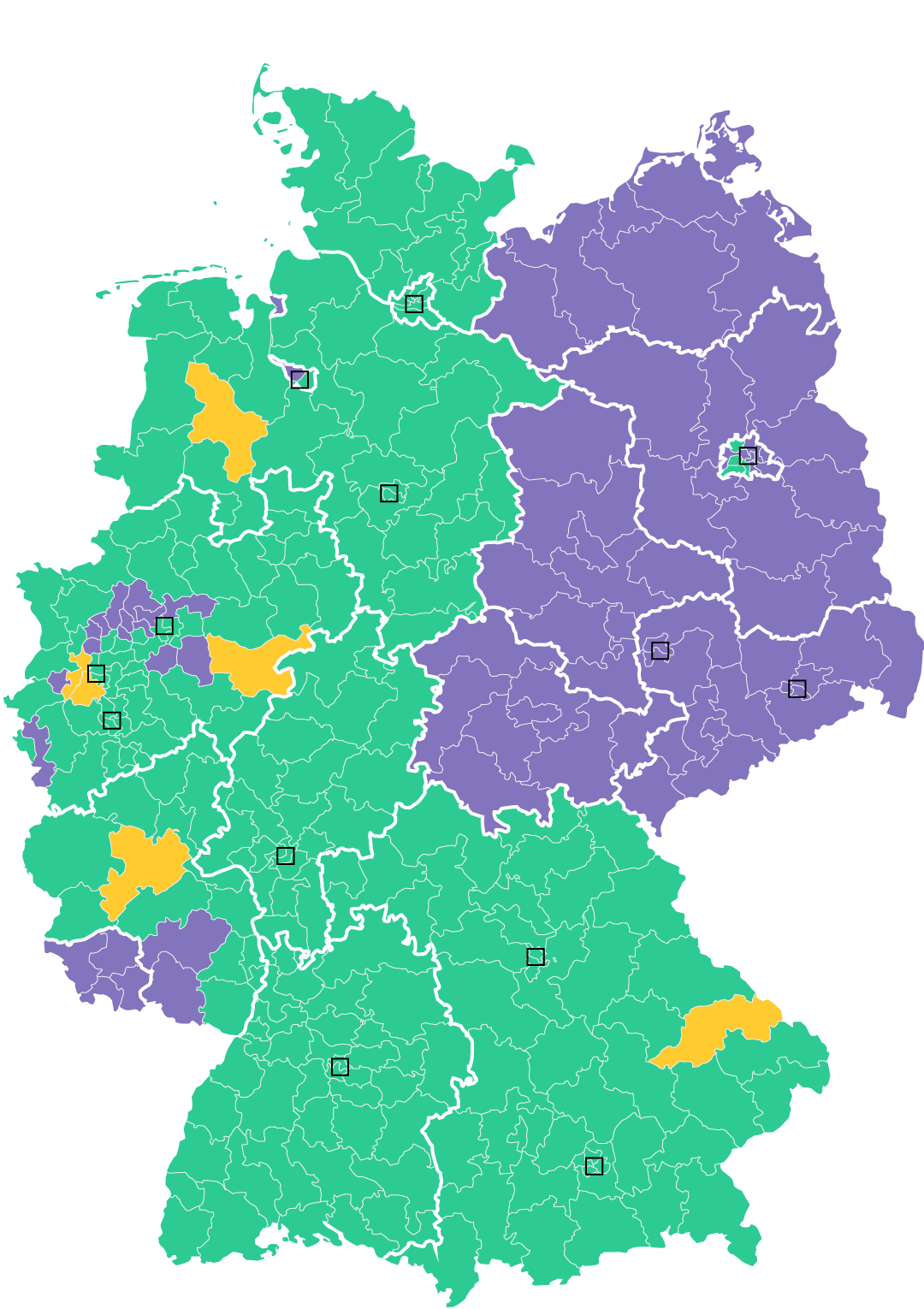
The benefits of the center’s weakening have mostly gone to the FDP and AfD rather than Germany’s second-tier Bundestag parties in 2013: the Greens and the Left. Yet for all their standing as frontrunners for coalition talks with Merkel this time around, the FDP and Greens only out-polled the AfD—which Merkel has repeatedly refused to even consider—in fewer than half of Germany’s districts, when looking at the national vote share.
Parties with highest support after CDU/CSU and SPD
2009
FDP
Greens
Left
Hamburg
Berlin
Cologne
Frankfurt
Stuttgart
Munich

2009
●Left ●FDP ●Greens
Hamburg
Bremen
Berlin
Hannover
Dortmund
Leipzig
Dusseldorf
Dresden
Cologne
Frankfurt
Nuremberg
Stuttgart
Munich
2013
FDP
Greens
Left
Hamburg
Berlin
Cologne
Frankfurt
Stuttgart
Munich
2013
●FDP ●Left ●Greens
2017

AfD
FDP
Greens
Left
Hamburg
Berlin
Cologne
Frankfurt
Stuttgart
Munich
2017
●Left ●FDP ●Greens ●AfD