Mr. MiFID on Finance’s Low-Fee Future


Steven Maijoor isn’t an obvious master of the universe. He was a longtime academic and then a financial markets regulator in the Netherlands before becoming chairman of the European Securities and Markets Authority in 2011. The far-reaching regulatory regime known as Markets in Financial Instruments Directive II, which takes effect on Jan. 3, has rapidly elevated the profile of Maijoor and a once-obscure bureaucracy beavering away in Paris. Working with national regulators within the European Union, Maijoor, 53, has helped to implement the legislation, which grew out of the financial crisis in an attempt to avoid another one by increasing transparency. While the rules—covering everything from unbundling research and execution costs to dark pools and interest rate swaps—are European, they will affect markets from New York to Singapore. MiFID II should mean lower fees for Europeans and “big opportunities” for asset managers, especially those offering cheaper products, according to Maijoor. Over the course of two recent interviews with Bloomberg Markets, Maijoor is serene in defense of his core mission: protecting investors and promoting orderly markets. And he has some surprising things to say about the dreaded prospect of MiFID III.
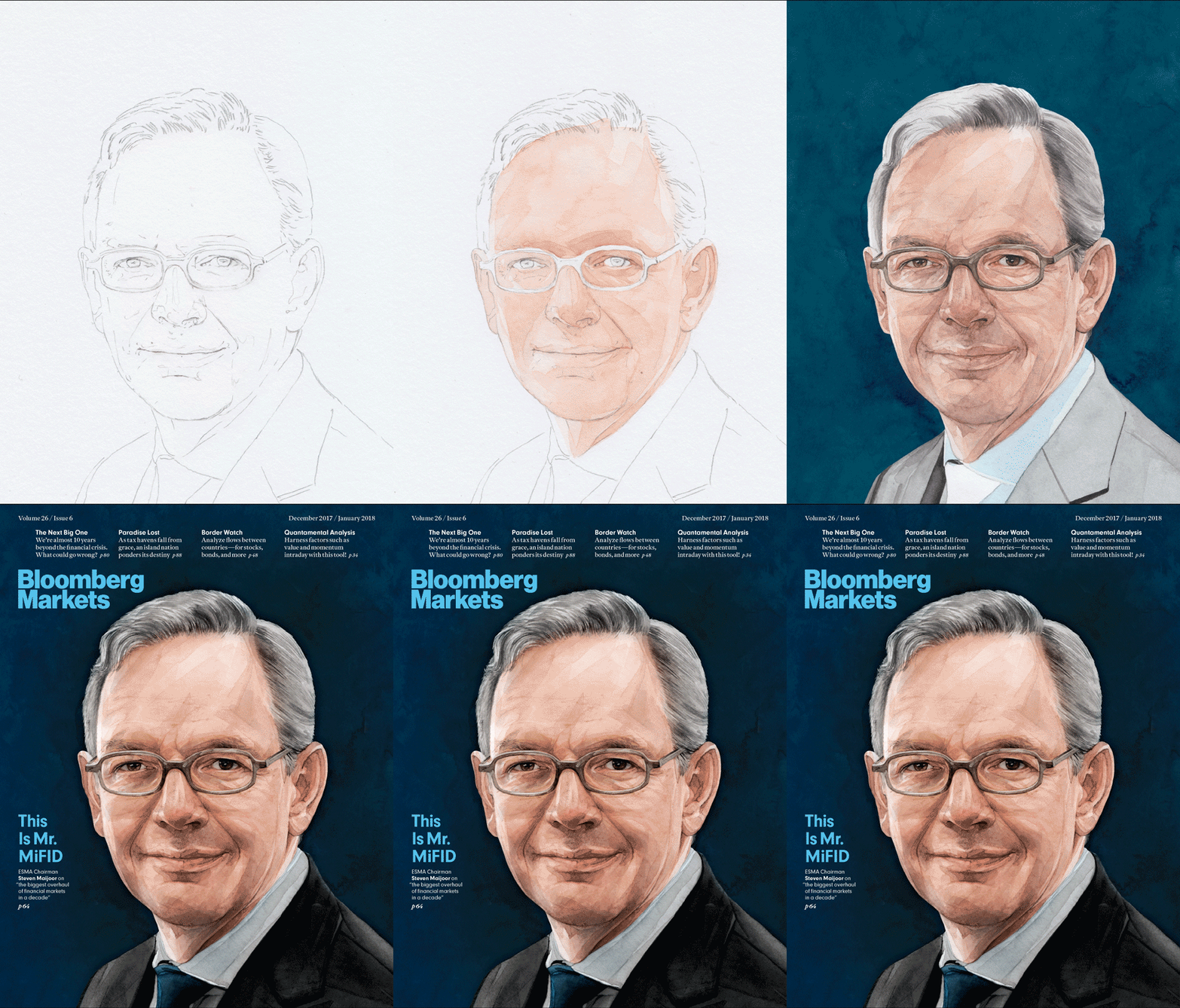
BLOOMBERG MARKETS Say you’re at a party, and someone who doesn’t work in finance asks, “What do you do?” How would you answer that?
STEVEN MAIJOOR It depends whether it’s a party for children or adults. But let’s say it’s adults. Typically, people know their national securities regulator, so I would say, “I’m the chairman of the European version of your national regulator, and what we do is help protect investors and make financial markets stable.” If they’re still interested and don’t want to start talking about soccer or politics, I would explain that we’re making rules for the EU’s financial markets.
People know what a bank is. They also know what an insurance company is. The securities market is a bit more distant. Basically we regulate all of the financial markets aside from insurance companies and banks. We regulate all that’s left—which is a lot. It can be an investment firm, a trading venue, a crowdfunding platform, etc.
If they’re still interested, I would say we also make sure the markets we regulate are supervised consistently across the 28 EU member states. I think that’s a very important ingredient of what ESMA does. It’s all about investor protection and the stability of financial markets in the EU.
BM People were probably less interested in this idea of protecting markets and investors before the financial crisis. How do they respond now?
SM What you have seen in the past 10 years is that the financial sector really got people’s attention. I think the markets have become safer, but for the time being the public will keep its attention on the financial sector. If there’s a track record over a longer period of time, if the sector functions well, I think you would expect that attention to lower. But clearly the fact that economies, and societies, were so affected by the financial crisis has really increased the public attention and political attention for the sector.
BM Say this party happens to include a few fund managers. What do they want to know from you right now?
SM There’s a lot of concern about the separation, or unbundling, of execution and research. This will, in my view, really contribute to better performance for the asset management industry. If you look at the broader picture, Europe is a region where the asset management industry doesn’t play as big a role in households as in the U.S., for example.
One of the important things that needs to change in Europe is a movement away from the banking sector and toward securities markets. In a typical EU household, there’s a much greater tendency to save through deposits. That’s not a desirable situation; it results in the long term in very low returns. If you want to have a decent return on investment, you need to participate in the capital markets.
I see big opportunities for the asset management sector here, but can these opportunities be reaped? The typical cost of funds in the EU is higher than in the U.S. Also, the average fund in the EU is smaller than in the U.S. We know that in this business, size is extremely important. One of the possibilities would be to increase the size of these funds.
I think we should work on a more competitive asset management industry in the EU. The unbundling of execution and research plays an important part in that. This is a very hot topic for the asset management industry, but I’m very happy that relatively early we’ve had large asset managers say, “We’ll start implementing MiFID II right away and covering expenses on our own account instead of billing the end consumers.” That’s much clearer and more transparent under MiFID II.
BM Let’s talk a little bit about the rules for inducements [monetary or otherwise, that accompany an investment-related service]. What are the objectives?
SM That focus is very much on the relationship between the brokers and the portfolio managers and the asset managers—those distributing the funds to their clients and the inducements they receive. I think what’s clear from the proposal is it’s a model where inducements are still possible.
In some member states, inducements are banned. The EU has chosen a model where you can still receive inducements, but when you receive them they should be quality-enhancing. We have followed this line when we’ve given our advice to the European Commission, which isn’t a technical standard. In some places we write the rules; in others we advise on the rules that are made by the commission. This is an area where we advise the commission and give them a number of examples we consider to be quality-enhancing.
We’re currently looking into the issue and into whether or not we need further Q&As [tools ESMA uses to collect and address public questions from stakeholders] to help us decide. But inducements are still allowed as long as they are quality-enhancing.

BM You were talking about size and how much that matters. Will larger asset managers be better suited to these new regulations than smaller ones?
SM First of all, there is the risk that, with bundling, it’s unclear who pays for research. Who consumes the thing is different than who pays for it. The departure point is this: If a portfolio manager can improve his performance by buying a certain amount of research, why wouldn’t he pay for it? It’s classic economics. If it helps a smaller asset manager improve, I see no rational incentive why he wouldn’t be willing to pay for it.
That there are distortions in this world is very clear to me. When we look at those asset managers that pursue an active investment strategy, obviously their performance has been problematic—we know that from many studies. That this market is not functioning at this stage is, I think, very clear. That’s the reason I very much support this unbundling. And as I said, if a smaller portfolio manager can improve his performance because he can see that an independent research house can help him with his performance, I do not see why he would not be willing to pay for it. If I were an asset manager and could improve my performance, I do not see why there wouldn’t be a market developing for research in this area.
BM If you fix what you see as a European problem, do you in effect create an unlevel playing field that allows, say, American fund managers to come in with a competitive advantage?
SM This is a separate story on its own. We regulate regionally, while these markets are global. And so we try to harmonize with other regulators and be as consistent as possible across the globe. The reality is we are still regulating at a regional or national level. It would be impossible to move ahead with new requirements only when everyone agrees. Europe is going ahead with this separation [of execution and research].
In the U.S., we know that some categories of brokers are not allowed to receive payments for research because then they need to be registered as an investment adviser. This should not affect a level playing field in the EU. We’re not saying anything about a U.S. broker offering research for free in the U.S.; that’s not for Europe to decide. What we’re concerned with is when a European asset manager can choose between an EU broker and a U.S. broker. There should be a level playing field between the EU broker and the U.S. broker providing those services to a European asset manager. We have said that needs to be done on a level playing field. So when the U.S. broker provides those services, it’s important that research is not an inducement and that there’s the unbundling of research.
BM The Securities and Exchange Commission will have a 30-month period during which it will decide what to do about MiFID. What’s your role in that process? Do they go off and decide by themselves, or do you talk to them on a regular basis?
SM We’ll provide our views, but clearly the decision and the policy response are their responsibilities. We stand ready to provide any information or technical support to the SEC, but this is something on their side and not on ours.
BM Will MiFID II go global?
SM I would not be surprised if it becomes a model used outside the EU. There are increased competitive pressures on asset managers in general, and I would not be surprised if, as part of that pressure, unbundling becomes a more standard model.
BM Is there a way in which harmonization can create a global regulator? In other words, can you have so much harmony that you get what amounts to a global consensus? And are things already moving in that direction?
SM One of the positive side effects of the crisis has been an enormous step forward in global rule-making. And the fact that after the crisis we have had these G-20 commitments means that rules become more consistent across the globe. What’s also clear is that we influence each other.
To some extent your question is also going in the direction of extraterritoriality, which is the negative side of this conversation. The principal element has always been that there needs to be a level playing field within the EU. Of course, people within the industry will say, “Yeah, but you require that I need to make changes here in the U.S. I need to provide services to an EU portfolio manager, and because of that, I have to change my system.” My response is, you only need to do it when you provide those services to European clients. We’re coming from the perspective of wanting a level playing field within the EU, not from the perspective that this should be the global model.
BM Are you worried about regulatory breakdowns following implementation on Jan. 3?
SM Obviously what we have been doing—and I think you would expect it from me as chair of the European authority—is to try to be as consistent as possible across the EU. I truly believe in the consistent protection of investors. We should avoid any cross-border financial risk, but it’s also beneficial to the industry to have a level playing field because we want to avoid barriers. Any difference from one member state to another would quickly become a barrier for market participants who wanted to do business across the EU.
As you can see, European financial markets are moving more and more toward identical requirements across the EU. And subsequently my role, and our role as an authority, is to limit as much as possible the discretion and supervision where it’s not warranted. A certain market might have higher risks requiring a specific national response, and MiFID provides discretion for member states. Obviously I accept that.
I also fully understand that for certain reasons, member states need to argue this is an EU directive. We need to take national factors into account in terms of how it’s regulated. I understand that. I accept that. At the same time, we want to avoid more barriers between the member states. We need to be transparent in that position.
BM Do you need to crack the whip or be respectful of the national regulators?
SM It depends very much on how it’s described in the law. To be honest, this comes back to the legal reading. What is the discretion at the national level, and what is the law? The general wish I would say is to converge, to be consistent—that is part of the DNA of regulators. So this is a case-by-case assessment.
BM When you talk about a level playing field within the EU now, you’re talking about 28 members. With Brexit, it could be 27.
SM Will be 27 …
BM Fair enough. Are you concerned that a huge financial player—London—might end up within a different regulatory framework after Brexit?
SM It’s always been part of our thinking that capital markets benefit from size and from scale. I would have obviously preferred that we continue with 28, as we are now, because the U.K. is the largest capital market. Our whole focus in the past 30 or 40 years has been lowering barriers, trying to increase the size of the EU capital market, giving benefits of scale, etc. That is obviously negatively impacted by the U.K. leaving the EU. How that will impact EU capital markets will depend on what kind of model exists at the end of the day.
We’re looking into three areas on Brexit. One area is, how do we work together with countries outside the EU and their regulators? We have done some thinking on so-called equivalency models. How does Brexit change our relationship with non-EU regulators, especially in the context of the biggest financial market moving outside the EU? How do we adjust the equivalency models we currently have? So that’s one important issue.
The second important issue is the so-called regulatory competition issue. We know some U.K. market participants are looking to relocate to the EU 27 because they want to continue their access to the EU 27, and that’s understandable. It is also understandable that market participants in the U.K. will select one of the EU 27 and then, on the basis of generous outsourcing and delegation arrangements, basically delegate and outsource everything back to the U.K. and be left with a shell company in the EU 27. I’m just exaggerating to explain the issue, but that’s something we want to avoid.
The third area is the consequences of Brexit on stability: the cliff-edge effect. What would happen? How do EU regulators need to respond in the event the U.K. exits in March 2019 without arrangements in place? That would most certainly impact the financial markets.
BM Could you see the U.K. and ESMA working alongside each other as a region?
SM The U.K. [Financial Conduct Authority] and especially [Chief Executive Officer] Andrew Bailey have been extremely committed to MiFID II. He has always been very clear that the FCA wants to implement MiFID II in full. And I think that is very helpful. What the precise arrangement with the FCA will be after 2019—I’m not in a position to comment, because that is really dependent on the bigger negotiation and what is coming out of that.
BM OK, let’s pretend we can forget about Brexit. When MiFID II goes into effect, there are bound to be unintended consequences. If anything goes wrong with the rules, how quickly do you think you can react?
SM It depends very much on the issue at hand. As a regulator, we basically look at the toolbox and say, “OK, there’s an issue here, how do we solve it?” Sometimes you can solve an issue with a Q&A. Sometimes you need something heavier, like a guideline. And in some cases you might need to revise the implementation rules by means of what we call a Level 2 measure—going back to the European Parliament and the European Commission.
I don’t want to use the phrase “goes wrong,” but if there are unintended consequences or if MiFID doesn’t go as expected, we will look at the issue and decide how we will repair it. Sometimes you need to repair it with a Level 1 measure [creating a new EU law]. The biggest Level 1 change we made was asking for a delay. Moving MiFID II from January 2017 to January 2018 required a Level 1 change—a process that took half a year to get accomplished.
One of the benefits of these technical standards is that we don’t have to wait for MiFID III. I don’t think anybody would like to wait for MiFID III.

BM Right, let’s discuss MiFID III. Presumably all this data you’re going to collect will make it easier to draw up?
SM Let’s not talk about MiFID III. I must say I would like to drop that word. We have just gone through the evaluation process with EMIR [European Market Infrastructure Regulation, which covers over-the-counter derivatives], and a number of changes have been made. I think it resulted in very sensible changes to EMIR, so we don’t have to wait for MiFID III to make changes to MiFID or MiFID II. Obviously the Level 1 principles cannot be changed or amended. So if at some point in time someone would like to change these fundamental principles, then we would be talking about a MiFID III. But there’s no special reason to believe MiFID III will be needed. It’s a matter of regulatory hygiene.
BM That’s a catchy phrase.
SM I’m looking for the right words here; maybe it’s “better rules” or “better rule-making.” Once MiFID II starts, we’ll monitor how it’s implemented. On a daily basis we’ll get Q&As from stakeholders and from national regulators, and on that basis we’ll adjust guidelines—as we already are. I would expect that at some point, just as we made changes to EMIR, there will be changes to MiFID II. You need to work with stakeholders on a daily basis, and when you do that, you get all kinds of questions: How do you do this? How would this general rule apply to the fixed-income market? And so you give guidance, of course, always respecting what the European legislators intended.
BM How would you frame MiFID II’s importance in terms of global regulation overall?
SM What can I say about it? It’s the biggest overhaul of financial markets in a decade. On the consumer side, you have product governance, target markets, target intervention to ban certain practices, the area around inducements. Cost transparency is also big on the consumer side. On the market side, MiFID II is moving to a much wider coverage of financial instruments. Under MiFID I, there’s a stronger focus on regulated markets. MiFID II is covering a wider range of trading venues—and is going to cover all financial instruments with more transparency on a wider range of transactions.
BM This is such a huge undertaking. Did you have to increase staff? Do you anticipate needing to do so again?
SM Overall, our staff has been increasing at ESMA, so the total numbers are getting close to 250. But we have also said that the number of people we have is not sufficient, and not just because of MiFID. We are underresourced, and so we definitely should get more staff in the years to come. It’s not like in January the work is done and at that moment in time you can reduce the number of people who are available for MiFID work. There will continue to be implementation issues as we have seen in the past. So having sufficient resources at ESMA continues to be a concern.
BM Presumably you’ll be looking to hire, and by hiring you’ll be competing with banks for compliance staff. Is that fair to say?
SM The people we are hiring—the mix we are getting—are a reflection of a lot of things, like different nationalities. There are more than 20 nationalities. In addition to that, we hire people with different backgrounds—people with experience as a national supervisor, people who have more of a policy background, who have been working at the European Commission or at a ministry. But also we get people straight from practice. And of course we’re not the only ones trying to get them. In some cases, we can see people from ESMA going to the private sector. These exchanges between the private and public sector are only natural, and it helps ESMA in terms of having the right mix of expertise in the organization.
BM Would you expect that in the early stages of implementation you’re going to have to be flexible, even lenient?
SM It is important to realize that in terms of day-to-day supervision of the application of MiFID, it’s up to the national supervisors. Noncompliance on the 4th of January will be judged differently from noncompliance sometime later in the year—you would expect national regulators to take that into account in their supervisory priorities. But it’s not up to me to make that judgment.
BM How concerned are you about regulatory fragmentation, forum shopping, country arbitrage, that sort of thing?
SM Regulatory competition is one of the main reasons why ESMA was established in 2011. It is also one of the reasons the financial crisis developed in the EU. We want to avoid regulatory competition and forum shopping.
BM What about outside Europe—New York, Hong Kong, Singapore? Do you know whether they’re going to be putting MiFID-like rules in place, or are they going to take advantage of the fact that they don’t have the same kind of regulation?
SM We know that global markets are interconnected. So the risks in one region might become the risks in another jurisdiction. It’s extremely important that we keep this level playing field across the globe. There have been some signals that this will become more difficult because of political developments, but I will say that so far we have worked well together with our regulators across the world, and I would say, let’s see how practices develop.
BM Is it fair to say that President Trump’s attitude toward regulation is one of the concerns you have?
SM In addition to Brexit, some signals from the Trump government might suggest that global rule-making will become more difficult. At the same time, I think what is very important is to look at what the actual decisions are, how the actual cooperation is going. And I would say, so far so good. Let the evidence speak for itself. The unbundling of research is an example of where there’s been very good cooperation between the U.S. regulatory authorities and the EU regulatory authorities.
BM There are some bigger metaquestions beyond what we’re talking about. One would be: Should regulation direct finance? Another: Are markets free or not free?
SM I think it is important to realize that markets need good regulation and good supervision. The reason being that financial markets—probably more than other parts of markets—are susceptible to information asymmetries, market failures, opportunistic behavior. Therefore it’s important that you have good, solid regulation and supervision.
On the other hand, markets need to thrive. They need innovation. At the end of the day, the whole market system is basically one big innovation. Stock exchanges or mutual funds are human innovations that have brought us a lot as societies. So going back to the philosophical questions, we need to have balance between these two things. To make innovation work, trust is important, stability is important. And this requires good regulation and good supervision.
BM People who see themselves as wealth creators often seem to manage to be one step ahead of regulators. That’s a fairly common perception, at least. Do you think that’s a fair perception or an unfair perception?
SM Obviously it’s the role of market participants to innovate. I don’t think our role as regulators is to be the ones developing products for financial markets. It’s only logical that we would not be very good at it. I think that’s something for market participants. I think it is only natural then that you have the innovation first—and then think about how can we regulate this. You couldn’t do it the other way around. If that results in any impressions of markets being first and supervision being second, so be it. I have no problems with that.
BM If you had to guess, where would you think the next financial crisis is going to come from?
SM Four times a year we publish what we think are the biggest risks in financial markets. And what we have identified systemically are the implications of low interest rates. The fact that we have low interest rates increases the risk that asset managers, for example, are trying to increase returns by going into products that are more leveraged and less liquid. A low-yield environment raises concerns about the appropriate valuations in financial markets.
BM Focusing on the bond market for a second. Obviously many of the issues with the financial crisis originated there. You’ve moved to boost transparency. Still, only about 2 percent of bonds will be caught up initially by the rules on trade reporting. Is that a mistake?
SM Let’s try to be precise on this one. We have always been very clear that you need to treat transparency in bond markets differently from transparency in equity markets and liquidity in bond markets differently from liquidity in equity markets. So you need to be careful with your calibration of transparency because in some cases it might harm or reduce liquidity. The European Commission wanted us to be careful. That’s the reason for having a staggered system in which over a couple of years we can increase the number of bonds subject to the transparency requirement.
BM A provision that would have given some dark pools a competitive advantage over stock exchanges was being reconsidered by national regulators as MiFID II implementation neared. Why?
SM The intention of MiFID II is to indeed increase trading in the lit market—the rationale being that the lit market plays a very important role in terms of price formation and benefits the dark parts of the market. But you have to make sure there is this right balance between what is traded dark and what is traded lit. One of the analyses of MiFID I was that too much trading was going into the dark. That’s what MiFID II hopes to improve. We want to see how it develops, and as we discussed earlier we’ll use our tools as needed to try to correct if there are unintended consequences in the area.
BM You’ve talked about the need to help ordinary people see lower fees in their investments. Would you expect there would be a rapid growth in exchange-traded funds?
SM I think what we’ve been seeing across the world in the past few years is more and more pressures on fees. I don’t think that what will happen in January will be a Big Bang. That’s because some of the market participants have already pre-empted or taken on board some of the MiFID requirements regarding the separation of research and execution. So, yes, I would expect there would be a further reduction in fees. Research and execution will help, transparency will help, but I think this is part of a longer-term process. I would expect MiFID to accelerate this but not necessarily cause a big jump. It’s part of a longer-term process.
BM You’ve told us what you do. What would you say is the biggest misconception about MiFID and what it does?
SM That’s an interesting question. I think it was quite bold from our standpoint to go to the politicians to get a one-year delay on MiFID II. As we got closer to the implementation date, there were even more calls for delays. I think that’s probably what surprised me the most.
BM How long would you expect to be in this job?
SM From a formal standpoint, the [ESMA] board of supervisors and the European Parliament are my bosses. You have the possibility of two terms, of five years each, and there’s no possibility, rightly so, of a third term. I’m about one and a half years into my second term. Those are the formalities. I plan to do this for another three and a half years, and then it will be for somebody else to take on.
BM What do you think you’ll do at that point?
SM I have no idea. I’m focused now on this work. This is taking up all my energy. I like doing my job. I liked being a national regulator. [Maijoor previously worked as a Dutch regulator.] I like my current role as a European regulator. But let’s first accomplish that, and then we’ll take it from there.
The Russian Banker Who Knew Too Much

BM Your office is in Paris; your bosses are in Brussels. Where do you spend most of your time?
SM I have an apartment in Paris. I live with my family close to Amsterdam. My work is about half in Paris and half somewhere else, either in Europe or outside of Europe.
BM Do you have any time for hobbies?
SM The only hobby I have is running. I like running, and there is the benefit of course of keeping healthy. So I’m into running. That is my regular hobby. Last September, I did a half-marathon in the Netherlands. I could possibly try for a marathon again, but I should admit that the last one I ran was three or four years ago.
BM You, personally, are at the center of a really enormous change in this industry you regulate. During this process, when you’ve been at the heart of something so massive, what have you learned about yourself?
SM First of all, I think it’s important to realize this is definitely not about me. This is a big process where many are involved—the European Commission plays a key role, the national regulators play a key role, and of course ESMA plays an important role. This all needs to be implemented by the practitioners themselves. I definitely don’t see myself as a key person in the process. At the end of the day this is about financial markets. MiFID II is about markets and not regulation and supervision. It’s about bringing greater transparency to financial markets.
Callanan is the investing team leader for Bloomberg News in London. McGuire is the features editor for the magazine.