
Republic of Distrust
The Supreme Court Tanked Its Reputation. This Is the Way Back.
The legitimacy crisis is getting worse. But it’s not too late to revive faith in America’s highest court.
This column is a part of Republic of Distrust, a series about the loss of trust in American institutions and what can be done to restore it.
As we face the start of another term, it’s clear that the US Supreme Court’s legitimacy crisis is getting worse, not better. Members of both political parties now trust the court less than they did in the 1980s. And the justices know it.
The question is: Can the court regain legitimacy and recapture public trust? And if so, how?
Democrats’ faith in the court began to fail after the 2000 Bush v. Gore decision, then went into freefall over the last couple of years, as this Gallup Poll shows. They worry the justices aren’t sufficiently ethical. They deplore the eagerness of the court’s conservative majority to overturn 50 years of precedent on issues like abortion and affirmative action. They are appalled at the court’s defiance of originalism — the idea that Constitutional law should rest on the document’s original meaning — to grant criminal immunity to former President Donald Trump for official acts while president.
And the Democrats are not alone: The legitimacy crisis also has a footing among Republicans. They trusted the court more than Democrats did even before Bush v. Gore, but their faith plunged during the Obama years. It mostly recovered under former President Donald Trump but fell again after he left office. A significant share of conservatives still disapprove of the court, according to polls from Gallup, the AP and Marquette Law school. The underlying cause of conservatives’ mistrust is probably the enduring sense that political ideology motivates the justices more than constitutional jurisprudence — a view that developed out of the Warren Court’s expansions of liberal rights and culminated in the conservative crusade against Roe v. Wade.
Both Parties Have Lost Trust in the Supreme Court
Source: Gallup
In the final days of his candidacy, President Joe Biden embraced some proposals to reform the court, including term limits for the justices and a binding code of conduct. Although Vice President Kamala Harris has endorsed the plan, citing “a clear crisis of confidence facing the Supreme Court,” the topic of court reform has since receded from the campaign in favor of the tried-and-true method of bending the court to your will: winning the Senate and appointing justices.
In the absence of some outside force, the task of restoring faith in the court falls to the justices themselves. Their ability to do so depends on their willingness to look hard at the specific drivers of declining trust: ethics, eagerness to overturn precedent and the ideological reasoning that produces often predictable voting patterns.
The Supreme Court’s Ethics Crisis
Let’s start with the perceived ethics issues. Public concerns stem from several exposés detailing the justices’ refusal to recuse themselves from cases where they might have conflicts of interest as well as their willingness to accept extravagant gifts and luxury vacations.

To address these problems, the court recently adopted an ethics code. Its language is similar to that which governs all other federal judges: norms for integrity, impartiality and recusal. Now, all that’s required is for Chief Justice John Roberts to make sure the code is enforced — and transparently. Doing so would allow the topic to fade from view and the justices’ collective reputation to gradually bounce back.
In practice, however, the justices get to police themselves. They issue annual financial disclosures, but they aren’t subject to any supervisory body — and without their consent cannot be — given that they are, under the Constitution, “supreme” over all other judicial bodies. The lack of any such enforcement mechanism will make it difficult for an ethics code alone to restore trust.
Consider Justice Samuel Alito’s decision not to recuse himself from the Trump immunity case or other Jan. 6-related cases — despite the upside-down American flag that flew at his home and the “Appeal to Heaven” flag flown at his vacation house. The most noteworthy aspect of his recusal decision was that Alito made it himself. (Unlike the decision to fly the flags, which he ascribed to his wife.) It satisfied approximately none of the court’s critics, who concluded that he should have recused on the ground that a reasonable person in possession of the facts would have considered him potentially biased. The same criticism has been directed at Justice Clarence Thomas, whose wife Ginni urged Trump’s former chief of staff Mark Meadows to challenge the 2020 election results.
The upshot is that an ethics code is only going to reestablish legitimacy if a skeptical public believes it is being followed. For that to happen, there would have to be some prominent examples of justices recusing themselves or taking other steps that publicly demonstrate that they are following the ethics code. As it is, justices rarely recuse and when they do, they typically don’t provide an explanation. For example, Thomas did recuse himself in one Jan. 6 case, involving his former law clerk, Trump attorney John Eastman, but not in others. No reasons were given for any of those decisions.
The justices should, at a minimum, bend over backward to show they are in full compliance with the code — and tell the public about it. Their decisions about their conduct should be grounded in the knowledge that the public might not see their behavior the way they themselves see it. They should therefore recuse themselves even under circumstances of doubt.
That should reduce the opportunities for ethics complaints from all but the most die-hard partisans, whose criticisms may actually stem from their feelings about the court’s conservative activism.
That activism is itself a separate problem, one that constitutes the second major factor in the court’s legitimacy crisis among progressives.
Red Court, Blue Court: Americans Are Divided Over the Justices’ Conservatism
Source: Gallup, 2023
The Supermajority’s Superpower
The court’s current era of conservative activism started in earnest in 2013, when, in the decision Shelby County v. Holder, it struck down part of the 1965 Voting Rights Act. That section of the law required state redistricting to be subject to Department of Justice pre-clearance in places with a history of racial discrimination in voting. The decision, written by Roberts, was a case of pure judicial activism, overturning a law passed and repassed by Congress. It undermined Roberts’s claims to believe in judicial restraint — claims that have become increasingly difficult to sustain in recent years.
But the shift only reached a revolutionary pitch after Trump’s three appointees fundamentally changed the court’s balance of power. Since Trump’s third appointment in 2020, the court’s conservatives have been cutting a swath through high-profile liberal precedents going back decades.
The archetypal example is the court’s 2022 Dobbs decision, which overturned 1973’s Roe v. Wade and ended the federal constitutional right to abortion after nearly 50 years. Dobbs marked the first time the court had ever reversed a longstanding fundamental right widely exercised by Americans.
The Supreme Court’s Supermajority Is Going After Longstanding Law
Then there’s the court’s 2023 repudiation of affirmative action in higher education (a practice upheld in 1978, 2003 and 2016); its overturning of a 1911 New York City gun-control law in 2022’s Bruen case; and several recent rulings gutting the separation of church and state, which include a reversal of doctrine going back to 1971. Those are just the most prominent examples. Several of them — Dobbs; Bruen and the establishment clause case and Kennedy v. Bremerton — inaugurated the conservative majority’s favorite new doctrinal toy, reliance on flexible “history and tradition” to produce favored outcomes.
Decisions like these undermine the legitimacy of the court. Overturning old precedents always unsettles the image of the court as a stable, thoughtful body that puts principle over party.
What’s worse is that from a legitimacy perspective, these rulings are obviously the proximate result of the appointment of three conservative justices by Trump. Notoriously, one of these justices filled an Obama-era vacancy that had been held open by Senate Republicans. The Senate’s behavior and the new court’s fast work have smacked of eagerness to fulfill a long-desired conservative constitutional revolution.
Precedents Are Now Overturned in a Conservative Direction More Often
Source: Bloomberg analysis of data from the Congressional Research Service and Washington University Law School’s Supreme Court Database
Paradoxically, however, the ferocity of the court’s recent decisions may allow the court to start looking more reasonable now that the worst of the damage is already done. Take guns. Having gone to such an extreme in the 2022 Bruen case — undermining all gun control legislation — the court now looks moderate in comparison when it allows any limits to gun ownership, as it did last term in United States v. Rahimi, which upheld the law that bars domestic abusers from carrying guns. To reach this reasonable result, the justices had to interpret the Bruen precedent very loosely. Acting sane after previously acting crazy is one way to restore a fig leaf of legitimacy.
The court could pull a similar trick if it stands up to Trump in the future. The radical Trump v. United States created near-total immunity from criminal prosecution for a president’s official acts, a ruling that constitutionalized the rise of the imperial presidency. But the decision’s sweeping nature gives the court the chance to look relatively reasonable if and when it rules against Trump in future cases, such as in the context of the coming election.
Judges... or Partisan Puppets?
This brings us to the third major legitimacy challenge facing the court: the perception that the justices are partisan actors. Over the years, the court has become more ideological in the political sense of that term, with the justices increasingly driven by jurisprudential philosophies that roughly match conservative and liberal worldviews.
Supreme Court Justice Votes Have Become More Ideological
Source: Bloomberg analysis of Washington University Law School’s Supreme Court Database
Note: Data are for 46,224 justice votes in 4,873 non-unanimous Supreme Court cases between 1957 and 2022. The direction of each vote is categorized as liberal or conservative based on the case issue.
Over the last several decades, the Republican and Democratic parties have become both more polarized and more ideologically consistent; one used to see plenty of pro-choice Republicans and pro-gun Democrats, for example. But for an array of reasons, that has changed. At the same time, presidents nominating new Supreme Court justices have taken increasing care to ensure, not only that the nominee is qualified, but that he or she hews to their party’s belief system.
The result is that today’s justices generally vote in a predictable fashion. Especially in high-profile cases, the liberals today vote with each other, as do the conservatives. For some of the public, the very predictability of the justices’ votes based on the party of the president who appointed them is itself a basis for distrusting the institution.
What’s worse — much worse, from a legitimacy point of view — is that the justices often appear to ignore their supposed jurisprudential principles when doing so would produce an outcome they don’t like. There’s a glaring example from the term just completed. The conservatives (except Justice Amy Coney Barrett) ignored textualism — the principle that statues should be read based on their language, not their purpose — in a ruling favorable to the Jan. 6 rioters. But the same justices hewed to it to a dystopian degree when overturning a ban on bump stocks. In the Jan. 6 case, the conservative justices acted like the purpose of the law mattered, which textualism denies. In the gun regulation case, they did the opposite.
And then there’s the “history and tradition” move, which lets the conservatives (again, minus Barrett, who has criticized the approach) cherry-pick historical examples that fit their preferences. That undermines the legitimacy of even sensible rulings like prohibiting some domestic abusers from owning guns in the Rahimi case. There, the justices claimed to apply Bruen’s Second Amendment rules but actually made up a new rule that allowed guns to be kept out of the hands of “dangerous persons.”
The Solutions
The long-term solution here is threefold. First, the justices could start splitting along less obvious ideological lines. That has always happened in certain kinds of cases, and for those in the know, it provides some comfort.
Last term’s prime example was the Purdue Pharma case, in which the court threw out a settlement between the opioid manufacturer, victims of the over-prescription epidemic and 50 state attorneys general. The justices split 5-4 but not along the familiar lines. Justice Ketanji Brown Jackson provided the decisive vote for a majority opinion by conservative Justice Neil Gorsuch. Justices Elena Kagan and Sonia Sotomayor joined the dissent by conservative Justice Brett Kavanaugh, as did Roberts. The basis for the division was, in my view, pragmatism versus idealism, with the pragmatists in dissent seeking to uphold the OxyContin settlement and the idealists rejecting it. More cases with results like this would undermine the narrative that the court is a purely political institution with justices who are pre-committed to their views.
Second, the court could regain some legitimacy with the emergence of more moderate, centrist justices whose votes can’t always be predicted in advance. Justices Sandra Day O’Connor and Anthony Kennedy were Reagan appointees who turned out to be historically important centrists. Their presence on the court meant a lot of 5-to-4 decisions, but those decisions didn’t always come out in predictable ways.
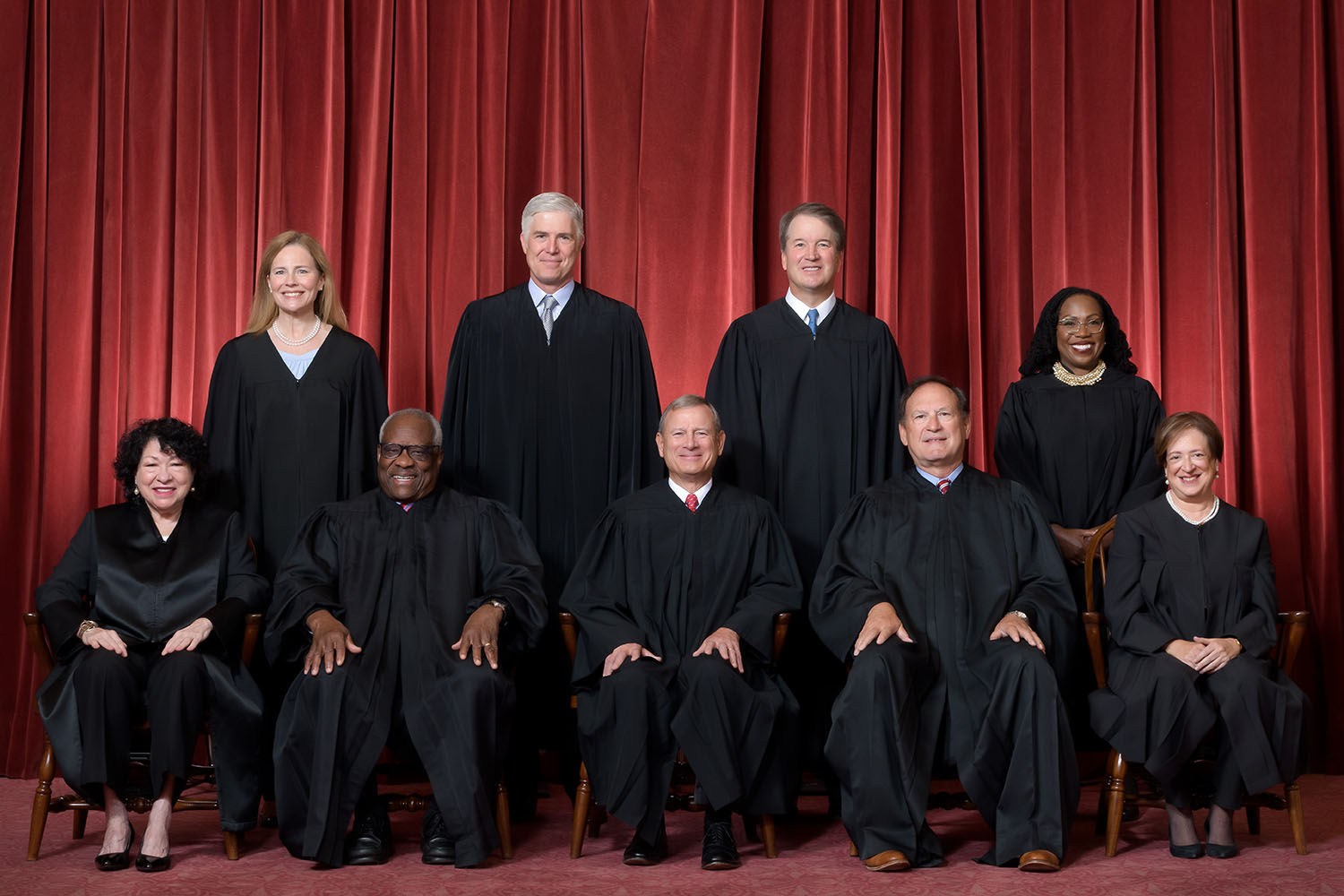
Trust in the Supreme Court has taken a nosedive since it became dominated by the conservative majority. Photographer: Fred Schilling, Collection of the Supreme Court of the United States
Arguably, in the last Supreme Court term, Roberts, Kavanaugh and Barrett began the process of differentiating themselves from the archconservative troika of Alito, Thomas and Gorsuch. If that trend continues — either through the evolution of sitting justices or the appointment of new ones — the court will look less like it is merely the product of hardball politics.
We are a long way from reaching that point, to be sure. But it is surely noteworthy that two members of this conservative-centrist faction were Trump nominees. That creates the possibility that the generational center of gravity on the court could shift subtly toward the center instead of the extreme right, where Thomas, 76, and Alito, 74, are the two oldest justices on the court.
Finally, the court could (and should) end its unremitting emphasis on arcane historical sources ranging from the Middle Ages to the nineteenth century as the basis for deciding real-world, real-time cases. Even most conservatives don’t really believe the meaning of the Constitution should depend on historical information unavailable to anyone without a history Ph.D., much less to the founders themselves. Roberts knows this, which is why he said in the Rahimi case that the law should not be “preserved in amber.” Barrett is a committed originalist, but she too dislikes the other conservatives’ posing as experts on Anglo-American legal history. In a trademark case this term, she neatly eviscerated Thomas’s dubious history, then said she preferred a simple common-sense test based on what was reasonable.
We need more common-sense decisions from the court, not fewer — despite the possibility of error or idiosyncrasy that’s inherent in judicial judgment. The justices are humans, not automatons. It is unrealistic to expect them (or their spouses) to not have personal political opinions, to never make mistakes or to eschew all personal ties that might create conflicts of interest.
What we should expect, however, is that they will recuse themselves when a conflict arises or is suspected, that they will respect precedent set by previous justices and that they will rule according to both the facts before them and a set of reasonably coherent judicial philosophies. No person’s views are completely immutable, nor should they be. But we ought to expect a greater degree of consistency — both with the past and with their own stated principles — from the most powerful members of the US judiciary.
In short, to see an improvement in the court’s legitimacy, we need a judicial majority dedicated to precedent, gradualism, freedom and reason — the values that made the court legitimate in the first place.