Republic of Distrust
How Shame, Blame and the Internet Eroded Trust in Science
The world turned to scientists, doctors and one another for answers during the Covid pandemic. No one handled it perfectly.
This column is a part of Republic of Distrust, a series about the loss of trust in American institutions and what can be done to restore it.
Has America lost its faith in science?
It’s a surprisingly complicated question. On one hand, most Americans accept climate science, but a stubborn fraction of the public does not, despite the growing threat of global warming. Most parents vaccinate their kids, yet diseases like measles have reemerged as childhood vaccine exemptions reach an all-time high. Then there’s this sad truth: Although many people lined up to get their Covid shots, more than 300,000 people lost their lives because they skipped or delayed getting the vaccine.
A 2023 Pew poll found that although Americans’ trust in scientists has dipped, we still feel more confident about them than we do most other professional figures — including police officers, public school principals and business or religious leaders. Medical scientists, specifically, are trusted even more than the military. Our foundational respect for science as a practice can be seen even in movements that seem to oppose it: Creationists prefer their theories to be called “intelligent design” and “creation science”; vaccine and climate change skeptics go to great lengths to explain how their views are backed by facts.
Scientists: Less Trusted Than Before, More Trusted Than Most
Source: Pew Research
Note: Survey responses on medical scientists are not available in December 2018. January 2019 responses are used instead.
How do we make sense of these seemingly contradictory impulses? A study led by political scientist Jon Miller of the University of Michigan offers a compelling possibility: He and his research partners found that from 2016 to 2020, trust in science overall remained relatively steady. But look deeper into the data and you’ll see a shift — people grew increasingly skeptical or increasingly trusting of scientific expertise, with the middle ground hollowed out. That trend held true when the researchers sliced the data by partisanship and scientific literacy. (Democrats, Republicans and those with either low or high levels of scientific knowledge all became either more or less trusting.)
Not surprisingly, Miller cites the pandemic as a driving factor in this schism. The arrival of Covid-19 meant many Americans engaged with science in a way they hadn’t before. Fatality rates and reproduction numbers became household conversation and stoked arguments on social media. For many people, that attention increased their trust in science and scientists. But it also put scientists — particularly the public health community — under a very hot spotlight.
As much as the pandemic was a massive challenge for scientists, it also offered a unique opportunity. They had the world’s attention. It was a moment when the slow decay of trust in the profession could be turned around, for countless lab hours that go unseen to be understood and appreciated by a public desperate for help and expertise.
You see that hunger in the Pew poll, where the share of Americans who say they had a “great deal of trust” in scientists rose from 35% in January 2019 to 38% in April 2020. But the upward trajectory didn’t last: Trust was falling again by December 2021 and bottomed out at 23% in October of last year.
So, what went wrong?
Trust in Doctors and Scientists Has Continued to Fall Since
the Pandemic
Source: Pew Research
Despite the relatively high level of trust that science has enjoyed for the past several decades, Americans have often had cause to look askance at the field. In the middle of the 20th century, for instance, scientists were at the center of the debate over whether then-common substances like lead and nicotine were harmful — and while some worked tirelessly to expose their dangers, others (backed by industry money) didn’t hesitate to sow doubt and discredit their efforts, resulting in needless deaths. (In Merchants of Doubt, historian Naomi Oreskes documents the way these techniques have carried over to current denials that carbon emissions are causing global warming.)
The pandemic, though, was different, both in the speed at which the crisis unfolded and in the sacrifices people were asked to make in the name of public health. It was also the first acute global health crisis we’ve experienced in the social media age. We saw 21st-century science in action as never before as researchers rapidly identified the new virus, sequenced its genome and developed a vaccine in record time. But there were also missteps. And as so often happens, those mistakes are still rattling around the public psyche.
Scientists and their public health compatriots at the Centers for Disease Control and Prevention (CDC) faced an incredibly difficult task, particularly in the pandemic’s early days: explain their constantly evolving knowledge of the virus and find ways to keep individuals and communities safe. In doing so, they too often chose a false sense of certainty over the transparency that’s at the core of the scientific method. Should we wear masks? First no — then yes. Americans were told the science argued for certain restrictions and behaviors (Remember the six-foot rule?), vaccine and booster mandates and even specific theories on origins of the virus. Many dutifully followed along, only to learn months or years later that some of these edicts were at best uncertain, at worst outright wrong.
Covid Spurred Stronger Opinions About Science
Source: “Citizen attitudes toward science and technology, 1957-2020” by Jon D. Miller et al, Science and Public Policy, 2024
Yet there was little tolerance for questions or dissent. Andrew Lakoff, an anthropologist who studies science and society at USC, says that demand for blind trust backfired. “It became a kind of blackmail where you couldn’t raise questions about the origins of Covid-19 without somebody saying, you are undermining public trust in science,” he says. “I think that it got very misused, this threat around public distrust, to protect scientists from scrutiny.”
What was widely referred to as “the science” became the default explanation for setting pandemic-related policy. But policy making is a much fuzzier business than science: It’s a subjective practice that requires weighing competing facts and prioritizing some factors over others. Scientists can study the odds that a disease will be transmitted in the classroom, but policy makers decide whether those odds are high enough to close schools. Clinical trials can predict the chances of a severe side effect from a vaccine or drug, but regulators have to determine how many bad reactions are too many.
Attempts to claim that policy simply “followed the science” had the effect of confusing — and politicizing — the two. Those who opposed pandemic restrictions or requirements (often conservatives) were dismissed as anti-science. Risk communication expert Peter Sandman says that some pandemic policies that were presented as neutral and science-based actually relied heavily on subjective goals, such as the idea that we should do everything possible to reduce, at all cost, Covid transmission. People who wanted to accept some risk in turn for other benefits — i.e., keep businesses open for economic reasons, at the risk of some people getting sick — were accused of ignoring science.
“I object most fervently to the fact that experts … insist that their policy preferences are grounded in nothing but objective, scientific truth, and that anybody with different policy preferences is either a bad scientist or a liar,” Sandman wrote in an email.
Not surprisingly, being ignored and belittled did nothing to bolster skeptics’ trust in science — and helped feed a dangerous cycle. The internet has long allowed anyone with a wifi signal to “do their own research,” and the rise of social media and its powerful algorithms have ensured no one has to look far to find information that aligns with their worldview — in fact, it might find them. That system was ready and waiting when people disillusioned with the government’s handling of the pandemic went looking for someone or something that would take their concerns seriously.
For some, going online meant becoming immersed in misinformation and conspiracy bait. One study published in Nature in 2023 found that searchers who took to the internet in an attempt to evaluate the accuracy of false news articles were more likely to emerge from their Google sessions believing them; the algorithms tended to lead people from one bad piece of information to other dubious sources rather than presenting them with rational counter-arguments.
The internet has also handed a megaphone to figures such as Robert F. Kennedy Jr. and Robert Malone, a fringe medical researcher who has appeared on Joe Rogan’s podcast. They often use the language of science to woo their followers. RFK Jr., in particular, advocates for a kind of blanket paranoia about the scientific establishment. It’s much easier to grab onto that idea than to do the work of understanding the science and sorting the good from the bad.
It doesn’t help matters that the world, including the scientific one, becomes more technical and complicated every day. Miller, who led the survey showing attitudes toward science were growing more polarized, says that he’s concerned with Americans’ lack of scientific knowledge. About half of Americans don’t really understand the difference between atoms and molecules and have no real understanding of what a virus is, he told me. When the pandemic broke out, he says, many Americans didn’t know what the CDC was or whether it was a private or governmental organization.
While it’s easy to bash conspiracy peddlers and the social media platforms that made them, some of the factors eroding trust in science have come from within. David Sanders, a Purdue University biologist tracking scientific misconduct, points to the current epidemic of scientific fraud, which has resulted in thousands of retracted papers. Important scientific advancements get mixed up and watered down with the bad and/or dishonest science being published in sub-par journals. And when that bad science turns up a surprising result (as it is prone to), the mainstream media may take notice — and pass it along to the general public.
This rampant misinformation and paranoia have cost lives. Individual scientists can do a great service by becoming trusted sources of information. The steps for doing so aren’t always easy, but the payoff of building the public’s faith is worth the effort.
Treat everyone with respect — even the doubters. It’s critical to recognize that skepticism and questioning from those on either side of the political spectrum don’t make people ignorant or “anti-science.” Yes, some are acting in bad faith, but it’s well worth engaging — changing even a handful of minds could save lives. When Neil deGrasse Tyson addressed Black people who had been reluctant to get vaccinated against Covid in 2021, he was blunt that they were making the wrong choice but never implied there was something wrong with them. Scorn may gain social media traction, but it does not build trust.
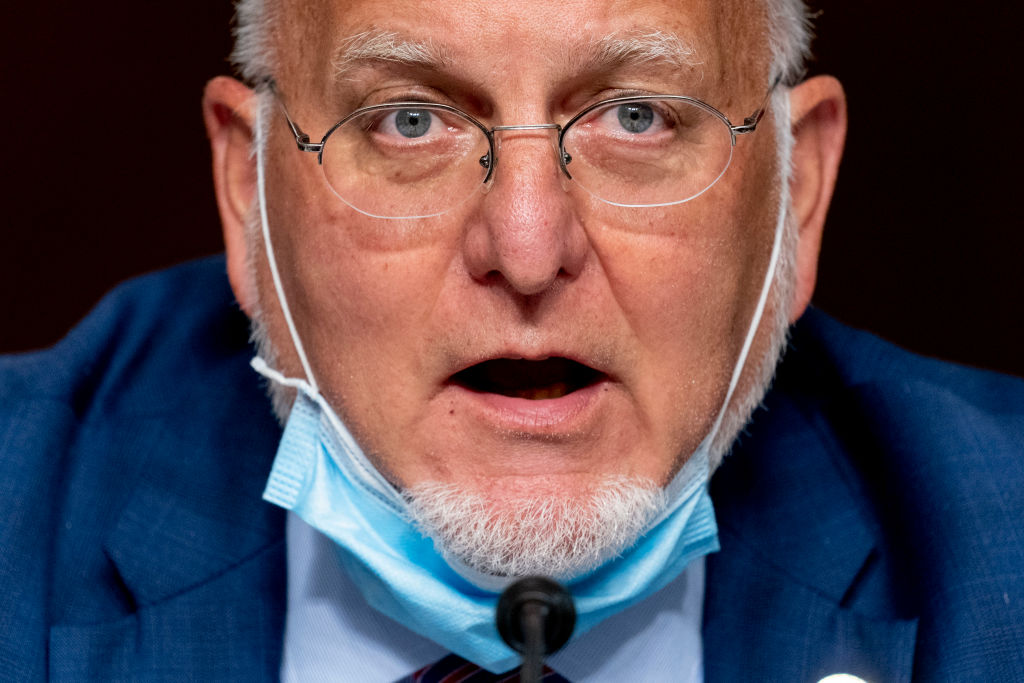
Do as I say, not as I do: Then-CDC Director Dr. Robert Redfield speaks about Covid response efforts at a Senate hearing on September 16, 2020. Photographer: Andrew Harnik-Pool/Getty Images
Practice what you preach — and don’t preach what you can’t practice. During the pandemic, we saw experts and policy makers demolish their reputations by recommending mask mandates but going maskless themselves. It became so common that the conservative Heritage Foundation began keeping a list of offenders. In 2020, the CDC director at the time, Robert Redfield, testified before Congress that masks were “by far the most powerful tool” we had to fight Covid — but did so barefaced. And we keep learning of even more shocking examples of hypocrisy. Recently, Jay Varma, a senior public health advisor in New York City, admitted he’d secretly attended sex and dance parties during the pandemic, including in the summer of 2020 — a time he’d been preaching that New Yorkers must mask up, distance, and avoid indoor gatherings of people from different households. When experts don’t follow their own rules, it hurts credibility.
Engage with the public through whatever medium feels right. Some scientists have become social media stars, but TikTok or Twitter aren’t for everyone. Michael Osterholm of the Center for Infectious Disease Research and Policy at the University of Minnesota told me he’s never warmed to social media — so when Covid hit, he started a podcast instead. Epidemiologist Katelyn Jetelina started a newsletter (Your Local Epidemiologist).
Other scientists, such as Johns Hopkins infectious disease doctor Amesh Adalja, accepted media appearances and interviews for a spectrum of outlets, including Fox News. He told me back in 2020 that solid scientific information was important for everyone, including — and maybe especially — for Fox News viewers.
Avoid technical lingo and communicate as clearly as possible. As Abdullah Shihipar, a public health researcher at the Brown University School of Public Health, has written, scientific research is often buried in impenetrable jargon that’s impossible for regular people to understand; something as simple as publishing plain language summaries can make new scientific discoveries accessible for all.
Admit what you don’t know. There are times when we’ll need new policies despite incomplete evidence, but transparency will pay off in the long run. Throughout the pandemic, Osterholm consistently explained all that he didn’t know about, say, how long vaccine protection would last. Paul Offit, an infectious disease expert with the Children’s Hospital of Philadelphia, has always been careful when discussing the benefits of booster shots to emphasize that the clearest benefit is older and immunocompromised people. I’ve talked with several scientists about the competing theories of Covid’s origin — lab leak or wet market mutation? — and the most persuasive are those like Laura Kahn and David Sanders, who admit that we just don’t have enough evidence to close the case.
Recognize your mistakes. Polarization is the biggest barrier to good scientific dialogue, and our political divide has opened into a chasm in recent years. To bridge it, Osterholm has suggested an investigation into how the public health community responded to the pandemic, similar to the bipartisan 9/11 Commission. If the government isn’t up to that challenge, perhaps there could be a collaboration between a more left-leaning institution, such as the Harvard School of Public Health, and a conservative group, say, the Heritage Foundation, or a more neutral one, such as the Brookings Institution.
Finally, work to increase scientific literacy. To build trust long term, we need a foundation that will help us all speak the same language. In a recent white paper, the Carnegie Foundation laid out some persuasive ways that teacher training and materials could be improved in science. It’s a strength of science that people don’t have to trust it — they should ask questions and expect honest answers. While trust in institutions might be crumbling, our love and respect for science give us common ground to rebuild.