UK’s Hope for Economic Rebound Fades With Slide in Job Vacancies
Reed Recruitment data shows slow start for 2024, with job hotspots in the south cooling
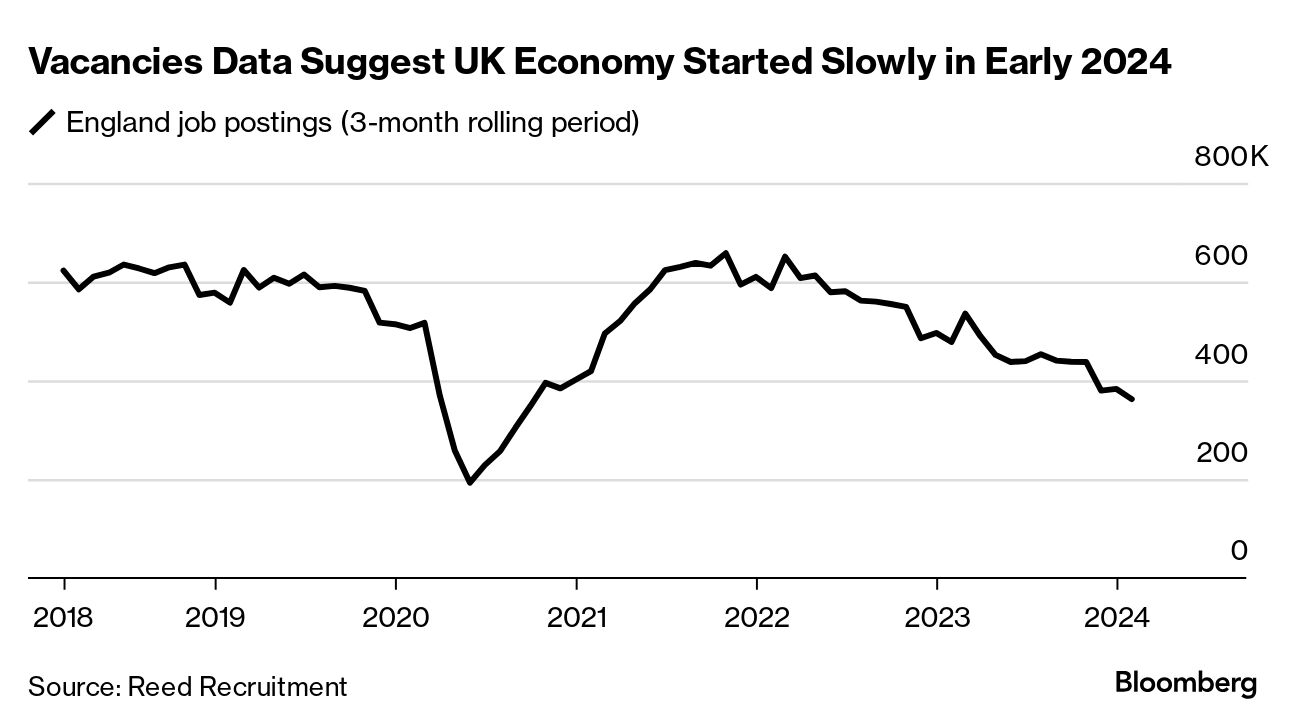
Job vacancies in England have fallen to their lowest in more than three years, reducing the hope that the UK economy will bounce back strongly from the recession that hit last year.
Data provided by Reed Recruitment and analysed by Bloomberg show listings for open positions fell by almost a quarter in the three months to February compared to a year earlier. The number of applications rose by a fifth year-on-year for February, adding to evidence that what was once a red-hot labor market has cooled significantly.
The figures will be a relief to the Bank of England, which wants to curtail inflationary forces and is watching alternative jobs data more closely due to a plunge in responses to the surveys done by the government’s Office for National Statistics. It also indicates a difficult backdrop for Prime Minister Rishi Sunak’s government to wage a campaign for reelection.
“Our latest data suggests a prolonged chill in the labor market, with 21 consecutive months of falling job postings and no strong indication of a bounce back happening this year,” said James Reed, chairman of the company that bears his name. “Reed’s accurate prediction stands in contrast with the Bank of England‘s misjudgment that a recession wasn’t likely.”
Reed’s figures have often been a reliable predictor of turning points in the economy and flashed recession warning signals for the UK last summer — several months before official figures confirmed a downturn. It also picked up resilience in the economy in 2022 when others were predicting recession.
Vacancies Data Suggest UK Economy Started Slowly in Early 2024
Official data due out this week are likely to show that regular pay growth remained stubbornly high at 6.2% in the three months through January and that the economy picked up in the first month of the year. Analysts surveyed as of Friday expect gross domestic product rose 0.2% in January, more than reversing a 0.1% drop in December.
The BOE is looking at labor and inflation data to gauge when it can safely cut interest rates from their highest level in 16 years.
Britain entered a shallow technical recession in the second half of last year, dealing a major blow to Sunak’s economic record ahead of a general election that’s widely expected in the autumn. While some indicators have pointed to a pick-up in momentum for the economy in January and February, Reed’s data indicates that any gain was tepid.
Jobs listed with Reed are down 45% for the three months through February from their peak at 362,000, the lowest level since late 2020 in the aftermath of the first Covid lockdown. There’s been a broad-based slump spanning almost all of the sectors, with towns and cities in the usually prosperous south of England suffering the biggest declines.
At the same time, the number of applications on Reed’s site was up 20% from a year ago in February, indicating that more workers are fighting over fewer available roles.
That points to a loosening labor market and less upward pressure on wages, which jumped in the past two years when employers struggled to find staff and workers demanded more pay to compensate for high inflation. Official, less up-to-date vacancies figures for the whole of the UK have shown a similar long-run pattern but recently suggested that the fall in vacancies was starting to plateau.
Fewer postings now suggest companies are wary over hiring in what economists and the BOE anticipate will be another year of stagnation for the UK economy.
While the pressure from interest rates and the cost-of-living crisis is expected to lift, analysts expect only a marginal pick-up from the tepid 0.1% growth in 2023.
Signs of weakness may embolden the Bank of England to press ahead with reducing interest rates later this year. A cooling labor market would help keep down inflation, which at 4% remains double the central bank’s target. Policy makers led by Governor Andrew Bailey have said they need to see lower wage growth before they can cut borrowing costs.
Reed’s figures were supported by a new survey by the Recruitment and Employment Confederation and KPMG on Monday showing a weakening labor market, including the weakest rise in starting salaries for almost three years in February. Its gauge of vacancies also showed permanent vacancies falling at the fastest rate in just over three years as demand for staff dwindles.
“Executives tell me they are ready to invest and grow — including taking on new staff — yet the reality is they’re being held back by the prospect of weak demand,” said Jon Holt, chief executive of KPMG in the UK.
A Plunge in IT Openings Leads a Slump in UK Job Vacancies
Annual decline for the top 10 industries with the most vacancies
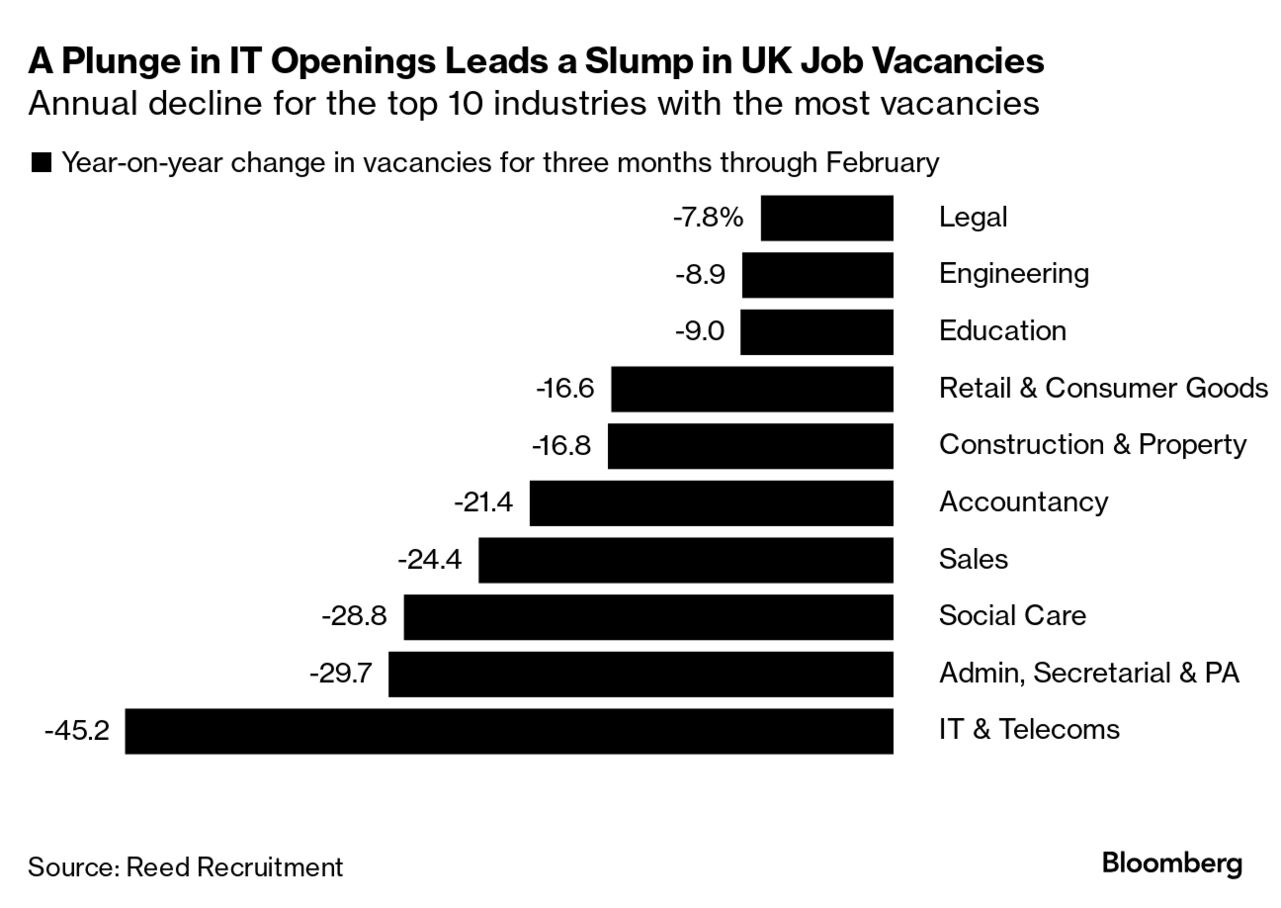
Reed’s data showed year-on-year declines in vacancies in every private sector industry except for estate agents. There was a particular weakness in IT & telecoms, customer service and security roles. Only two sectors saw more vacancies in the three months to February compared to the previous three months. Openings in retail, science, security and transport and logistics were among the biggest declines on that basis.
“The technology space has contracted — a 43% year-on-year drop in postings in our data — suggesting that the rise of artificial intelligence has so far contributed to redundancies rather than new hirings,” said Reed.
Many employment hot spots in the south of England have suffered the biggest cooling in their local job markets in the last 12 months. Of the 10 areas to see the sharpest falls in vacancies per 10,000 workers, seven were in southern England.
Job Hotspots in the South of England Suffer Biggest Cooling
Year-over-year change in postings per 10K workers, December 2023-February 2024 period👆
Note: Includes only towns and cities in England where the relevant Built-Up Area mid-2020 population was at least 100,000 people.
Sources: Reed Recruitment; Office for National Statistics
Cambridge, Reading and Milton Keynes were among the cities with a high level of jobs per 10,000 workers. They were also among the top 10 worst performing areas year-on-year for new vacancies. Blackburn in the north west of England saw a 37% drop in jobs by that measure, the most in England when looking at areas with at least 100,000 people.
Manchester had the most vacancies, registering 208 per 10,000 people. That’s much higher than London’s 64 and Birmingham’s 80. The capital suffered a 27% fall in vacancies from a year ago.
“Some regions have been hit harder than others, particularly London,” said Reed. “Recent labor cuts from big accounting firms situated in the capital have been well documented as employers navigate challenging economic headwinds — a trend playing out more widely than businesses will have hoped.”
More On Bloomberg