England's Falling Job Advertisements Ring a Recession Alarm
James Reed was optimistic the UK would avoid a severe slump — until the latest data emerged.
A sharp drop in the number of advertised job openings in England is dimming the prospects for the economy, raising the risk that the UK will slip into recession this year.
Jobs listed with Reed Recruitment are down 24.4% in the three months to June from a year earlier and are 26.6% lower than the same time in 2019, before the pandemic. That’s shaken the confidence of the company’s Chairman James Reed in the prospects for the UK.
“The alarm bell is sounding a lot louder now than it was, as the labor market is beginning to loosen,” Reed said. “This continued contraction in job postings, which have been falling since this time last year, therefore suggests that a recession may well be imminent.”
Reed’s gloomy outlook represents a turnabout from last year, when the sky-high number of vacancies led him to reject forecasts for a lengthy recession from the Bank of England and others. He ended up being right.
Vacancies Are Down Across England
Number of job postings, 3-month trailing period
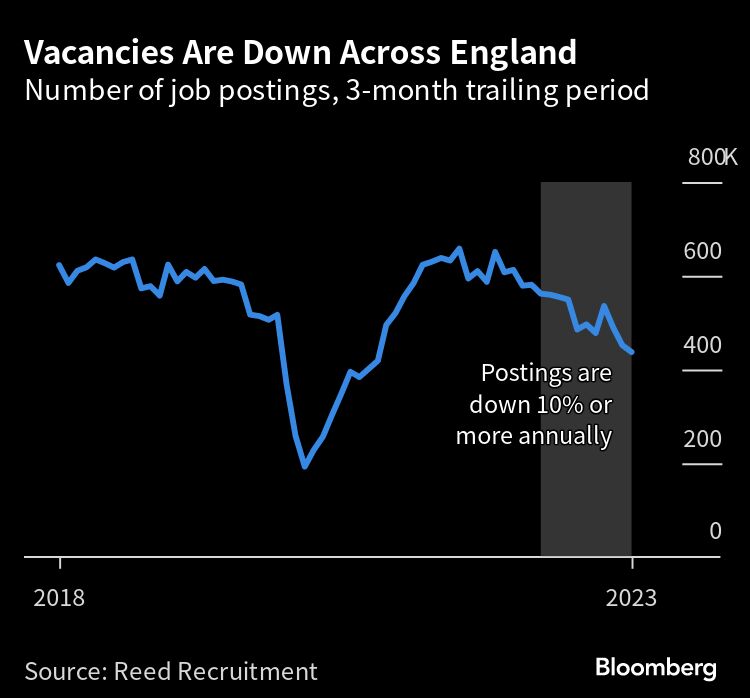
A Bloomberg analysis of Reed Recruitment’s data highlights a slow loosening in the labor market that may indicate more difficult times ahead for those looking for jobs. It also points to an easing of the inflationary pressures that are alarming the Bank of England and underpinning expectations that interest rates will rise through this summer to the highest in 25 years.
The Reed figures imply that the pain will be sharpest in a few areas of England. Job opportunities are limited and falling year-on-year in neglected northern and coastal towns such as Gateshead, Southend-on-Sea and Sunderland.
This could both exacerbate inequalities across the country and provide a setback for the levelling-up agenda of Prime Minister Rishi Sunak’s government. It would undercut one of the key policies that the Conservative Party hoped would spread prosperity beyond London ahead of a general election expected next year.
Vacancies and Recessions
A large decline in vacancies often coincides with economic weakness in data from the Office for National Statistics stretching back to 2001. But those figures are at least 1 1/2 months behind what Reed Recruitment reports, suggesting that Reed’s data may provide important clues about where the economy is headed.
The picture isn’t pretty. Vacancies on Reed’s platform, adjusted to account for seasonal fluctuations, fell by 16,127 between the first and second quarters of this year — a 10% plunge.
A decline of that scale, if mirrored in the official statistics, historically has been associated with a 0.6% contraction in GDP in the same quarter, said Dan Hanson at Bloomberg Economics. In this case, that would mean a sharp contraction in the quarter that ended on June 30.
Reed Postings Are a Possible GDP Predictor
Falling vacancies are somewhat correlated to economic downturns
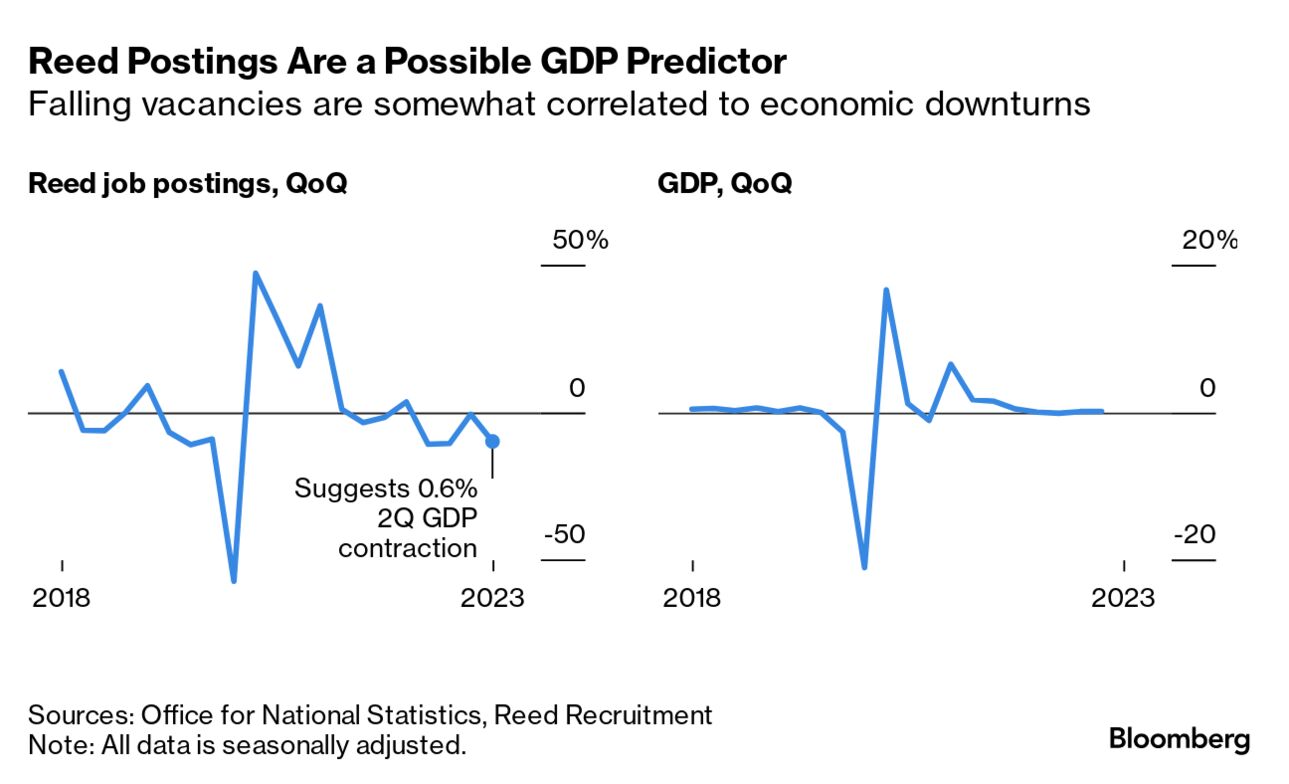
So far, a drop of that scale hasn’t materialized. GDP was unchanged in the three months through May. Data for June will be released next month, and it would take a 0.1% decline on the month to see output contract over the second quarter, according to the ONS.
There are some caveats to Hanson’s calculations. They’re modeled on the relationship that existed between GDP and vacancies from 2001 to 2019, before the pandemic hit. It’s unclear whether this relationship remains, given the chaos that Covid wreaked on the labor market.
There’s also little correlation between a fall in vacancies over one quarter, and the effect this will have on the next quarter’s economic output, making it difficult to predict a recession — or two consecutive quarters of contraction — with any certainty.
But even so, the dramatic fall in vacancies is enough to worry Reed who thinks the “tide has turned” on labor market tightness. “Reductions in vacancies are a visible leading indicator of a recession,” Reed said. “Ultimately, jobs are advertised before they are filled, so a shrinking number of vacancies would indicate a softening in the demand for labor.”
He’s not the only one who’s worried. Blackrock’s managing director Alex Brazier, the BOE’s former executive director of financial stability, said at a media round-table last month that he expected bringing inflation down to 2% would “in all likelihood” require a recession. In June, former US Treasury Secretary Larry Summers said that he would be “very surprised” if the UK got through the next two years without a recession.
Regional Woes
Some drop in job vacancies is to be expected after the frenzy of hiring activity when Covid lockdowns ended. But James Reed thinks his company’s data “suggests this is decelerating beyond a ‘cooling off’ period into an economic downturn.”
“After any spike in labor market activity, a slowdown in vacancies is inevitable,” he said. “However, this trend is occurring at a more significant rate than more normal market fluctuations.”
Year-on-year, some of the cities with the fewest job postings per 10,000 working people have also seen some of the biggest falls in opportunities, including the likes of Gateshead, Sunderland, Southend-on-Sea, Luton and Wolverhampton.
Where Vacancies Are Falling Fastest as Recession Looms
Job postings per 10K workers, 3-month trailing period👆
Note: Includes only towns and cities in England where the relevant Built-Up Area mid-2020 population was at least 100,000 people.
Sources: Reed Recruitment; Office for National Statistics
Pickings may be slim for workers trying to find a role in those regions. Reduced competition between employers could lead to slower wage growth, according to Reed.
“Power may now be shifting in favor of employers,” he said. “During the jobs boom, we witnessed a ‘seller’s market’ structure play out in the labor market.” But the huge drop in vacancies over the last year has been matched by a rise in applications of more than 30%, meaning businesses now have more say over the talent they choose.
Those trends are likely to worsen inequality and concentrate wealth around London and the Southeast. Talent is unlikely to flow to areas where jobs are scarce and less financially rewarding, leaving lucrative and high-growth industries such as technology and finance huddled around the capital.
“The UK is the most regionally imbalanced large and advanced economy” among the members of the Organisation of Economic Cooperation and Development, Marcus Johns, a research fellow at the Institute for Public Policy Research, told lawmakers on Parliament’s Treasury committee this month. This imbalance affects people’s quality of life — one of the reasons why the UK economy as a whole is stagnating, in the IPPR’s view.
But there’s reason for optimism. Some of the smallest year-on-year falls in postings were in traditionally neglected towns such as Lincoln, Huddersfield, Bradford and Liverpool. The town of Rochdale in Greater Manchester, and Blackburn a little farther north, are the only places where postings are still above where they were a year ago, according to Reed Recruitment.
Safety in Numbers
Employees in certain sectors may also be better-placed to weather any recession, according to Reed’s data.
While health, medicine, IT and telecoms did well after the pandemic, postings have now slumped. Opportunities in education and energy are still readily available. They’re two of just a handful of sectors where job postings are up on pre-pandemic 2019 levels, and where there has been a shift towards more secure full-time positions rather than part-time or contract work.
Most Sectors Have Fewer Vacancies Than Pre-Covid
Change in job postings and share of part-time and contract work compared to 2019, April-June period
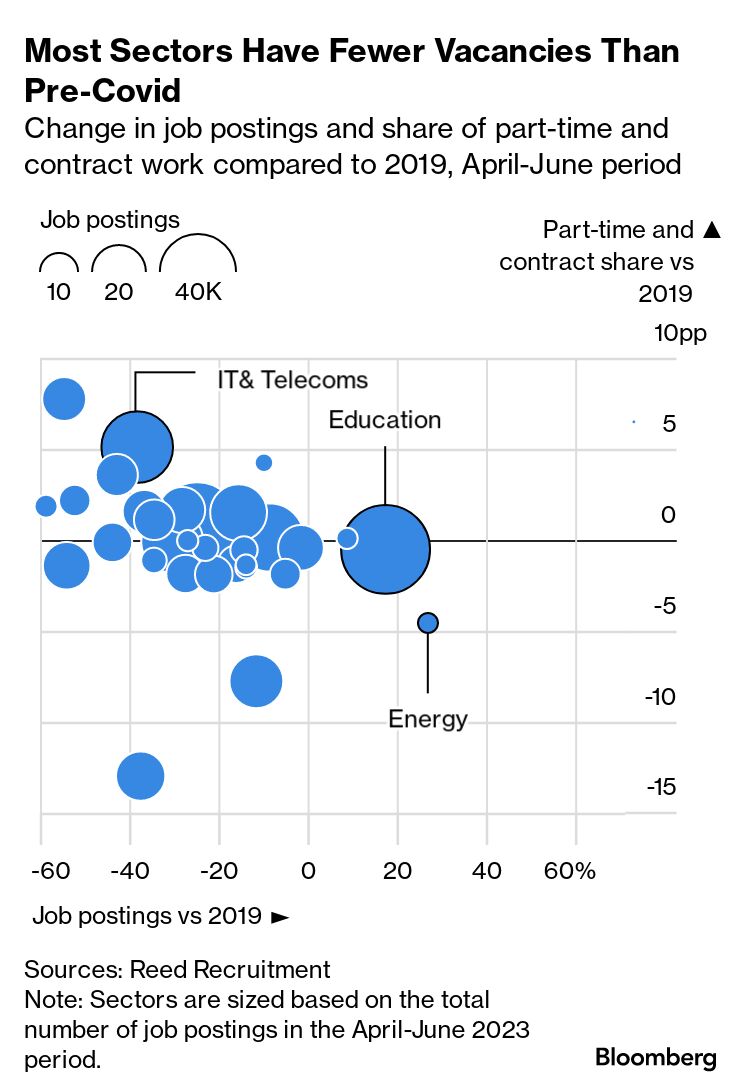
Workers in consumer-facing industries will be at the sharp end of any fall in spending, and the number of postings has already slumped. A slide in postings in the media, digital and creative sector will also raise similar worries.
“In the face of a possible recession, businesses may feel tempted to cut their workforce,” Reed said. “But they should think carefully before doing so. It will be harder to replace talent once the market stabilizes.”
More On Bloomberg