
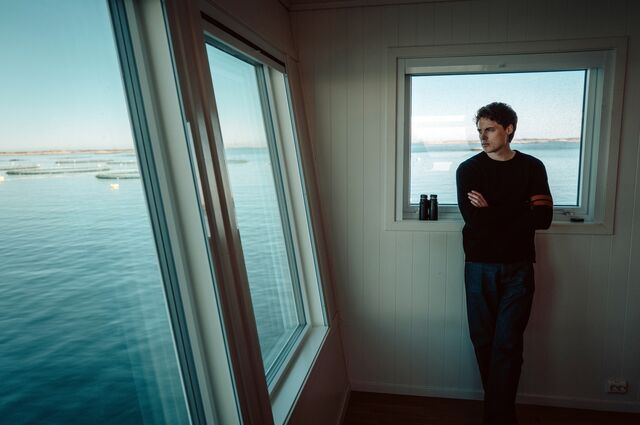
Norwegian Billionaire Bets Fortune on ‘World’s Best Fish Farm’
Gustav Witzoe decided to stay in Norway despite wealth tax increases that cost him around $100,000 a day, and is embracing technology to help grow the family business.
Gustav Witzoe has spent his life surrounded by fish.
The 33-year-old majority shareholder of SalMar ASA remembers visitors from Japan and China dropping by the family farm on Froya, an island off central Norway. They came eager to learn how his father grew the company from a single cold store and slaughter house into the world’s second-biggest salmon producer.
For about two years in his 20’s, he would wake up at dawn and board a small boat for the 25-minute ride to the firm’s coastal pens. There, he worked shifts — from 7 a.m. to 5 p.m., one week on, one week off — under a childhood friend, who pushed him “a little harder than the others.” Amid the movement of tides, he fed, counted and monitored the health of salmon, handled feed pellets and delivered fish for slaughter. He recalls ice-cold hands tying up supply vessels on dark winter mornings, when the sky barely brightened above the horizon.
In October 2022, Witzoe had a decision to make: Stay on the island or move to Switzerland to escape higher wealth taxes. He nearly left; a house in Lugano was rented, a plane ready. But a conversation with friends over beers changed his mind. “Everyone told me it was the right thing to do for the business, but it wasn’t the right thing to do for me,” Witzoe said in an exclusive interview on Froya. “I was basically on the tarmac and turned around.”
He added, “Windy, remote, dark and cold in winter — it’s not for everyone, but there’s a special strength in this community and I love it.”
Witzoe grew up as an only child feeling safe and grounded. “Grandma lived close, I could just run across the lawn” to see her. He preferred football to studying — he didn’t go to university — and during a rebellious phase, he worked as a model, spending time in New York City and enjoying “the anonymity of Manhattan’s bars.” At New York Fashion week in 2019, he met his American partner, Lexi Fernandez, with whom he has a daughter.
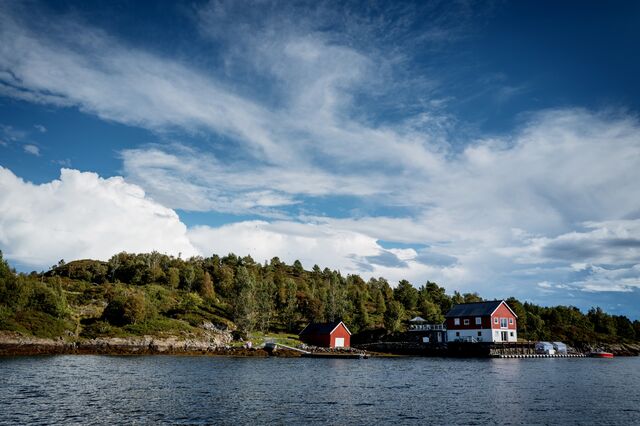
Froya is an island of about 5,700 people, home to three other billionaires whose fortunes were also built on aquaculture. It’s known locally as “billionaire island,” and inspired a 2024 Netflix drama series about rivalry among its salmon farmers. Yet despite all that wealth, the only sign of affluence is a new sports stadium. The main town and nearby areas remain modest, with low houses and winding streets. Luxury properties along the rugged coastline are hidden from view.
A “can-do attitude” among residents helps explain its transformation over five decades from a poor and isolated fishing outpost into a global hub for a highly profitable salmon industry, according to Mayor Kristin Stromskag. Two other listed firms — fish farmer Masoval AS and packaging manufacturer Bewi ASA — operate on the island, alongside a range of supply chain firms. And two major privately held agribusinesses — Cargill Inc. and Skretting AS — are active on its shores.
Most companies are locally owned, and cooperation with Froya’s politicians is smooth, the mayor said.

Witzoe pays a high price for staying: about 1 million kroner ($100,000) a day in levies.
When he was 14 years old his father transferred SalMar to him for tax reasons, and by 18 he was among the country’s top taxpayers, according to tax lists, which are public in Norway. In January, he became CEO of Kvarv AS, the parent company of the family’s investment structure that controls SalMar, and he is now closely involved in the operational side of the business. His fortune stands at around $5 billion on the Bloomberg Billionaires Index.
He doesn’t regret his decision, but says the money he puts aside for levies would be better spent on developing the company, part of Norway’s second-largest export industry after oil and gas. “I believe in paying taxes and that people with a lot should contribute more,” Witzoe said, “but this kind of tax is hurting the business.”
Three other billionaires also stayed on Froya after the government raised rates on high net worth individuals and adjusted dividend taxation. A fourth, a member of the Masoval family, was among around 300 super wealthy individuals who — according to estimates based on migration and tax data — had moved abroad by 2024.
Gustav Witzoe Senior focused on expanding the business he founded in 1991 along the Norwegian coast up to the Russian border. Then establishing a presence in key North Atlantic regions — in Iceland through Arnarlax ehf. and in Scotland via a stake in Scottish Sea Farms Ltd. And setting up an offshore farming site, Ocean Farm 1. Scaling rapidly through the late 2010’s, SalMar has since been widely regarded as Bergen-based Mowi ASA’s main competitor. Revenue last year reached around 27.4 billion kroner.
To become “the best salmon farming company in the world,” defined by the highest margins and the lowest salmon mortality rate, his son is embracing new technology. “I want us to be pioneers,” he said. “We want to take care of both people and the ocean, if you don't evolve as a company, you die.”
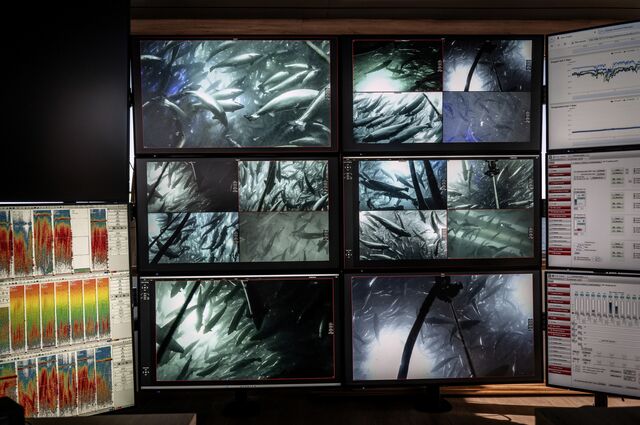
Through his investment company, Ichthus Venture Capital, Witzoe backs TidalX, an AI spin-off of Alphabet Inc.’s Google, and is testing parts of its still-in-development “delousing system,” which uses underwater cameras and monitoring to identify individual fish, track their welfare and growth while optimizing feeding and treatment for lice.
In 2024, SalMar deployed an automated underwater laser system by Stingray Marine Solutions AS, designed to detect and kill lice while minimizing damage to fish. On screens inside Ocean Farm 1’s control room, flashes of light appear from “pistols” zapping the flat, jelly-like crustaceans as salmon move calmly through the deep water.
The parasites are the industry’s biggest challenge. Attaching themselves to salmon skin, they feed on mucus and blood, and can spread quickly through pens, causing stress and leading to higher fish deaths during severe outbreaks. Traditional remedies often involve harsh chemicals, or scrubbing with a mechanical brush.
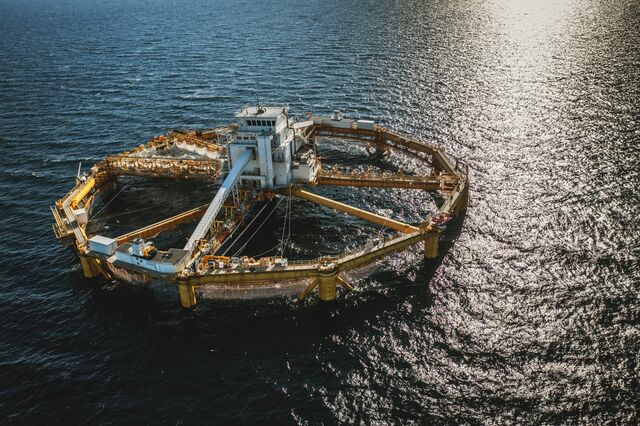
Ocean Farm 1 is located 24 kilometers (15 miles) off Froya’s northern coast, and can produce some 7,000 tonnes of salmon each generation, or every 1.5 years.
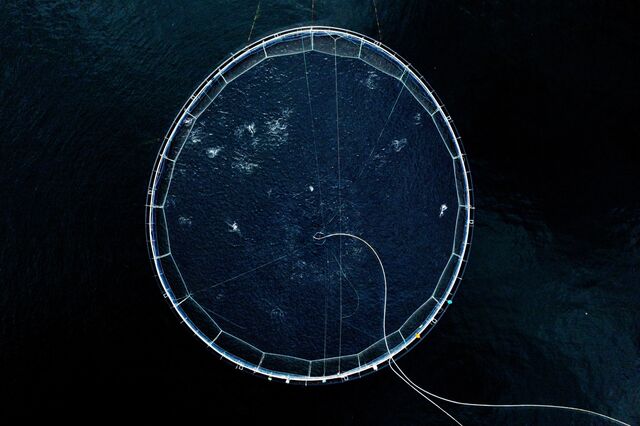
The round, yellow steel construction resembles a giant rig and is secured to the ocean bed by eight massive anchors. About 1 million salmon were swimming around its internal cage on a recent Monday, their backs a dark blue, having adapted to the color of the sky, said farm operator Brage Strand Hansen.
This is the most expensive way to farm salmon in the ocean, but one of the healthiest for the fish: mortality offshore is much lower than average rates in pens closer to land. While the Norwegian industry average is around 15%, Ocean Farm 1 hopes to reach just below 3% this year. “The further out you go, the better the conditions for the fish,” Witzoe said on a walkway that swayed as waves crashed through the mesh nets below. “Stronger currents, more oxygen, more stable environments.”
He would like more of these farms, but his ability to expand out in the ocean is limited by costs and strict regulation.
Wuchang Shipbuilding Industry Group built Ocean Farm 1 in China, for about $100 million, according to SalMar, and towed it to Froya where it began operating in 2017. That was the company’s biggest investment to date and required around five major hard-to-obtain licenses under Norway’s regulatory system, designed to control environmental impact, fish health and competition for marine space. Nine years later, it remains the country’s sole facility of its kind.
Frustrated, Witzoe said, “There is so much potential here.”

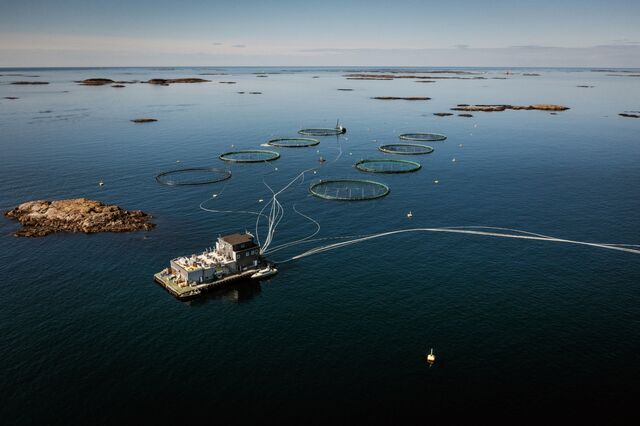
Closer inshore, at Rataren — SalMar’s largest fish farm — production shifts to high volumes. The site consists of 16 pens and delivers around 15,000 tonnes of salmon per generation. According to the company, that’s a world record.
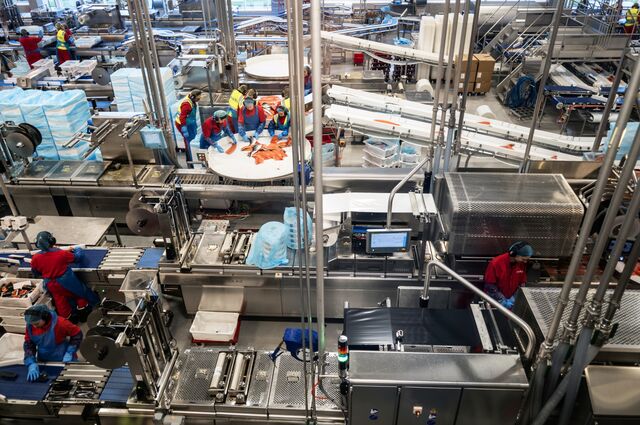
Its fish, along with those from Ocean Farm 1, are harvested when they weigh about 5.5 kilograms (12 pounds) each, and shipped to countries around the world, including the US, Japan, Brazil, Poland and China. Asians like whole fish, gutted with the head on. European consumers tend to buy individually packed portions. Americans prefer filets.
Runar Sivertsen, head of strategy at SalMar, describes tariffs as “a challenge,” but said that demand for sustainably produced Norwegian salmon in the US remains high. He believes Asia will be among the strongest providers of growth over the next five years, particularly China, as well as new and emerging markets like India.
The company has invested “several billions” of kroner in new technology, as well as testing closed and semi-closed pens, Sivertsen added. The industry is working “purposefully to minimize its footprint” in collaboration with local and national authorities, as well as academia, he said.
Activists have long been critical of the industry, which has grown rapidly since the early 2000s as large-scale aquaculture boosted supply and global demand for protein increased. They question the impact of open-net farming on fish health and marine ecosystems — a recent report highlighted rising nutrient pollution in fjords — and whether it can ever truly be sustainable.
Witzoe said he’s certain his salmon are happy, though he accepts they would rather live like wild salmon, which spend most of their lives in the ocean, swimming into fjords and up rivers to breed. “That’s what matters the most to us,“ he said, “to everyone who works here, that the salmon are well.”
As he watched salmon leap and circle under a rotor scattering feed pellets, their backs glistening in the sunlight, Witzoe spoke of the camaraderie, physical labor and rhythm of his long days on Rataren.
Now, he sits behind a desk in a leadership role and his nights are more restless. “It was a great job with great people. I slept so well, both from my body being tired and not having to think about anything,” he explained. “When the shift was over, I could just turn my head off and sleep.”
Reflecting on his very first job at SalMar, helping pack fish aged 12, Witzoe said, “I’ve been close to the business all my life. Now, I want to go all in.”