
These are the startup founders, Big Tech managers, low-key investors—and even a bureaucrat— who could play a bigger role than you realize in shaping tech’s future.
These aren’t the biggest names in tech, but they’re doing big things. They’re running Amazon.com Inc.’s logistics operations (Udit Madan) and building consumer-product conglomerates for the e-commerce age (Tushar Ahluwalia). They’re making artificial intelligence startups that do things that didn’t seem possible in the recent past (Demi Guo) and finding and funding the entrepreneurs and startups that you’ll be hearing from in the future (Dave Fontenot, Emily Liu and Luciana Lixandru). It’s impossible to predict what the next big thing will be, but chances are that people on this list will be involved.

Tushar Ahluwalia
Co-founder and CEO, Razor Group GmbH
Ahluwalia has emerged as a key player among Amazon.com aggregators, a mini-industry of companies that aim to create consumer-product conglomerates by rolling up e-commerce brands. The online shopping spree of the Covid-19 era made this strategy seem intriguing enough that about 100 companies were able to draw $16 billion in investment. But the boom fizzled with rising interest rates and a slowdown in online sales growth. The largest aggregator, Thrasio Holdings Inc., filed for Chapter 11 bankruptcy protection in February.
Ahluwalia is undeterred. He scored a major win in March when his Razor Group bought Boston-based Perch in an all-stock deal. It was the company’s fourth acquisition, and its largest to date. Ahluwalia is now searching for other targets and trying to redefine the industry. He says the future isn’t in replicating the enduring brands of yesterday but in creating nimble companies that respond to consumer demand with new products faster than competitors can. He also aims to reduce Razor’s reliance on Amazon to 60% of sales, from 80%, by expanding internationally, where Amazon isn’t as dominant.
Backed by the private equity arm of Bernard Arnault, the world’s richest man, Razor sells 40,000 products, including pet supplies, toys, baby products and sporting goods. Ahluwalia’s biggest asset for the moment could be his reputation as a dealmaker at a time aggregators and their investors are looking to recoup what they can. “We try to approach the founders along with the biggest stakeholder that we ideally know already and discuss high-level terms,” Ahluwalia says. “We then have to convince residual stakeholders that this is the best path forward.” —Spencer Soper

Brendan Carr
Commissioner, Federal Communications Commission
Carr is the senior Republican on the Democrat-led Federal Communications Commission, an obscure post that he’s animated through a combination of showmanship, hustle and firecracker rhetoric. The 45-year-old lawyer has visited more than 40 states and has a habit of climbing communications towers–including a 2,000-foot monster in South Dakota–to pay tribute to rank-and-file workers.
It would be much easier for Carr to attract attention should there be a second Trump administration. He’s a possible choice to become chairman of the agency just when conservatives see reining in Big Tech as a top policy priority.
Carr has demonstrated his taste for a fight since becoming a commissioner in 2017. His relentless criticism of TikTok, which he’s bashed in official statements, congressional testimony and multiple TV appearances, has recently raised his profile in Washington. Carr acknowledges he was a “bit of a dog with a bone” in his pursuit of the video-sharing app, which now stands to be banned from the US if it doesn’t separate from its Chinese ownership.
He’s now ready to move on to other issues, such as what he describes as censorship from US-owned tech companies. The heavy lifting may require assistance from Congress and the courts, but Carr says there’s plenty the FCC could do. He’d aim to trim safeguards enjoyed for decades by online giants including Facebook and Google, who’ve been largely immune to legal repercussions for decisions to host or bar online speech. “Right now the decision is made basically at a centralized point in Silicon Valley,” Carr says. “Let’s decentralize that” and leave decisions to individuals.
Finding common ground to act in closely divided Washington isn’t easy, Carr says, but he’d relish the opportunity to try. “I do have a lot of policy ideas that if I had the opportunity,” he says, “I’d love to work to get ’em across the finish line.” —Todd Shields

Dave Fontenot & Emily Liu
Co-founders, HF0
Fontenot and Liu’s startup residency, HF0, promises to give entrepreneurs “the most productive 12 weeks of their life.” To them, this means the founders of 10 different companies living together for three months in a historic-mansion hotel in San Francisco. They gather for three meals a day and think about nothing but building a company. The idea is to remove every mental and physical need, leaving only focus, says Fontenot, who’s both run hackathons and lived in monasteries: “You can suspend yourself in the Matrix here and write code.”
HF0, or Hacker Fellowship Zero, started in 2020. Now hosting its eighth cohort, the fellowship and its alumni network already have an in-crowd feel in SF’s clubby AI scene, and its demo day pulls investors from top companies. The program descended from a Silicon Valley lineage of startup incubators and bunk-bed-filled hacker hostels, but Liu, Fontenot and their third co-founder, Evan Stites-Clayton, say HF0’s approach of providing everything including housing, personal guidance and seed investment has created a new category. “People understand a hacker house, a fund, an accelerator,” Liu says. “But no one really understands what a residency is, because it hasn’t existed before.”
After initial iterations in Taiwan and Miami, HF0 is settled for now in San Francisco, a city Fontenot says is “living six months if not two years in the future.” They run three programs a year, and their goal this year is to keep bringing in people they believe are the best founders. In their current batch, 4 out of 10 teams have founders who’ve built a startup worth more than $1 billion. Like more established accelerators such as Y Combinator Inc., HF0 takes a cut of the company—currently 3%—but Liu says she thinks communal living can transform founders into people who are more cooperative in spirit. “I want to Trojan-horse community values into the future tech leaders of the world,” she says. —Ellen Huet

Demi Guo
Co-founder and CEO, Pika
At a time when new AI startups seem to be everywhere, Guo is making her company, Pika, stand out with software that lets anyone type a few words and get a vivid video clip in response.
Guo started Pika in April 2023. It grew out of her work as a graduate student at Stanford University, where she focused on using AI to create content, plus her frustration while trying to make a short film. (She designed an algorithm that let her take live-action footage and make it look animated.) “I realized the video-making process was still very difficult,” she says, recalling her thinking at the time. “I couldn’t imagine with AI, five years from now, it would be the same process–so complicated and so inefficient.”
Guo left Stanford to focus on Pika and, with a co-founder, Chenlin Meng, rolled out its first AI video-making software late last year. The program lets users generate short videos from written prompts, still images or other videos. A feature for sound effects makes clips more lifelike, as when an AI-generated clip of an impossibly pink waterfall is paired with the sound of rushing water.
For now, Pika is one of only a handful of companies that offer text-to-video software—perhaps the most high-profile would-be competitor, OpenAI Inc.’s Sora software, doesn’t yet have a release date. Pika has raised $55 million in funding.
Guo expects things will keep changing rapidly. “Every month, every three months, there’s huge progress made in the industry,” she says. “And I think we’re a step closer to the dream we’re trying to work toward.” —Rachel Metz

Luciana Lixandru
Partner, Sequoia Capital
Since 2020 Lixandru has been in charge of bolstering Sequoia Capital in Europe, which isn’t known for tech startups. But when Sequoia formally separated from its China and Asia operations last year, it made sense to focus there. Although Asia still takes more venture dollars, Europe is closing the gap. Last year, Asia accounted for 28% of investment from venture capitalists globally, down from 39% in 2015; Europe grew to 19% from 12% over the same period, according to PitchBook data.
After growing up in Buzău, a small town in Romania, and moving to the US for college, Lixandru is now based in London. As a partner at Accel, she led the firm’s investment in the New York-based business software company UiPath. When it held a $1.3 billion initial public offering in 2021, Lixandru was several months into her new job at Sequoia. The storied firm has taken some recent hits to its reputation, but Lixandru says that “being on the Sequoia platform is a huge privilege,” adding that the firm’s reputation resonates with founders.
She’s led investments in eight startups since joining Sequoia. Three have come from the Munich area: supply-chain software business Tacto Technology, modular-robot company RobCo and business-software maker Xentral. Berlin is generally considered Germany’s top startup town, but Lixandru says the top-tier AI and robotics programs at Technical University of Munich have seeded a thriving ecosystem. “In Munich there are less companies, but they’re higher quality,” she says.
Paris, home to accounting startup Pennylane, the first $1 billion company from her Sequoia portfolio, has also become a favorite hunting ground. Lixandru says attitudes have changed in France from the days when starting a company was viewed with bemusement. Today, “culturally, it’s not just acceptable but encouraged,” she says. —Sarah McBride

Udit Madan
Vice president for worldwide operations, Amazon.com Inc.
Madan, the 37-year-old who took over Amazon’s sprawling logistics division in January, is exactly the kind of hardworking, detail-obsessed engineering type who thrives in the company’s pressure cooker. He oversees 1.1 million people—the vast majority of whom work in warehouses that store and ship the items for sale on Amazon—making him one of the most important executives at the company and in the broader logistics industry.
Madan, who grew up in India and came to the US to attend the University of Texas at Austin, joined Amazon in 2008. His first assignments were on teams charged with automating and expanding the company’s warehouse network. Madan is named as an inventor on patents for software that visualizes how a warehouse is performing against its targets, estimates the number of trucks needed to carry goods and calibrates expected work rates so the company can meet shipping deadlines.
In 2015, Madan started working on “last mile” delivery, the portion of a package’s trip that ends on a shopper’s doorstep. He oversaw software related to Amazon’s gig-economy Flex driver program and helped build a network of delivery companies to cut Amazon’s reliance on UPS and the US Postal Service. When Amazon sealed a deal to buy 100,000 electric delivery vans from Rivian Automotive Inc., his signature was on the work order.
Most of Madan’s public comments have been the paeans to customers and fast delivery speeds typical of Amazon executives. But several years ago, in an internal interview at Amazon, Madan reflected on what kept him at the company. “I really like working on problems that aren’t solvable in a day,” he said. “They aren’t solvable in a week. They’re problems that you will probably never solve in your lifetime, but you will keep finding better and better solutions over time.” —Matt Day
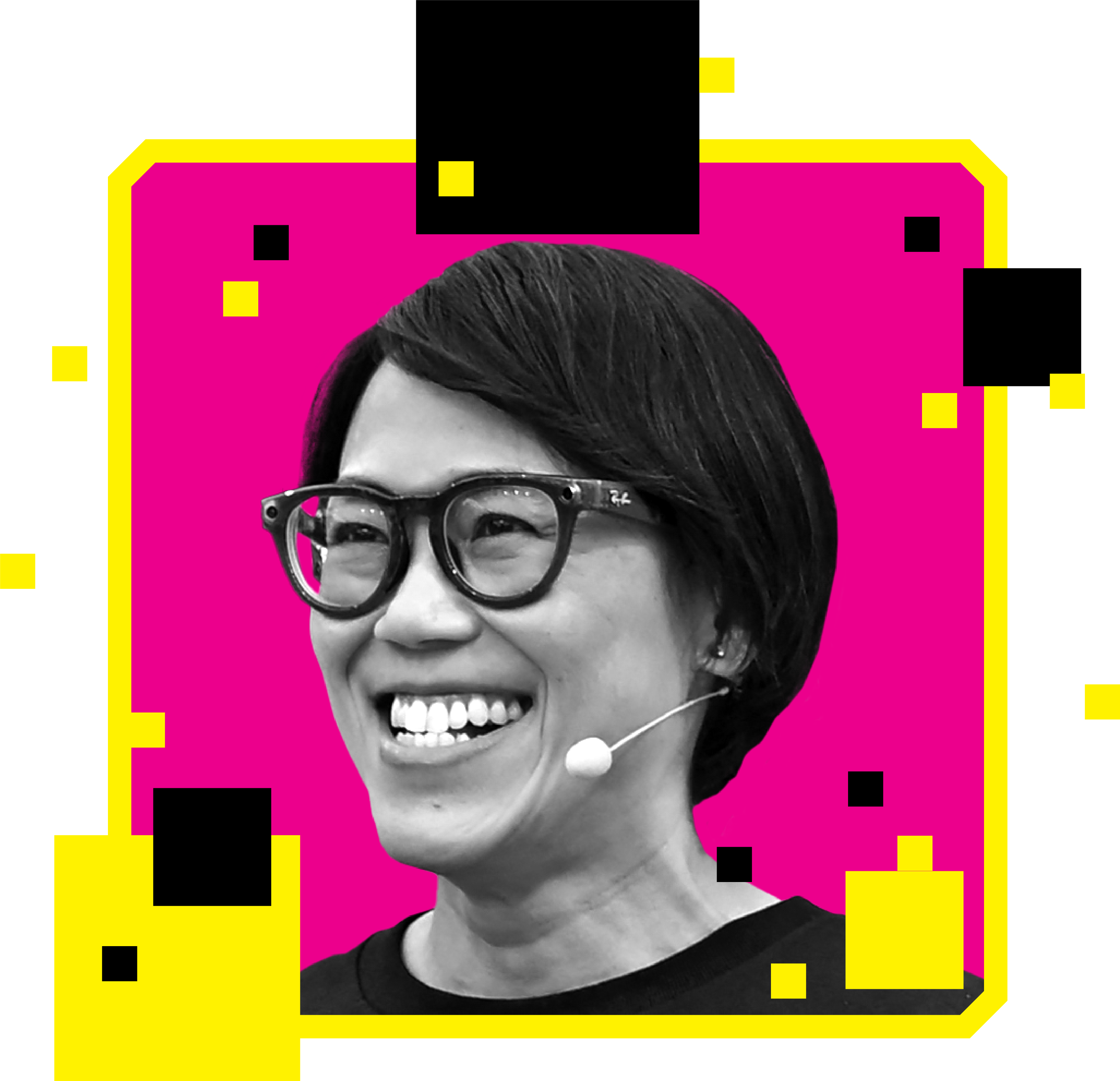
Li-Chen Miller
Vice president for product management, Meta Platforms Inc.
Miller was working at Microsoft Corp. in late 2021 when she discovered Meta’s first pair of smart glasses, the Ray-Ban Stories. Miller earned money as a teenager selling T-shirts at night markets and immigrated to the US on an engineering scholarship because she couldn’t afford college in her native Singapore. She says she rarely spent money on anything, but she was so intrigued by the glasses that she made an exception. Despite her excitement, she found the glasses themselves underwhelming. So she sent a cold email to Meta’s head of augmented reality with a list of 10 ways to improve them.
The company soon hired her to fix the product herself. Miller now leads a team that works on many of Meta’s augmented reality devices, part of a push in which it’s spent $50 billion since the beginning of 2021 building technologies it hopes can one day replace foundational gadgets such as laptops and smartphones.
Miller’s remit includes smart glasses and as-yet-unreleased wrist wearables but not the company’s Quest VR headsets. Although the VR headsets have a higher profile now, the smart glasses may be the most likely to go mainstream. Not only do they look and feel like conventional sunglasses, but the second generation, called Ray-Ban Meta, includes cameras for capturing photos and videos, speakers for playing music and a voice-controlled AI assistant.
Miller is convinced her team is closing in on the formula for the next major computing platform. If all goes well, she says, what Meta is building will be “the new way that your kids and your kids’ kids are going to experience the world.” —Aisha Counts and Kurt Wagner

Evan Reiser
Co-founder and CEO, Abnormal Security Corp.
It’s been more than five years since Reiser first turned to algorithms to spot oddities in workplace emails. Was the sender in an unlikely time zone? Pushing an unexpectedly urgent invoice request? Contacting new people or altering their usual phrasing? Any of these possibilities might be clues that the emails were ways to trick people into clicking on a malicious link or sending money to the wrong account. A system that identified such behavior could be the basis of a powerful cybersecurity tool. When it comes to hacking, Reiser says, “email’s the big open front door.”
He co-founded Abnormal Security in 2018 to offer such a tool. The startup has signed contracts for more than $100 million in annual recurring revenue last year by helping its clients protect their front doors. (It now also guards side doors such as Microsoft Teams, Slack and Zoom, and is working on products to protect Salesforce, ServiceNow and Workday accounts.) Abnormal counts 15% of the Fortune 500 companies among its 2,000-plus customers and has raised about $300 million from investors who have valued it at $4 billion.
Reiser says he hopes his startup will be known not only for protecting corporate inboxes but also for building an AI platform that understands humans better than they understand themselves. “We had to use email security as the proving grounds for AI, because it’s the most sophisticated attack, the most important,” he says.
Reiser came to appreciate the power of AI from his work in behavioral ad targeting–he sold a startup he co-founded to a company that Twitter subsequently purchased, and he ended up running the social media company’s ad platform for almost three years. (“All the annoying ads around the internet, it’s probably my fault at some level,” he says.) He’s not aiming for a similar acquisition with Abnormal. Instead, he’s expecting to take it public late next year. —Katrina Manson
(Updates first paragraph in entry on Lixandru with information about when she joined Sequoia.)
Ahluwalia: Courtesy Subject. Carr: Courtesy Subject. Fontenot and Liu: Courtesy Subject. Guo: Courtesy Subject. Lixandru: Courtesy Subject. Madan: Courtesy Subject. Miller: Josh Edelson/Getty Images. Reiser: Courtesy Subject.