
Green
How Frankfurt Harnesses Local Wind Currents for Urban Cooling
One of Germany’s hottest cities captures the airflow between office towers and through residential neighborhoods to cool down
This is the fourth story in Climate-Proofing Cities, a series that explores how cities around the world are adapting to the impacts of global warming. Read about how Mozambique is pioneering a cyclone warning system, how São Paulo is planting rain gardens to keep dry and how Boulder, Colorado, is warding off wildfire.
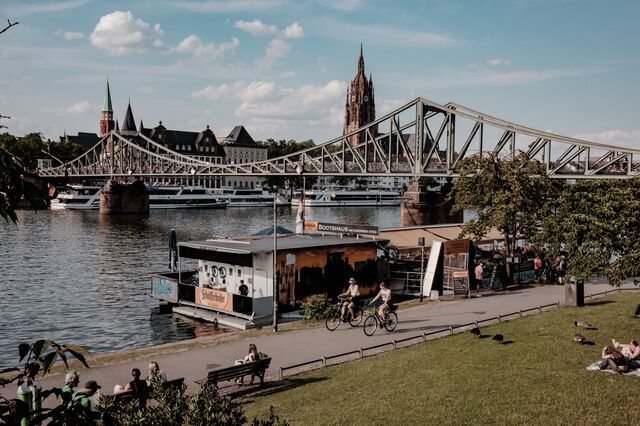
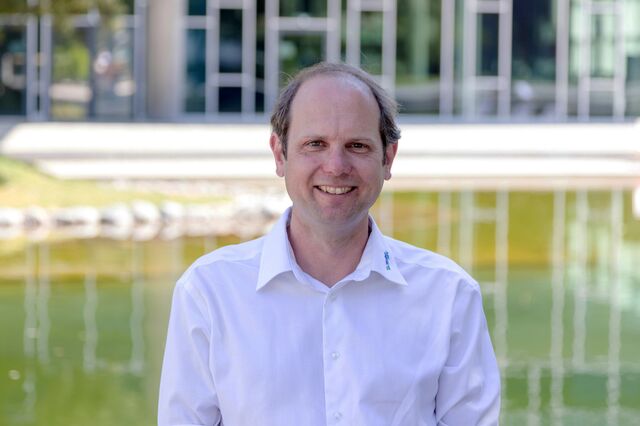
After a long trek through a landscape of steel, concrete and glass on an early summer day last year, Matthias Ratheiser found his way to the banks of the Main River, where the panorama of Frankfurt’s skyline unfolds. Looking back at the cluster of high-rises that give the city its silhouette, with the sun setting behind them, he could feel a small breeze starting to pick up from the northeast, bringing along a whiff of fresh air.
This gentle wind makes all the difference for Frankfurt’s climate, and one of Ratheiser’s goals is to make sure it can keep flowing around new towers reaching into the sky. The Austrian meteorologist is among a group of experts who helped finalize a new city master plan that envisages many new skyscrapers.
Ratheiser, who’s based in Vienna and is co-chief executive officer of the research firm Weatherpark, which focuses on urban climatology, scrutinized all their sites during his research trip to Frankfurt last summer. “Visiting a place and getting a feel for it is extremely important in every wind analysis,” he said. What he learned fed into the 3D model of Frankfurt’s downtown area on his computer screen, where he can make new buildings appear and show how they change air-flow patterns.
Frankfurt is one of Germany’s warmest cities, with a record temperature of 40.2C (104F) registered in 2019 and thermometers reading well above 30C every year. During these weeks, the city feels stuffy as dense central neighborhoods absorb daytime heat and release it once the sun has set. Few buildings have air conditioning.
Three wind systems are at play in Frankfurt. None of them is particularly strong, but they do help make life bearable during hot summer days and nights. With the prospect of more warming ahead, city hall is determined to harness whatever fresh air comes flowing in.
Urban planners, architects and scientists joined forces several years ago to create a climate atlas that identified not just the city’s hottest areas, but the wind corridors that can cool them. Frankfurt has also promoted other initiatives to help lower temperatures in buildings and streets: Roof gardens and green facades are compulsory for new dwellings. Local rules on well-insulated, low-energy passive housing are among Europe’s strictest. Authorities are experimenting with porous pavements, street fountains offer refreshment and more than 200,000 trees across the city provide shade.
But it’s early days on Frankfurt’s heat adaptation path, with more work still needed to raise awareness of the dangers of high temperatures. In 2023, about 3,200 people in Germany died because of heat, and that number is expected to increase as the atmosphere warms.
“Climate change is an experiment we can’t control,” said Ratheiser, 49, who has worked with cities across Germany and Austria. “I’m worried—not just about how it will affect life in cities but also whether and how future generations will manage to adapt.”
The new skyscraper development plan—approved by the city council in mid-June—is the latest example of Frankfurt’s proactive approach. It comes with a whole chapter of climate analysis highlighting the “central importance” of weather systems in cooling and bringing fresh air into urban areas, especially during summer heat waves. The images accompanying the report, gray cityscapes featuring black squares for new towers and blue and sometimes orange winds, are Ratheiser’s work.
They show that the strongest and most frequent winds come in during the day from south-southwest, at an average speed of 4.5 meters per second, or 10 miles per hour. More relevant to cooling down the city at night though is a regional wind system reaching Frankfurt from a stretch of land known as the Wetterau, to the northeast. After sunset, the air there cools quickly and flows into the city, just when the concrete of downtown releases the heat it captured during the day. Several local low-wind systems, carrying fresh air from the nearby Taunus mountain range or Frankfurt’s east, offer some additional relief.
“The Wetterau wind is our biggest lifeline, climatically speaking, during summer,” said Uwe Wahl, one of Frankfurt’s city planners focusing on ecology and landscape design. It’s usually noticeable from 11 p.m. onward—though sometimes earlier—and is crucial in keeping nighttime temperatures below 20C, a critical level for comfortable sleep and productivity.
In the banking district, high-rises actually help catch the wind and divert it to the left, right, up and down. “That’s why we have a much stronger wind dynamic at street level there,” said Wahl. “So when the city overheats at the height of summer, the banking district is still the most pleasant part of town.”
Residential neighborhoods benefit from wind in other ways. Currents travels through two natural corridors: the Main and Nidda rivers, which almost encircle the city and offer wide-open space. The former is an avenue for winds including those coming from the Wetterau; the latter funnels cold air from nearby hillsides into surrounding quarters. Tracks leading up to the main train station, Frankfurt’s east harbor and a relatively new avenue that’s 60 meters (almost 200 feet) wide in the western part of town all serve as auxiliary channels for air.
Climate maps like the one that Lutz Katzschner, a researcher at Germany’s Institute for Climate and Energy Concepts, created for Frankfurt about a decade ago show them all—plus the capacity of different parts of the city to store heat, and how urban planning can improve ventilation.
“The first recommendation is always to link these air corridors, but also to keep them clear, not to build more houses” in them, he said. While Frankfurt has done well on the first count, creating a well-connected belt of 45 parks and 350 green spaces, a chronic shortage of housing is making the latter more complicated to achieve.
Frankfurt needs some 68,000 new apartments by the end of the decade. A project planned in the northwest of town to supply a tenth of those is running into resistance from residents, in part because the land—currently used for farming—produces cold air for surrounding neighborhoods.
“This is the biggest challenge: to develop a strategy so demand for housing is met and new residential areas can handle that” from a climate perspective, Katzschner said.
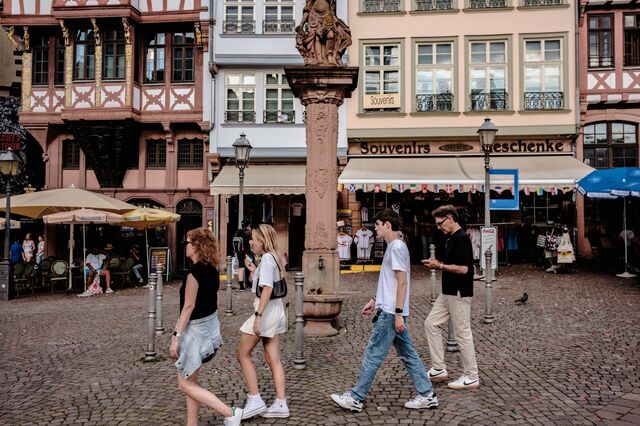
For Frankfurt’s densest neighborhoods, including the medieval center but also residential areas beyond the green belt such as Nordend and Westend, relying on wind for cooling isn’t enough. The focus is on preventing those neighborhoods from heating up in the first place.
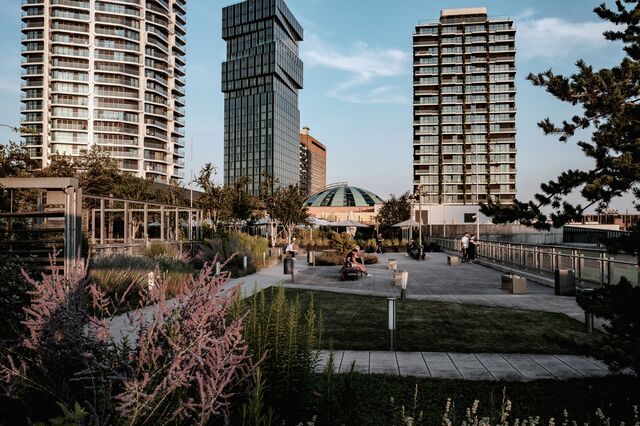
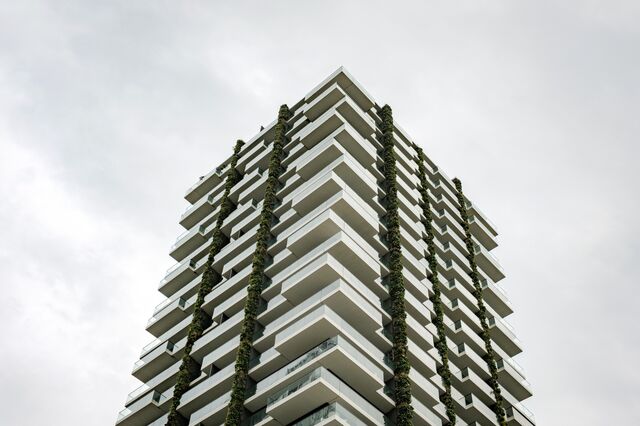
Statutes in force since last May stipulate that all new buildings and conversions—as well as the open spaces around them—must be designed in climate-adapted ways. That means roofs and facades need to be “extensively” greened, sealing must be avoided and shaded areas created. Gravel gardens and high private fences are no longer allowed.
“Gravel gardens are taboo in Frankfurt—hey only heat up, and insects don’t eat stones,” said Tina Zapf-Rodriguez, the new city councilor for climate, the environment and women, in office since mid-July. “Instead there are rules on greening, for roofs, for example. Green roofs are not only good for the urban climate. They also help to save heating energy.”
Green facades are still relatively rare in Frankfurt, and some have drawn criticism because plants are simply hung outside rather than planted in soil. But green roofs are growing quickly across all parts of town.
Frankfurt Airport, one of Europe’s largest, has greened many of its expansive roofs since 1990, while Skyline Plaza, a large shopping center, even offers overnight camping—with barbecues, campfires and guitar music—on its roof garden during the summer school holidays.
Stefan Rieger has designed, built and cared for gardens in the Frankfurt area for 25 years and is seeing rising demand for green spaces on top of buildings. One in four of his projects now involves planting on roofs.
One he’s particularly proud of is a 250-square-meter space he created for a family of four in Frankfurt’s south. It was subsidized by the city with a grant of €50,000, won a competition and was featured in an exhibition at the German Architecture Museum.
“The developers had no vision,” he said during one of his regular visits to the place that boasts unobstructed skyline views. “But the new owners and I immediately thought big.”
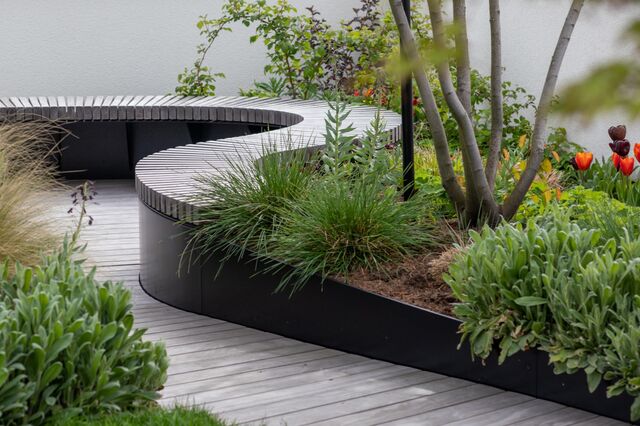
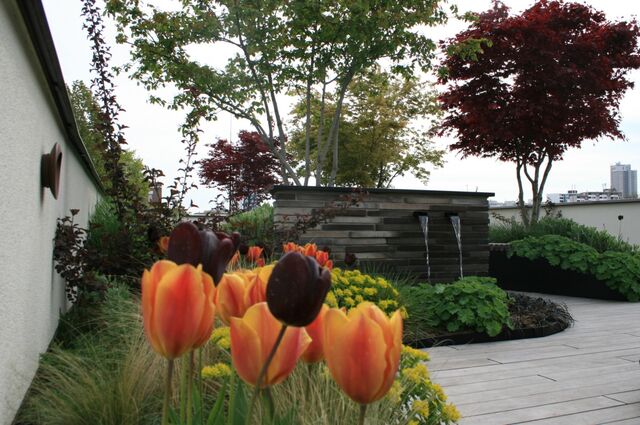
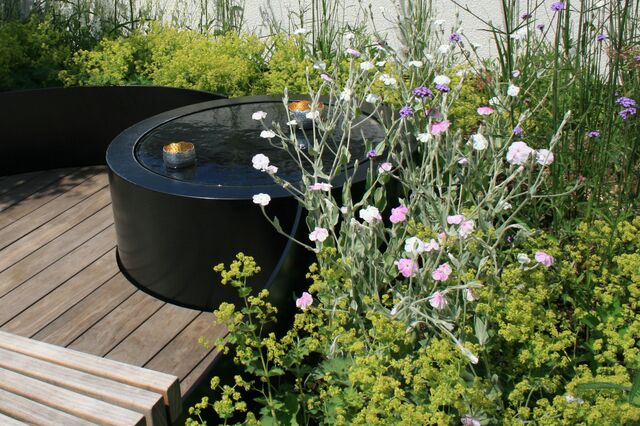
Instead of a bit of grass, three maple and two rock pear trees now offer shade, making the space usable on hot summer days. Their roots—strapped onto lattice cages—reach some two feet into the ground, and lightning rods make sure they aren’t struck during the many thunderstorms that regularly hit Frankfurt.
Raspberry, blackberry and currant bushes cover the white walls surrounding the garden on the third floor of a condominium building. A wooden walkway snakes through a stretch of lawn and dozens of perennials, shrubs and geophytes, leading from a terrace where a water cascade drowns out the noise from nearby train tracks to a seating space all the way in the back.
One of the greatest challenges is getting irrigation right. “A roof garden is basically a large tub,” Rieger said. “Unlike on the ground, a plant can’t simply stretch out its roots when water is scarce in one place. An empty tub is an empty tub.”
Green rooftops have their detractors. Both attaching plant mats to facades and growing trees in the air are “unnatural,” said Christoph Maeckler, a Frankfurt-based architect focusing on urban planning. “We mustn’t believe that technology can solve all our problems.”
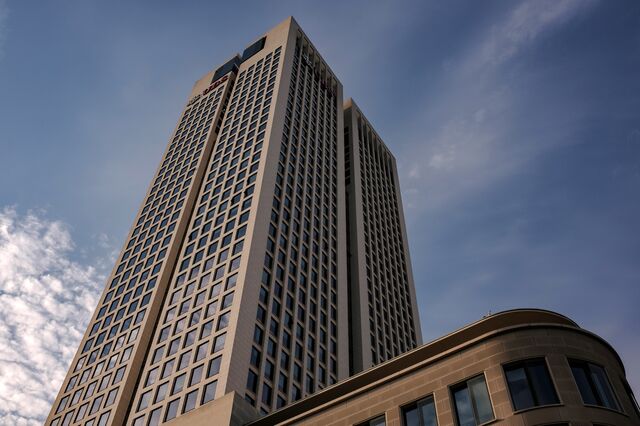
His skyscraper OpernTurm—completed in 2009 just across from Frankfurt’s 19th-century Old Opera House, and home to UBS—saves energy because one-third of its facade is made of limestone rather than glass, reducing heat absorption and the need for mechanical cooling.
What the city really needs is more shade, he said, and it should seek inspiration from southern European cities such as Rome or Madrid. (Notably, Frankfurt is already greener than Paris, London or New York, according to one assessment.)
Two years ago, Maeckler collected €30,000 during a fundraiser to plant trees around the city. He recently returned the money to his donors because officials couldn’t tell him where to put them.
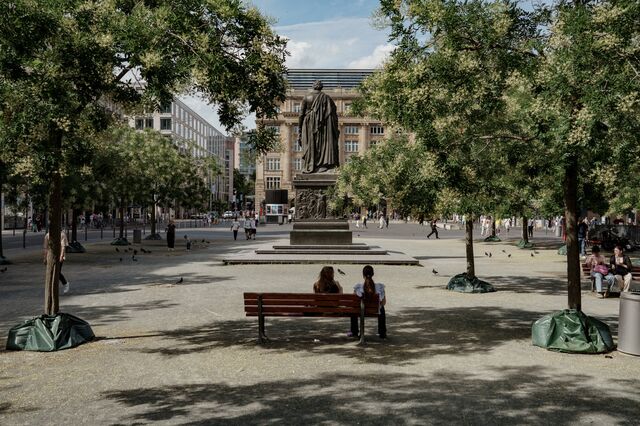
“You can never plant enough trees,” Frankfurt city planner Wahl agreed. “But there are many constraints to consider,” such as clearance for power lines and cables running underneath the streets. “‘Take away a parking lot and plant a tree’ sounds easy,” added Wahl. “Let me tell you, it’s not that simple.”