Living in the Shadow of Statistics in Rust Belt Ohio
What coming back home means in a region that's been deemed the least livable for Black women.
The following essay is the second in a series on making cities livable for Black women. Read the last two here and here.
Who is listening to Black women—our bodies and our families?
This question brought me back home. I recently moved back to Ohio, a place characterized by Toni Morrison as neither plantation nor ghetto. I’m a comebacker trying to manage work-life balance in a post-2020 society. Ohio is not the place with cities that show up at the top of “most livable” lists; in fact, quite the opposite, particularly for Black women. And yet, it’s worth examining why we would continue to call it home.
I know four Black women from different generations with different stories and life trajectories, living in the same region that breeds apathy and disappointment, who lovingly call Elyria, Ohio, home.
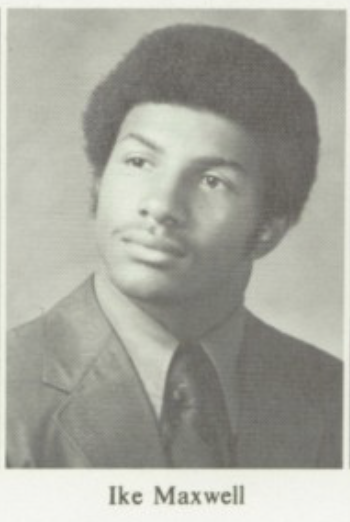
I interviewed these women during the summer of 2021 for a documentary film I’m producing and directing on Ike Maxwell, the legendary Black high school football player whose brother, Daryl Maxwell, was shot and killed by a white Elyria police officer in the 1970s. In telling Ike’s story, the film also highlights the story of Elyria, a Rust Belt city characterized by its proximity to Cleveland and industrial decline.
Elyria is a city roughly 30 minutes west of Cleveland, Ohio. It sits on Indigenous land and its territory is marked by The Great Migration. Author and native Elyrian, Shirley Brown-Reeder, writes about Elyria as a microcosm of The Great Migration in her book, Looking at Elyria History With Ebony Eyes. She traces Black Elyrians’ routes from Tennessee and Alabama, and discusses the role Black churches played in allowing Black Elyrians to “socialize freely.” Over the last 40 years, Elyria has also experienced socioeconomic hardship as a result of industrial decline. Though its landscape and demographic shifts can be characterized by a mass movement of Black Americans leaving the south at the turn of the 20th century, like other northern cities in the US, Elyria is also marked by a history of racial violence.
During the summer of 1975, tensions between Black Elyrians and law enforcement came to a tipping point. It began when two white police officers spotted a 19-year-old Black man climbing out of a window of a local bar. He tried to flee before he was shot by one of the police officers. According to the police report, the officer fired two shots after yelling, “Stop, stop the police!” causing the suspect to fall to the ground. The young man was Daryl Maxwell, Ike’s younger brother. Two years later, Zora Maxwell, their mother, received a $17,500 out-of-court settlement for Daryl’s wrongful death, despite seeking $2 million from the district court.
Civil Rights activist Dr. Charles H. King wrote in The Atlanta Voice, “When they rolled Daryl over, shot while fleeing from a bar he had burglarized, clutched in his hands were a batch of canceled lottery tickets and a box of cough drops.” The Herald Journal, among other local news outlets across the country, described racial violence running rampant in diverse cities like Elyria, comparing the events of that summer to the Boston Riots, which occurred around the same time.
Darlene is Ike’s sister, an elder who’s hip to trends and speaks in one-liners. “Ain’t nothing coming to a sitter, but a seat. A mover has to move,” she told me.
She’s old-school, religious, and loves Black people, especially Ike, who she cares for now.
Despite pain she’s endured over the years, much as a result of losing her biological and step fathers to gun violence, along with her brother Daryl, she wants to serve the community the best way she knows how, which is through food. She hopes to run her own restaurant one day.
“I know my purpose is to be in the community,” she said. “[Black people] show our love by what we feed you [even though] we never had much to give.”
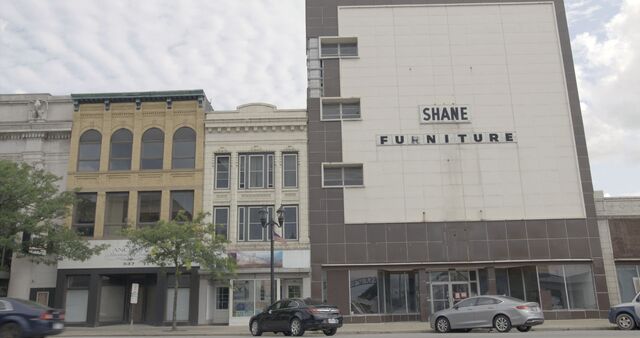
Darlene is facing enormous barriers when it comes to economic mobility. For Black women in Ohio, aspiring to start any kind of business is an uphill battle. According to a recent business report, Ohio ranks among the worst states for minority-owned small businesses. Cleveland, the largest city closest to Elyria, saw declines in Black-owned businesses as a result of the pandemic. In Lorain County, where Elyria sits, it’s difficult to find recent data on Black-owned businesses because they are rare to find.
It doesn’t help Darlene’s circumstance that she has to relive family trauma as journalists come knocking on her door asking about the riot of 1975 and both of her brothers’ places in that story. I got a sense that Darlene just wants to move on, but everyone else wants to remind her that she can’t.
“Elyria is home. As painful as it is, as dreadful as it is, I’m stuck here. That’s how I feel. So being stuck [means] I gotta make a difference.”

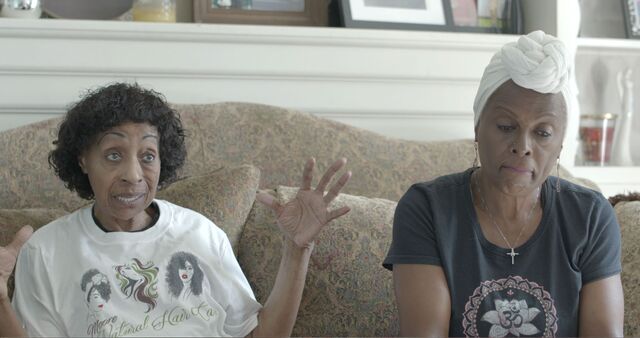
Carolyn and Brenda, the Arnold sisters, carry family stories with them too, and it shows. They grew up a few blocks away from the Maxwells. Brenda shows me a picture of her and Walter Maxwell, Ike and Darlene’s brother, attending a Commodores concert together sometime in the 1970s. Carolyn is my aunt and Brenda is my mom.
During our interview, I asked what it was like growing up in Elyria. A brief silence fell over the room before either spoke, and I know why. They’re cautious in how they narrate our family story for public consumption. Black women don’t always trust who’s listening.
Mom and Aunt Carolyn talked about happy times when “it was all about family.” They reluctantly recalled the death of their mother, my grandmother, which altered the shape of our family. Mom also talked about leaving Elyria twenty years ago.
“I cut myself off,” she said flatly. Aunt Carolyn, who never left Elyria, sat quietly.
The Arnold sisters personify the conundrum Black women from Rust Belt cities confront. That is, whether to stay or leave. Yet, my mother turned the conundrum on its head by returning. She’s a comebacker. She wants to start an organization for women in the trades, a sector where she broke down barriers as the first female lineman for the Elyria Telephone Company in 1975. Similar to Darlene, she’s moved by a desire to serve people on the margins, like Black women, a distinctly invisible demographic in this region/state.

It’s hard to tell where Black women in Elyria show up in local data. In Ohio, the wage gap persists, with men earning 1.34 times more than women. When zooming in on Elyria, statistics are even more alarming, yet obscured. Women ages 25 to 35 in Elyria make up the largest demographic living in poverty, with women across all adult age groups surpassing men living in poverty. And while Black Elyrians make up the largest nonwhite population living in poverty, of that demographic, it’s difficult to parse what percentage represents Black women because data on race aren’t disaggregated by gender. One has to infer the systemic barriers Black women face.
Despite these statistics, the Arnold sisters are optimistic that Elyria’s new and younger leadership will step up to support Black women.
Kaleena Whitfield, a fifth-generation Elyrian, is a magnetic, educated Black woman and mother. She’s statuesque like Michelle Obama but noticeably of a different generation, marked by her long box braids and open-toe sandals. She’s comfortable and very busy. She’s the wife of Frank Whitfield, Elyria’s first elected Black mayor, and when we met she was pregnant with their fourth daughter.
Kaleena spoke fondly about growing up in Elyria, a place she said her family “chose to give all their energy, love, gifts, and talents to.” She also understands the challenges Black women and girls face.
“The challenge is staying and making Elyria better. I’m proud to raise my kids here,” she told me. “We need to make sure our Black girls are experiencing new things, especially recreationally, a space that I worked in. We need to make sure they’re getting exposed so they can walk into spaces not as fearful.”
She goes on to say the biggest challenge for Black women in Elyria is being the only one, or the first, to make an impact: “There’s only a few [of us] allowed in spaces or jobs. It breeds discouragement. If there’s one job that they typically fill with a Black woman, it can feel limiting especially in the diversity, equity and inclusion space.”
As I listened to her, I saw a glimpse of what progress might look like for Black women. I also saw what’s required for progress to be possible.
Progress requires addressing many of the disparities that persist for Black women, namely by holding social institutions accountable for preserving systemic barriers rather than protecting people. Thinking beyond social institutions, we must also ask: What is care worth, especially for Black women and girls who disproportionately perform care work? It takes time, money and energy to mobilize community members across generations. And Black women who want to make change in the community, but lack resources to do so, deserve access to local governing and economic powers.
Methodologies for understanding demographic shifts must also change to account for the unique disparities faced by Black women, in my home state especially, like maternal mortality. We need quantitative and qualitative studies that examine where Black women live and work, especially in the Rust Belt. The way our stories are told also matters. News organizations must be held responsible for how they shape narratives about us and our families.
But perhaps more than anything, progress for Black women in cities like Elyria requires protection across all domains, public and private.
When confronted with abysmal statistics and systemic failure, it begs the question: Who is listening to Black women, our bodies, and our families?
Despite statistics that scream this place isn’t for you, I chose to return home like my mother, because my family and community are here. I also returned because I want to listen to Black women from Ohio, and I want my scholarship, activism and creative projects to reflect their stories while I still have energy to produce them. I’m also drawn to places that were never built for me. I’m Brenda’s daughter in that respect.
I’m also Elyria’s daughter. I’m like Darlene, a Black woman who senses the good in people and holds back tears when talking about loved ones who’ve passed on. I’m like Kaleena, a Black woman who has the advantage of age, education and charisma on my side — all the things that allow me to enter into unwelcoming spaces. I move like the Arnold sisters, Black women who model a bond of sisterhood despite grief, betrayal and lost memories, and who compel family members to walk in love no matter what.
We are Black women from Ohio living in nuance bonded together by multilayered stories of the Black experience in the Midwest. Our lived experiences aren’t always captured by statistics and media narratives that say more about the negligence of social institutions than about the circumstances that keep us going. We are daughters and mothers who dig our feet in the soil to shift the ground; the stayers and comebackers who find purpose rooted in the Rust Belt we call home.
Tara L. Conley is an assistant professor in the School of Media & Journalism at Kent State University. She’s currently directing and producing DRY BONES, an independent documentary film about Ike Maxwell, a legendary Black high school football player from Elyria during the 1970s.