

Colombia’s Green Energy Ambitions Hinge on Windswept, Wary Province
The country’s remote La Guajira region has some of the best wind resources in the world. But community mistrust has proved hard for developers to overcome.
At sunrise, Betty Granadillo and her driver head out in an all-terrain SUV to visit the rancherías. She always takes a bag of coffee and sugar as gifts to thank her hosts. When she returns to the city of Riohacha, it’s usually already dark.

Granadillo is a member of the Wayuu people, the largest Indigenous group in Colombia, and an outreach worker for the energy company Grupo Energía Bogotá (GEB). The company wants to build a major power line in this remote province, La Guajira, to connect future wind farms to the nation’s grid. GEB representatives have held thousands of meetings with local communities in a bid to secure their agreement to let the line cross their land.
“Communities have many needs in their territory, and they see this as an opportunity to improve their conditions,” Granadillo says as she sits in the passenger seat of the white SUV, the desert landscape flashing by: trees and shrubs growing in the orange-tinted sand, and here and there a herd of goats feeding on the leaves.
Hanging in the balance is one of the most promising locales for wind energy on Earth, as well as the ambitions of the nation’s president, Gustavo Petro, to make La Guajira a model for an energy transition that advances social equity while ending society’s dependence on fossil fuels.
Located on South America’s northernmost tip, La Guajira has powerful trade winds that blow year-round across its sun-drenched desert. Their speed is double the global average, meaning the wind here has the potential to meet practically all the power needs of the nation of 52 million.
Colombia Aims to Make Remote La Guajira a Wind Energy Hub

The area is central to Petro’s goal of reaching 6,000 megawatts of wind and solar capacity by the end of his term in 2026 — enough to meet about one-third of demand. Colombia already has one of the world’s cleanest grids. About two-thirds of its electricity comes from hydropower. But that makes the Andean nation especially vulnerable to the El Niño weather phenomenon. Dry weather is causing reservoir levels to drop and nudging energy prices up. At the same time, the country’s reserves of natural gas are declining. That’s where solar and wind come in.
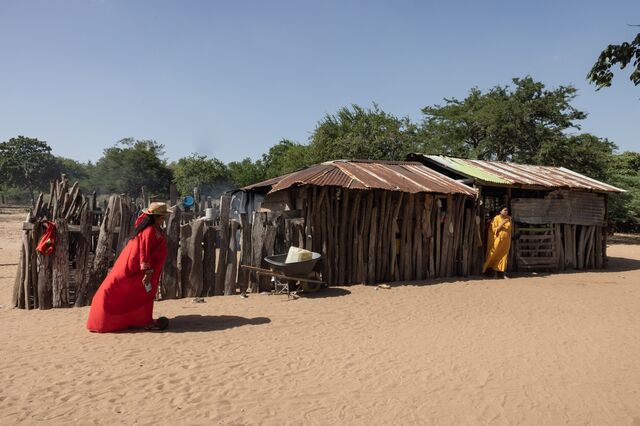
In its quest to build the 475-kilometer (295-mile) line, GEB has spent four years fanning out across La Guajira: up the Sierra Nevada de Santa Marta mountains, which are inhabited mostly by Indigenous peoples including the Kogui and the Arhuacos, and across the vast desert where the Wayuu live in rancherías, or small family compounds.
Beyond its wind and solar potential, the region is also home to Cerrejón, Latin America’s largest open-pit coal mine. And its natural gas fields are the second-biggest suppliers of the fuel in the country.
Although the coal and gas industries pay royalties to the local government, corruption and inefficiency have greatly limited the benefits that flow to the people of La Guajira. That has created a “legacy of frustration,” says Weildler Guerra, a Wayuu who holds a doctorate in anthropology from Bogotá-based Universidad de Los Andes.
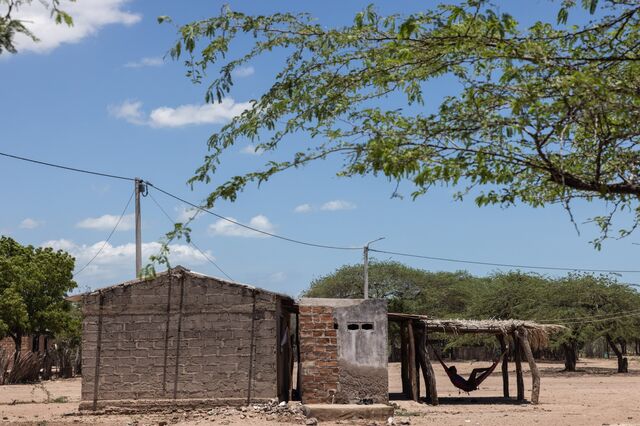
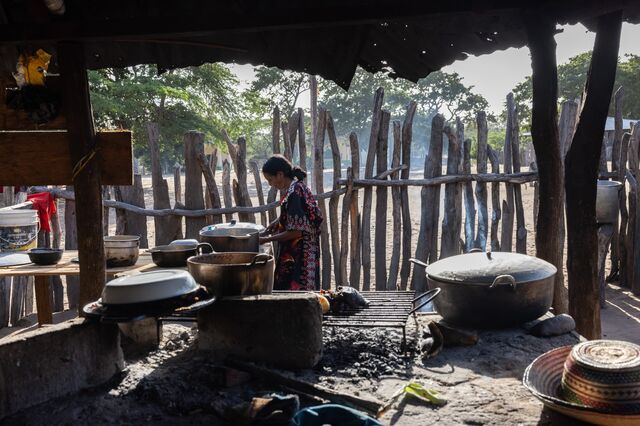
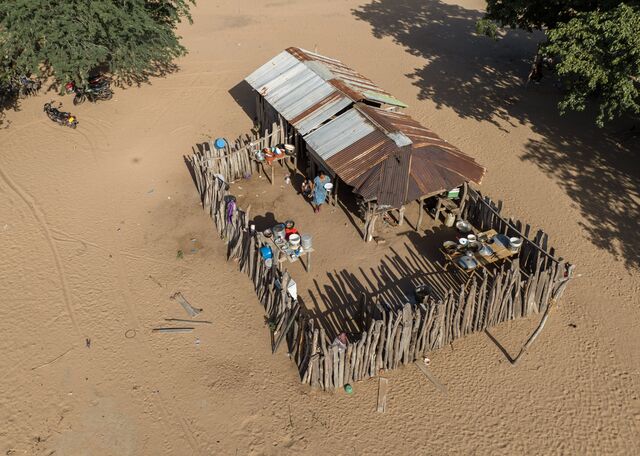
The poverty rate in La Guajira is 66%, the highest in the nation, and malnutrition and lack of access to clean water are long-standing problems. The region doesn’t have large industry and many Wayuu rely on their goats and the sale of mochilas, colorful woven handbags, to survive.
The renewables boom, offers a chance for a reset. Under the principle known as Free, Prior and Informed Consent — stemming from an international agreement that Colombia ratified and included in its 1991 constitution — Indigenous peoples have the right to participate in decision-making on new development projects that may affect their way of life and traditional lands. The Wayuu don’t have one single leader or council; decision-making is decentralized and happens at the level of the ranchería.
Which is why GEB has devoted so much time and effort to meetings. The company has spent 100 billion pesos (around $25 million) on consultation, compensation for communities and applying for an environmental permit, more than double what it had originally planned.
In June, the company reached a huge milestone. It signed the last of 235 separate agreements with local communities, giving it the legal green light to begin construction of the transmission line.
Even so, it’s not taking anything for granted. The recent experience of an Italian energy developer, Enel SpA, that planned to build a wind farm in La Guajira is a cautionary tale. After reaching the required agreements, investing more than $1.6 million in community projects including school upgrades and getting an environmental permit, Enel’s Colombia division announced in May that it was suspending the project indefinitely because of local obstruction, and that it would look for a buyer.
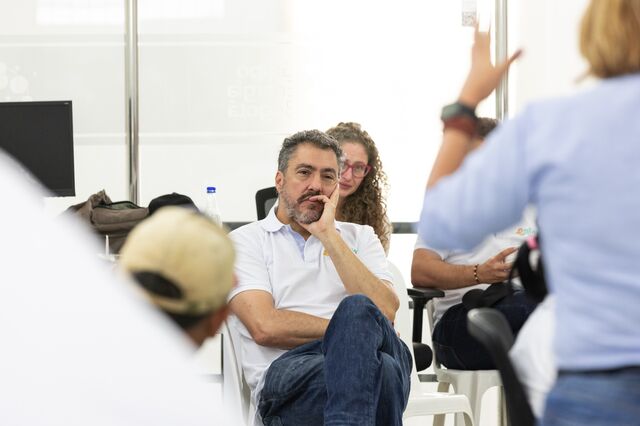
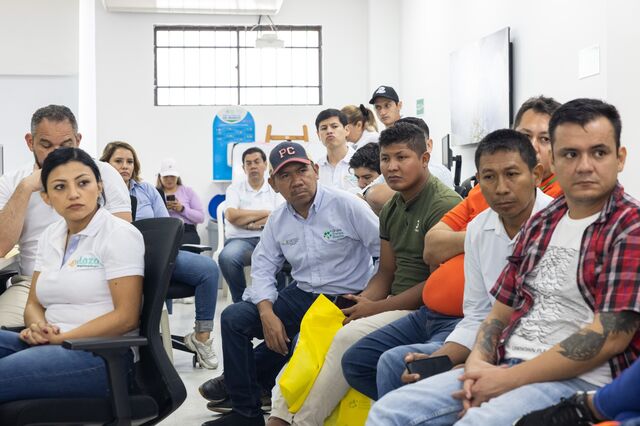
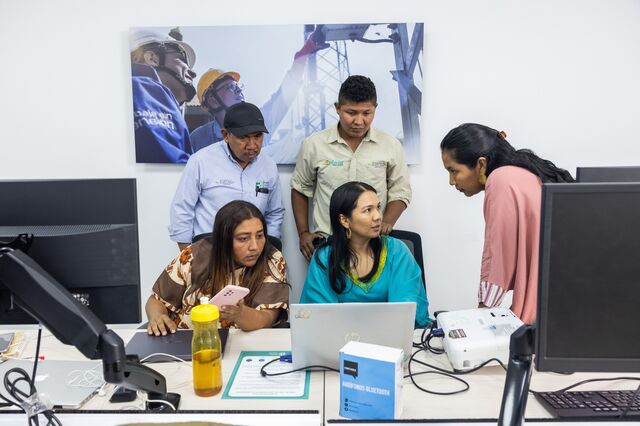
On a Friday morning in August, GEB Chief Executive Officer Juan Ricardo Ortega is at the company’s office in La Guajira’s capital of Riohacha. In the bright white room, he and several other executives who have flown in from Colombia’s capital Bogotá sit with members of the outreach team, many of them Wayuu, who helped broker the community agreements.
The conversation turns to the possibility of road-blocking protests that could stop construction. These are common in La Guajira as a way to protest everything from a lack of water to deficiencies in education and health care. People might block building as a way to pressure a company to offer compensation, or if their community reached an agreement but they changed their minds.
Under Colombia’s constitution, communities aren’t entitled to veto development projects unless the impacts are life-threatening, toxic or would force them to relocate. But the government has so far avoided clearing road-blocks to let construction projects proceed.
According to Enel, conflicts with communities halted 50% of its working days in 2021 and 2022, and 60% this year, effectively making progress impossible.
It’s weighing heavily on Ortega.
“Everyone is watching, wondering if we’re going to be able to do this or not,” he says.
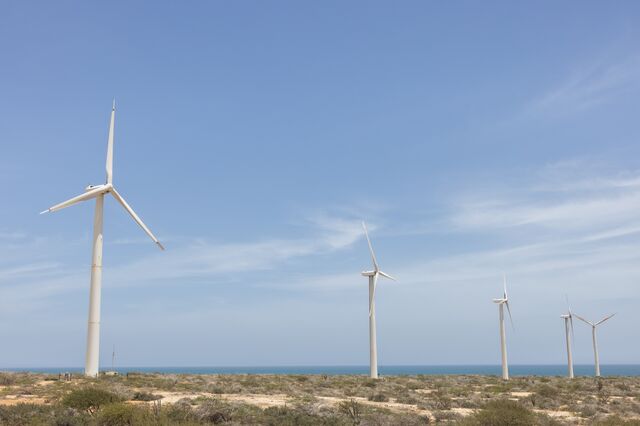
Despite Enel backing out, other companies still intend to build wind projects on a timeline parallel to GEB’s, so they are ready to start generating once the power line is ready, targeted for the end of 2025.
The utility Empresas Públicas de Medellín, or EPM, and energy generator Isagen SA are both planning to build projects in upper La Guajira. EPM has a history in the region, having built a small wind farm as a demonstration project 20 years ago which ceased operating last month. The Colombia division of energy giant AES Corp. hopes to build a cluster of six wind farms, which would be the nation’s largest, with a total capacity of 1,100 megawatts.
“Few places in the world have the quality of the wind resource that there is in La Guajira,” says Federico Echavarría, who heads AES Colombia, adding that the country’s solar potential is just average. “If Colombia wants an energy transition, it needs the wind and the sun. But it’s clear that with the sun alone there is no energy transition. Without La Guajira there is no energy transition. And that is why we continue to bet on the development of La Guajira.”
Two of AES’s wind farms already have the agreements and environmental permits in place and therefore could begin construction. Yet with an estimated cost of between $800 million and $1 billion for the first phase of four wind farms, Echavarría isn’t willing to risk starting until there are clear signs GEB’s transmission line will become a reality.
“The worst thing that can happen to you is to build, make all this investment, and not be able to get the energy out,” he says.
Companies are betting long-standing relationships will help them avoid the fate of Enel.
GEB has taken pains to build trust that goes deeper than a legal agreement, says Carol Varela, who heads GEB’s outreach team. “There’s no exact formula, no perfect recipe,” she says.
Aritaimana is one of the Wayuu family compounds that GEB reached a deal with. It lacks running water, and the energy company has pledged to set up a pipe system to carry water from a well to the few houses on its land. Yet Remedios Sierra, Aritaimana’s leader, is conflicted about agreeing to the project.

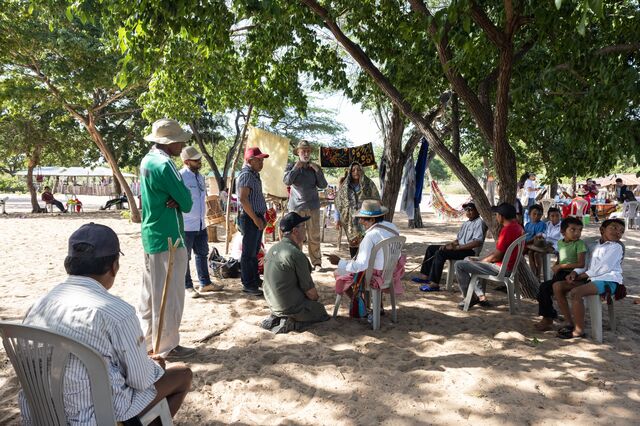
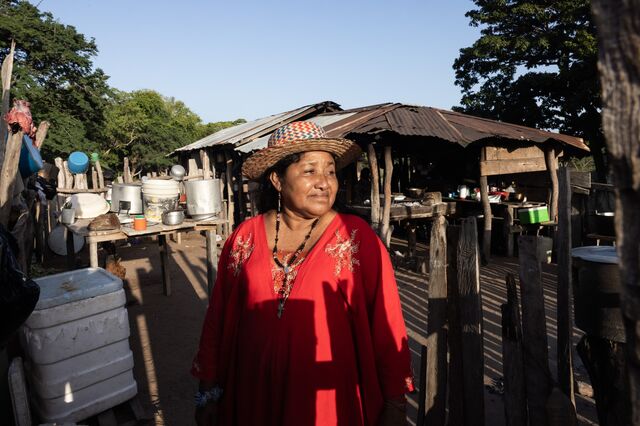
“We’re connected to this land, it’s part of us,” she says as she sits in the cool shade of a tree, wearing a traditional embroidered dress and straw hat. “I have to get used to the idea that there will be something else interrupting my relationship with that little piece of land” where the line will pass, she says.
The language of the Wayuu is Wayuunaiki; not everyone in the community speaks Spanish. And there are other cultural differences with the alijuna (pronounced a-li-hu-na) — the Wayuu term for non-Indigenous people.
For the alijuna, the wind is a resource to be used. But for the Wayuu, the winds are beings with personalities, says Guerra, the anthropologist. The wind from the ocean brings the fish; the land wind is fickle, and the wind in the mountains helps farmers grow their produce.
When GEB began discussing with rancherías what they wanted in return for the power line crossing their land, many asked the company for better access to water — improving the waterholes where they gather rainwater, building deep wells and pumps or putting in place water purification systems. Communities have also asked for more goats to add to their herds and for improvements to their cemeteries. Funerals are important events for the Wayuu.
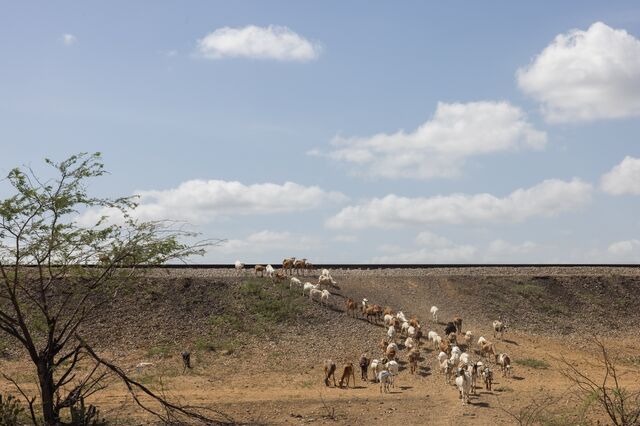
If and when the wind farms and power line are built, the electricity will bypass Aritaimana’s dwellings, traveling at high speeds to the interior of the country. The only power in the settlement is provided by a few small solar panels that residents use to charge their mobile phones. But more isn’t high on the wish list for Sierra.
“It’s not that we don’t like it,” says Sierra, who teaches Spanish, social studies and math to children in the ranchería. “But we want to conserve our surroundings.” At night, artificial light would scare off fireflies and keep goats from returning home, she said.
The alijuna “will never understand. You can’t survive without electricity and you’ll never allow some Indians that love the Earth to interrupt development,” she says.
When GEB secured its 235th and final community agreement, Colombia’s energy minister at the time announced the news. She was in La Guajira: President Petro had brought his cabinet to the area to govern from there for a week, partly to help advance the power projects. Representatives of Indigenous groups, companies and the government signed a non-binding “pact for the just energy transition in La Guajira.”
The pact is emblematic of the social and environmental agenda of Petro, Colombia’s first leftist president, who described climate change as “the mother of all crises” in a speech at the UN General Assembly in September. To shift to a low-carbon economy, his government has set a goal of quickly weaning the nation off fossil fuels and stopped awarding new oil and gas exploration licenses. Petro has also pledged to reduce inequality and defend Indigenous rights. But he’s struggled to get support for his proposed reforms in the country’s congress.
How a just transition is best realized on the ground in La Guajira is open to interpretation. GEB hasn’t paid cash directly to rancherías, instead spending money on community improvements they request. AES Colombia, which is planning wind farms, intends to give compensation money to associations of multiple rancherías, which will decide together how to invest it. In addition to that money, they’ll receive 4% of revenue from power sales, as required by law, and half the funds from sales of emission reduction certificates tied to the project.
Locals must be able to actively participate in energy generation, even though the wind farms won’t serve them, says María Victoria Ramírez, director of electric power at Colombia’s Mines and Energy Ministry. Ramírez says the government can help increase access to solar power in the area.
Officials “now understand we can’t do this behind [local residents’] backs,” says Ramírez. “It’s sitting with the communities and dialoguing. If they see the benefit for them, they will participate. What cannot happen is that in this renewable energy boom they are once again excluded.”
José Vega, a research associate at the Stockholm Environment Institute, has studied the energy transition in La Guajira and says it’s too early to say whether the projects will succeed or communities will benefit in an equitable way.
“One of the main determinants of social acceptance of projects is tangible benefits for local communities,” says Vega. “That will translate into megawatts.”
Egal, a renewable energy company based in Cartagena, Colombia, had set aside plans to build wind farms in La Guajira four years ago after realizing the social difficulties the projects faced, says Iván Martínez, its chief executive officer. But after seeing GEB’s success with agreements, it has decided to restart some projects or else buy others that are further along.
As Martinez sees it, La Guajira’s wind resource is so great that it’s not a question of if wind projects will happen there but when.
“The million-dollar question that we all ask ourselves is how fast that great future of renewable energy will arrive in La Guajira,” says Martinez. He’s willing to bet the answer is now.
Visual media produced in partnership with Outrider Foundation.