The Assault on Apple Daily
The demise of Jimmy Lai’s newspaper shows how far China will go to bring Hong Kong into line.
Journalists tend not to be early risers. So when some 500 police officers arrived at the offices of Apple Daily, Hong Kong’s most prominent pro-democracy newspaper, at 7:30 a.m. on June 17, feature writer Shirley Leung was still asleep in her apartment. She finally checked her phone around 9 o’clock. The messages coming in were alarming. The police had detained the paper’s top editors and were sweeping its newsroom, carting away files and hard drives, a scene that would have been hard to imagine in Hong Kong even a few years earlier.
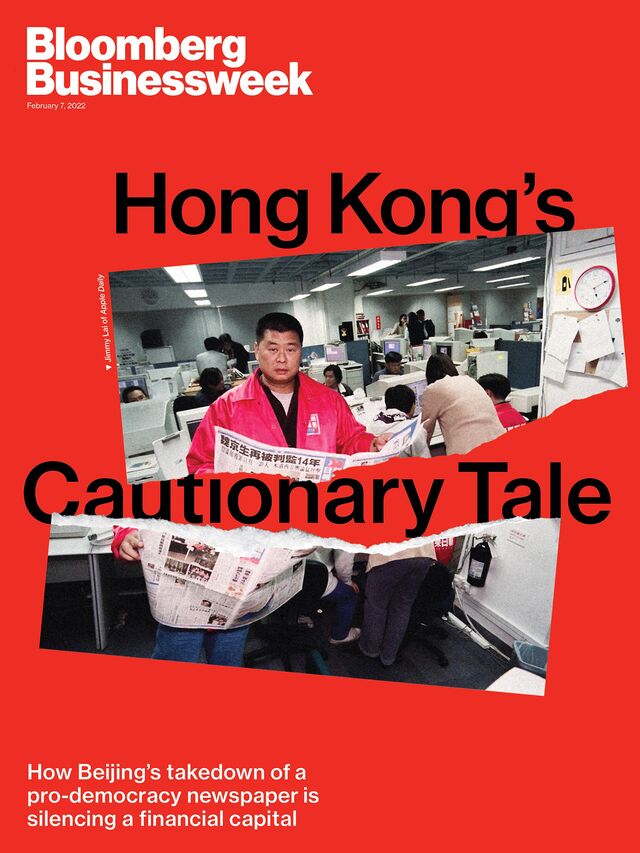
It seemed wise to stay away from the building, so Leung didn’t come in until 2 p.m. Her desk, close to where some of the arrested editors sat, was a mess; officers had ripped out her computer, leaving only the monitor behind. Leung was glad that, like many journalists at Apple Daily, she’d stopped keeping confidential documents or sources’ details on her office system. But she had little time to think about the implications of what had just happened: She and her colleagues still had a paper to put out. She borrowed a computer and got to work.
Leung had joined Apple Daily in 2018. After working for a string of more conservative publications, she felt lucky to be at the bold, if somewhat sensationalist paper. Owned by Jimmy Lai, one of Hong Kong’s most idiosyncratic tycoons, Apple Daily had more than 3.8 million registered web users, equivalent to half of Hong Kong’s population, and 630,000 paying digital subscribers. Reporters could pursue whatever stories they wanted, from profiles of democracy activists to investigations of shady real estate deals. When antigovernment protests rocked the city in 2019, Leung put on a helmet and gas mask and dashed in and out of street fights in dense, neon-lit Kowloon, dodging pepper spray and tear gas canisters fired by riot police. She kept covering the demonstrations even on what were supposed to be her days off, sending in quotes and color from the latest clashes. By then, working at Apple Daily felt to her like a cause as much as a job. “We were fighting for something together,” Leung says.
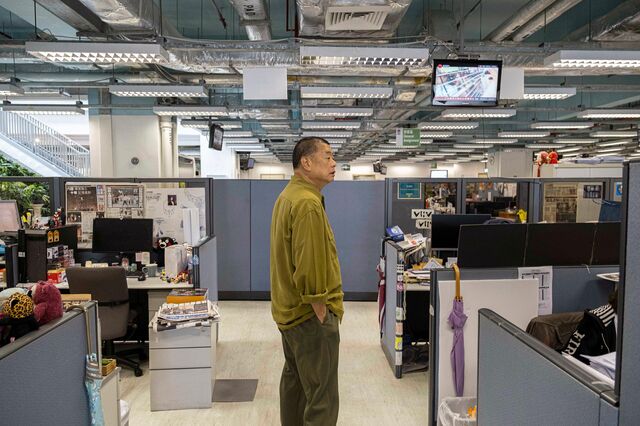
In their June raid, police arrested the paper’s five most senior staff, including the editor-in-chief and publisher, accusing them of colluding with “foreign forces” by publishing stories that called for China to be sanctioned over repression in Hong Kong. Then the government went further. Police froze bank accounts belonging to Next Digital Ltd., Apple Daily’s publicly listed parent company, citing alleged violations of the new National Security Law (NSL). The legislation gives the Hong Kong government broad powers to act against any person or entity it suspects of terrorism, “subversion,” encouraging independence for the city, or working with external actors against Chinese interests. The potential offenses are vaguely defined, encompassing activities that would be considered part of normal political debate in other places, and carry penalties as heavy as life imprisonment.
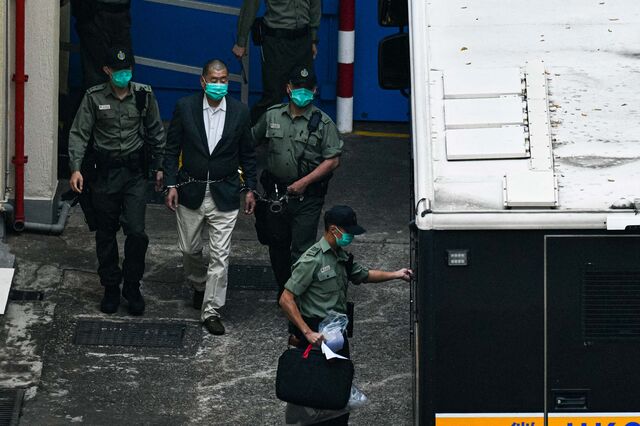
Although Next Digital had approximately $70 million of cash on its balance sheet, the account freeze left it unable to pay staff or suppliers. A week later the company announced it had no choice but to shut down Apple Daily. The arrested employees were charged with national security offenses. If convicted, they could find themselves locked up alongside Lai, 74, who was already serving a nearly two-year jail sentence for participating in pro-democracy protests. Further charges against him, alleging that he conspired to endanger China, could keep him behind bars indefinitely.
The assault on Apple Daily was clearly a sharp escalation of efforts to dismantle Hong Kong’s democracy movement. But a little over half a year later, it’s apparent that it was also something more: a turning point in the city’s public life, demonstrating just how far its authorities and their masters in Beijing are willing to go to stamp out any hint of opposition, or even of independent social organization. Nonprofits, trade unions, and professional associations have all closed their doors under official pressure in recent months, devastating a once-vibrant civil society. The impartiality of the courts—long trusted by international companies to adjudicate even the thorniest disputes—is increasingly doubted by foreign legal experts. Public access to the Hong Kong corporate and land registries, troves of information on Chinese companies and real estate that are prized by analysts, reporters, and investors, is being sharply limited. School curricula are being rewritten to emphasize obedience to China.
Hong Kong is thus a city transformed, with the freewheeling atmosphere that made it Asia’s financial hub all but forgotten. The situation has been exacerbated by draconian Covid-19 restrictions that have sealed it off from virtually anywhere else and which the local government has provided no timetable for removing. Anyone entering from overseas, vaccinated or not, must spend 14 days in quarantine, and travel from the U.S., the U.K., Canada, and other major economies has been prohibited outright since early January—all in the hopes of reopening the border with mainland China, which Chief Executive Carrie Lam has said is far more important than connectivity with the rest of the world. Record numbers of residents, both Hong Kong natives and expatriates, are moving overseas.
Lam and other officials have said repeatedly that the vast majority of citizens, as well as local and foreign businesses and investors, will feel no effects from the NSL and related changes to Hong Kong’s legal order. They insist that the dozens of politicians, democracy activists, and journalists who’ve been arrested and denied bail ahead of repeatedly delayed trials were targeted because they were genuine security threats, not because they dared to criticize Hong Kong’s direction. But as Beijing’s grip on the city tightens and the institutions that defined its modern history are hollowed out or simply closed down, what happened to Apple Daily is starting to look less like an exception aimed at snuffing out a uniquely successful source of opposition. It’s starting to look more like a template.
When Apple Daily began publishing in 1995, Hong Kong’s media was relatively staid, dominated by black-and-white broadsheets covered in dense blocks of text. Lai, a mainland-born entrepreneur who arrived in the city as a refugee in the late 1950s, made his first fortune in fashion—his clothing brand, Giordano, was a pioneer in marketing Gap-style casual apparel in Asia—and brought a retailer’s sensibility to the newspaper business. Apple Daily ran big, colorful photos under splashy headlines, often incorporating Cantonese slang in stories. Breaking-news reporters were given motorcycles and sometimes made it to crime scenes before the cops. Some of the photos they brought back were so lurid that, in the early 2000s, an editor issued a memo instructing staff to run fewer blood-spattered images. The paper had a knack for embarrassing the powerful, whether by investigating corruption or exposing the hypocrisies of politicians, tycoons, and film stars. “It totally changed the whole industry,” says Ronson Chan, chair of the Hong Kong Journalists Association. “It became a new way of doing journalism.”
That novel approach didn’t always include maintaining strict standards of accuracy or taste. In one instance, the paper had to pay a defamation award to a lawyer it had falsely accused of absconding with her clients’ money. A well-known columnist who wrote under the pseudonym Fat Dragon published ratings of Kowloon prostitutes, while much of the paparazzi-style celebrity coverage was plainly intended to titillate rather than inform. According to an ex-reporter—who, like many former employees interviewed for this story, asked to remain anonymous because of the mounting risks of being associated with the publication—ordinary Hong Kongers sometimes refused to speak to journalists after learning they worked for Apple Daily. Some members of the city’s intelligentsia, meanwhile, objected to the right-wing content of its opinion section, which published columns endorsing the 2003 invasion of Iraq, among other conservative causes. (Lai, a convert to Catholicism, has long been popular among Republicans in the U.S., and one former staff member describes Apple Daily as something like a cross between the New York Post and the opinion pages of the Wall Street Journal.)
But love it or hate it, people certainly bought it. By the early 2000s, Apple Daily was selling about 340,000 copies per day, making it Hong Kong’s second-most-read title. Its corporate parent, then called Next Media, was the city’s largest listed media company, with a portfolio that also included its three most popular weekly magazines. Flush with cash from the Hong Kong operation, Next expanded to Taiwan, launching a local edition that soon had a daily circulation of more than 400,000.
One element of Apple Daily’s popularity, practically from the start, was its explicitly anti-establishment stance. As the 1997 handover to China approached, many Hong Kong media outlets became more cautious, reluctant to do anything that could jeopardize their status once Beijing took over. Lai took a different approach, betting that widespread anxiety about mainland rule had created a market opportunity. Mark Clifford, a journalist who was on Next Digital’s board until September, recalls Lai telling him in the 1990s that “people want democracy, but no one else is going to serve it.” Instead, Lai continued, “I’m going to give them what they want.” He stuck to the same strategy even as major advertisers such as banks and property developers shunned Apple Daily, fearful of angering China. There were enough foreign companies that wanted to reach its audience to make up the difference.
Besides, in the first 20 or so years of Chinese rule, critical media coverage was broadly permitted. As a condition of its takeover, the Communist Party had pledged to maintain a “high degree of autonomy” in Hong Kong for at least 50 years, centered on respect for the Basic Law, a broad-strokes constitution that guarantees freedom of speech and assembly. Writers could publish articles and books that examined the most sensitive mainland taboos, such as the wealth of senior party officials. Protests were permitted and frequent, a tolerance that extended even to vigils in central Victoria Park for the victims of the Tiananmen Square crackdown—commemorating an event that Chinese authorities barely acknowledge took place.
Apple Daily was rarely shy about supporting demonstrations. In 2003, when hundreds of thousands of Hong Kong residents took to the streets to protest an earlier security bill, the paper was an active player, using its presses to print posters for rallies and encouraging readers to attend marches. It assumed a similar role during the Occupy Central demonstrations, beginning in 2014, in which pro-democracy activists took over part of the financial district for months.
When the 2019 unrest began, sparked by a plan to allow extraditions to China proper for the first time, Apple Daily was again on the figurative front lines. Virtually every day it ran lead stories lionizing the actions of protesters, criticizing police tactics, and demanding the government give in to pleas for greater political freedom. At times its content blurred the boundaries between journalism and activism—or leaped right across them, as when the paper ran a front-page headline before a large rally that read: “See you today in Victoria Park.”
Even Apple Daily’s defenders concede that such open advocacy made it an obvious target. “The Hong Kong government, and increasingly Beijing, didn’t see Apple Daily as a newspaper,” says one ex-staffer. “From their perspective, and not totally without merit, you were not behaving like a newspaper. It had always been behaving as an opposition political machine against them. And I hate to say it, but it’s true.”
The first police raid on Apple Daily’s newsroom occurred in August 2020, just over a month after the passage of the NSL. Officers arrested Lai and several Next Digital executives on charges similar to those that would be filed against senior editors a year later. Inside the paper, staff were predictably furious, but some were comforted that none of the detained employees were reporters or editors; locking up working journalists seemed still to be off-limits. Instead, the arrests appeared intended mainly to harass Lai, who was a high-profile critic of China’s policies in Hong Kong.
Apple Daily continued to enjoy considerable public confidence, particularly in the arena that’s traditionally at the center of Hong Kong life: the stock market. On the first trading day after Lai’s arrest, supporters bought up thousands of Next Digital shares to show solidarity, sending its stock up by 1,100%. And more than anything else, says a veteran Apple Daily editor, newsroom staff were confident that they hadn’t actually violated the NSL—and that in Hong Kong, you still had to commit a crime to go to jail. Officials had repeatedly described the legislation as a means to punish a “small minority” of criminals following the sometimes violent unrest of 2019, and they said its provisions would preserve freedom of expression. In the following months, Apple Daily kept publishing as it always had, continuing to report on topics like police brutality and the imprisonment of protest leaders. “We were naive,” a former editor says. “We thought Hong Kong had rule of law.” But the NSL, he adds, “isn’t a law. It’s a weapon.”
By the spring of 2021 the government appeared to be targeting Apple Daily more directly. In its coverage of Hong Kong’s first-ever “National Security Education Day,” which included offering tours of police facilities to schoolchildren, the paper ran side-by-side photos on its front page: one of kids playing with fake guns at a government training center and the other of real-life cops pursuing protesters. The police commissioner at the time, Chris Tang, was incensed, claiming Apple Daily was trying to “incite hatred and divide society.” Tang, who’s since been promoted to an even more senior security job, also suggested the photo spread was evidence that Hong Kong needed a law prohibiting “fake news,” even though the images were unaltered. Around the same time, according to former employees, some reporters began to hear from sources that officials wanted the paper closed by July 1, exactly one year after the NSL came into effect.
The government made sure, when it moved against Apple Daily in June, that there was no way for it to survive. With its bank accounts blocked, Next Digital couldn’t pay bills for ink, printing, electricity, or anything else. John Lee, then Hong Kong’s top security official, suggested that anyone who maintained even a tangential relationship to Apple Daily, from advertisers to convenience stores, could pay a “hefty price”—including prosecution. “You should cut ties to the suspects, or you’ll regret it very much,” he said. (Like Tang, Lee has since been promoted—in his case to chief secretary for administration, the No. 2 position in Hong Kong’s government.)
Within days, Next Digital had been forced into a kind of state-sponsored bankruptcy. It was a remarkable turn of events in a city that, for 25 years, had topped the conservative Heritage Foundation’s ranking of the world’s freest economies. Even more unusually, Next Digital’s largest shareholder had no formal say in the matter. Lai, who held 71% of its stock at the time of the raid, had already been stripped of his voting power by government decree—an almost unprecedented restriction on shareholder rights. The company hired lawyers to appeal its treatment, but the suit was quickly dismissed, with the judge saying that he wasn’t able to make a decision because of the national security implications of the case. “You have a listed company with good financials that can just be shut down at the stroke of a pen,” says Clifford, the former board member. “Is this a kangaroo court or a modern city with the rule of law?”
The Hong Kong government maintains that Apple Daily wasn’t doing what officials call “regular journalistic work,” but instead “colluded” with unspecified foreign agents to undermine the Chinese state. Bernard Chan, a businessman who sits on Hong Kong’s Executive Council, told me that the vast majority of citizens, businesses, and nongovernmental organizations have nothing to be concerned about under the NSL, though he acknowledged that some feel they need more clarity about what’s permitted. “If your aim is not to subvert or to overthrow or to promote separatism, why would any company get into trouble? There’s just no way,” Chan says. “But of course, if you are trying to test that limit or to cross that line to see when the line is breached, then you’re asking for trouble.”
The problem for many companies and organizations, as Hong Kong approaches the second anniversary of the security law’s implementation, is that the line appears to be moving nearer and nearer. Banks are now required to report any client they suspect could be “endangering national security,” and Beijing proposed, but eventually shelved, imposing a law that would expose bank employees to countermeasures if they execute U.S. sanctions against China—something every global financial institution does as a matter of basic compliance. Charities have been warned they could lose their tax-exempt status if anything they do is deemed “contrary to the interests of national security.”
The authorities have made it clear that they view the concept expansively. On the mainland, the government has cited security concerns to justify a range of policy measures, from restricting the activities of ride-hailing giant DiDi Global Inc. to forcing Chinese companies to abandon stock market listings in New York. In Hong Kong “it’s delusional to think they won’t touch other businesses if they want to,” says Dennis Kwok, a lawyer and pro-democracy lawmaker who fled the city after China’s central government began singling him out as a source of disruption. “Basically, the national security police can freeze whatever accounts and assets they want, and there’s nothing you can do about it. And going to the courts is useless, because they’re adopting the same view as the prosecutors.”
The starkest effects so far have been on Hong Kong’s NGOs. Their treatment tends to follow a regular routine. First, a police or security official blasts a group in the pages of a pro-China newspaper; next, other policymakers muse that it’s meddling in “politics” instead of sticking to its stated mission. Soon the organization closes. After that, the government usually says it’s investigating its staff. In the past six months, a similar process has occurred at Hong Kong’s second-largest labor group, at the main teachers’ federation, and at a charity that advocated for prisoners’ rights. The Hong Kong Bar Association and the Hong Kong Journalists Association have also faced mounting pressure. Lam, Hong Kong’s chief executive, said recently that the government might even cut its connections to the 114-year-old Law Society, which has a formal role in regulating the legal profession, if it’s “hijacked by politics.”
Not surprisingly, virtually no pro-democracy media outlets are still in business. In December, 200 police officers descended on the offices of Stand News, a Chinese-language website that had continued to publish critical stories, arresting seven of its employees and prompting it to shut down. (Chan, the Journalists Association chair, was also an editor at Stand News. Police detained him briefly, searching his apartment and seizing his computer.) Citizen News, another independent site, ceased operations a few days later. Books written by people charged with national security offenses have disappeared from public libraries, regardless of whether they’ve been convicted. For media freedom in Hong Kong, “Apple Daily was like the guard at the gate,” with the money and reach to contest lawsuits and attempts to restrict expression, says Mark Simon, who worked as its general manager in the 2000s. “Once you take the guard out,” he says, “that’s it.”
These changes are unfolding in a city cut off from the world by Covid restrictions, which are intended to keep local cases as close to zero as possible. Airlines have drastically reduced their schedules, and some companies are giving $5,000 grants to expatriate staff to cover the cost of mandatory hotel quarantines. Virus-fighting policies range from tight restrictions on cargo flights, which have prompted warnings of a sharp rise in food prices, to a mass culling of pet hamsters, on the theory that they could be vectors of transmission. Another rule caps gatherings in public places at just four people, with violations punishable by imprisonment. Billed as a necessary public-health measure, it’s also one more tool that prevents organized opposition.
Apple Daily went out on a high. There were long lines at newsstands for its final edition, which sold a record 1 million copies. Some shopkeepers and cab drivers still occasionally display it as a small sign that they continue to support the moribund democracy movement. Tributes to the paper’s work poured in from around the world, with President Joe Biden praising it as “a much-needed bastion of independent journalism in Hong Kong.” Its closure, he said, was a “sad day for media freedom.”
Its staff have scattered across the city and beyond, some joining the almost 90,000 Hong Kongers who moved overseas in the 12 months ended last June, a record outflow. Among those who stayed behind, many have switched careers, abandoning journalism to sell real estate, drive cabs, or, in one case, open a fried chicken restaurant. Some worry that their experience at Apple Daily makes them unhirable for many positions.
Leung, the feature writer, has become a freelancer, writing profiles of young people who participated in the 2019 protests. A substantial proportion of her subjects have received prison sentences. She publishes the stories on Facebook, earning modest wages from supporters who contribute to her through Patreon. It’s not much, but it’s enough to keep her working. “I want to record history. I want to record these people,” Leung says. “I’ll continue to do this until I get arrested, I guess.”