
Meet Private Equity’s Next Generation

Kewsong Lee and Glenn Youngkin of Carlyle Group LP are ushering in private equity’s second generation.
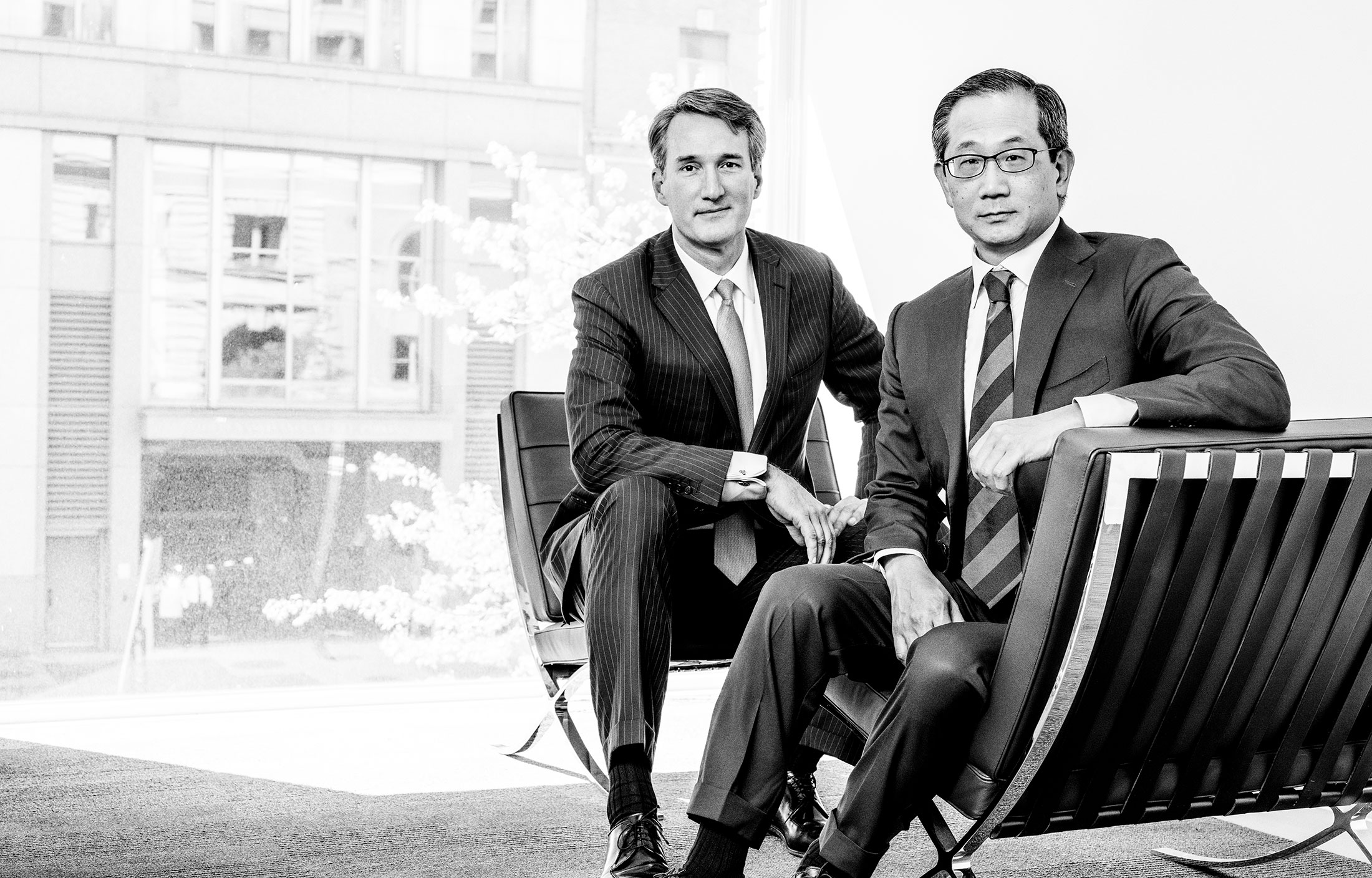
After three decades honing the art of investing, Carlyle’s billionaire founders are taking a chance on Lee, 52, and Youngkin, 51, as co-chief executive officers. Competitors Apollo Global Management LLC, Blackstone Group LP, and KKR & Co. have laid out their own succession plans, but none has turned over full control to new leaders.
The Carlyle duo, both alumni of Harvard Business School and McKinsey & Co., inherited at the start of this year more than $200 billion of assets under management and flagship buyout funds that are among the industry leaders. But the stock has lagged behind rivals for the past five years, and Carlyle’s credit and real estate funds haven’t shown the same spectacular returns as some of the competition.
In their first major joint interview, Lee and Youngkin describe what it’s like to take the reins from David Rubenstein*, Bill Conway, and Daniel D’Aniello, entrepreneurs who helped invent an industry in the 1980s but still sit just down the hall.
And they say it’s not only their company but the entire industry that’s poised for change. “Private equity,” Lee says, “is an old turn of phrase for what we are really doing.”

BLOOMBERG MARKETS Let’s start at the beginning. We want to understand how you got here.
KEWSONG LEE: I was born in upstate New York, in Albany, went to school in Connecticut, then had the privilege of being able to go to Harvard. I started out thinking I would be some kind of medicine, engineering, professional type. Having done musical theater and all kinds of other things, I thought maybe I should try this business thing out and ended up at a firm called McKinsey & Co. I was in their analyst program for a couple of years. From there I went to Harvard Business School, did a little stint at Goldman Sachs for the summer, and basically had an opportunity to go back to McKinsey or go to Goldman, and I decided to go back to McKinsey. But after a few years of that, a friend called and said, “You know, you really should come over to Warburg Pincus.”
BM What year?
KL This was back in 1992. I remember getting an offer the night before I got married. I officially started at Warburg Pincus basically right after I got married and was there 22 years before I got a phone call from Mr. [David] Rubenstein.*
BM What did he say?
KL A mutual friend called and said, “I think you ought to travel down to D.C. and meet with David.” And I was basically like, “Well, why?” And he said, “Don’t be stupid. You might as well just meet David.” What was supposed to be a very short meeting, because David doesn’t really meet for long with folks, turned into an hour and a half, and then Bill [Conway] was an hour and a half, and Dan [D’Aniello] was an hour and a half.
After my first meeting with David, I kept getting phone calls from, I think, a Maryland area code, and I don’t answer phones unless I know who is calling me. I just kept hitting “deny.” One night, I think it was a Thursday or Friday—and you’re not supposed to answer the phone while you’re driving—but I just, it was this weird number and I was about to hit this no-thank-you button, but I must have missed, and I heard, “Hello? David Rubenstein.” I looked, and literally he had called me 22 times after the first time we met. But I just didn’t know! It was late fall, about five years ago.
BM What persuaded you to say yes?
KL David basically made the pitch, “Look, Warburg is among the best at what it does, but now take that and do it a lot more globally, across a lot more asset classes, in scale and quantum.” Warburg had 8 or 9 offices, we had 33 or 34 offices. I also got some good advice from people along the way who said, “Listen, Kew, if you’re going to try and step up to leadership of a much broader, more complicated global platform, this would be it. This is not without risk. But on the other hand, if you could pull this off, that would be great, because it’s such a wonderful platform.” It’s not without complications. You’ve got founders. You’ve got politics. It’s not easy for an outsider to come in and try to have an impact. It was a little bit like Alice in Wonderland for a while, but I figured it out, and I worked well with others, and others were very supportive, and here we are.
BM Glenn, your turn.
GLENN YOUNGKIN: I joined here when I was 3. I’ve been here ever since. [Laughter] I grew up in Virginia, went to school at Rice University, was a science undergrad, and thought I was going to be an astronaut. Then I was told if you’re 6-foot-6-inches and 230 pounds, they’re not going to send you up in a space capsule. I should have known that. I was a basketball player, but one of my primary reasons for going to Rice was the Space Center right down the road.
When I was coming out of school, someone introduced me to this world of investment banking. I didn’t really know what present value meant, but I could tell you how much fluid could go through a pipe at different temperatures. And being able to add up was helpful. So I went to work for a firm that doesn’t exist anymore called First Boston, which was swallowed up by Credit Suisse. I had a great boss who said, “Son, it’s time to go to finishing school,” so I had a great chance to go to school at Harvard, which was kind of beyond my dreams at the time.
KL Don’t put that it’s a finishing school in the article.
GY I’d taken this really neat class about private equity deals, and I wanted to work for a private equity firm. When I was coming out of school in 1994, private equity firms didn’t hire anyone, so I went to work for McKinsey. About nine months into McKinsey, I was introduced to a few of the private equity firms, and I found myself here with David. At the time, in the beginning of 1995, Carlyle was 25, 30 people. We had just finished Carlyle Partners I. We were getting ready to launch Carlyle Partners II. David had some more meetings that were supposed to be short but ended up being long. I met Bill, I met Dan. My wife asked how it went. I said, “I think I can spend my career with these people. They’re good men. They’re trying to build a really neat company.” So I packed my box, because I worked across the street, and I left.
The first day, David came running by and said, “Don’t worry, don’t worry, we’ll raise money, don’t worry.” And that’s what Carlyle was back in those days. The business plan was still coming together, we were just launching Carlyle Partners II, we had a very small real estate team—and it was fabulous. Over the course of the next few years, I had a chance to work directly with Bill, to work directly with Dan, to go run our London office for a bunch of years, to run one of our global investment sectors. All along, David, Bill, and Dan have been rocks. They treat people well. They bring in great talent. As well-known as they are, they are incredibly humble people. I think that’s what keeps people here.
So 23 years later it’s incredibly humbling to play this role—to have a chance to be at a firm from the very early days, work with great founders, and learn from them, and then have a chance to play this role is really, really special.
BM When you were younger, is this where you saw your career going?
KL I actually did feel like I wanted to be a founder, entrepreneur, or leader, or something like that. Starting 5 or 10 years ago, you start having thoughts like, Oh, that would be nice. But sometimes career progression is a series of very fortunate circumstances and opportunities that arise, and it’s about trying to take advantage of them instead of trying to methodically plot.

GY I think what happens in people’s careers, as Kew said, is you’re put in circumstances where you all of a sudden have absolute new horizons opened up to you that you never could’ve dreamed of. Kew and I did a whole bunch of meetings this week together, and you have to step back and say, “What an opportunity we have in front of us. We have a small market cap relative to our peers. We have nothing but opportunity.”
BM Tell us about the moment you were tapped for this job. Of the major companies, this is the first where the founders have really handed over the keys.
KL Glenn and I had been working together for a while before the transition because we were both a part of an executive committee group overseeing the major strategic decisions of the firm. Within our respective areas, we’ve basically been doing the job without the title, in the sense of having real authority, really driving investment processes, etc.
Decisions can’t be formally made because we’re a public company—you have to make an announcement. So there’s a lot of hypothetical “If we were to do X, Y, Z, would we do A, B, C?” To the founders’ and the board’s credit, we think about succession planning a ton, not only at the firm level but at all of our portfolio companies and all throughout the firm.
They landed on a solution, and that’s when we were informed that there might be a plan and we would be a part of it. That’s when Glenn and I worked really closely together and with the founders and the board to figure out executive authority. How are the committees going to work? Who’s going to report to who? What are the day-to-day areas that Glenn’s got, what are the areas that I’ve got, how do we structure this so we’re prepared for when the formal announcement is made?
Real executive operating authority has all been handed down to Glenn and to me. All of the employees report up to us, [and we make] all decisions about compensation, hiring and firing. You’re correct in observing this is the first real transition from the first generation to the next. We were told three to four months before.
GY It was a solid four months before [the announcement that we started] the hypothetical “This is what we think we want to do. Tell us how we get the rest done.” Remember, we’re going from three to two. There were five people in the room plus our independent board. Most of these things, you put smart people in a room, and they’re going to figure it out. I think we’ve landed on a very good construct. It really is rested on the fact that we report to the board. David and Bill chair that board, so we have very frequent interactions with them. We still have an executive committee that the three founders are on.
The key then is making sure the founders understand and agree with what their role is. That’s been one of the important parts. The key is to figure out how to allow them to do the things they like to do and remove them from the things they don’t like.
So where are we today? Bill has a chance to do what he loves, which is advising investment committees, working with themes, sharing Bill-isms—which is really core to the ongoing investment tradition of Carlyle. David gets to travel around the world, talk to our investors, talk to heads of state. There may be nobody better than David doing that. Dan is still involved with the board as a chairman emeritus. So they have roles that they like, and that allows us to play our roles. On top of that we all get along really well.
KL David Rubenstein has so much energy and so much ability to get to people with his network, we’d be stupid not to use that. Bill has so much knowledge, why wouldn’t the deals teams continue to tap into that? And Dan is a culture carrier. We’re quite lucky because we can use the best of the founders while still doing what we need to do to drive the firm to the next level.
BM You’ve talked about letting David be David, letting Bill be Bill. How do you make sure that the world sees that you are the ones in charge?
KL Look, I think the greater vision and the next step of our development is about the institution, not about any one person. This is the transition that all companies have to go through, and we’re clearly in the midst of that. So, you know, it’s not about who is the face of the firm. It’s about, How do we institutionalize and invest and build an incredible platform that in the minds of our customers in the external world is this powerful investment group?

BM We talked about the division of responsibilities, but can you break down for us how things work?
KL We see eye to eye on almost every major priority of the firm. In fact, the organization has no idea we’re synced up as well as we are. Day to day, in terms of businesses, private equity and global credit are things that naturally would flow up to me given my background. Glenn naturally has assets and solutions. Certain functional areas have to come to both of us—finance, our CFO, legal, our general counsel, and our head of operations have to come up to the two of us because they’re platform-wide. And then there are other things day to day where we say, “That one’s yours, that one’s mine.” Glenn has a much deeper background dealing with public markets and our unit holders, so that’s a natural. Corporate development, I got the lead on. But we’re connecting all the time on those kinds of issues.
The year-to-year stuff, we’re kind of on the same page. The day-to-day, we tend to leave each other alone.
GY And there’s a morning-to-morning sync.
BM Do you have a shared Google calendar?
KL No, not that far!
GY I do feel sorry for folks who have two bosses day to day. Poor [Chief Financial Officer] Curt Buser, he does a great job. Because Kew and I sit next to each other in Washington, and we sit next to each other in New York, Curt’s right beside us. He just is really good at grabbing both of us at the same time. We meet with Curt every Monday morning, and we go through our agenda. We make sure the three of us are synced up.
KL Carlyle has a culture of cooperation and a culture of partnership that is genetically embedded in the organization because of the way the founders worked and the way the firm developed. If you look at our investment teams, we almost always have co-heads, not single heads. It is not a weird thing at Carlyle—in fact, it’s the opposite.
It does put pressure on certain key positions. Glenn used the phrase “You’ve gotta be Gumby”—Glenn over here, Kew over here. We have special people we can put into these places, and they’re quite adept at understanding [how to adjust to our] different styles.
BM Can you give more detail about how you work together on a typical day?
KL We’re probably the first two guys to come into the office and among the last two guys to leave, so work-ethic-wise, we’re very much on the same page. Communication-wise, we call each other or we walk into each other’s offices. Being right around each other is great. We just make sure we sync up, because at the end of the day, we know we can get a lot more done than if we were to do it each on our own.
GY I’ll also add that we will routinely run off to an adjacent office in a building next door and spend a long two hours together with nobody else around. “What do you think about that? How about this? Are you on board with that?” And that’s critical. And we just call them the Kew-Glenn off-sites. It takes the pressure off of—you know, folks do watch what we do.
When we are in big group discussions, we are going to, of course, debate. We do debate in front of other folks. But we want to make sure we are synced up on big issues so that we can lead together. This is just basic respect for each other. If you make sure you are putting the time in to treating the person as a true partner, it works.
BM How did you initially get to know each other, and how did that develop? Was it going to dinner together or taking in a ballgame?
GY When we had problems in our credit business, Bill sat the two of us down and said, “One of you has got to go fix this. Kew, you’re in New York, you fix this. Glenn, you work on these things.” We were part of the executive committee, but we were always working on different things.
KL To be honest, it’s not like we’re going out and drinking and bonding around the campfires, roasting marshmallows and singing songs. The key ingredient isn’t the social-bonding stuff. It’s the understanding that we respect each other and are synced up on a commonality of purpose.
GY There are things along the way that give you faith in your partner. My mother passed away in February, and we’re at my mom’s memorial service, and Kew and [his wife] Zita show up. That means a lot. You’re dealing with a funeral, and he said, “I got it, don’t worry.” That’s a different kind of partner.
As you are thrown into this role, you end up recognizing that the CEO job can be a very, very lonely job. This construct arguably could be a better outcome—when you actually have a partner who in the morning you can speak with and say, “Did you see that happen yesterday? I thought it was crazy.”
There’s no more succession planning here. We’re going to win together.
BM How has the organization changed under your leadership?
GY Our founders have been fabulous. And they have very comfortably gotten used to the statement “You should speak to Kew and Glenn about that.” And that’s step No. 1.
BM How worried were you that this might not happen?
GY Given the purposefulness and discipline that went into the whole process of setting this up, I was actually very confident. This was handing over the CEO title, and therefore the founders were really committed to making it work.
This organization is founded under one basic principle, which is investment excellence. And everybody recognizes that in order to be excellent investment advisers, we have to be a fabulous business.
Let’s be blunt. Blackstone is really good, TPG [Capital] is really good, KKR is really good, Apollo is really good. If I leave someone out when you write this, then fill them in. Everybody here knows we have great competitors. People want to win. Driving the organization to actually be able to win, all it does is reinforce people’s enthusiasm for being here.
KL It’s important that from the very top we have folks who are cut from the cloth of investors. I still spend a vast majority of my time on investment committees dealing with investment decisions because that is the life and soul of the place.
Not only are our competitors sophisticated, but our customers are also so sophisticated with their thinking these days. It’s all we can do to keep up with them to make sure we’re providing them our very, very, very best. I like competition—it makes us better. I like sophisticated customers—it makes us better.
GY The other thing that’s been really rewarding and comforting is that the teams have really come together. Pete Clare, who serves as our co-CIO, has been here forever. Pete as co-head of U.S. buyout and co-CIO just continues this tradition of investing. Xiang-Dong Yang, who’s our chairman in Asia, is the best investor in Asia. He’s just outstanding. And that business continues to grow. Marco De Benedetti and Gregor Boehm, who run our European buyout business, have been with us a long time. They’re fabulous. Sandra Horbach, who’s now co-head of our U.S. business, joined us 15 years ago and has truly established her mark on how we think about investing. Marcel van Poecke, who is going to head up our energy business around the world, is one of the foremost investors around the world. Rob Stuckey, who runs our real estate, Mark Jenkins who runs our credit, Lauren Dillard who runs our solutions, who is homegrown from Carlyle—we just have outstanding people running these investment platforms.
The firms when they grew up were about founders, and now they’re about huge teams. Huge teams coming together to deliver outstanding investment results.
BM Do you need more gender and racial diversity?
GY One of the clear challenges in the financial sector broadly is both race and gender diversity. The numbers are something like 9 percent of senior executives are minorities or women. Carlyle, a number of years ago, began to dedicate itself to addressing this. We adopted a top-down approach, which I think was critical. We did it systematically through hiring in the entry-level and middle-level and growing talent, although we had a few notable external hires. We still have a long way to go. Just about 20 percent of the principal group, up through partner, are either gender- or minority-diverse. The more telling number is our incoming class of buyout associates, which is a reasonably large class, and it’s 63 percent diverse. We’ve had that kind of number for the last four or five years, which is how you feed diversity in a way that is consistent with your culture. Kew and I, the second we stepped into this role, we emphasized that this approach was not only going to continue, but it was going to be one of our key priorities. We feel like, from a numbers standpoint, we’re better than the industry. In an absolute sense, it’s still wholly not acceptable.
KL I just want to add that it’s not diversity for diversity’s sake. We cherish, at Carlyle, diversity of thought. The way we do things, make decisions, are investing—it requires an ability to have a lot of creativity and diversity of thought. And we push that even beyond Carlyle employees. Glenn and I, starting a year and a half ago, we put out that we want our portfolio companies, especially those businesses we control, to increase diversity on the board, so the portfolio companies can benefit from diversity of thought.
BM How would you describe Carlyle’s culture, and what are some reasons a person might not fit in?
GY At the core of our culture is a demand that we push each other, that we perform, and that we respect each other. The comment I make to every incoming class—and if I had my business card in front of you it would actually work better—is that you can’t spend more time thinking about the black part of the business card than the blue part. The blue part says, “The Carlyle Group,” and the black part is your name.
BM Your stock has lagged behind Apollo, Blackstone, and KKR. Why?
GY We’re a young industry in an absolute sense when it comes to relationships with public unit holders, and we’re complicated. We don’t report the same way that a simple manufacturer does. The public-investor universe doesn’t fully appreciate how good we are as an industry and, specifically, how strong a firm Carlyle is. We have four segments that each would be an industry leader on its own and collectively are incredibly strong. We don’t feel like we get rewarded for it in the public marketplace yet. Remember what our private investors do: They sign up for a 10- to 15-year partnership and allow us to have full dominion over their capital. The public investors just don’t have 30 years of experience with us yet.
KL It is frustrating but understandable why the public values us the way they value us. Each one of these firms is very different. I would argue that, over time, all of us as a class have suffered. All of us are basically no higher than when we went public. I think it’s a little bit unfair to pick X period.
BM One criticism of Carlyle is that, outside of private equity, there have been some struggles. What do you do, maybe starting with credit?
KL The first thing you have to do in credit is recognize it’s a fundamentally different asset class. It has a different rhythm. The velocity and flow are much faster. It’s not as episodic as private equity. It’s also more scalable if you do it right. And the most important thing we could have done is first understand that. Second, we brought in a great person to build the business. One piece of credit I would give to Blackstone—they have been able to identify unbelievably talented leaders, and the senior-most leaders and founders in the firm have been great in supporting them and allowing them to build businesses. That is what we are doing in investing behind Mark Jenkins.
We are pretty well advanced in our credit platform and have $30 billion-plus of assets under management. [That includes] an unbelievably performing direct lending business, we just got our credit opps [opportunities] business going, and we have a distressed [investing] business that’s been top quartile four successive funds in a row. But it hasn’t really had the top-down orientation of saying this could be a really meaningful business.
BM What about buying a credit business?
KL If we could buy it, great, but I would point out a few things. It may be the wrong time in the cycle to buy because it’s expensive. Two, acquisitions culturally and integration-wise are very difficult. And three, we already had an existing platform. If you have nothing, maybe you go out and buy, but we already have something. So it almost might be easier to invest in that, give it some hugs and some capital. I think we’ll be in a better spot five years from now if we just help it along. That doesn’t mean we won’t selectively and opportunistically buy things.
GY The key decision point around this buy-build topic was when Kew was able to recruit Mark Jenkins. It’s all about leadership, and when someone with Mark’s experience comes in and says, “I have a view of how I can work with you guys at Carlyle and how to build this business,” it’s a compelling argument to build it.
BM What about real estate?
GY If there were two areas with relatively meaningful growth opportunities, they’d be credit and real estate. To put things into context, private equity is about $75 billion in assets under management, real assets is about $45 billion, credit is $33 or $35 billion, and then the solutions business is $45 billion. We have a great foundation in the U.S. real estate business. We’ve just crossed over $5 billion in commitments for Carlyle Realty Partners VIII. This is one of the bigger real estate businesses around.
The opportunity is in fact to grow it and go from a big established business to a really big-scale business.
BM There’s been a lot of talk from your competitors about attracting retail investors.
GY Kew and I talk about retail probably every third day. High-net-worth retail, which is really what people are targeting for most of what’s out there today, is a big area for us. We offer our funds through most of the private banks. But the big step in retail is when you all of a sudden create structures and products that appeal to a larger group. One of the big steps was an IPO for our BDC [business development company]. It trades very well.
KL Liquidity and finding the right structures that will be protective of these investors are tricky. It’s not conducive to private equity, which is inherently difficult to scale. You have to be very careful. Credit is something that might have more validity. It’s scalable: You can get in and get out. Certain structures within real estate might be the same way.
We have had lots of people working on opportunities, not only in retail, but also in other forms of permanent capital. In fundraising you either die of dehydration or you die drowning from the fire hydrant. If you’re not careful with retail, that’s the fire hydrant.
BM In terms of the institutional investors, where does that go?
KL When you look at the construction of most funds these days, more is coming from the biggest LPs. If you go down to the bottom, more is coming from high-net-worth and feeders. That middle section of clients has gotten compressed, some of our statistics show, by like a third. These are pension funds, etc., that may have a harder time keeping up with the speed of fundraising, trying to figure out how to co-invest, and trying to get allocation of funds that are more oversubscribed.
At the same time, the big sovereigns are saying, “How do I get more strategic benefit? The best way to do that is concentrate some of my dollars and make sure I focus in on these two or three GPs.” Meanwhile the middle [tier of investors] is coming to the exact same conclusion that it’s a pain in the neck to manage all these relationships and they’re not getting any benefit, so they’re trying to narrow down their list. So, folks like us, if they can perform, will just get more and more of the dollars. When the big guys come to us and say, “We want fee concessions,” the offset is just that there’s more demand. That’s where retail comes in. Retail is relatively less price-sensitive.
BM As you think about geopolitical and economic concerns, what are the things that worry you?
KL The most important thing we have to watch out for is complacency. Volatility has picked up. But I remind everybody, I’m not so sure volatility has picked up as much as that the past six to seven years was abnormally low volatility.
Of course markets can come down and disruptions can happen, but that’s kind of an episodic thing. Our business model is much longer term so you kind of push through that. And if anything, it may be more of a reset opportunity.
One risk that all of us need to think hard about is, What happens if valuations persist? What happens if the central banks and policymakers do make it right? What happens if asset valuations rise another 15 to 20 percent? So all of us are worried about the pullback and positioning to make sure we don’t get burned. On the other hand, the cost of not being deployed adequately is penal if everything keeps going up for another 10 to 20 percent. So the risk of underinvestment is a real risk that you have to watch out for in a world where things are more or less clicking along and prices remain high. It may be the biggest risk we have, yet all of us have turned a little bit defensive.
GY Our general view is that’s a reasonably likely outcome. The stability of the banking system relative to what it was back in 2006-2007, the integrated nature of economies suggests that this could go for quite a while. We are all watching the central banks and recognize that there’s a reasonable chance they do get this right.
What the big investment risk has been over the last 20 to 25 years is when people took big breaks [from investing]. The best portfolios consistently invest over many, many years.
KL Maybe there is a dislocation. Maybe flows go one way, and we were hoping they’d go another way. We have investment strategies that profit from that. Special situations funds, opportunistic funds, distressed funds would love for that to happen. Keep in mind, in private equity—in Europe it’s a little bit less, in Asia it’s a little bit more—about 70 percent of all our investment returns are driven by fundamental Ebitda growth as a result of revenue growth or productivity enhancement.
We used to be good deal guys, good financial engineers. Increasingly now, we’re in the business of spotting terrific CEO partners and management teams, finding great companies that we can make even better, and assessing the ability of that team to create fundamental value at these companies.
GY In a period where asset prices are high, there’s a risk that they stay high for a long period of time. There’s also a risk that there’s a reset. What do you do? You recognize that in order to buy an asset you’re probably going to have to pay the highest price. So you better be in the center of the bull’s-eye, stuff that you have great amount of conviction with, sectors that you’ve been investing in for 25 to 30 years, management teams that you’ve backed before. That kind of capability, in a culture like Carlyle, we think is unmatched.
KL The only offset to a full price is having a better plan.
A Salvage Operation
BM How would someone describe a Kew- and Glenn-led Carlyle that’s different from the one that was founded 30 years ago? How will you make your mark?
GY I would say that in 10 years’ time, the firm won’t be about two individuals who founded it or are running it. The firm will be about excellence. It will be about culture. It will be about a place where we can recruit people to spend their whole careers. This industry has been defined by great entrepreneurs and founders. They are just extraordinary. Our job is to take Carlyle into its next decade with the ambition that it will be about Carlyle, not about a couple of people.
KL This industry is evolving. Private equity is an old turn of phrase for what we are really doing. Even the word “alternative” in front of “investment” in 20 years may no longer be there. The whole role of what we do in the global economy is only going to grow.
Look at the number of IPOs that are happening now vs. 10 to 15 years ago. It’s a fraction. Who wants to be a public company these days if you can get more money from us on great terms? Do you need to go public just for a branding event? No, you can do a deal with a private equity firm. Do you need an IPO to attract management talent? In fact, we can attract better management talent.
*Rubenstein hosts a show on Bloomberg TV.
Kelly is an executive editor and New York bureau chief at Bloomberg. Perlberg reports on private equity from Washington.