
Your Next High-End Safari Destination: The Plains of Montana
From 
“If you listen closely, you can tell their tones apart,” says Daniel Wendell, a private chef and, for the moment, our color commentator on a late summer’s elk rut on the Great Plains of Montana. From an overlook in the Charles M. Russell National Wildlife Refuge, my wife, Mary, and I have been following the action through binoculars and a telescope. In between his analysis, Wendell and his team set a table—linen, china, cloth napkins, wineglasses, wildflower arrangements—for an evening picnic.
Downslope on a tawny cottonwood-studded meadow, five or six elk bulls move among several dozen cows and bugle their mating call. To my untrained ear, they all sound about the same—the louder and more frequent, apparently, the better a bull’s chances to expand his harem. But for such immense beasts, some of their tones are awfully squeaky, like a pennywhistle dropped into a pail. Let’s Get It On sung not by Marvin Gaye, but Alvin and the Chipmunks.
What we’re really hoping for, naturally, is a fight. As Wendell plates our first course of baby kale tossed with tomatoes, Wagyu bacon, and tamari-toasted buckwheat, another of our hosts, Alison Fox, calls our attention to one particularly restive bull. He pulls up alongside another, and at first they take a little walk together. Then, right as it seems they might wrap things up—“good talk, man”—they back up, square off, and charge.
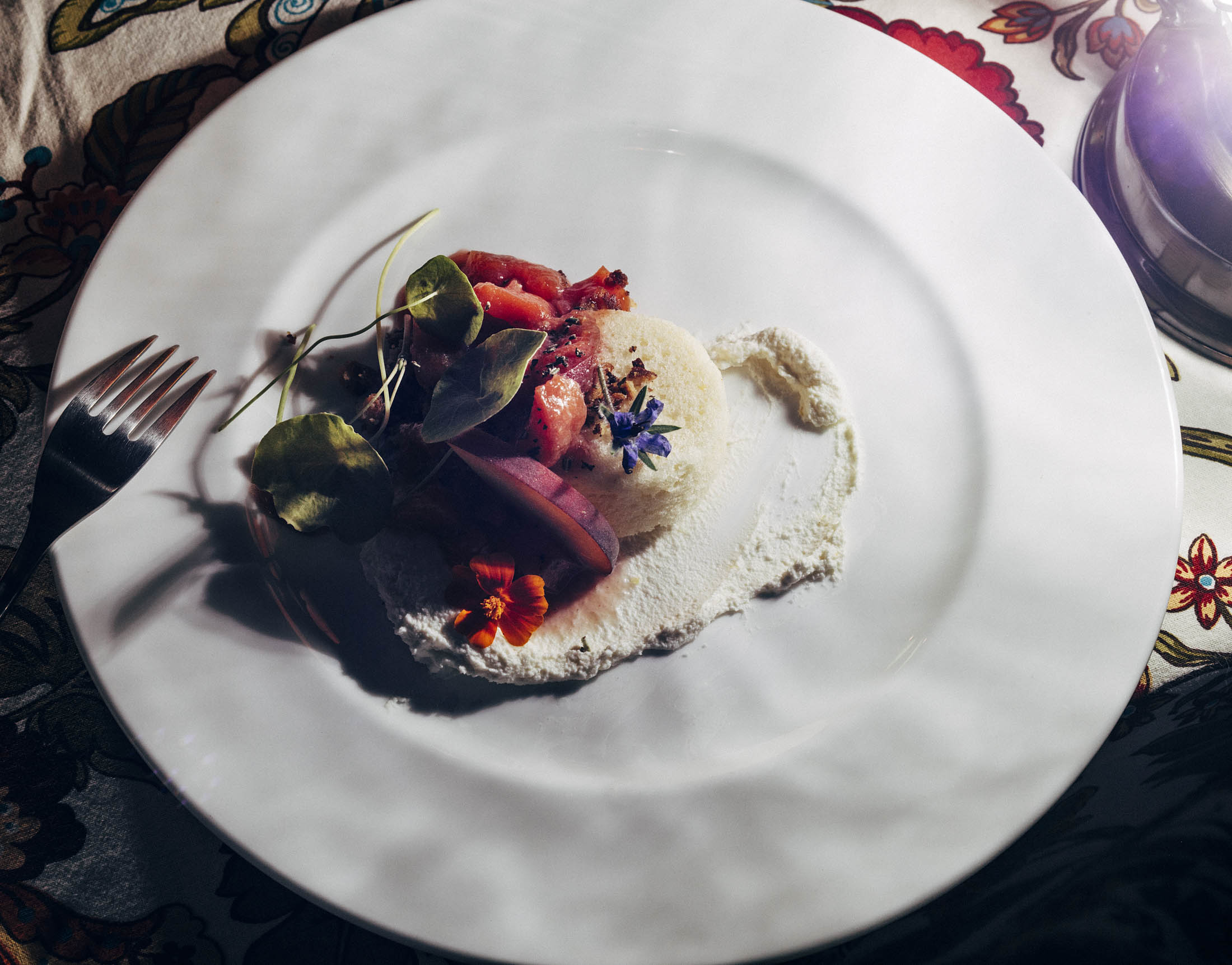
Even from our distance, we can hear the clack of their racks colliding and the grunting trash talk that follows as they push each other around. “There’s more where that came from, buddy,” Wendell translates. The challenger relents, and we turn to our appetizers, which are followed by a meal of sous vide rib-eye loin with golden yams in a horseradish crème and, for dessert, sponge cake with whipped ricotta, peaches, and edible marigolds and nasturtiums.
We’ve come to Montana to explore the American Prairie Reserve, an ambitious project that reflects a sea change in how land and wildlife conservation is practiced. Whereas most U.S. national parks’ boundaries are based on the attractions people wanted to visit, the APR is drawn from the range and migratory patterns of plants and animals, so that native species, including the endangered black ferret and long-gone brown bear, can recover and return.
Founded as a nonprofit in 2001, the APR has raised about $80 million, all from private donations. Some are from high-profile philanthropists such as Susan Packard Orr, daughter of the co-founder of Hewlett-Packard, or the heirs to the Mars candy fortune. Smaller contributions have come in the public radio $10-per-month range. That funding has been used to buy and lease some 307,000 acres to fill in the gaps between existing federally protected areas such as the Russell Refuge and Upper Missouri River Breaks National Monument. Right now, the APR is a patchwork of parcels that don’t yet form a single park. Eventually the reserve will spare the plow on 3.5 million contiguous acres—an area the size of Connecticut that stretches east from the Missouri Breaks to Fort Peck Lake in central northeastern Montana.
One way to think of the APR’s approach is as an American take on the African safari. (An early National Geographic documentary on the project is called American Serengeti, a phrase the reserve eagerly promotes.) African safaris hype the “Big Five”—lion, leopard, elephant, rhino, Cape buffalo. So far, the APR reliably delivers a “Big Two,” 800 head of American buffalo, aka bison, and those elk we spy on during our picnic.
The reserve seeks to include other native species such as mountain lion, wolf, fox, bighorn sheep, and brown bear. “We tend to think of grizzlies as creatures of the mountains,” says Fox, the APR’s thirtysomething managing director, “but that’s only because they’ve been forced to hole up in the Rockies or parks like Yellowstone. They used to run the Plains.”
For the past 15 years, the reserve has been working to put itself on the map with Yellowstone and the region’s other better-known attractions, the Grand Tetons and Glacier National Park. It may not have an Old Faithful, but it does have Kestrel Camp, a handful of luxurious yurts that opened in 2013 to entertain donors and tourists willing to spend $4,800 for a two-person, two-night stay, during which they’ll be well-fed by Wendell, who came into his own following a stint at Chez Panisse.
We finish our picnic and take the two-hour drive to camp. As we emerge from our dust-choked and bug-splattered rig, we’re treated to a breathtaking array of Northern Lights. These aren’t the green-curtain Aurora Borealis familiar from pictures taken in Alaska or Scandinavia; they’re more like the opening-gala searchlight edition, a half-dozen shimmering ribbons of color combing the Milky Way.
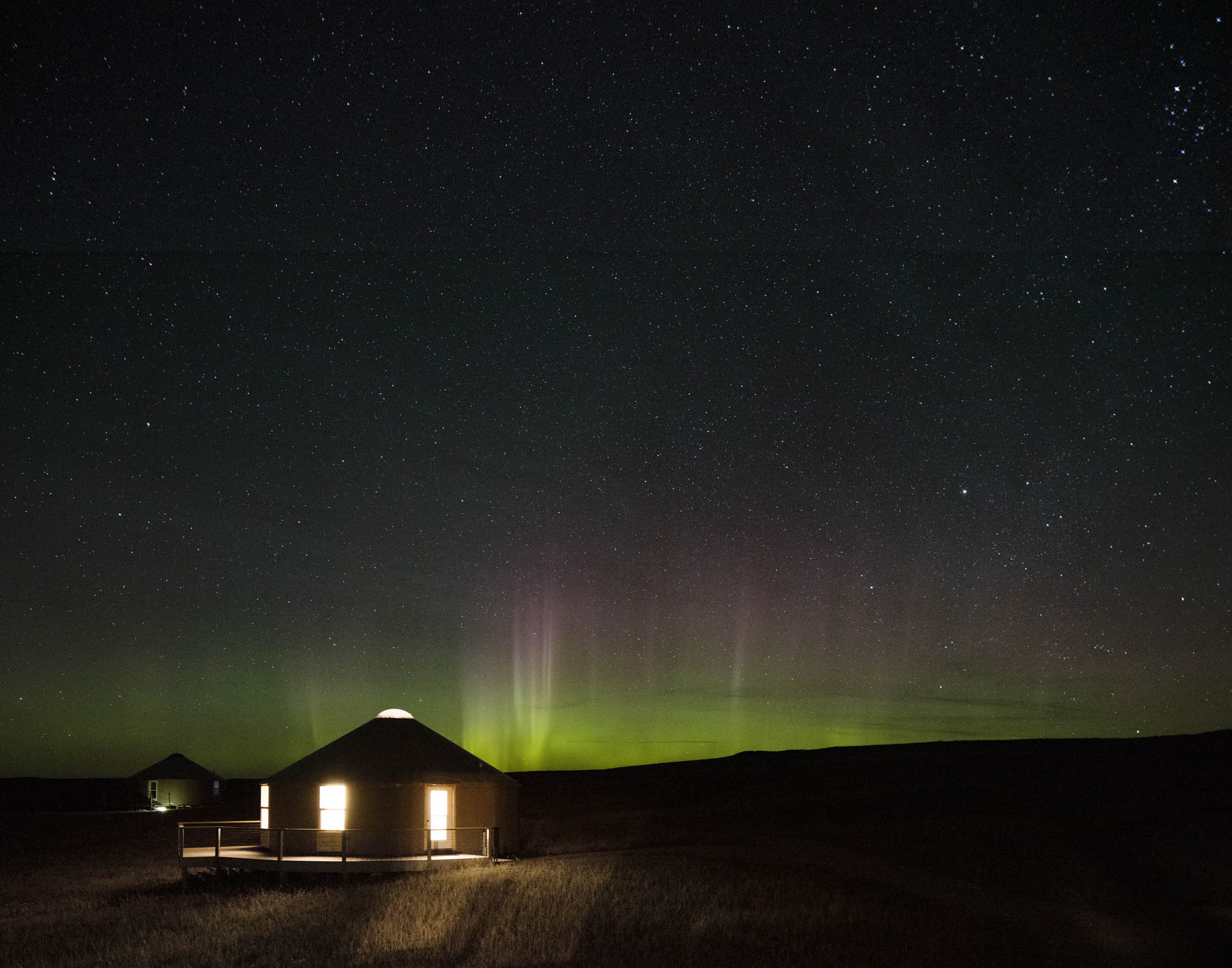
One other advantage to arriving in the dark: You wake up the next day to discover just what you’ve gotten yourself into. At Kestrel, this reveal is made more dramatic by the way the sunlight pours like a bore tide across the Plains, a time-lapse photographer’s dream landscape.
We brew up a pot of the Ghost Town coffee provided in the yurt and sit on the deck, steam rising from our mugs, the last of our travel stress melting away. Some years ago, I’d moved to the high desert in New Mexico and worried I’d miss living near a body of water. A hippie did his best to reassure me: “Dude, the sky will be your ocean.” I’d laughed, but he wasn’t wrong. That mind-clearing horizon is here in Montana, too.
As in the desert, prairie mornings start chilly but warm up fast. We’d arrived at the tail end of summer, so we wear lightweight puffs for the short walk to the communal yurt for breakfast. Afterward, we peel them in a slight sweat. The unofficial APR look is a fleece tied around your waist, sun hat, and zinc for your nose. It’s a place of blazing sun and goosebump-raising breezes, for short sleeves and a wool hat at the same time.

We pile into a Mercedes Sprinter van to begin our safari. A guide, Ellen Anderson, takes us to a prairie dog town, where we hear the industrious buggers clicking to each other. At the Enrico Education & Science Center, a 7,000-square-foot modern building, we meet a few summer interns. One young woman sitting with a pad and watercolors paints a still life, which looks like a great way to spend a few hours out here.
It turns out to be a splendid day for wildlife peeping. We see coyote, mule deer, pronghorn antelope, sage grouse, and a meadowlark. But the bison are the draw. At one point, a dozen or more surround the Sprinter, and a few slam their massive bodies to the ground just a few yards away for a dust bath. They roll back and forth like happy dogs—really, really big happy dogs. Although they don’t have the royal bearing of a lion or the gawky swing of a giraffe, they’re captivating to watch, even when they aren’t up to much. They seem so top- and front-heavy, I keep waiting for one to tip forward and face-plant.
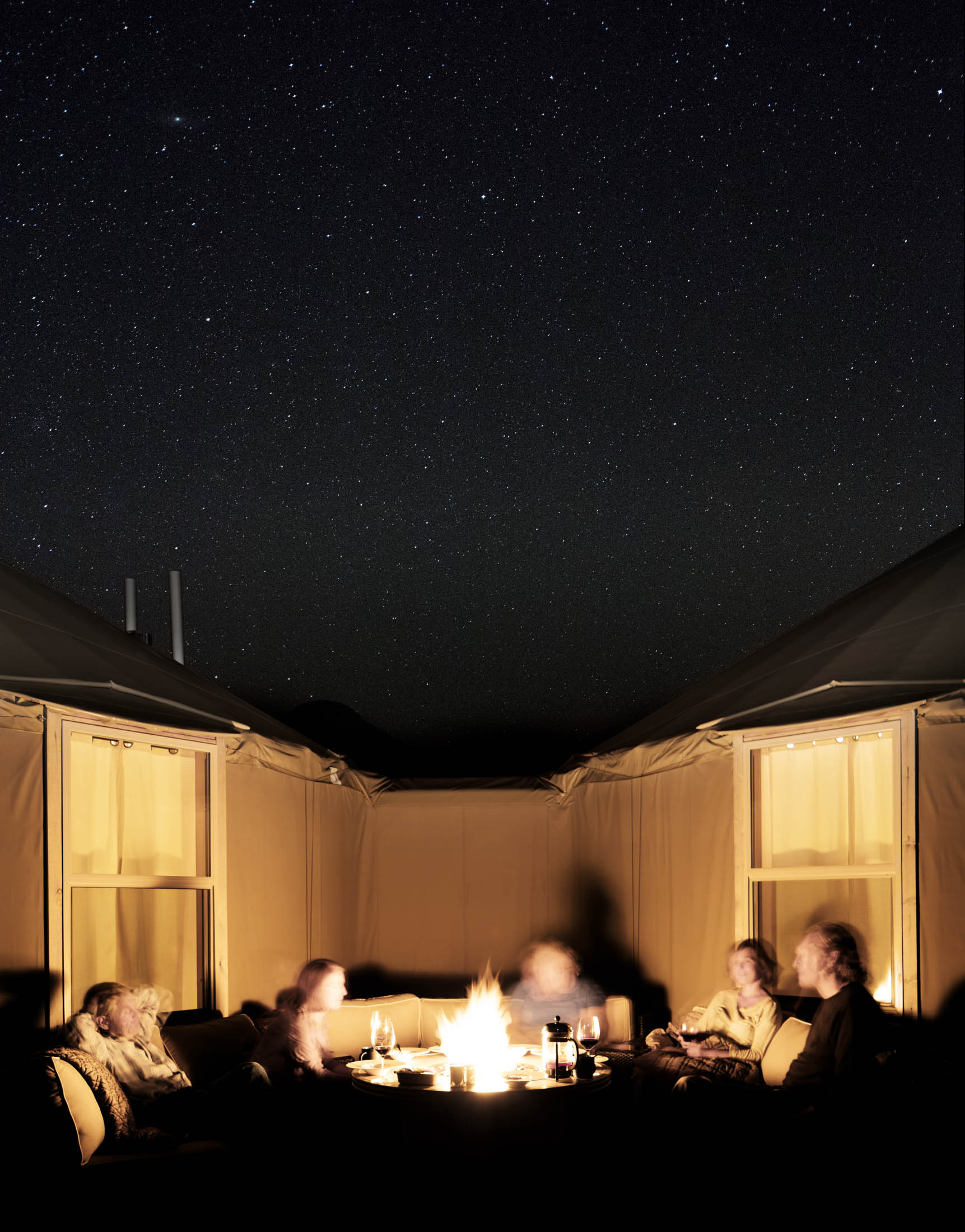
Wendell indulges us with another exquisite meal at the dining room yurt that evening. (The sauvignon blanc and trout stand out.) We end the night around a fire pit with the other guests, including two longtime APR board members, Gib and Susan Myers. They’re both retired; Gib was a partner at the Mayfield Fund, a Menlo Park, Calif., venture capital firm, and Susan helped produce documentary films. Everyone proves fine company, but at the end of another long day, and with a neat High West bourbon in hand, it’s tempting to drift from the conversation and just stare at all those stars.
The explorers Lewis and Clark stopped near here on April 22, 1805. “I ascended to the top of the cut bluff this morning,” Meriwether Lewis wrote in his journal that day, 11 months into their 28-month, 8,000-mile trip from St. Louis to the Pacific and back to explore the Louisiana Purchase territories. “I had a most delightful view of the country, the whole of which, except the valley formed by the Missouri, is void of timber or underbrush, exposing to the first glance of the spectator immense herds of buffalo, elk, deer, and antelope feeding in one common and boundless pasture.”
At that time, two skilled hunters could provide all 200 members of the Lewis and Clark team with 8 to 10 pounds of meat per man—a literal ton of meat each day. Broadly speaking, the APR wants to bring back the plenitude Lewis described.
“We looked all over, at all the last remaining grassland regions, the Yukon, Alberta, and Saskatchewan,” says Dr. Curt Freese, a conservation biologist who partnered with the World Wildlife Fund and other private groups on this reserve in 2000. He’s also developed an index—the Freese Scale—to help land managers balance agricultural production and ecological vitality. “Here in Montana, we found the largest areas of intact land, the highest concentration of biodiversity, and the lowest [human] population density.”
On the third day of our visit, I’m invited to join a group making a “transect,” or crossing, of reserve land by foot and mountain bike. Even though it means giving up the splendor of the yurt for a cot in a canvas tent, I jump at the chance. Some of the trails are single tracks, much of it’s fire road, but it all makes for a decent morning’s ride. From my bike perch, I take in some spectacularly weird places I might have otherwise missed.
We move through several distinct terrains: juniper and ponderosa on knolls similar to the Black Hills of South Dakota; a steppe that reminds me of ones I’ve seen in Nevada; and stretches of calf-high, waving grasses and sagebrush. I feel like a bit of a poser—most of the group I’m with have been rolling for 13 days so far. But then we crest a hill with the sky so high it feels less like cycling and more like flying.
On the ride, I get to chat with Sean Gerrity, the APR’s 57-year-old president. Given the populist moment we’re in, it’s not surprising that the reserve is controversial. “Don’t Buffalo Us” signs stud a few roads leading in and out of reserve property. Gerrity speaks freely, if carefully, about the friction. The crux of the conflict, he says, is buffalo vs. cattle. Restoring the natural order of things on the prairie makes cattle appear, as they are, an invasive species. Cowboys don’t take kindly to the notion of anyone telling them how to be, and exaggerated fears about bison as vectors of disease abound as well.

Gerrity says the reserve isn’t pushing anyone out or threatening anyone’s livelihood—or livestock. “We only buy land from willing buyers,” he says. The reserve has created a for-profit brand, Wild Sky, to sell grass-fed beef from area ranchers at regional supermarkets as an added incentive to help them tolerate wildlife on their property instead of hunting and killing it.
Although Mary and I did miss the comfort of the yurt (even the clever moth that figured out how to trip the motion sensor on the night light), the transect wasn’t roughing it too badly. The part that was hardest to get used to was something I hadn’t expected: the wind. Almost all day, every day on the prairie it blew. Even when there was no other sound, it was always loud. At times, the wind roared like a standing ovation at a stadium; at others, inside the yurt, it thrummed like soft rain or radio static. Then, when it did stop, a deep silence took hold, like a black hole had eaten all the noise in the world.
A two-night stay at the yurts in Kestrel Camp on the American Prairie Reserve begins at $2,400 per person, including meals.
(Corrects the cost for a two-night stay for two people in the ninth paragraph.)