Institutional investors are playing a much more influential role in crypto markets as retail traders <meta itemprop="suid" content="RIX7KJDWLU6K"><meta itemprop="type" content="StoryLink">retreat, and that explains much of the recent rangebound price action, according to Michael Safai of trading firm Dexterity Capital.
“We might have been playing checkers two years ago,” said Safai, whose firm traded more than $1.2 trillion in crypto last year. “We’re playing chess now.”
Safai joined the “What Goes Up” podcast from London this week to discuss the state of the digital-assets market, and how high-frequency crypto trading strategies differ from the famous “<meta itemprop="type" content="WebLink">Flash Boys” of the stock market. Here are some highlights of the conversation, which have been condensed and lightly edited for clarity. Click below to listen to the full podcast, or subscribe on <meta itemprop="type" content="WebLink">Apple Podcasts or wherever you listen.
Q: Tell us about Dexterity.
A: The short version of Dexterity Capital is we’re a proprietary trading firm. We specialize in high-frequency trading of market-neutral algorithmic strategies for cryptocurrency assets. So there’s about a team of 17 of us and together we trade a few billion dollars’ worth of crypto per day. In 2021, we traded over $1.2 trillion, which made us one of the biggest traders of cryptocurrency in the world.

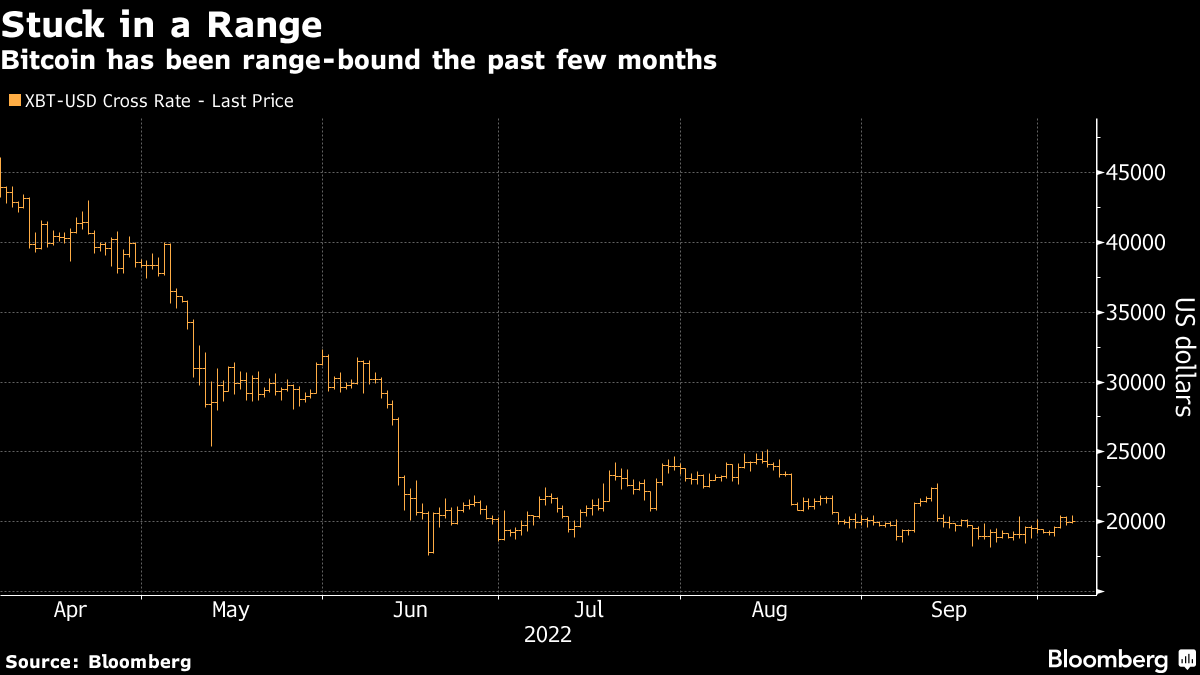
Q: How do you explain the fact that Bitcoin and other cryptocurrencies have been range-bound for the last several months?
A: There’s a few factors. As we all know, with the Fed raising rates, money’s tightened up. And with the kind of big controversies we’ve had in crypto around the Terra crash and around the Celsius collapse, retail has fled the market. So what’s happened in recent months is we’re seeing a lot more institutional flow than we did over the course of the past five years. Now, institutional players are smart. So when we might have been playing checkers two years ago, we’re playing chess now. And when you’re playing chess, things tighten up and these guys are keeping things in the same range while we do price discovery, but still try to make a good profit.
Q: Crypto has been trading in tandem with stocks. What are some of the factors that have influenced crypto this year?
A: With institutions coming in, they’re playing by the rules they’ve always played by. So we’re crypto-native -- Dexterity never traded equities, we’ve always traded crypto. And that’s what we were raised on, so to speak, over the course of our five-year history. But as institutions have come in, they’re bringing in strategies they adopt in mainstream markets, in equities markets, in FX. So part of what we’re seeing is that as equities drop, Bitcoin drops and they stick together. And it’s because the same strategies are being enacted by big players in the institutional world across both asset classes.
Q: So much of the focus on high-frequency trading in equities is the idea of latency (or maximizing technology to reduce the time it takes to make a trade). Is that a factor in crypto at all?
A: I always feel kind of funny talking about crypto and HFT because the real “Flash Boy” HFT, you’re talking nanoseconds to microseconds latency. And in crypto you don’t really get there. The difference is co-location is the exception. Most of the major crypto exchanges in the world are all in AWS (Amazon Web Services). So it’s not like I can go buy a machine and put it right next to theirs and try to minimize the length of my cable down to one meter, instead of two, to be faster.
So it’s fundamentally different, and there’s two types of latency to think about. There’s internal and external. So external is that AWS layer: I want to submit an order, I’ve got to send it through a bunch of machines across the world and try to hit the receiving exchanges as fast as I can. That’s something these days that’s on the order of milliseconds and that’s true whether you’re Citadel or whether you’re Dexterity. And it’s an interesting problem still to solve.
Q: When you talk about all these institutions entering into the market, how much of their strategies are HFT-based as well? Are we really in a speed battle at this point among the big traders of the crypto industry?
A: Not yet, but we’re getting there and we can see it now. And part of it is exchanges themselves maturing. So we talk about latency, but it’s also once I’ve sent a trade to an exchange, how are they going to process it? And is getting there first actually going to matter? Now in traditional markets, definitely, but with crypto exchanges there’s this thing called <meta itemprop="type" content="WebLink">jitter or this moment as orders arrive, how fast are they processing them? Do they queue them up properly? Do they do them first-come, first-serve? And in the past they really didn’t. So whether I was at 100 milliseconds or 110 milliseconds to get my message out didn’t matter much.
They’re improving though. And this is going to enable guys like the Citadels and the <meta itemprop="suid" content="R998MGT1UM1L"><meta itemprop="type" content="StoryLink">Jumps of the world to get better. And it also means internal latency matters. It also matters how fast you process information you receive from an exchange and how fast you make a decision to send a message back out. And while we didn’t think about that too much in the past because HFTs didn’t matter, with the big guys in, we have to think about that now. We have to think about our internal latency. So we’re at the beginnings of this arms race to be faster, to be smarter, to really win.
Q: And as more sophisticated players like this dominate the volume in crypto, is there any worry that you might scare away the retail investors and traders? And do you really need them in the market to optimize your strategies? Do you need that unsophisticated mom-and-pop trader to give you the best opportunities?
A: The key about retail traders is they’re not price-sensitive the way institutions are. So institutions will care about a single bip (basis point). A hundredth of a hundredth, they’ll care about that. But a retail trader, they’re not bothered if they pay one penny or two pennies on top of $10 to get a trade done. So when retail goes, it ends up being just a bunch of institutional players scrapping over a tiny little sliver. But because crypto is so unique, because there’s new products that people don’t fully understand, because there’s models that haven’t been developed for decades, like in TradFi, there’s lots of opportunity to find alpha.
This was just the highlights of the conversation. Click below to listen to the entire podcast: