

A Failing Promise to Left-Behind Britain Awaits Next UK Leader
Boris Johnson’s pledge to close the UK’s wealth gap is stuck in reverse. Tory leadership contestants Liz Truss and Rishi Sunak will need to win over former Labour voters
This is the fifth story in “Autumn Reckoning”, a six-part series on the political and economic landscape facing Britain’s new prime minister
Cheese-monger Steven Thorpe embodies the challenge facing Liz Truss and Rishi Sunak if they succeed Boris Johnson: How to retain the new voters the outgoing UK prime minister secured for the Conservatives at the last election.
Thorpe, 69, was a lifelong Labour supporter before Johnson’s pledge to complete Brexit and “level up” the nation persuaded him to vote Tory in 2019. But with Johnson defenestrated, he’s not sure he’d do so again.
“He failed on what he promised he were going to do,” Thorpe said as he packed up his market stall in the northern town of Penistone. “Miracles aren’t going to happen but something needs to change.”
Surrounded by disused coal mines, Penistone elected only Labour MPs between the 1930s and Johnson’s victory. Like swathes of England’s former manufacturing heartlands that predominantly voted Brexit and historically backed Labour, it was won over by Johnson’s electorally potent offer to re-tool Britain’s economic geography.

That means making good on leveling up—Johnson’s mission to close the gap between the richest and most deprived areas—is critical to his successor’s chances of retaining the backing of the electoral coalition that gave the Tories their biggest election win since 1987.
In their first head-to-head debate of the runoff on Monday, Truss said she’s “completely committed” to the pledge, and Sunak gave “an unequivocal massive yes” when asked to back it.
Warning Signs

Behind in 2019 and falling or unchanged
Ahead in 2019 but falling or unchanged
Behind in 2019 but levelling up
Ahead in 2019 and gaining
Red Wall constituencies that flipped to Conservative
Scotland
NORTH
EAST
Bolton
North East
Penistone and
Stocksbridge
North
WEST
Yorkshire and
The Humber
Northern
Ireland
East Midlands
West Midlands
East of
England
Wales
South WesT
South East
London
Ahead in 2019
but falling or unchanged
Behind in 2019
and falling or unchanged
Ahead in 2019
and gaining
Behind in 2019
but levelling up
Red Wall constituencies that flipped to Conservative
Scotland
NORTH
EASt
Bolton
North East
Penistone and
Stocksbridge
North
WEST
Northern
Ireland
Yorkshire and
The Humber
East Midlands
West Midlands
East of
England
Wales
South West
South East
London
Ahead in 2019
but falling or
unchanged
Behind in 2019
and falling or
unchanged
Ahead in 2019
and gaining
Behind in 2019
but levelling up
Red Wall constituencies that flipped
to Conservative
Scotland
NORTH
EAST
Bolton
North East
Penistone
and Stocks-
bridge
North
WEST
Yorkshire
and The
Humber
Northern
Ireland
East
Midlands
West
Midlands
East of
England
Wales
South West
South EasT
London
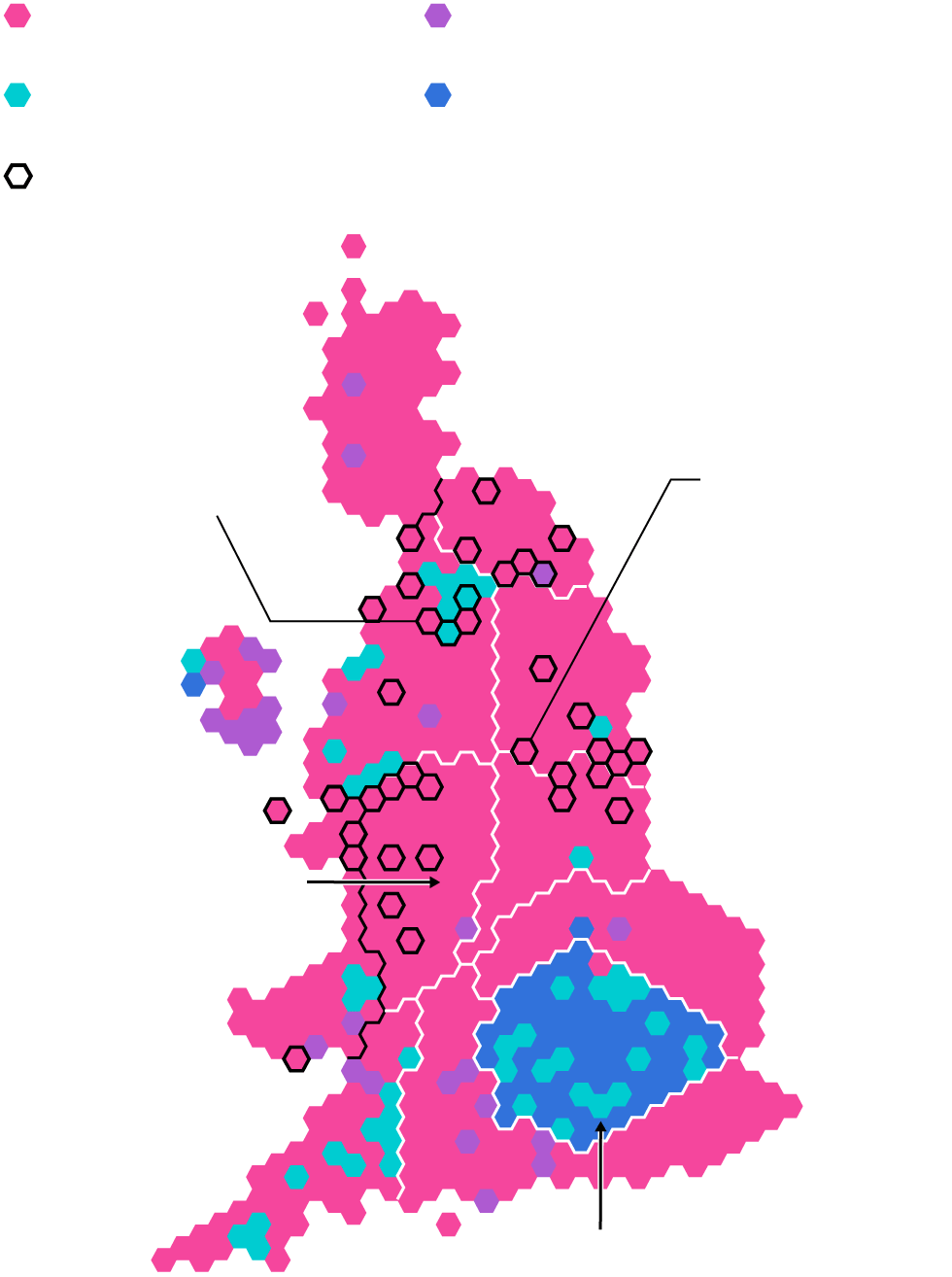
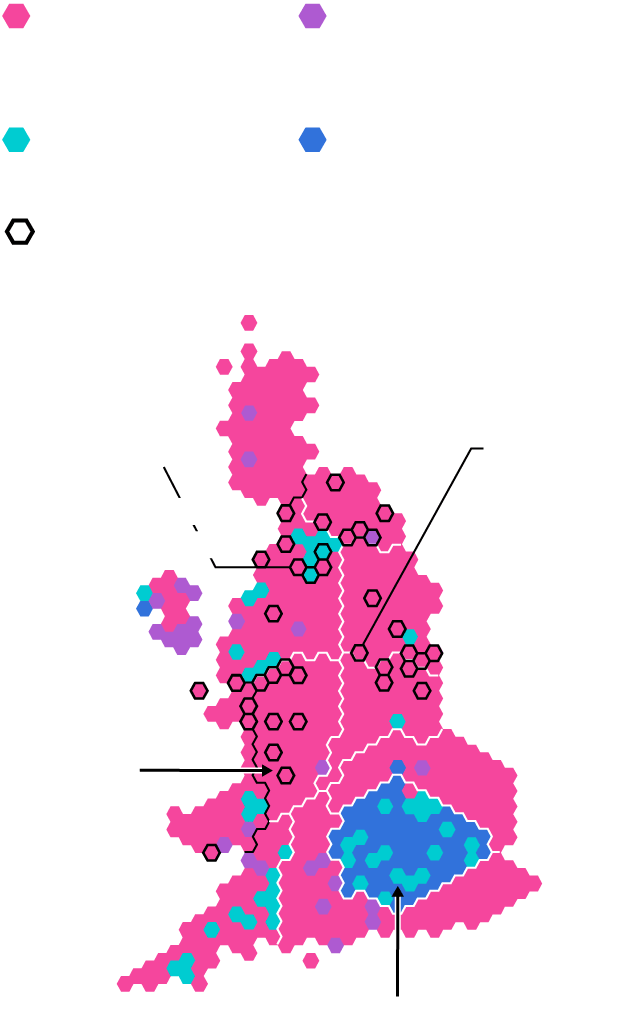
But Truss or Sunak will inherit a failing promise. Bloomberg’s Levelling Up Scorecard shows that since 2019, the salary gap relative to London and South East has widened in nine out of 10 constituencies. Homes are less affordable nearly everywhere and public spending per head has fallen behind the capital in every region of England. It’s been noticed in Penistone.
Nicola Ward, a 50-year-old who runs a fish-and-chip shop on the high street and voted Conservative in 2019, is another voter having second thoughts. “We don’t ever get anything out of Westminster,” she said. “I don’t think they’ll ever level up between north and south. They don’t believe we exist.”
Penistone and Stocksbridge’s Levelling Up Scorecard
Leveling up is just one major test for the next premier. Over the past week, Bloomberg News has looked at soaring living costs, public-sector pay, the National Health Service crisis, and the costs of Brexit.
The UK has greater regional inequality than almost every other developed nation, according to Bank of England and University of Sheffield research. As the economy shifted to services around London and the South East, once-thriving towns that flourished during the Industrial Revolution—built on industries such as shipbuilding, coal and steel—went into decline.
In Bolton North East, the challenge is clear. Johnson took the seat after 22 years of Labour control. But the town center remains pockmarked by shuttered stores, and a 1-billion-pound ($1.2 billion) regeneration plan has been repeatedly delayed.
Gayle Rostron, 53, an undecided voter who works at a tanning salon, complained about petty crime, anti-social behaviour and a lack of safe places for her 5-year-old granddaughter to play. “The town center is tragic,” she said. “I have lost faith in the government.”
Bolton North East’s Levelling Up Scorecard
Local MP Mark Logan, whose 378-vote majority is one of the party’s slimmest, said the pandemic hit Bolton hard, setting back efforts to improve the area. He’s been pushing for a tram extension to better connect Bolton and neighboring Manchester. It’s yet to materialize.
Leveling up “will take some time,” Logan said, pointing to 22.9 million pounds of funding the town received at the last budget. “Bolton can have a reinvention once again.”
Watch the Quicktake video:
The upheaval in Westminster has stalled the effort. First blown off course by the pandemic, Johnson then spent months in survival mode, attempting multiple resets to satisfy his restless MPs.
His administration’s Leveling Up Bill—including measures to revitalize high streets—was finally published in May, but Johnson then fired Michael Gove, the minister in charge, before announcing his own departure. That leaves the ministry in limbo, with former Business Secretary Greg Clark effectively a caretaker until the new leader is chosen.

The electoral warnings signs for the Tories about failing to deliver on their central policy are flashing red. They lost the pro-Brexit northern seat of Wakefield at a special election in June. The constituency has a similar profile to the three-dozen “Red Wall” seats Johnson won from Labour in 2019. A similar swing at a general election would see the Tories lose the bulk of their gains from last time, endangering their working majority of 71.
The increasingly bleak economic backdrop doesn’t help Johnson’s successor. Inflation is at a four-decade high and Britons are experiencing a record squeeze on living standards that’s due to worsen when energy bills rise in October. But the amount of funding committed specifically to leveling up is modest at roughly 12 billion pounds—about 3% of total government departmental spending in fiscal 2019.
For Sunak and Truss, the electorate that counts in the immediate future are the 175,000 Tory Party members who elect the party leader and, by extension, Britain’s next premier.
Ahead of a party hustings in Leeds this week, Truss burnished her credentials by supporting a high-speed rail connection to Liverpool, a plan that was pared back by Johnson in November. She also won the backing of Tory MP Jake Berry, who leads the Northern Research Group of Conservatives and is outspoken on the need to spread opportunity.




At the hustings, 67-year-old Tory party member Greg Morgan said he hadn’t witnessed any leveling up and its definition was still hazy. Vickie Rank, 55, said it would never happen but thought Truss more likely to deliver than Sunak.
Once Sunak or Truss has won the leadership, their attention will have to turn back to the 14 million Britons who put their trust in Johnson in 2019. For voters like 73-year-old pensioner Elaine Hampshaw in Penistone, they’ll have their work cut out.
“He’s done nothing, hasn’t he? And that’s with the other two as well. They’re just promising all sorts,” Hampshaw said of Johnson, Truss and Sunak. After voting for Brexit in 2016 and the Tories in 2019, she says she wouldn’t do so again. “I thought things would be a lot better.”

(Corrects regional foreign investment totals and impacted constituency levelling up categories in all graphics where such data appears, without significantly altering the overall distribution or findings.)
More from the “Autumn Reckoning” series: