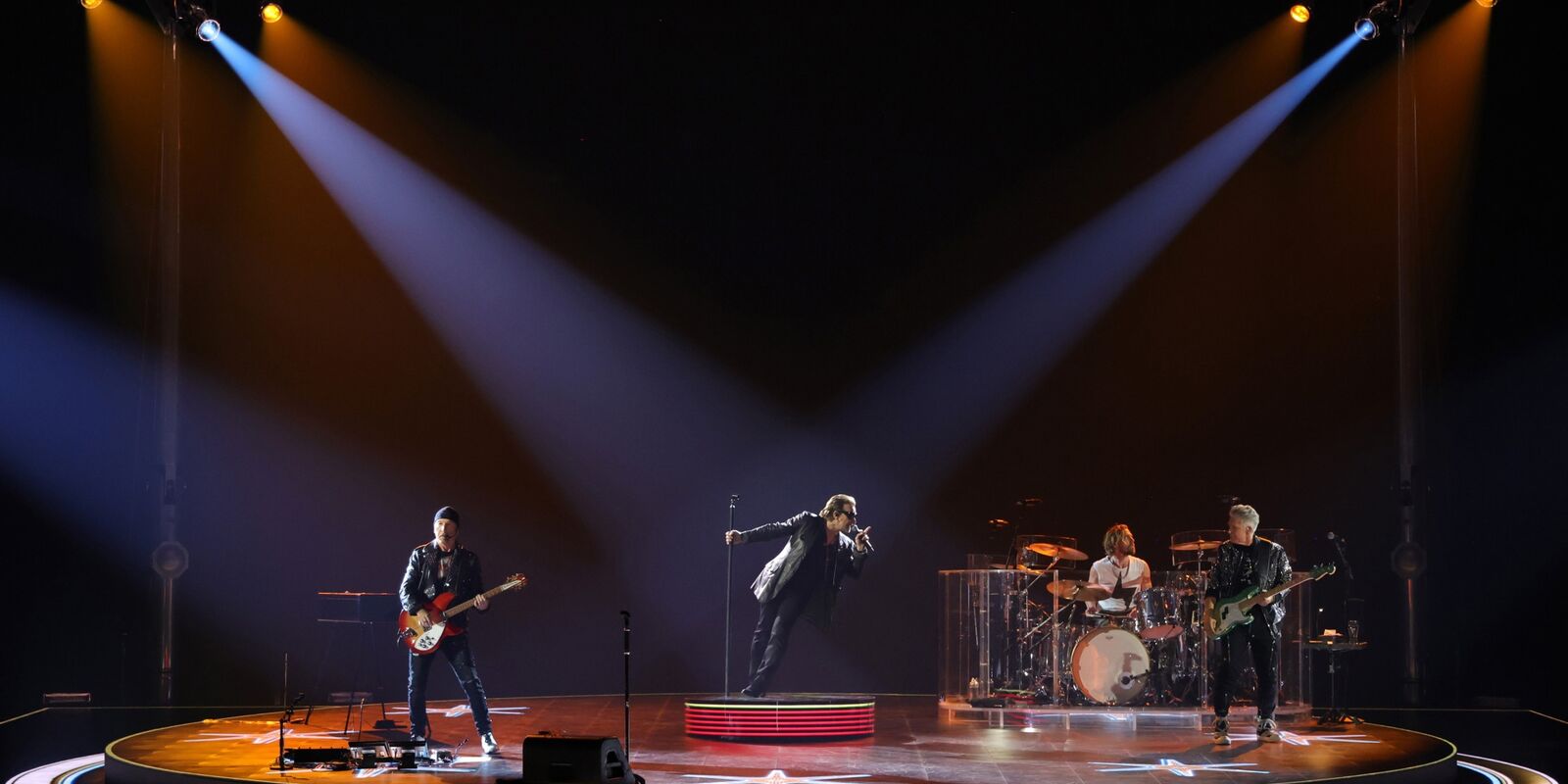
At the Sphere, U2 Establishes a Hit Residency
Just last year, the future of the Sphere at the Venetian, the wild looking, new entertainment venue in Las Vegas, seemed dubious. Construction costs on the experimental project had ballooned by over a billion dollars, and visitors to Las Vegas were criticizing everything from the venue’s impact on the desert skyline to the annoying glare of its bright lights through their hotel room windows.
But the prolonged struggle to get the Sphere built seems to have paid off, at least for its first musical act: U2. Based on their 40 dates christening the orb-shaped arena, the veteran Irish band is now topping tour charts with some of the most successful live events in months.
In February, thanks to their run at the Sphere, U2 reached No. 12 on Bloomberg’s Pop Star Power Rankings. Their first 17 shows sold 281,000 tickets and grossed $109.8 million, per Billboard’s Box Score. The Sphere seats over 18,000 people.
When the group’s residency comes to an end in March, they’ll be followed by Phish, then Dead & Company. Meanwhile, fans continue to love the spectacle. U2’s setlist at the Sphere centers on their hit 1991 album Achtung Baby, and throughout the concert, attendees are surrounded by stunning visuals, including an image of the Vegas skyline and various technicolor animals. All of which looks surreal and jaw-droppingly vivid.
For all of U2’s success, the Sphere is still facing serious questions about profitability, programming and future expansions. James Dolan, executive chairman and chief executive officer of Sphere Entertainment Co., said on the company’s most recent earnings call that much of the music programming will continue to focus on residencies. Currently, artists can’t make a brief stop at the Sphere while on a national tour, in part, because playing the distinctive arena requires creating custom-made visual effects, which can be costly.
“With the Sphere, because of how unique it is, what they build for Sphere really doesn’t move into a touring model, or at least most of it doesn’t,” Dolan said. “So they need to justify it based on the run that they have at the Sphere. So, one or two shows doesn’t do it.”
See other Pop Star Power Rankings
U2 spent 18 months conceptualizing and preparing for their Sphere performances, according to Esquire. “The commitment required, creative, intellectual, financial… I find it very hard to imagine how anybody else could play here,” said Willie Williams, U2’s creative director.
While the artist residencies are profitable, Dolan said, most of the Sphere’s programming is unrelated to music. Currently, a movie directed by Darren Aronofsky, Postcard from Earth, screens regularly. Tickets start at over $60 for the roughly 50-minute film, and unlike the reaction to U2, many of the reviews left on Ticketmaster’s website have been less than stellar. People mostly complain about the price for an experience that some describe as akin to “Imax on steroids.”
Last quarter, Sphere Entertainment lost $193.9 million on revenue of $167.8 million, primarily due to scrapped plans for an expansion in London. Nearly half of the Sphere’s sales last quarter came from 191 screenings of Aronofsky’s film while concerts accounted for almost all of the event-related revenue. The company also generated sales from brands advertising on the outside of the venue, called the “exosphere.”
In recent months, U2 has drawn a long line of celebrities to the arena, including Oprah Winfrey, Paul McCartney and LeBron James. In October, Lady Gaga stopped by to sing a duet with frontman Bono.
The singer is using the high-profile shows to highlight various social and political causes, including his concerns about Russia’s war on Ukraine.
“Next week it will be two years since Putin invaded,” he said during a recent performance at the Sphere. “For these people, freedom is not just a word in a song. For these people, freedom is the most important word in the world — so important that Ukrainians are fighting and dying for it. And so important that Alexei Navalny chose to give his up.”