The Covid Resilience Ranking
The Best and Worst Places to Be as World Enters Next Covid Phase
This article is no longer being updated as of June 29, 2022. For the latest coverage on the future of health care, subscribe to our Prognosis newsletter.
Since November 2020, Bloomberg’s Covid Resilience Ranking has tracked the best and worst places to be during the pandemic, using a range of datapoints to capture a monthly snapshot of how the world’s biggest economies were handling this once-in-a-generation health crisis.
Twenty editions in, the virus has become something most countries are living with. After nearly two years of fluctuation—during which the top and bottom of the Ranking shifted as the pandemic shape-changed—places have largely settled into their permanent positions, drawing the project to a natural close. June, 2022 will be our last update.
In a reflection of how far we’ve come since the coronavirus first emerged in central China, this month’s top ranked are those most effectively putting the pandemic in the rearview mirror, with the fewest scars. They’ve been able to reopen their borders and economies without a substantial spike in deaths.
A consistently strong performer in the Covid era, South Korea moves into first place in June, followed by the United Arab Emirates and Ireland. No. 1 for three months in a row, Norway drops to fourth place, with Saudi Arabia rounding out the top five.
Covid Resilience Ranking
Scroll to see all indicators →
- ← Worse
- Better →
All of the top performers are successfully executing a strategy that most of the world has largely settled into: accept that the virus is here to stay, vaccinate the most vulnerable aggressively—and try and resume economic and social activity like it’s 2019.
They’ve been able to execute this approach well for several reasons: most are wealthy, with the ability to pay for vaccine supplies and the logistics of getting shots in arms.
Then there is the intangible but powerful factor of societal trust and cohesion. This has proven a major differentiator in why some populations have more effectively mobilized at every stage of the pandemic: they’ve consistently and in greater numbers complied with social-distancing guidance like mask-wearing, come forward to be inoculated in large numbers—Korea has vaccinated almost 90% of its population—and worked to protect the most at risk among them.
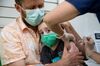
If there’s one lesson that the Covid era has made clear, it’s that societies with this strong component of trust and cohesion are in the best position to weather a crisis of this scale.
“Clearly, when the population trusts the public health messaging, you’re going to see more resilience,” said Amesh Adalja, senior scholar at the Johns Hopkins Center for Health Security in Baltimore. “If you have places where science is trusted, where this isn’t seen as a political issue but a public health issue, then you’re going to have much better outcomes.”
Wealth and scientific prowess are significant advantages, but neither trump public trust when it comes to limiting the death toll. The US and UK were instrumental in developing life-saving vaccines and the first to disseminate those shots, but end up middle of the pack—at No. 36 and 22 respectively.
While they reopened ahead of others in mid-2021, their Covid death tolls are among the highest in the developed world. In the US, almost as many people died after shots became available than before, reflecting the cost of deep political division that held back vaccination.
Riding Out the Pandemic
Read about the methodology behind the Covid Resilience Ranking
The bottom rungs of the Covid Resilience Ranking are largely unchanged from May, showing how some places are entrenched in situations and strategies that keep them trapped in the Covid era.
They include the Covid Zero holdouts—the places still trying to eliminate and keep out the virus. In the first year of the pandemic, before vaccines were developed and the virus mutated into ever-more infectious strains, Hong Kong (No. 49), Taiwan (No. 52) and mainland China (No. 51) were highly ranked as a strategy of travel curbs and aggressive containment kept life largely Covid-free.
But they’ve been unable to outrun omicron: Taiwan and Hong Kong both saw deaths spike as more virus circulated, while China had to deploy ever more stringent restrictions through the spring to drive cases back toward zero, paralyzing economic growth and fomenting social unrest.
The world’s second-largest economy still officially has the lowest death roll of the 53 places ranked—Beijing’s key justification for refusing to live with Covid—but scores low on Vaccinated Travel Routes, Flight Capacity, Community Mobility and Lockdown Severity, even with some easing to its quarantine regime, still the strictest in the world.
In these places, early containment success became a double-edged sword; with the virus only a theoretical threat through much of 2020 and 2021, complacency and vaccine hesitation took root, especially among the elderly.

In contrast, other early Covid Zero adherents like Australia and Singapore made the tough transition to accepting more fatalities and living alongside the virus. They’re now highly ranked at No. 9 and 14 respectively, reflecting another pandemic lesson: in a public health crisis, constant adaptation matters.
The elimination strategy “was largely effective in terms of substantially reducing transmissions” until omicron, said Michael Osterholm, who heads the Center for Infectious Disease Research and Policy at the University of Minnesota. “The difference with omicron is like trying to stop the wind. You can deflect it but you can’t stop the wind.”
So what’s next for the post-Covid world?
World Health Organization Director-General Tedros Adhanom Ghebreyesus said in February that the “acute” phase of the pandemic could end this year if about 70% of the world is vaccinated by mid-2022. Currently, about 67% of the world’s population has received one dose and 61% are fully inoculated, according to Our World in Data.
In many places—even developing countries earlier unable to secure supplies—vaccine stock is piling up and governments are now focused on new crises, like food and energy shortages.
That doesn’t mean we’re in the clear.
Pandemic MVPs

Rank
1
Worst
26
53
Best
UAE
These three places never fell to the bottom half of the Ranking over the past 20 editions
Canada
Finland
South Korea
Norway
Switzerland
Saudi Arabia
Denmark
UK
US
Chile
Ireland
Singapore
Netherlands
Japan
Spain
Israel
Sweden
Germany
Portugal
New Zealand
France
Turkey
Australia
Iraq
Austria
Bangladesh
Egypt
Iran
Italy
Nigeria
Belgium
India
Greece
Thailand
Romania
Taiwan
Mainland China
Colombia
Czech Republic
Poland
South Africa
Peru
Hong Kong
Vietnam
Malaysia
Argentina
Russia
Indonesia
Philippines
Pakistan
Mexico
Brazil
1
26
53

Rank
1
Best
Worst
26
53
UAE
These three places never fell to the bottom half of the Ranking over the past 20 editions
Canada
Finland
South Korea
Norway
Switzerland
Saudi Arabia
Denmark
UK
US
Chile
Ireland
Singapore
Netherlands
Japan
Spain
Israel
Sweden
Germany
Portugal
New Zealand
France
Turkey
Australia
Iraq
Austria
Bangladesh
Egypt
Iran
Italy
Nigeria
Belgium
India
Greece
Thailand
Romania
Taiwan
Mainland China
Colombia
Czech Republic
Poland
South Africa
Peru
Hong Kong
Vietnam
Malaysia
Argentina
Russia
Indonesia
Philippines
Pakistan
Mexico
Brazil
1
26
53
Now is not the time to take the focus off vaccination, says Kate O’Brien, director of the WHO’s Department of Immunization, Vaccines and Biologicals. “The most important part of the coverage is not a random set of 70% of the population,” she said. “The most important and most impactful part of the coverage is when countries achieve 100% or close to 100% coverage of their highest risk populations.”
Then there’s the risk of a new, more lethal Covid strain emerging that defies vaccine protection and plunges countries back into efforts to minimize spread. This may even be in the form of a new disease, which accounts for the high level of concern over monkeypox.
The lessons of the Covid Resilience Ranking will endure as long as there is the threat of new pandemics.
For now, the focus should be on insulating high-risk people as the rest exit, said David Heymann, professor of infectious disease epidemiology at the London School of Hygiene and Tropical Medicine.
As long as serious illness and deaths are being monitored, “we should move on,” he said. “We should get on with our lives.”