China’s Secretive Missile Program Is Making Dozens of Companies Rich
China appeared to ramp up missile production last year by the most since Xi Jinping became president in 2013, according to a Bloomberg analysis that mapped out the sector’s finances for the first time.
A review of the corporate filings of every listed Chinese company that mentioned either of the nation’s two leading state-owned missile makers at least once per year in that period. The number of firms that disclosed producing key missile components rose to 81 last year, more than double than during Xi’s first year in office.
Within that group, last year saw the highest percentage of companies reporting record revenues of any during Xi’s tenure, which the analysis indicates is due to a surge of new orders to expand China’s missile program. That contrasted with an aggregate drop in revenue over the same period among China’s 300 largest listed companies.
Chinese Missile Companies’ Revenue Soared in 2025
Source: Bloomberg
Note: Bloomberg identified 81 companies in China’s missile supply chain but only 80 reported revenue in 2025 after one was delisted in 2023.
The corporate disclosures provide a rare glimpse inside China’s secretive defense sector, pointing to an urgent drive in Beijing to bulk up missile capacity even as Xi purged many of his top generals, including much of the leadership in the People’s Liberation Army Rocket Force overseeing those weapons. The buildup indicates that China is flush with missiles just as US stockpiles have been depleted by President Donald Trump’s war in Iran, raising concerns for Taiwan and American allies in the region.
“Both the US and China are trying to build up stockpiles to be sufficient enough to be able to outgun the other,” said Becca Wasser, an analyst with Bloomberg Economics in Washington. “They also want to be able to outlast the other in a potential conflict.”
Trump will meet with Xi Thursday on his first trip to China in nearly a decade, with Taiwan and the war in Iran set to feature in the discussions.
China doesn’t make public the size of its arsenal, and details about the missile supply chain are scarce. The Pentagon estimates China has at least 3,150 ballistic missiles and 300 ground-launched cruise missiles as of 2024. That’s respectively a 147% and 50% increase from 2015, when the US started systematically disclosing estimates on Beijing’s missile arsenal.
For Xi, bolstering missile capacity is critical to any attempt to forcefully take Taiwan, the self-ruled island the Communist Party seeks to control. It would also expand Beijing’s ability to strike across the Indo-Pacific region, including Guam, nearly 3,000 miles away, where the US has a vital military outpost.
The Chinese expansion comes as countries from France to South Korea ramp up defense spending and rush to manufacture more missiles — a task given added importance by the war in Iran. As that arms race unfolds, the success of Beijing’s defense companies is giving Xi a powerful advantage in his mission to counter US military dominance on the world stage.
Since coming to power, Xi, China’s most powerful leader since Mao Zedong, has called for greater cooperation between civilian firms and the armed forces as he pushes to have a modern military on the 100th anniversary of the PLA in 2027.
China’s missile-making ecosystem relies on a vast network of state and civilian companies. Companies within the PLA supply chain provide products ranging from 3D-printed metals to embedded computers for an industry long shrouded in secrecy.
Although many items have dual uses, all the company documents Bloomberg reviewed explicitly reference making sales for defense purposes. Many firms stated outright that they are part of China’s missile program, spearheaded by two state-owned firms: China Aerospace Science and Industry Corporation (CASIC) and China Aerospace Science and Technology Corporation (CASC).
Some of the parts appeared to be specifically for cruise or ballistic missiles, said Michael Duitsman, a research associate at the Middlebury Institute of International Studies at Monterey, who identified the potential applications of the components.
The US has blacklisted scores of leading Chinese companies for their alleged links to the PLA, and restricted Beijing’s access to cutting-edge chips central to artificial intelligence in a bid to hold back its military advancement.
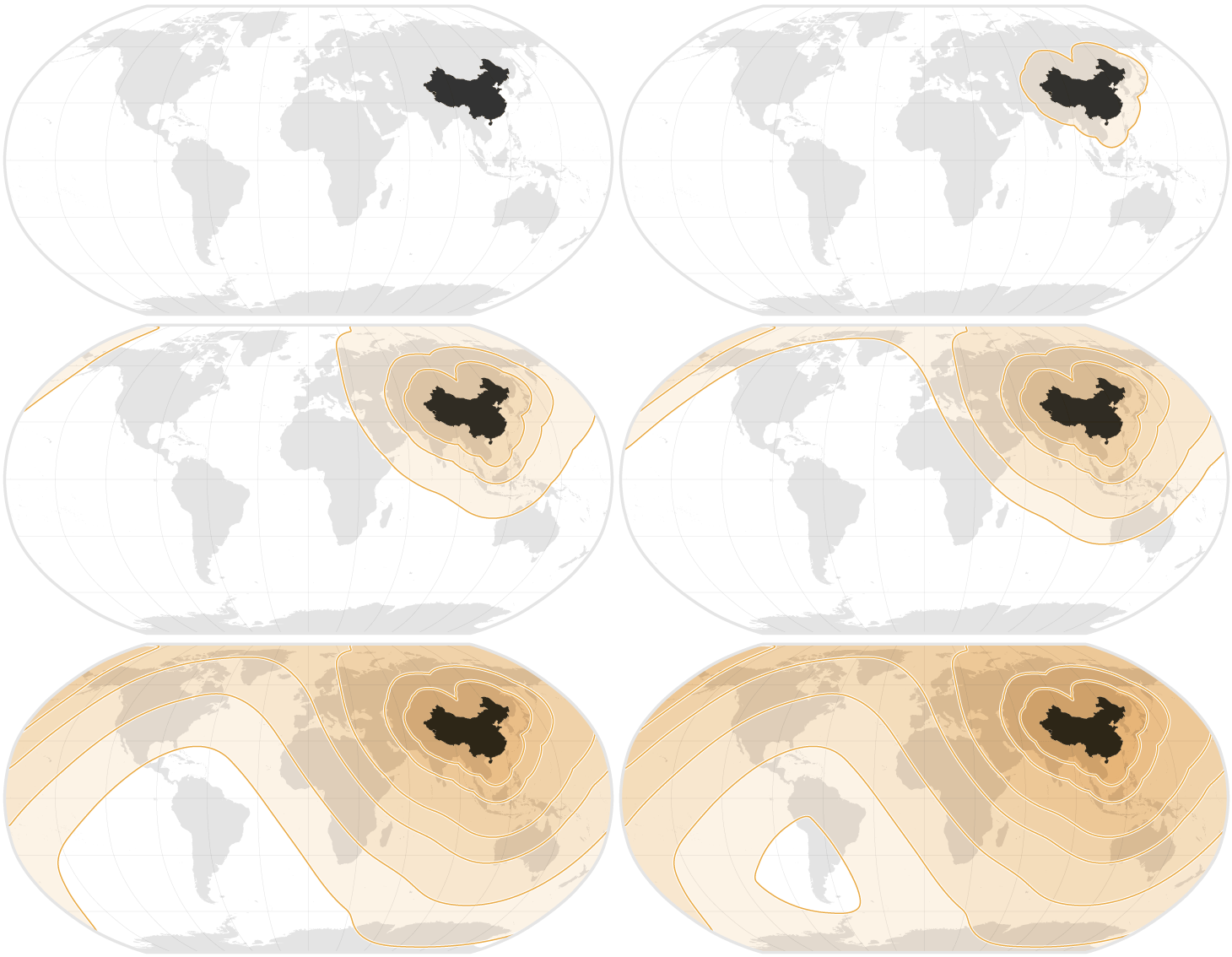
China’s missiles now cover much of the world. Its ballistic missiles can hit targets across the Second Island Chain, which extends from Japan to eastern Indonesia. Cruise missiles can be used for shorter-range, stealthy, precision attacks on targets in Taiwan or ships at sea.
Representatives for China’s Ministry of Defense, CASIC and CASC didn’t respond to requests for comment. China hasn’t been to war since a brief conflict with Vietnam in 1979 and maintains a no-first-use policy on nuclear weapons, saying its missiles are for self-defense.
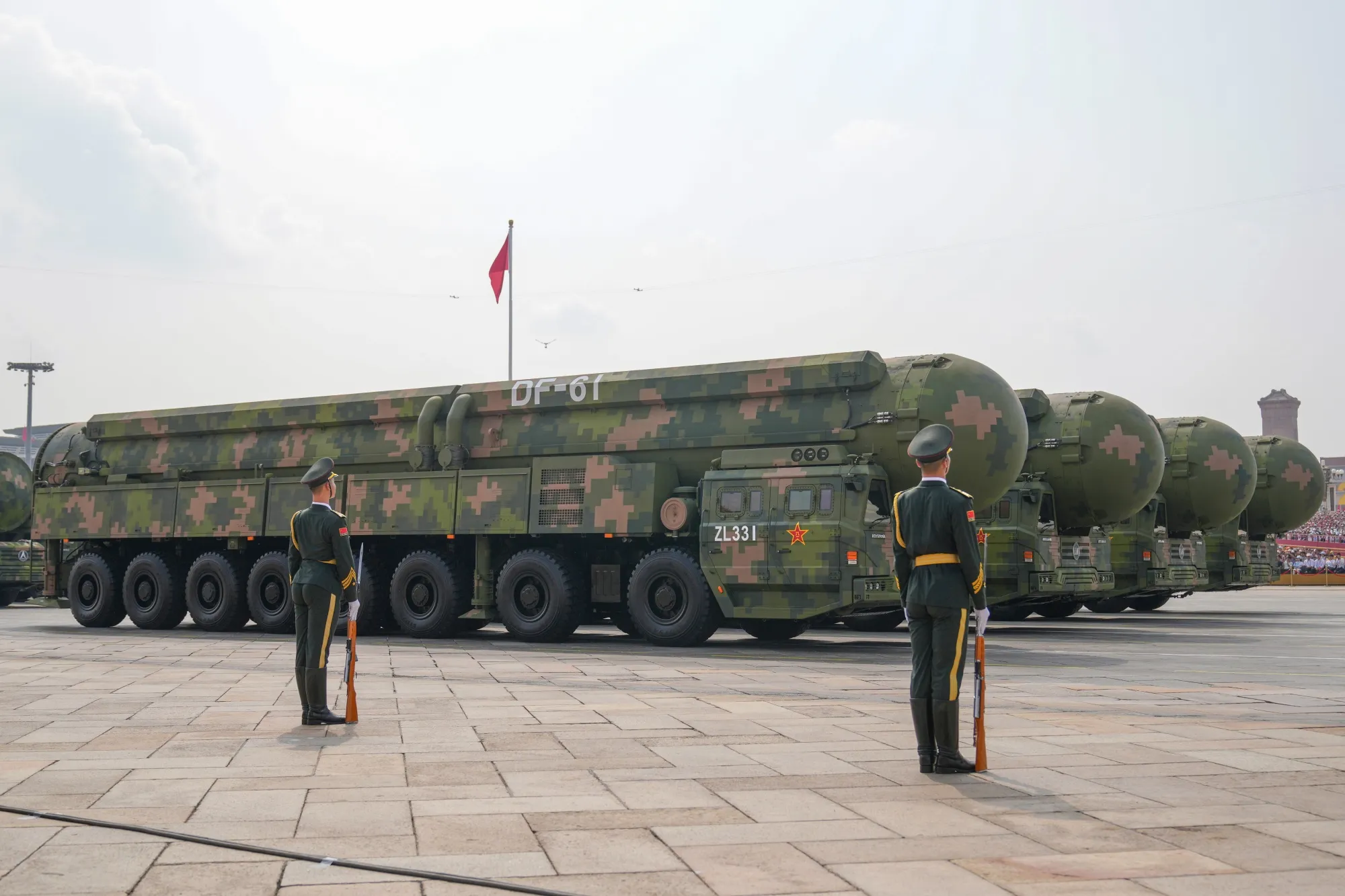
DF-61 missiles on display during a military parade at Tiananmen Gate in Beijing, China, on Sept. 3, 2025. Photographer: Andy Wong/AP Photo
China’s missile arsenal is dominated by the Dongfeng series, which derives its name — translated as “east wind” — from a Mao Zedong speech during the Cold War.
While the US has far more intercontinental ballistic missiles and nuclear warheads, China is catching up. Beijing is conducting the world’s fastest nuclear weapons expansion, and has ICBMs that can hit the United States.
Its shorter-range weapons include the DF-21D anti-ship ballistic missile and the DF-26, also called the “Guam Express” because of its ability to hit the US island. At China’s once-a-decade military parade last September, Xi also showcased the YJ-21 and YJ-17 hypersonic anti-ship ballistic missiles, as well as the new DF-61, which is almost certainly an ICBM.
China’s Missiles Cover All But a Small Part of the Globe
Source: CSIS; Institute for Peace Research and Security Policy
Note: Ranges are not exhaustive but include the maximum known reach of China’s missile arsenal.
“Recent events have likely sharpened the perceived need to both defend and deter against potential US military or political action vis-a-vis Taiwan,” said John Van Oudenaren, a research analyst at BluePath Labs specializing in China’s state-owned missile giants. As Trump’s foreign policy swings bring fresh uncertainty — the US this year attacked Venezuela and Iran — policymakers in Beijing clearly “feel a need to respond,” he added.
Homegrown Talent
CASIC and CASC, along with their subsidiaries and institutes, receive orders from the military, which then trickle down to a network of smaller suppliers. Increasingly, those firms are fundraising on the stock market, with their filings to shareholders providing a rare portal into the country’s missile manufacturing structure.
Among the companies that reported 2025 as their best year is Wuhan Guide Infrared Co. Founded in 1999 and based in central China, it’s a prime example of private innovation benefiting military advancement. Guide Infrared specializes in infrared sensors, which Duitsman said were most likely for cruise missiles or drones — another area of asymmetric warfare where Beijing has massive civilian manufacturing capacity.
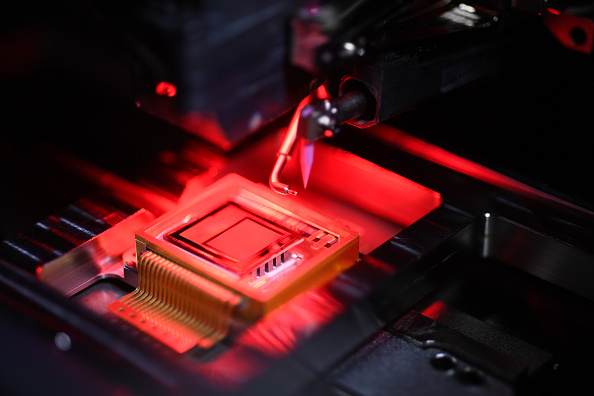
An employee works on the infrared chips at Wuhan Guide Infrared Co. in central China’s Hubei province. Feature China/Future Publishing via Getty Images
Guide Infrared first gained domestic attention during the SARS crisis that swept China starting in 2002, when its sensors screened for high fevers. By 2020, defense applications accounted for more than 70% of the company’s sales, according to estimates by Zheshang Securities. It’s now one of the few civilian companies in China permitted to do whole weapon development and assembly, and has a research institute dedicated to missile development.
Besides components for larger weapons, it has developed a series of anti-tank missiles spotted during the recent Cambodia-Thailand border conflict.
Guide Infrared’s ties to the PLA have attracted blowback. One of its subsidiaries has been sanctioned by the US and European Union, which accused it of supporting the Kremlin’s war machine. Despite that, the company’s revenue soared by 73% in 2025 compared with a year earlier thanks to a rebound in defense business. Guide Infrared didn’t respond to an emailed request for comment.
Anatomy of an Anti-Tank Missile
Another company, Yangtze Optical Electronic Co., produces fiber-optic coils for CASIC. They can be used in gyroscopes as part of precise navigation systems for aerospace and ballistic and cruise missiles, Duistman said.
YOEC said in its 2022 IPO explanation that unnamed CASIC units accounted for at least 43% of its revenue from 2019 to 2021, including one that it said was among China’s biggest research and production facilities for tactical missiles. As of 2025, the company’s fiber-optic business accounted for about 70% of revenue. Its sales rose 20% last year due to more orders and delivery of fiber-optic coils.
Chengdu Jiachi Electronic Technology Co., founded in 2008, makes a product almost exclusively for the military: stealth coatings applied to jets, ships and missiles to reduce their visibility to radar and infrared detection. The company said last year that its products are used in missiles, without elaborating.
JC Technology’s half-year report in 2025 showed it had at least one research project for fighter jets, drones and cruise missiles. It counts CASC as one of its main clients. Its 2025 revenue rose 16% from a year ago, thanks to a recovery in stealth coating sales and record-high revenue of stealth components.
JC Technology and YOEC didn’t reply to emailed requests for comment.
China’s Missile Stockpiles
Source: US Department of Defense
Note: Bloomberg was unable to verify why the data shows a drop in cruise missile stockpiles in 2024
It’s unclear whether the seemingly steep increase in missile production will continue. China’s defense spending will expand by 7% this year, the slowest pace since 2022, as the government sets a less ambitious economic growth goal. At a meeting with military lawmakers in March, Xi reiterated the need to ensure “every penny is spent where it matters most.”
As Beijing investigates top generals and leading defense researchers, orders for missile suppliers could shrink. China’s corruption probes into defense executives led to a revenue decrease in 2024 for the country’s military giants.
The purge of top scientists — such as microwave weapons expert and former nuclear test base commander Liu Guozhi — could disrupt missile research and development programs, said Yang Zi, a research fellow at the S. Rajaratnam School of International Studies in Singapore. “We should also expect the PLA leadership to tighten the procurement process aimed at ensuring equipment quality lives up to official standards,” Yang added.
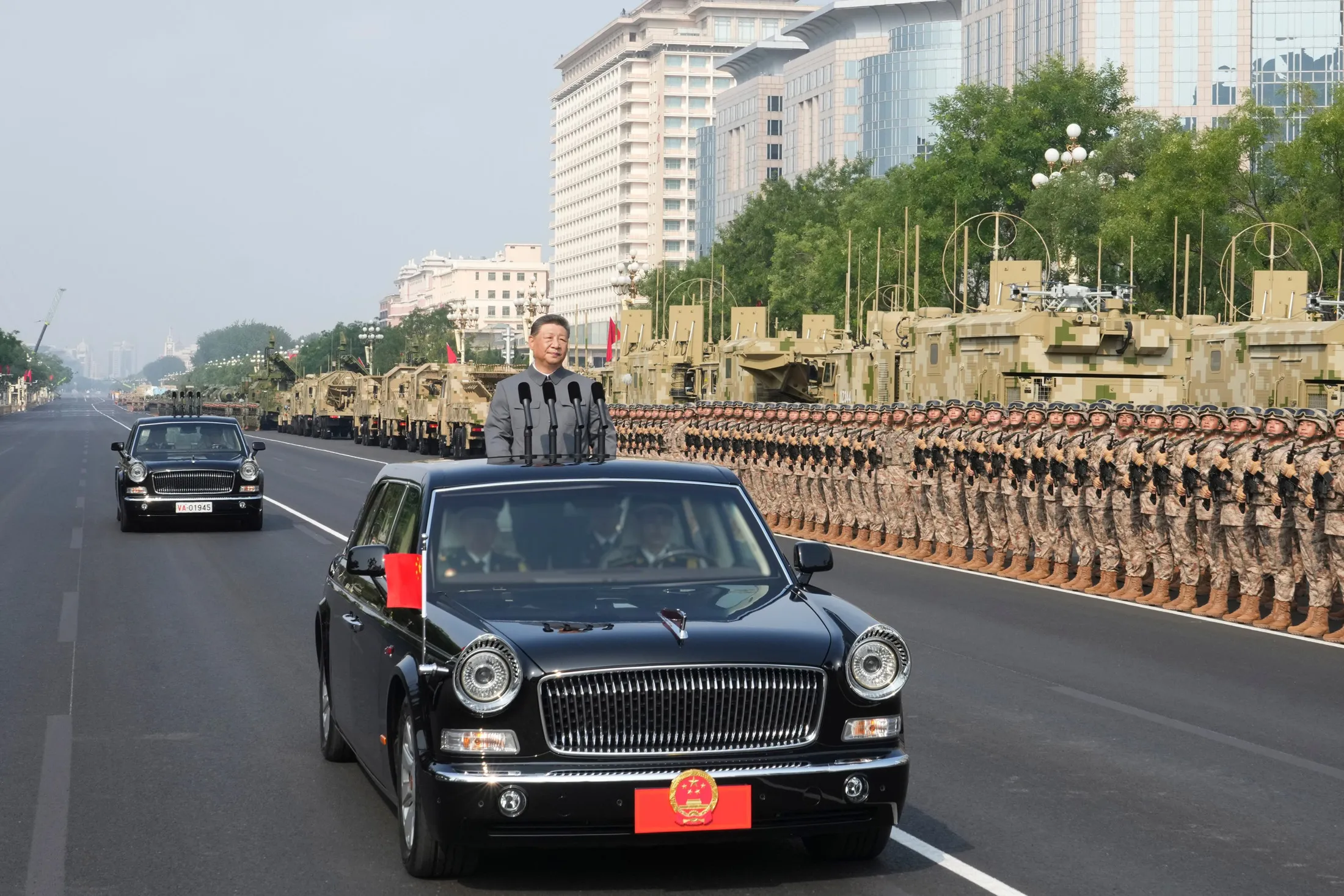
Chinese President Xi Jinping reviews a military parade in Beijing on Sept. 3, 2025. Photo: Xinhua/Shutterstock
So far, the first-quarter data reported by the missile suppliers shows a cautiously positive picture — total revenue is up some 20% from the same period in 2025. In comparison, China’s 300 biggest companies saw their first-quarter sales rise 2.4% year-on-year.
That shows that China’s missile program remains crucial to Beijing’s strategic deterrence and ability to win wars. If anything, Xi himself has made that clear.
“Today, humanity again faces a choice between peace and war, dialogue and confrontation, win-win and zero-sum,” Xi said in September atop the Tiananmen Gate as he inspected his country’s latest military hardware. “All officers and soldiers must faithfully fulfill their sacred duties and accelerate the building of a world-class military.”