
Xi Unleashes China’s Biggest Purge of Military Leaders Since Mao
On a crisp April morning in Beijing earlier this year, China’s most senior military leaders gathered for a routine tree-planting ceremony that ended up providing a rare glimpse into the secretive world of power politics under President Xi Jinping.
Ahead of the event, reports spread that He Weidong — the second-highest ranking uniformed officer in the People’s Liberation Army — was the latest casualty of a sweeping purge that had already taken down two former defense ministers. Less than three years ago, Xi had appointed He as a vice chair of the Central Military Commission (CMC) over more senior generals, indicating he was one of the president’s chosen men to run the Communist Party’s armed forces.
Breaking Precedent
Source: Bloomberg
The annual tree-planting event had included all of the top CMC members since Xi took power in 2012, a tradition that goes back four decades. As a nightly state-run television broadcast showed the group in camouflage uniforms shoveling soil, China watchers quickly noticed that He was missing, the clearest sign yet that he had become the most senior general to be ousted since Mao Zedong’s chaotic rule ended in 1976.
Chinese officials at a tree-planting event in Beijing on April 2, 2025, as shown in a CCTV news report. He Weidong was not present. Source: CCTV
As surprising as He’s disappearance was, it fit a growing pattern under Xi. China’s leader has ousted almost a fifth of the generals whom he personally appointed while running the country, something his predecessors never did, according to a Bloomberg News analysis of TV footage, parliamentary gazettes and other public records. Moreover, Xi’s purge has left the CMC with only four total members, down from seven when his third term started. That’s the fewest in the post-Mao era, the Bloomberg analysis shows.
As more and more of China’s top military leaders fall, it leaves those trying to understand the nation grappling with a near-impossible question given the opaque nature of the Communist Party: Is this all a sign of Xi’s political strength, or of his weakness? The implications reach around the world and across the global economy.
All of Xi’s Men
Each represents the tenure of a general that Xi promoted since he became China's leader in 2012 until the beginning of August 2025.
Interact for more details 
 Promoted
Next week, when Xi oversees China’s first military parade since 2019 from atop the Gate of Heavenly Peace overlooking Tiananmen Square in Beijing, outside observers won’t just be looking for new tanks, missiles and other weaponry that could be used to attack Taiwan and threaten US military supremacy. They will also seek clues on whether Xi trusts his own generals to wage war — and try to determine what the recent military shakeup means as he nears a potential fourth term in power in 2027.
“No doubt there’s a lot of turbulence in the upper echelons right now,” said James Char, Singapore-based assistant professor at Nanyang Technological University, who researches China’s military. “It’s bad optics for sure.”
When Xi first took office, he warned that corruption in the military posed an existential threat to the Communist Party. Post buying was an open secret: Newcomers paid as much as $16,000 to pass the People’s Liberation Army entrance exam, while officers bribed generals for promotions and then repaid the debt via kickbacks.
As Xi embarked on an unprecedented corruption crackdown that took out political rivals, he also began to restructure the People’s Liberation Army so it could “fight and win wars” — a tacit acknowledgement that it lacked the ability to do so. A decade into that effort, an ominous government notice published on the social media platform WeChat showed he was ramping up his makeover of the armed forces.
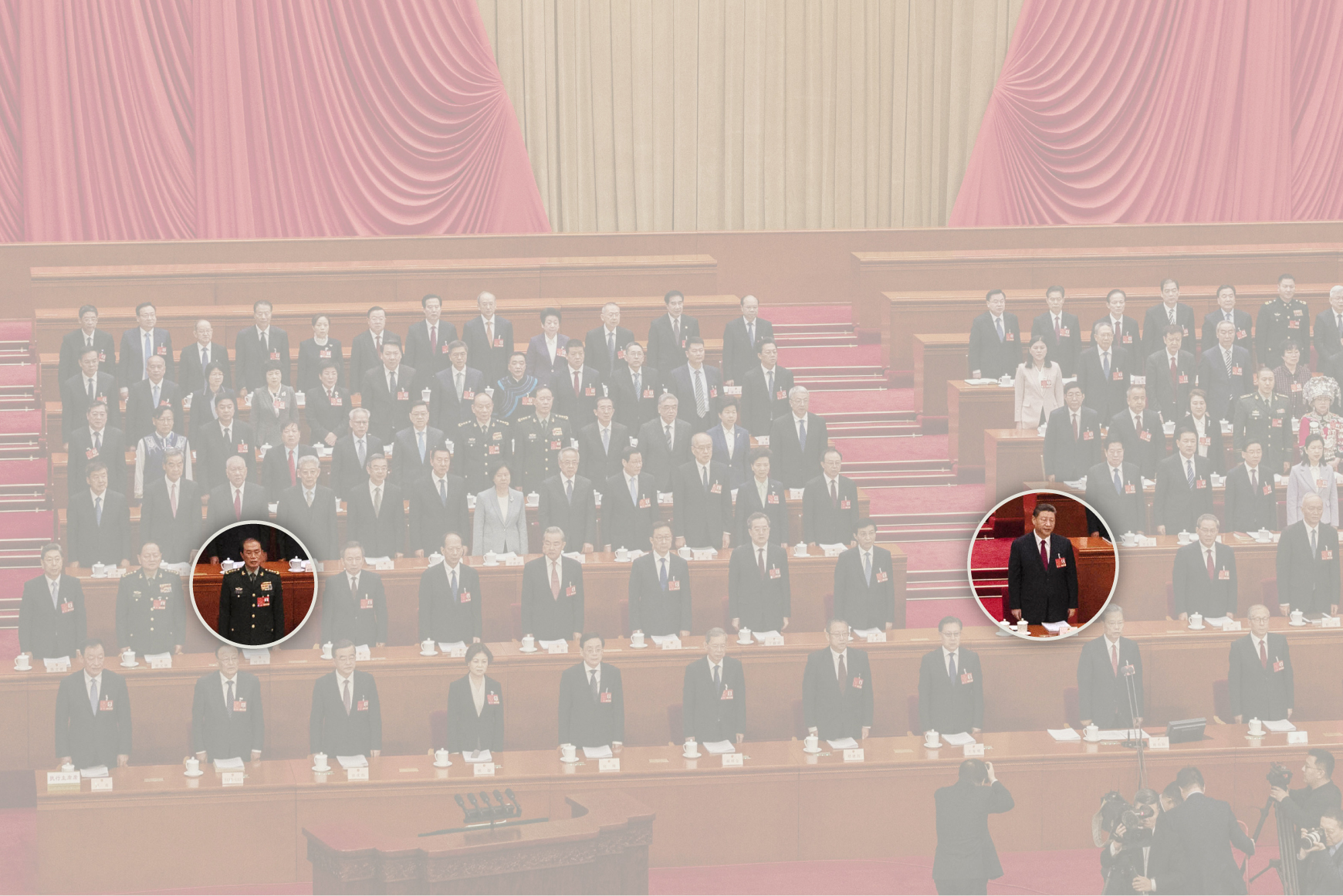
Xi Jinping, circled right, and He Weidong, circled left, at the opening session of the National People’s Congress in Beijing, on March 5. He was last seen in public on March 11 at the closing ceremony. Photographer: Kevin Frayer/Getty Images
The military’s Equipment Development Department, which is responsible for obtaining weapons, warned in July 2023 that it was investigating eight issues, including information leaks and private cliques spanning back to 2017. That led to the ouster of senior leaders in the Rocket Force and has since spiraled all the way up to generals directly under Xi.
China’s military is even more secretive than its government, making it hard to gauge the true scale of the purges. Typically, a leader’s downfall only becomes known when they miss a public event, like He’s absence from the tree-planting ceremony. And even then it’s not always clear what happened.
Senior military officers who doubled as national lawmakers had their ousters divulged in parliamentary records. Signs of trouble emerged for former Defense Minister Li Shangfu when he abruptly skipped an annual meeting with his Vietnamese counterpart. The fate of his predecessor, Wei Fenghe, became known after he was snubbed from a Lunar New Year greeting.
Those are the high-profile casualties. During Xi’s third term, 14 of the 79 generals promoted under him have either gone missing or been probed, according to a Bloomberg analysis. By comparison, Jiang Zemin and Hu Jintao didn’t investigate a single general promoted during their rule.
Path to the Top
Source: Analysis of public records by Bloomberg
China’s Central Military Commission isn’t simply powerful because it commands the world’s largest standing army. The organization is technically controlled by the Communist Party, not the Chinese government, meaning it’s also key to holding power over all of China’s 1.4 billion people.
Although China’s top leaders have traditionally held three titles — president of the country, general secretary of the party and chairman of the CMC — the last one has always been seen as crucial to consolidating power. China didn’t have presidents for a period and some Communist Party general secretaries have been weak. But the chairmanship of the CMC for the most part has been held by China’s strongest leader dating back to Mao, who famously declared “political power grows out of the barrel of a gun.”
The CMC will be a key body to watch if Xi, who ended presidential term limits in 2018, is ever to appoint a successor. While Jiang joined when he took power in 1989 following the deadly crackdown on Tiananmen Square protesters, Hu and Xi both became civilian vice chairs of the CMC roughly two years before taking on the role of general secretary.
Xi’s recent moves have reduced the CMC to four members from seven when his third term began in late 2022 — the highest proportion of vacancies since Mao, whose Cultural Revolution in the 1960s and 1970s upended all of China’s institutions. The body currently consists of Xi, Vice Chair Zhang Youxia, 75, and two other members, Zhang Shengmin, 67, and Liu Zhenli, who is around 60 years old.
Zhang Shengmin, a veteran political commissar from the imperiled Rocket Force, was appointed in 2017 and later became the military’s top graft buster, a role Xi added to the body. Zhang Youxia and Liu are two of the few Chinese generals with battlefield experience from brief border fights with Vietnam in the late 1970s and 1980s, the last time China has fought in a conflict.
Just weeks after the Sept. 3 military parade, Xi has an opportunity to restock the CMC at the Communist Party’s Fourth Plenum, where more than 300 cadres will huddle behind closed doors in Beijing to chart China’s next five-year economic plan and make key personnel decisions.
“Xi seems intent on keeping allies and rivals alike guessing about succession, perhaps right up until the last moment,” said Neil Thomas, a fellow researching Chinese politics at the Asia Society Policy Institute in Washington. “If Xi elevated a civilian to the CMC at the Fourth Plenum, it could signal a potential heir — but that would be highly unusual, and highly unlikely.”
Despite persistent speculation, Xi has shown no sign of moving to appoint a successor — and any mention of the topic is heavily censored on China’s internet. It’s more likely that he fills the CMC by picking from the slimmed-down group of 29 generals still standing.
The Long Arm of the CMC
Note: *He Weidong’s ouster cannot be confirmed, but he hasn’t made a public appearance since March 2025. Sources: US Department of Defense, analysis of public records by Bloomberg
In October 2022, Xi took the unusual step of placing He Weidong into a vice chair seat on the CMC without first trialing him as a regular member of the body. Nearly three years later, He is poised to become the most senior sitting member known to be investigated since former General Secretary Zhao Ziyang, a civilian, was ousted in 1989 for supporting pro-democracy students. What’s more, a uniformed vice chair hasn’t been removed from the body since Mao got rid of He Long in 1967, according to Thomas.
At one point He’s rise looked unstoppable. Born in 1957, he overlapped with Xi in the southeastern province of Fujian across from Taiwan, the self-ruled democracy claimed by China. He climbed his way up the military ladder, from the now-defunct Nanjing Military Command to the Western Theater Command to the Eastern Theater Command, which would spearhead any potential attack on Taiwan. He was promoted to general, took one of the top spots on the CMC and also became a member of the 24-man Politburo overseeing the entire country.
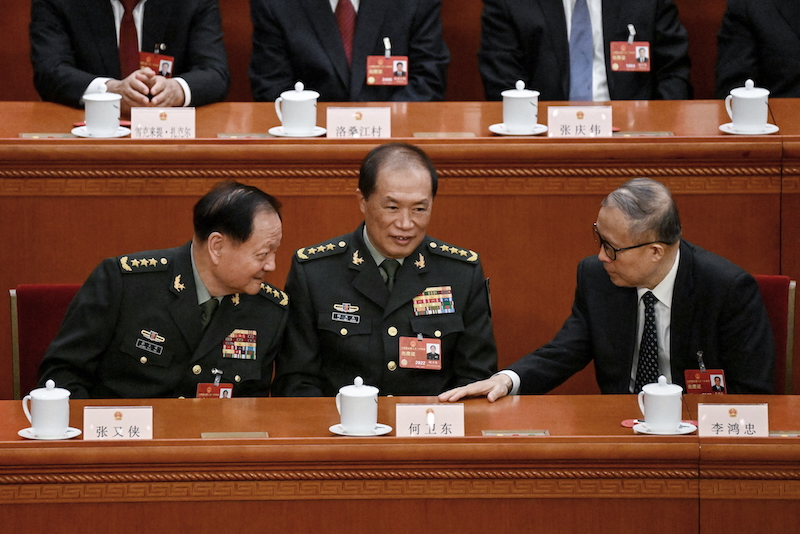
From left: Zhang Youxia, vice chairman of the CMC, with He Weidong and Li Hongzhong, vice chairman of the National People’s Congress, at the fifth plenary session of the NPC in 2023. Photographer: Noel Celis/AFP/Getty Images
He’s surprise appointment at the time was seen through the lens of China’s greater strategic emphasis on Taiwan. While his downfall hardly means that Taiwan is no longer a top priority, Xi’s removal of senior generals still raises questions about China’s military readiness.
Even as some younger members of the PLA ranks are likely to see Xi’s expulsions as cleansing corruption from the system, more senior military officers have an incentive to hide any equipment defects from procurement scandals that might not become apparent until they are used in combat, according to Joel Wuthnow, a senior research fellow at the US-based National Defense University’s Center for the Study of Chinese Military Affairs.
“It’s hard to say how much the purges have impacted readiness,” he said. “The main point is that Xi himself probably can’t be fully confident in the quality of PLA equipment — even as the PLA prepares for a major parade in Beijing designed to show off its new capabilities for a global audience.”