
The Options for Finding Iran’s Hidden Uranium: Attack, Negotiate, or Wait
We look at the scenarios that could play out as the US and Israel consider their next steps.
The US spent billions of dollars accounting for gram levels of uranium around the world since the end of the Cold War. It paid for UN monitoring and security summits while directly repatriating some 7,000 kilograms of the radioactive material from 47 countries to minimize the possibility that it could ever be used in a weapon.
But on June 13, those decades of international effort were rolled back overnight. Even as Israeli attacks dealt grave damage to Iran’s capacity to make new nuclear fuel, it eliminated monitoring of the Islamic Republic’s vast inventory of enriched uranium.
Iran’s 409 kg of highly-enriched uranium could be stored in 16 transport cylinders
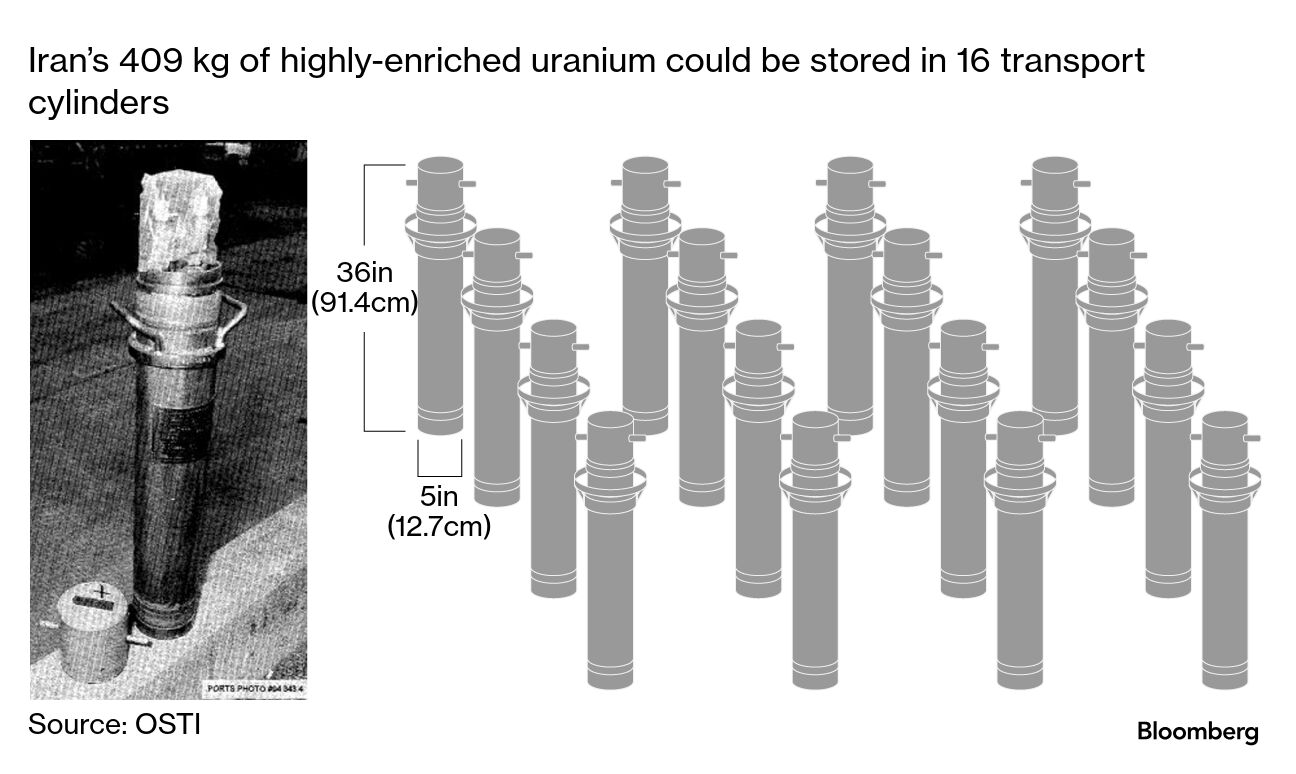
At last count, Iran possessed 409 kg of near-bomb-grade material, along with 8,000 kg of uranium enriched to lower levels. The whereabouts of that stockpile hasn’t been verified since the attacks began.
Iran had warned it would take the material to a secure location if attacked. With the UN nuclear watchdog prohibited from inspecting for the first time since Iran began making fuel in the early 2000s, there’s now the possibility that Tehran has taken its stockpile to a clandestine facility.
By failing to account for or destroy the nuclear-fuel inventory, Israel and the US have provided Iran with “strategic ambiguity” it didn’t have before the war began — a bargaining chip in any potential negotiations over what happens next.
The dilemma is how to respond.
Here’s a set of scenarios and options the US and the International Atomic Energy Agency could take in their approach to handling the situation. Click on the options below to see how events might unfold.
Cold War Legacy
The concept of strategic ambiguity was developed during the Cold War, most notably by Nobel Laureate economist Thomas Schelling, to manage uncertainty at the onset of the nuclear age. Effectively a measure of risk or threat, it allowed some level of guess work over capacity and intentions that was meant to prevent a slide toward all-out war. Israel, for example, uses it to manage perception of its own nuclear stockpile, neither denying nor confirming its existence.
While intelligence agencies may be able to reduce ambiguity by using spies and analyzing satellite imagery, eliminating it altogether requires diplomacy or force. That’s because nuclear material needs some level of physical verification to ensure it hasn’t been diverted for military use. Less than 25 kg of highly enriched uranium is needed to construct a bomb. At last count, Iran possesses uranium enriched to various levels, which taken together is enough feedstock for two dozen weapons.
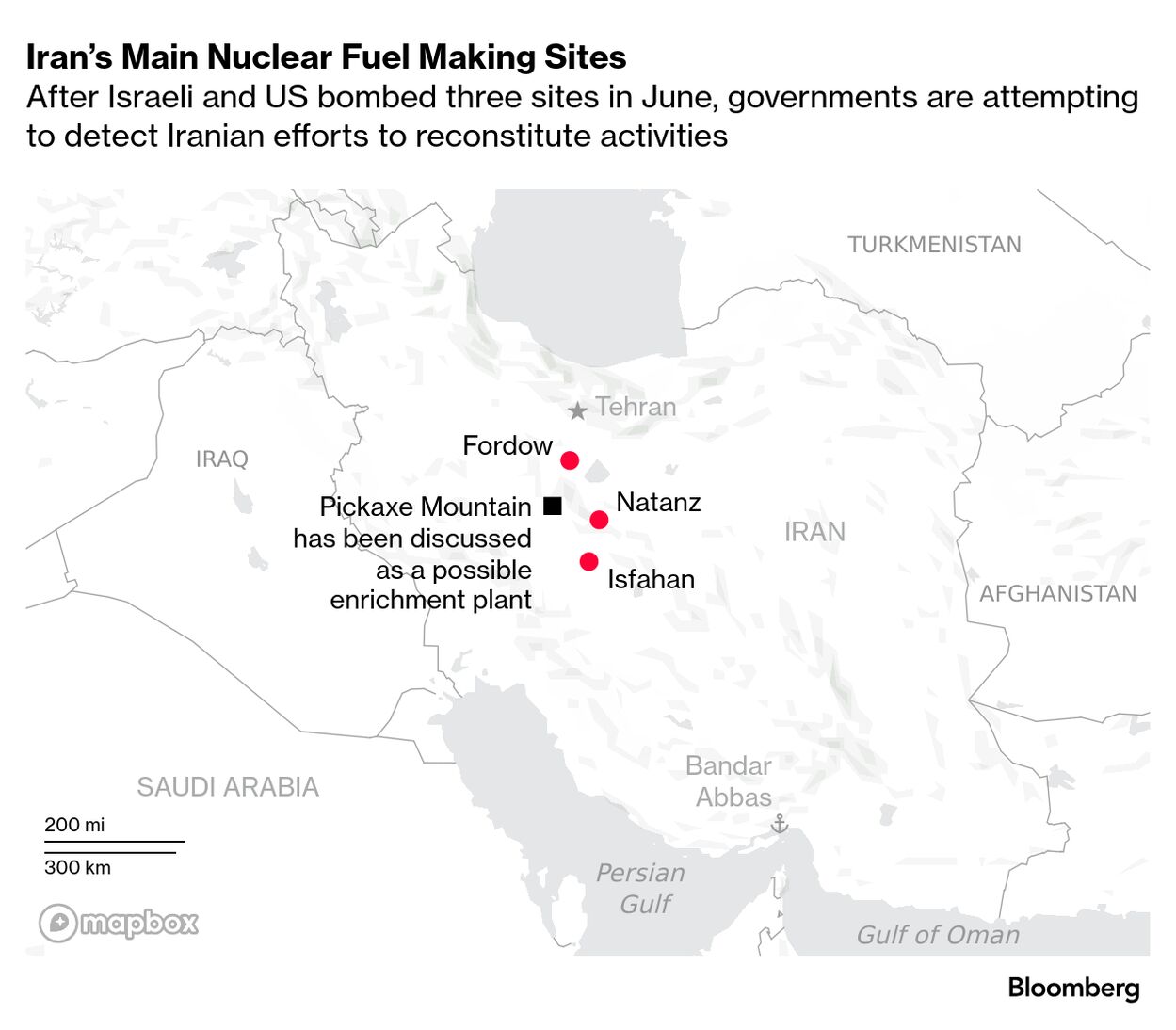
Iran’s Main Nuclear Fuel Making Sites
After Israeli and US bombed three sites in June, governments are attempting to detect Iranian efforts to reconstitute activities
The amount of ambiguity the US and Israel can tolerate is set to play a decisive role in their actions through the end of the year. How much of Iran’s nuclear inventory are they willing to leave to chance? That’s the question facing decision makers.
Given the Trump administration insists it has obliterated Iran’s nuclear program, the US and Israel may choose no further action. In such a scenario, actors would have to be highly tolerant of ambiguity, not least because the cache of uranium last seen in Iran’s possession will be weapons-usable for thousands of years.
Another possibility is that the US and Israel have low tolerance for ambiguity, and that they are willing to go all in on compelling Iran to verify the state and location of its uranium. In the absence of an Iranian capitulation, they will need to enforce compliance, potentially with boots on the ground for verification. Even with the most powerful weapons at their disposal, air strikes alone cannot eliminate ambiguity over Iran’s fuel inventory status.
Mutually acceptable, or negotiated ambiguity, is another potential outcome. A combination of remote-sensing, statistical methods and physical on-the-ground verification is used to account for material. That’s what UN nuclear inspectors were doing before the attack, publishing the results every three months.