The Red Sea Has Become a War Zone Full of Vulnerable Ships
Older ships with untraceable insurance are navigating the Red Sea in the face of Houthi attacks — and they’re increasing the threat to environmental and structural damage for everyone else
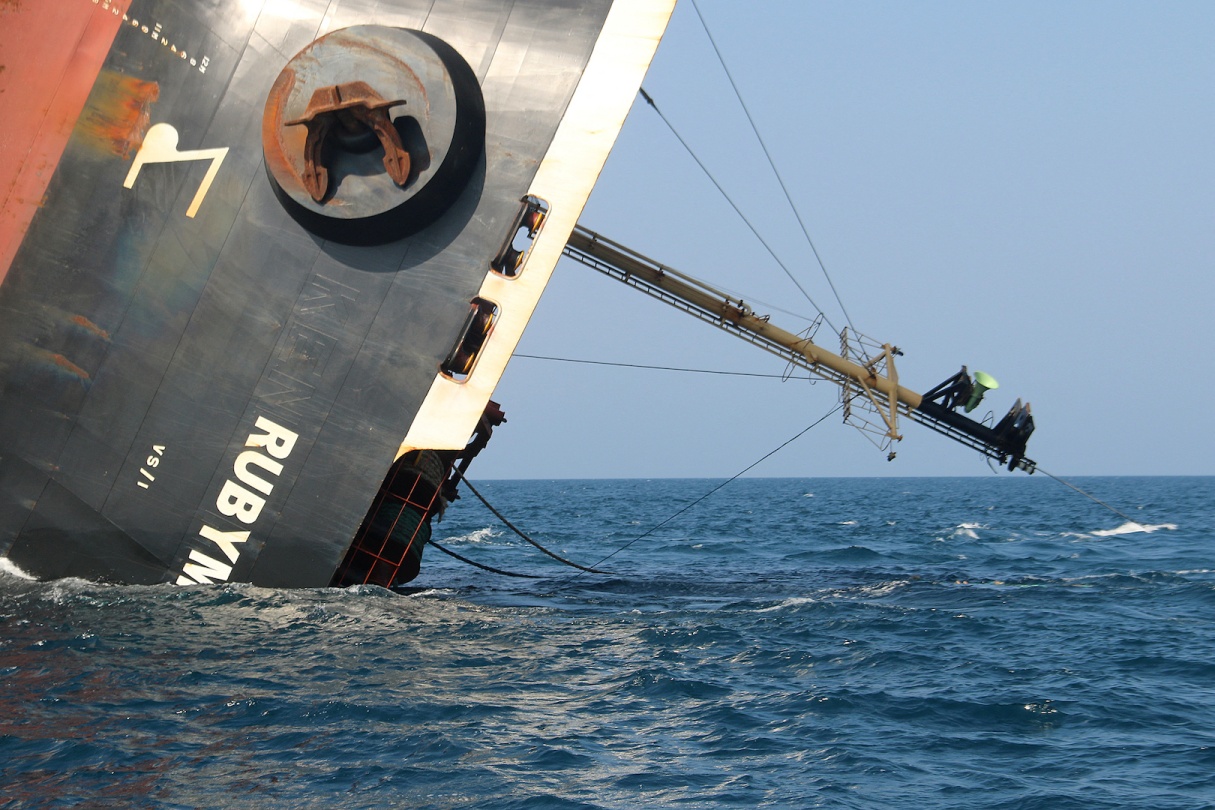
Weeks after a Houthi rebel missile attacked the Rubymar in the globally important Bab el-Mandeb Strait, the ship dumped fuel into the sea and could still pour environmentally damaging fertilizer into the waters. It presents an ongoing risk for other ships transiting the Red Sea, and the ship’s anchor has likely damaged subsea cables.
A Bloomberg News analysis shows that the UK-owned cargo vessel — which had been sailing the world’s oceans since 1997 — is far from the only vintage ship still passing through the Red Sea. With huge chunks of traffic diverted around Africa, the tankers and cargo ships still attempting to sail through what has turned into a war zone off the Yemeni coast carry a higher-risk profile.
A ship’s age and insurance coverage against risks like oil spills and collisions (known as P&I insurance) are two of several ways to determine the quality of a vessel. Bloomberg News examined these factors for a sample of nearly 10,000 commercial ships that traversed the Red Sea or the Cape of Good Hope between Dec. 1, 2023 and March 10, 2024. The ships that still make the dangerous trek towards the Suez Canal are more likely to be older and with unknown insurance information compared to the same period a year ago. They’re also more vulnerable compared to the ships opting for the safer route along the southern tip of Africa.
Red Sea Fleet More Likely to Be Higher Risk After Houthi Attacks
Sources: Bloomberg News analysis of vessel movement and characteristics data; IHS Markit; Wood Mackenzie/Genscape; Clarkson Research Services
Note: Data is for a sample that includes tanker, cargo and passenger ships with an internal volume of 5,000 tons or more and for trips between Dec. 1 and March 10. Find more details about the analysis in the methodology note at the end of the story.
The Red Sea is a choke point for global maritime trade — a fact Yemen’s Houthi rebels have capitalized on by denying passage and then targeting global shipping with missile attacks since November last year. The strategy began as a protest against Israel’s ground invasion in Gaza, specifically targeting ships bound for Israel. On Nov. 19, the Iran-backed group hijacked the commercial car carrier Galaxy Leader. Israeli businessman Rami Ungar owns the boat.
The scale of attacks has since expanded to include vessels linked to the US and UK after the two countries launched air strikes on the Houthis.
Ships must pass the narrow Bab el-Mandeb Strait near Yemen’s coast if they want to sail from Asia to the Suez Canal in Egypt, which accounts for 12% of the world’s seaborne trade. The attacks have led to a plunge in journeys through that region, and a commensurate rise in voyages around Africa. Surrounding ports are benefiting.
“All the reputable owners are avoiding the Red Sea and the Suez Canal,’’ Paolo D’Amico, Chief Executive Officer of oil tanker company d’Amico International Shipping SA said on an earnings call this month.
That’s a flip image of the Cape of Good Hope, where traffic has increased substantially. That trend is evident when current daily transits are compared against a four-year average.
Red Sea Transits Have Diverted to South Africa
Source: IMF PortWatch
Note: Data through March 17, 2024. Based on a seven-day moving average of daily transits for all ships from Nov. 19, 2019 to Nov. 19, 2023, the day of the first Houthi vessel attack.
The riskier profile of ships that continue to transit through the Red Sea heightens the chances of spills of everything from the oil helping to power ships to any cargo that sails across the oceans. It increases a threat to coral reefs and mangroves, fish stocks and ports, casting doubt over who would pay to clean up the damage.
Ships With Untraceable Insurance Continue to Transit the Red Sea After the Rubymar Attack
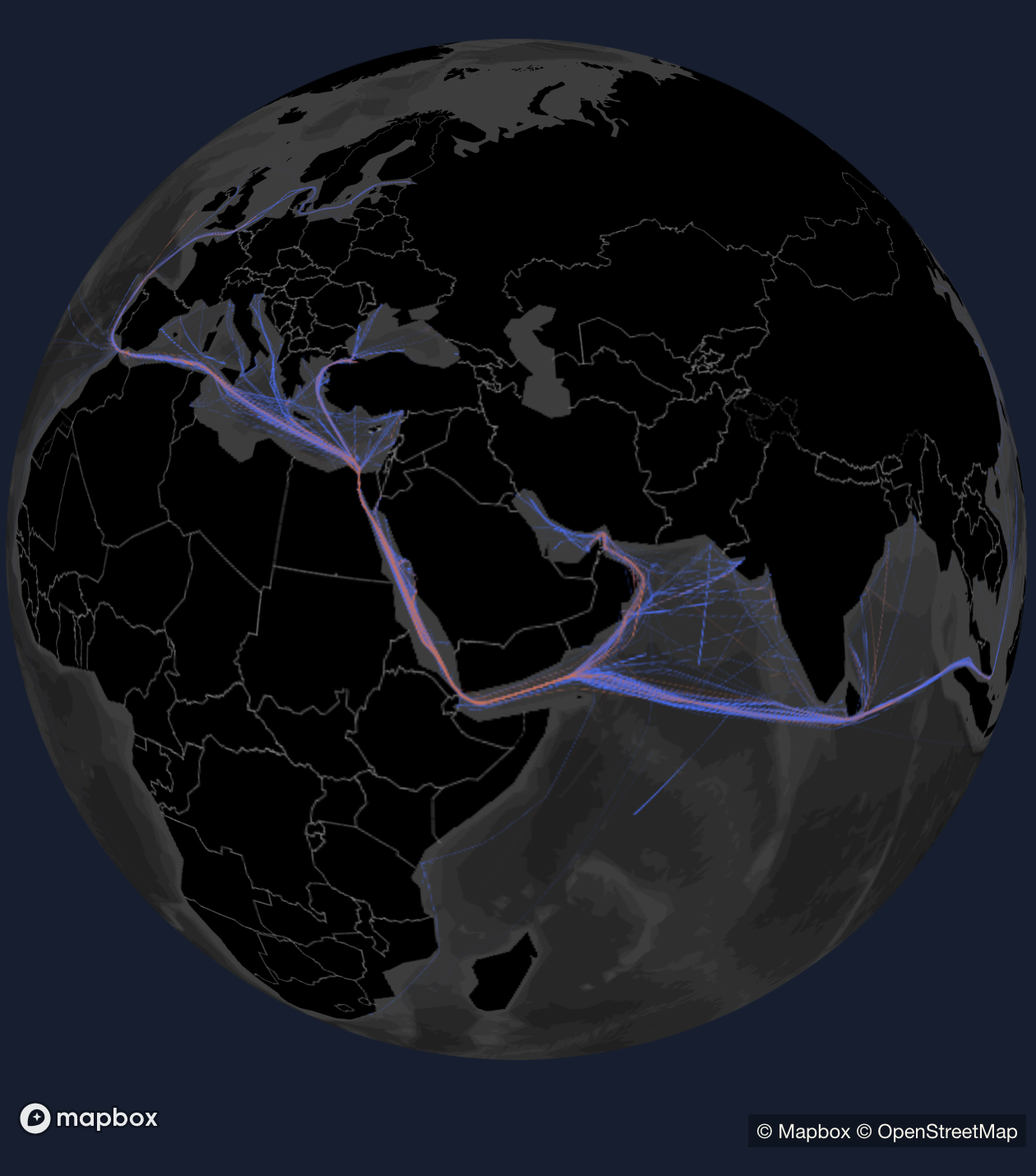
Note: Ship movements shown cover Feb. 1–March 15.
Note: Ship movements shown cover Feb. 1–March 15.
Under the guidance of regional authorities and security companies, some ships turn off tracking systems while in the region, so the true numbers could be higher. Data from the Global Fishing Watch public map shows that from November 2023 to February 2024, a total of 177 detections of vessels longer than 15 meters, as seen by radar, were not broadcasting signals from the Automatic Identification System (AIS). Ships have also been mixing up speeds and transiting at night to avoid attack.
According to data from maritime risk management firm Ambrey Analytics, more than 70 confirmed merchant ships received some sort of Houthi threat, as of March 15. The overwhelming majority of these threats were flagged as “suspicious approaches” or “sightings”. Such incidents include nearby missile hits or the circling of vessels by Houthi-controlled boats. Around a third of the merchant ships were physically damaged.
The relative increase in the age profile of ships transiting the Red Sea also shows up in the vessels being attacked. While early incidents more or less straddled the average age for the merchant fleet, more recent attacks have skewed towards older ships as younger ones have embarked on detours. Of the confirmed carriers that were damaged or threatened, more than two-fifths were older than the average age of ships globally.
43% of Merchant Ships Attacked by Houthis Are Older Than Global Average
Sources: Ambrey Analytics; Bloomberg News analysis of vessels characteristics data
Note: Attacked vessels as of March 15. Ship age is at the time of attack.
All the while, the Houthis continue to seek vessels that have US, UK and Israeli links, even if those links are outdated.
“The Houthis are very likely using publicly available databases to obtain information on which ships to target,’’ said Dirk Siebels, a senior analyst at security advisory business Risk Intelligence. “Based on that data, most of the targeted ships had an Israeli, US or UK nexus, in line with the criteria publicly announced by the Houthis. However, there have also been some mistakes based on outdated information.”
The Rubymar was one such vessel — targeted for its UK links. One potential reason for the ship’s targeting was an outdated residential address in Southampton, England on marine ownership databases. The vessel’s operator was a company called Blue Fleet Group, which has offices in Greece and Lebanon.
The eventual spill from the sunken ship could prove to be as much as 21,000 tonnes of ammonium phosphate that it was carrying, as well as the fuel it used for power.
Its insurer against spills was Thomas Miller Specialty. The company, which has offices in London, confirmed the cover but said it couldn’t comment further on the ship for reasons of confidentiality. Around the time of the attack the Thomas Miller Specialty published a notice saying that it was withdrawing some coverage for ships in the Red Sea. The company declined to comment on whether that notice impacted Rubymar.
Rubymar Leaves Behind Toxic Chemicals
Sources: IHS Markit; Wood Mackenzie/Genscape; Planet Labs PBC (PlanetScope, SkySat); Copernicus (Sentinel-1, Sentinel-2)
Note: Rubymar locations and oil spills since the attack are based on a Bloomberg News analysis of multiple satellite imagery sources.
The Rubymar’s sinking ultimately had another unintended consequence — when it dropped anchor after being attacked in mid-February, it is believed to have hit subsea cables. Three cables were shut offline after the anchor drop.
Read more: Houthi-Sunk Ship’s Anchor Likely Severed Sea Internet Cables
E-Marine, a subsidiary of Abu Dhabi-based Emirates Telecommunications Group Co. PJSC, will send out a boat to repair all three cables, but securing the necessary permits could take weeks.
Red Sea Is a Weak Spot for Global Internet
Sources: TeleGeography; HGC Global Communications
Note: Representations do not show a cable’s actual physical path. For damaged cables, the entire extent of a cable is higlighted, not just the site of the damage.
Data has since been re-routed, but the damaged cables expose wider risks and unexpected costs to Israel’s invasion of Gaza to fight Hamas and the Houthis’ response. The lines carried about 25% of internet traffic in the region and were critical in connecting Europe’s telecom infrastructure to Asia’s, via Egypt.
With a dense number of sea cables in shallow waters, the critical infrastructure remains vulnerable, as are the old ships with unknown insurance that are still sailing through the region. Though Gaza cease-fire negotiations have now resumed, there’s still not a clear end in sight of the Houthi attacks in the Red Sea, nor of when traffic in the region will start to look more normal.
“It’s very difficult because it’s a fairly large area that you need to defend and so far we have seen the attacks of the Houthis continue,’’ Rolf Habben Jansen, Chief Executive Officer of container shipping company Hapag-Lloyd AG said in a Bloomberg TV interview this month. “We hope that we are going to be able to go back through in a couple of months, but I know there are also people who feel that it may last quite a lot longer.”