
An Opinionated Guide to Big, Fat, Green Weddings
Weddings are expensive, but they’re costing the planet even more. To plan a greener one, take our carbon footprint quiz.
Anant Ambani, the son of Asia’s richest man, and Radhika Merchant invited 1,200 of their nearest and dearest to Jamnager in the Indian state of Gujarat for a spectacular three-day event to celebrate their union in March. On the first night, 5,500 drones put on a light show after dinner, while the flower arrangements by celebrity florist Jeff Leatham took table arrangements to towering new heights. Dozens of chefs created more than 500 dishes for the weekend, while hair, makeup, laundry, styling and other services were available for guests. Rihanna was the main entertainment.
The extravaganza reportedly cost more than £93 million ($100 million). Oh, and that was just the “pre-wedding.” The actual ceremony will take place over three days beginning July 12 in Mumbai. It’s expected to be even more opulent.
Only the children of the super-rich could throw such a big bash: Anant’s father is Mukesh Ambani, the chairman of Indian conglomerate Reliance Industries; Radhika is an Indian classical dancer who sits on the board of directors for pharmaceutical company Encore Healthcare Pvt Ltd, which was founded by her parents. But these are the kinds of wedding plans that shape the dreams of us mere mortals — and the various ways our celebrations can impact the environment.
So, what’s the carbon footprint of a super-wedding like this?
Hayley Neil, founder of Rolling in Roses, makes her sustainable wedding dresses in York, UK.
Videographer: Vivian Wan/Bloomberg
It’s impossible to properly estimate without knowing all the little details: the number of floral arrangements and where the flowers were grown, the number of freshly tailored outfits, the use or absence of renewable energy and so on. But based on the information we do have about the event — the thousand-plus guests flying in from various locations, as well as a dinner for 51,000 locals — I came up with an estimate using a wedding carbon footprint calculator: The weekend alone could well have contributed about 2,700 metric tons (2,976 tons) of CO2, the equivalent of more than four SpaceX Falcon 9 flights to the International Space Station.
This figure captures only a very rough estimate of food and travel. I assumed that 600 guests would be flying long-distance and 600 would fly short-distance. The estimate also doesn’t account for a whole host of things like drinks, energy use, private jets (likely a lot, given the wealth of the guests), staff flights on commercial airlines or Rihanna’s “crates of crap.” The figures were so high that they broke the first wedding carbon footprint calculator I found (If you’d like to see how your own nuptial choices stack up in terms of CO2 emissions, take our quiz below). And then the couple and their clans staged another prequel: a private cruise for celebrities and sports stars out of Barcelona in late May. Guests were flown into Spain on 10 chartered flights, while family and staff traveled to the Catalan capital on private jets, according to media reports.
The Big Celebrity Wedding Bash
While the rate of marriage has actually gone down in the US and UK, the costs have not. Indeed, the greater your wherewithal, the more likely you are to get married — and spend big on the ceremony. The average has been steadily climbing for years, apart from a dip during the pandemic. In 2023, it was $35,000 — a 25% nominal increase from 2019 — according to The Knot, a wedding planning website. What we don’t talk about is the other price to be paid: the environmental cost. It can be sizable.
A couple’s wedding is likely to be the most exorbitant day of their lives but also the most carbon intensive. Though estimates vary (and none are definitive), the average carbon footprint of a US wedding amounts to around 56 metric tons (61 tons) of CO2. In contrast, Americans individually produced just 14.9 tons each in 2022. That’s not even considering the waste produced by all the events associated with weddings, from the bachelor and bachelorette parties to bridal showers.
Yet the ritual is universal and almost impossible to abandon. During the pandemic, couples opted for drive-through ceremonies, broadcasting their vows over Zoom or radically diminished events, rather than forgo nuptials entirely. Since Covid receded, revenge weddings have become a trend, and surveys indicate the size and spend have bounced back to or near 2019 levels.
Michelle Miles, founder of the Sustainable Wedding Alliance, says that high-end aspirational weddings bear responsibility for their effects on the planet because of the influence they have. The same goes for magazines and influencers, which tend to promote “over-opulent weddings with a ton of floral foam,” she said, referring to the single-use, non-biodegradable plastic that keeps flowers hydrated. “The content that we are putting out as an industry really needs to be achievable for people.”
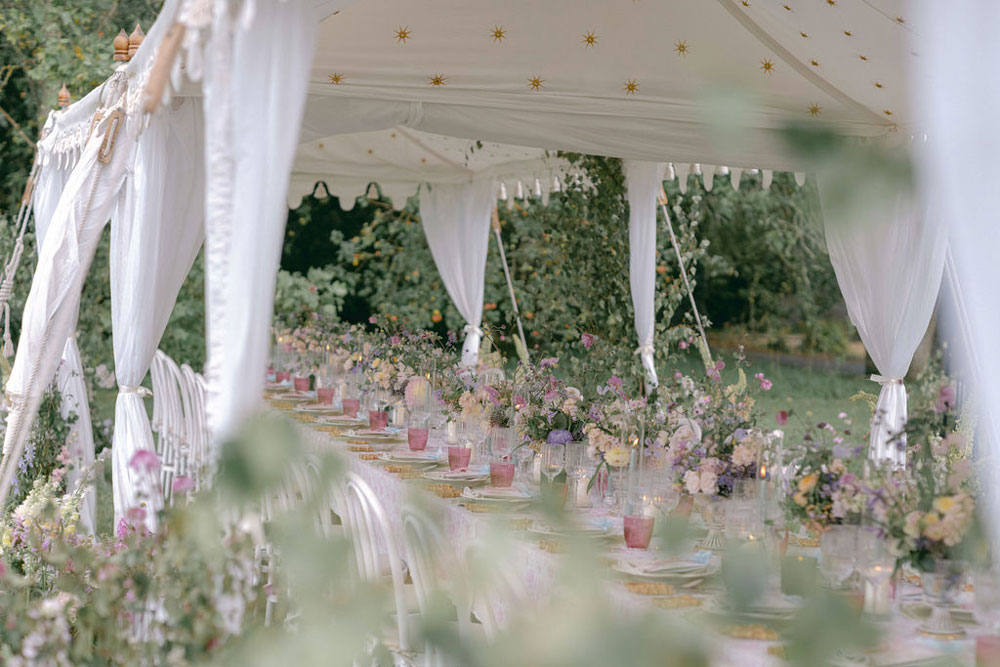
Sustainable weddings can still look glamorous.
Photographer: Katie Julia; Event production: Studio Sorores; Catering: Social Pantry
Let’s introduce climate consciousness to our communal celebrations of love. Our choices add up. I don’t say this to be a party-pooper or to suggest that weddings are a major contributor to climate change. Ultimately, that responsibility rests with the burning of fossil fuels. But as we aim for sustainability, we have to be aware that individual decisions can have powerful economic impacts, particularly in helping eco-friendly business practices and products to scale.
Admittedly, the most climate-friendly wedding is more like being dunked in cold water than throwing a party. The couple walk to the registry office or their religious venue of choice with two witnesses, dressed in clothes they already own. Afterward, they might stop off at the pub on the way home for a convivial toast. For some couples, that’s all they want, but that kind of minimalism is a damper for many people. Can a couple have a big, fat wedding that’s still green?
There’s little information to aid couples in budgeting for sustainability. The betrothed have to rely on their own research — and the knowledge of their planner or vendors — to be guided in a greener direction. The good news is that the multi-billion-dollar wedding industry is slowly beginning to come up with planet-friendly choices in venues, clothing, food and flowers. We just need to start making them.
I’m here to help.
Slicing Up the Carbon Wedding Cake
Everything comes with a carbon footprint — weddings are just one lens through which to examine the impact our decisions have on the environment — but it’s not always easy or intuitive to understand them. We’ve sprinkled questions throughout the next section to help you to understand the implications of different consumer choices.
If you broke down the emissions of a wedding into the shape of a tiered cake, the bottom layer — the big base that supports the little statuette of the happy couple at the top — would be travel. At an estimated 14.5 metric tons (15.9 tons) of CO2-equivalent, a unit which represents all greenhouse gases in one number, a wedding in the UK emits just a fraction of the US’ 56 tons. That’s because it’s pretty easy to get around the island without flying.
Where’s the wedding being held?
When choosing a venue, select a location close to where the majority of your guests live. Vanessa Harness, who specializes in luxury and outdoor weddings with her company Harness & Co. Ltd, put it to me this way: If all your guests are local to London, why are you having a wedding in Scotland or Spain? Granted, certain family members may live there or perhaps there are ancestral ties to be honored. Maybe some guests who live overseas need to fly in regardless. Couples ought to at least ask the question before opting for a destination wedding.
Simply having fewer guests keeps associated pollution down, too. So take your guest list and halve it. All the emissions associated with guests — travel, food, accommodation — will be halved. It’s also a good excuse to give when you cross off all your parents’ friends from the guest list. It’ll help with keeping down the cost of weddings — which is a source of much anxiety. Searches for “micro weddings” reached an all-time high this year in the US, according to Google Trends.
How long is the guest list?
When Sebastian Manhart, a senior policy adviser at carbon-removal credit platform Carbonfuture GmbH, got married, it was important to him and his fiancée that, in addition to a ceremony in Italy, a celebration take place on Kea, the Greek island where they met. Because of the travel involved, they limited their guest list to just 18 people to minimize emissions.
It’s not just guests. Your vendors — the photographer, DJ, florist, caterer etc. — have to travel, too. Harness recommends using suppliers local to the wedding venue and contracting with as few as possible. “If you’re hiring tables, chairs, kitchenware, get one supplier to do it all for you,” she explained. It’ll make logistics much more efficient, and will save you money if you’re not paying for your make-up artist to travel from London to Devon.
What best describes your reception venue?
Then there’s the location itself. I naively assumed that a wedding in a field in the countryside would be fairly low carbon as well as romantic. It’s close to nature, right? Harness corrected me: If you want a wedding in a field, you will likely have to transport marquees, furniture, tech equipment and toilets, plus generators to power the lights, bar and kitchen. Those generators most commonly run on diesel. (Battery alternatives are becoming more available.) Instead, you could try to find a suitable party hall or house. “Venue weddings have less of an impact because everything is there already,” Harness said.
If the size of your wedding’s footprint still bothers you, you can do what Manhart did. He offset his Greek and Italian wedding events with carbon removal. That’s paying for removing CO2 from the atmosphere to be stored permanently. To do that, he purchased biochar credits, having calculated emissions from travel using an online calculator for each guest’s journey. For food and other miscellaneous emissions, he made a quick estimate: “Its impact is negligible compared to travel.” A single credit is equivalent to almost a metric ton of removed carbon.
Where are the guests staying?
It’s a substantial and sustainable stamp on your wedding, but it’s not cheap. The price of the credits are determined by the carbon market. In 2023, a biochar credit sat at an average of £139 ($150). When everything was added up, 25% of Manhart’s wedding budget was spent on carbon credits.
The Trouble with Flowers
What’s a wedding without flowers? They’re in buttonholes, bouquets, centerpieces and beyond in aspirational dreamland. The union (now over) of Kanye West and Kim Kardashian sparked a trend for lush and expensive walls of flowers. Flowers can also be displayed on arches, hanging installations, and theatrical tablescapes. But imported flowers are the biggest contributor to a wedding’s environmental impact, after travel, accommodation and the operation of a venue, according to Stanford Magazine’s SAGE (Sound Advice for a Green Earth) project.
Pick a bouquet
What’s wrong with flowers? They’re biodegradable after all. And don’t plants suck up carbon dioxide? That’s all true. The problem with blooms is how and where they’re grown.
In the UK, imports make up 86% of the trade in cut flowers. Most are from the European Union (specifically the Netherlands), but increasingly stems are being flown in from Kenya, Ethiopia and Ecuador. A huge number of flowers in the US are also flown in from South America, via complex supply chains. During the Valentine’s Day period this year, about 43,500 metric tons (48,000 tons) of fresh, cut flowers passed through Miami International Airport. In the Netherlands, flower production typically requires gas-heated greenhouses. You don’t need artificial heat or light in Kenya (which supplies a third of all roses sold in the UK), but the emissions involved in fertilizer, transport and refrigeration almost make up for that.
So what’s a bride or groom to do to stay green? A small industry of seasonal-flower farmers is blooming in both the UK and US.
Up until about five years ago, commercial flowers grown outdoors in the UK were rare. A 2016 National Farmers’ Union report found that the value of British cut flowers remained largely the same between 1980s and 2015, rising just 3.8% in that period to £82 million ($87 million), while the value of imports ballooned by 446% to £666 million ($712 million)..
Since then, a community of small-scale growers has burst forth, helped by increasingly sophisticated logistics networks set up by companies like Evolve Flowers Ltd, a specialist wholesaler, and organizations like Flowers From the Farm, a trade association.
Rebecca Yussuf — who used to be a meteorologist — understands the importance of reducing emissions more than most florists. After 10 years of working anti-social hours, she quit weather forecasting. Retrained, she launched Lilac & Lace Floral Design in 2016. In 2018, Yussuf ditched floral foam — the single-use plastic material that holds water and supports flowers in displays, turning to moss and chicken wire as a sustainable alternative. In 2023, she also started growing her own flowers to use in her clients’ weddings. There isn’t enough supply to use only British seasonal flowers. Some imported flowers have to make up for shortfalls. Still she’s also introduced a rewards scheme for couples who opt to have solely British flowers. And by the end of this year, Yussuf aims to go completely local.
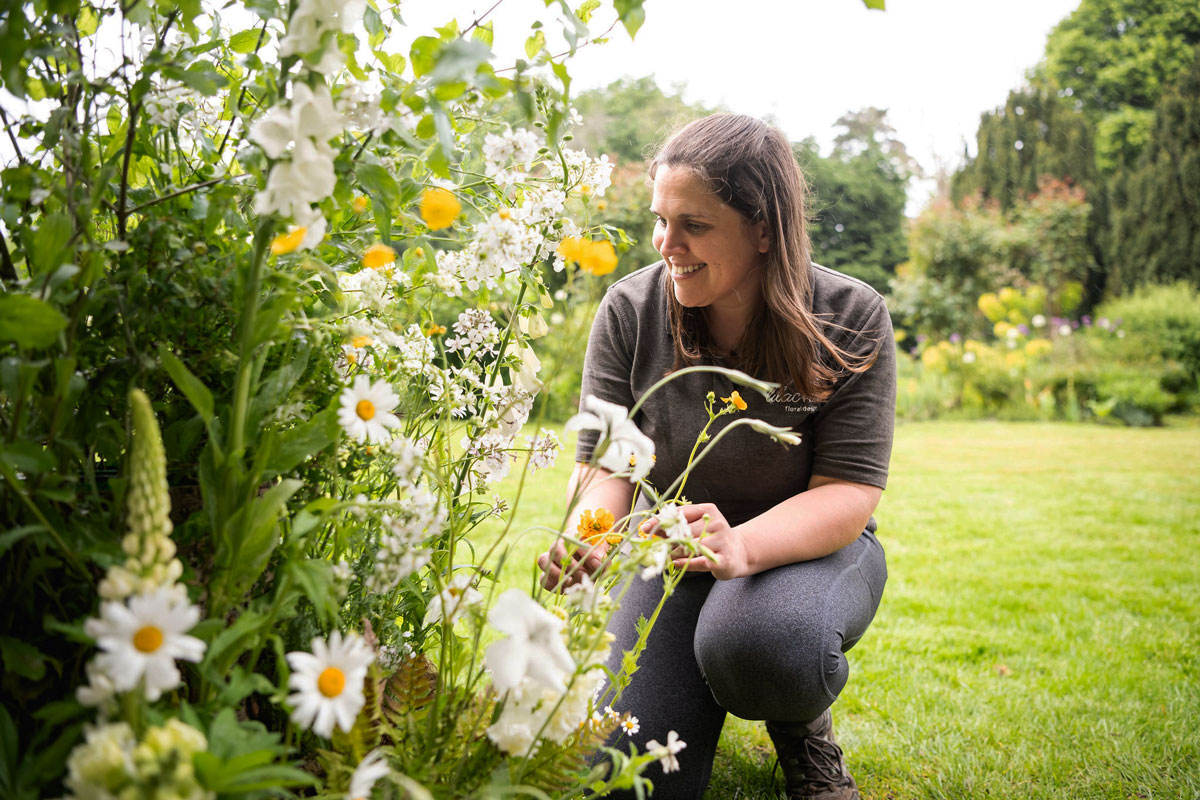
Rebecca Yussuf of Lilac and Lace Floral Design.
Photographer: Emily Brown
If you’re going for homegrown, seasonal flowers, you’ve got to cap your expectations. “Let’s be honest, everyone wants a peony,” laughed Yussuf. But they’re only available in the UK for a brief six-week period. Luckily, plenty of alternatives have the same floral aesthetics available for longer: among them, roses, the ranunculus family that includes buttercups, and camellias. If you’re getting married during the winter months, dried flowers are a good option — or embrace a bouquet of winter foliage.
Yussuf says Pinterest Inc. is a “wonderful tool” but a “massive problem.” Social media can make some brides a little inflexible. It’s hard to fall out of love with the special bloom you’ve seen on your digital mood boards. Miles of the Sustainable Wedding Alliance told me there’d been a recent trend for a specific type of toffee-coloured rose that was only grown in Ecuador. Not exactly the sustainable choice for anyone outside of that nation.
So go to your florist with simply a color scheme and general feel. The truth is, whatever you may want, florists might not even know the quantity, quality and type of stems available until about three or four weeks before a wedding. The weather can get in the way. They can’t make hard and fast guarantees — and you should be skeptical if they do. Availability can also vary by location: Tulips might bloom a full week later in Cumbria than Cornwall. It’s hard work for new-age floral designers. “When we work sustainably,” said Yussuf, “the mechanics are more time-consuming.” The more established florist chains might see all the sourcing and new-fangled engineering of eco-friendly flower arrangements as a waste of time.
However, the payoff in reduced emissions is huge. While a Dutch lily creates about 3.5kg CO2e, a commercially grown British lily produces just 0.8kg CO2e. Growing flowers outdoors in the UK produces just 0.1kg CO2e per stem.
The Wear and Tear of What You Wear
For many brides and grooms, the outfits make the day. These garments are likely to be among the most expensive clothing purchases of their lifetime, but that doesn’t necessarily make them sustainable. Whether a Western white gown, a lehenga, a hanbok, an ao dai dress or a suit, the environmental impact will mainly come from the production of the outfit’s raw materials — that is, the growing of the cotton, the extraction of the silk, the fabrication of the polyester and the processing of these fibers into glossy, slinky materials.
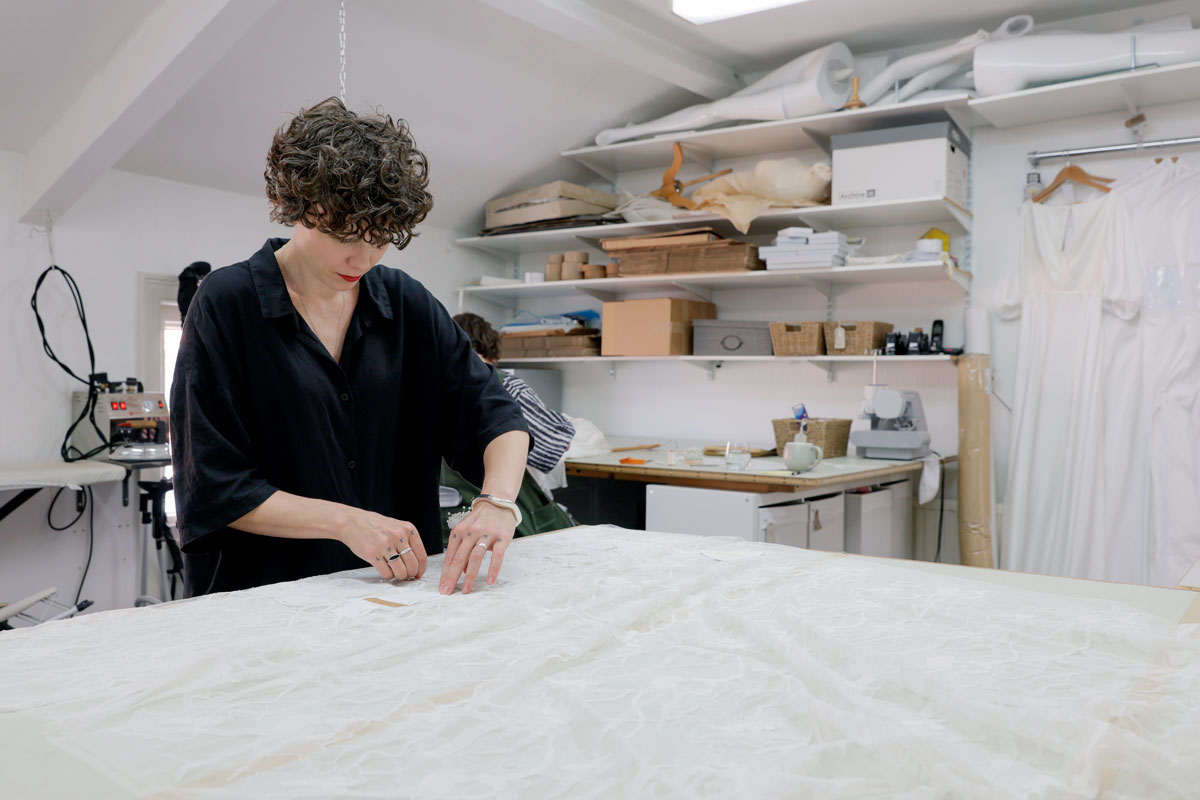
Hayley Neil, founder of Rolling in Roses.
Photographer: Vivian Wan/Bloomberg
The wedding dress industry can be confusing for the well-intentioned couple. Plenty of brands call themselves sustainable while churning out polyester dresses, or boasting about cutting fabrics as economically as possible. “Everyone does that!” says Hayley Neil, founder and designer of Rolling in Roses. “It’s not something to be proud about.”
There are optimal sustainable choices: Rentals are becoming popular, as well as buying secondhand or vintage garments. These extend the life and use of clothing already in existence. But there are other options if you’re set on something new.
Where are we getting the outfits from?
Neil says a dress made of eco-friendly fibers is key. That includes anything from linen, organic cotton and modern rayon. Neil uses innovative fabrics such as a viscose sourced from sustainably managed pine and eucalyptus forests; and there’s also smooth and lustrous lyocell, which can be made from the byproducts of the orange juice industry in Sicily. If you want a really romantic fabric, you can buy satin made from organic rose petals.
These fabrics are more than just biodegradable. Lyocell is made in a closed-loop system, meaning the water and chemicals involved are cleaned and recycled, reducing demand for an increasingly sparse resource as well as preventing pollution.
What’s the dress made out of?
While it’s getting easier for dressmakers like Neil to source sustainable materials, it’s still a challenge. Some fabrics, though beautiful, take a little while to learn how to use. “From a commercial point of view, that’s time wasted,” says Neil. “Polyester, on the other hand, hardly creases and it’s cheap.”
Wedding dresses are, in some ways, the ultimate throw-away fashion item. Worn once, they are left to languish in the back of the closet. That makes their emissions-per-wear index pretty hefty. It’s also a shame to put on your most expensive and best-fitting outfit for just a single day. Neil does dye tests on all the material she uses, so the fabric can be tinted safely for non-ceremonial use. She also urges brides to fashion their dresses into a shorter style for wearing long after the wedding.
It Doesn’t Always Have to Be Vegan
Pay close attention to catering because 26% of all greenhouse gas emissions come from food production. Approximately half of the global food system’s emissions comes from waste. Think about donating leftovers or serving plated food instead of a buffet. There are also specialist zero-waste caterers you might consider.
One such outfit is Social Pantry, founded by Alex Head in 2011. Everything in her kitchen gets used. Carrot tops are transformed into a bright green powder for garnishes. The whey from making labneh contributes to a caramel for desserts. The remaining lemons and limes at the bar get turned into limoncello and lemon oils. What can’t be fermented, pickled, dried or eaten by staff gets fed into the food waste digester to be transformed into grey water that can be sent to water treatment facilities. The coffee grounds from one of Head’s cafes goes to feed a local lady’s worm farm.
What’s on the menu?
As with flowers, the best options for food are seasonal, outdoor-grown, local produce. But data show that what’s on your menu tends to be more important than where it comes from. The vast majority of pollution comes from land-use change and on-farm emissions. What that means is that you’re often better off serving a vegan menu than plating up local beef.
“Over the years we’ve done a number of vegan weddings and I’m always secretly really proud of those brides and grooms,” Head told me. But will Uncle Dave be annoyed that there’s no chicken? Traditionally, meat has been the centerpiece of a celebration meal across many different cultures. But there’s no reason plant-based food can’t be as celebratory and delicious.
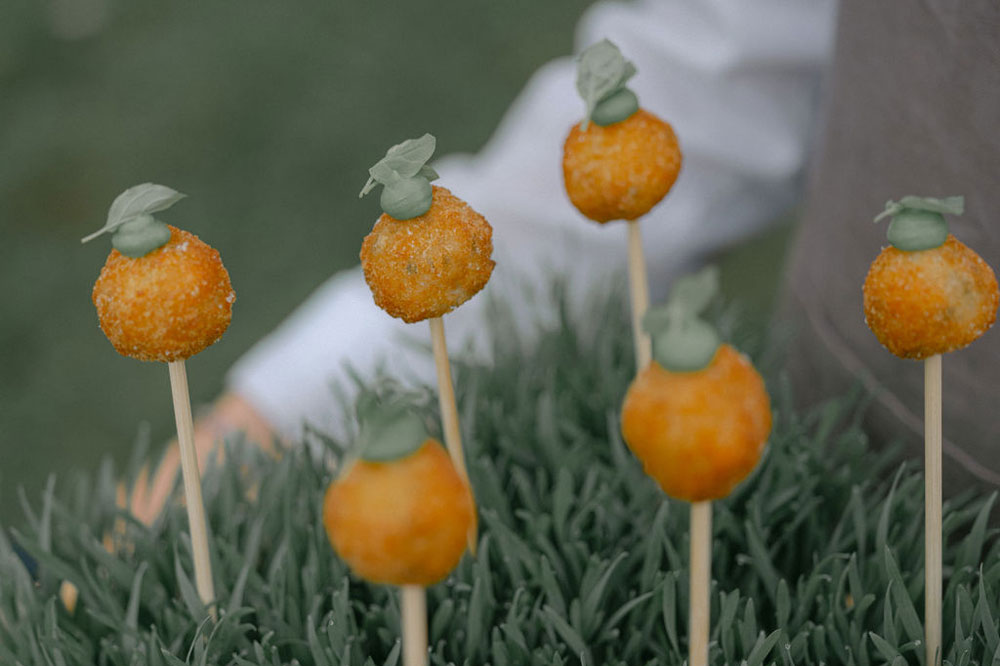
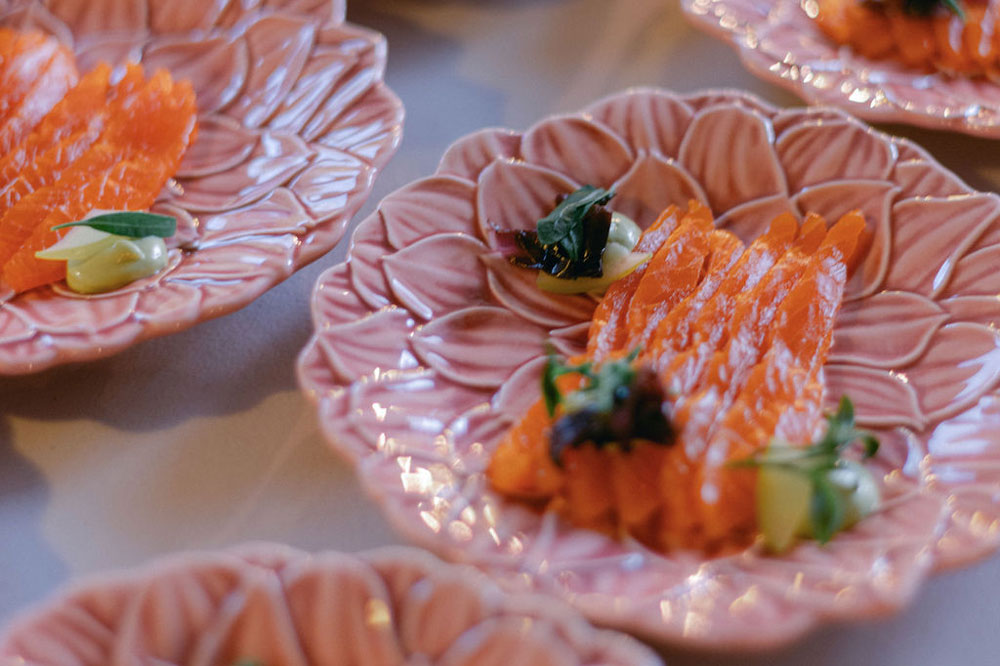
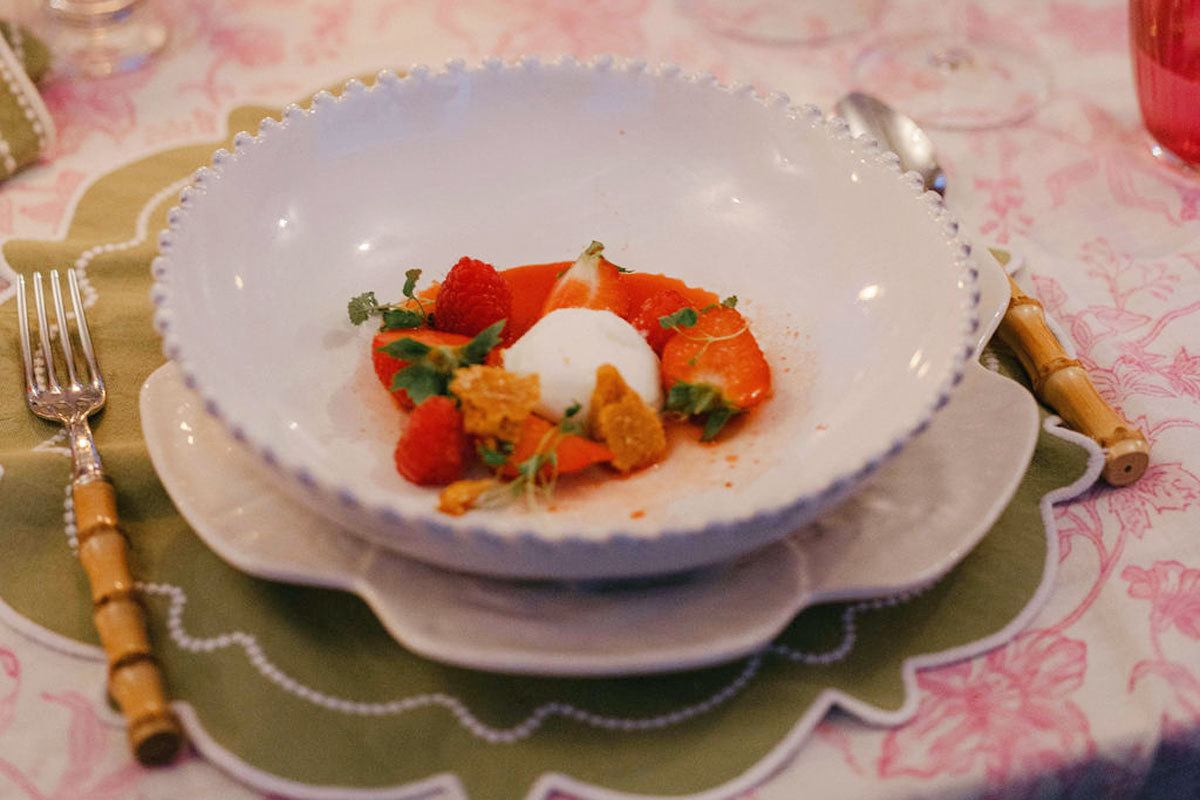
Reception sustenance.
Photographer: Katie Julia; Event production: Studio Sorores; Catering: Social Pantry
Is anything off the Social Pantry’s menu? “We haven’t served avocados for about three or four years,” explains Head. Avocados require vast amounts of water — 15 times that required to grow apples — and have been linked to illegal deforestation in Mexico, the largest producer of the so-called green-gold. Red meat, however, is still an option. She offers the option of venison when possible (deer populations currently need to be kept in check to protect Scottish landscapes, and wild game comes with a fraction of the carbon footprint of farmed meat); and her kitchen sources beef from farms using sustainable practices. Head says that ruling out meat “would be commercially too tricky at this point.” It rings true with the wider industry: There are countless examples where vegan restaurants have had to start serving meat to make ends meet.
Moving Sustainability From Niche to Norm
More and more vendors and couples are becoming aware of the impact their decisions have on the planet. But the message isn’t sinking in as deep as it needs to. According to Bridebook, a wedding planning app, only 13% of surveyed couples in 2023 didn’t have anything sustainable at their wedding. However, the most popular effort by far was plant-based confetti at 51%. That’s a wonderful and easy win, but leaves a lot of room for improvement.
Perhaps the easiest way to throw a sustainable celebration is to shun the allure of the super-wedding. Cut down on frills — the favors, the basket of flip flops, special getting-ready outfits, printed programs and custom signage. Having fewer of these extras won’t make it any less fun or meaningful, and you’ll cut down on emissions and — bonus! — the cost of the day. But to do that, you’ve got to be aware in the first place. And that’s tough because most people who intend to marry haven’t planned a wedding before.
It’s become easy to draw lines between, say, plastic straws and environmental damage or travel and carbon emissions. It’s less obvious that the perfectly lit images of white roses in wedding magazines or on your Instagram feed also come with a cost. Knowledgeable vendors are key to connecting the dots. But some are held back by their own lack of knowledge or by commercial pressures.
Headspace is another barrier. My engaged friends often talk about decision fatigue: Trying to get a wedding arranged alongside your full-time job, social life and exercise routine, is a lot of work. If you don’t have sustainably minded vendors or a planner to hold your hand, then some things — like reusing flower displays throughout the day or knowing where to hire, rather than buy, decor — won’t even cross your mind. You’re just trying to get the job done.
Cost, meanwhile, isn’t necessarily the barrier people think it is. In my research, I’ve seen how sustainability can happen across the spectrum of wedding budgets and styles — from glamorous and big budget to modest and intimate.
Kind of Climate-Friendly Celebrations
Source: Bridebook Wedding Report
My friends Connor Ibbetson and Siobhan Gallagher are planning their wedding in August. It’s going to be a small, family affair. For them, being sustainable is the same as being cost-effective. Gallagher has bought a second-hand wedding dress and everything on the day is within walking distance. There’s no need for cars. Together, the couple has been churning out bunting on Gallagher’s sewing machine, made from old bedsheets and calico bags used to transport wicker coffins to the funeral directors where Ibbetson’s father works. The same fabric will be used to make a welcome banner and photo backdrop.
I said that weddings aren’t the major cause of climate change. But they can become major victims of it. Sogflation, or its cousin heatflation, will hike up the cost of catering. Flooding could rob local flower farms of their peonies. Extreme heat will push people into hosting weddings elsewhere — in more northerly latitudes, in air-conditioned venues, or at different times of year. You might have fewer choices then — and more costs.
A wedding in the Sicilian town of Taormina ran into difficulties last year when a heatwave struck much of Europe. As temperatures soared to 46C (115F), the priest fainted at the end of the ceremony, which was taking place in a church with no air conditioning. Brides and grooms used to worry about rain on their wedding day, now they fret about temperatures rising beyond what could be considered safe for grandpa. Miles told me that even the fact that grass is often brown in August these days may be putting people off having late summer receptions. It doesn’t look as good in photos, after all.
Sustainable weddings aren’t a style or a trend. They’re simply a series of conscious decisions that will support local economies and produce less waste, both physically and financially. Planet-friendly practices need to become the norm, rather than a niche business. That can only happen if couples start taking the initiative. Imbue your ceremony with more meaning. It’s already a celebration of love. Make it a commitment to the planet your future together depends on.