
What Has Biden Accomplished? Look at These 10 Metrics, Not the Polls
Biden has outperformed Trump on a number of fronts, from inequality and green spending to stocks and crime. But not all.
President Joe Biden’s third year in office was dogged by political gridlock yet blessed by an economy that refused to break despite painful inflation and surging borrowing costs. If presidential elections hinge on “the economy, stupid,” then winning a second term should be a cakewalk for Biden given the robust labor market, strengthening household finances, and improving confidence among consumers and businesses. Instead, his poll numbers predict the opposite, weighed down by the legacy of Covid-era inflation and doubts about his age. Looming even larger is the influx of migrants at the southern border, which Republicans would rather use as a weapon than fix via bipartisan immigration reform. As Biden and his presumptive opponent, Donald Trump, take their message to voters ahead of the November election, Bloomberg Opinion columnists tell you how the president’s performance stacks up against his predecessor by the numbers.
Immigration | Health | Jobs and wages | Inflation | Energy transition | Household wealth | Income inequality | Markets | Homicides | Job approval
Immigration reform is failing
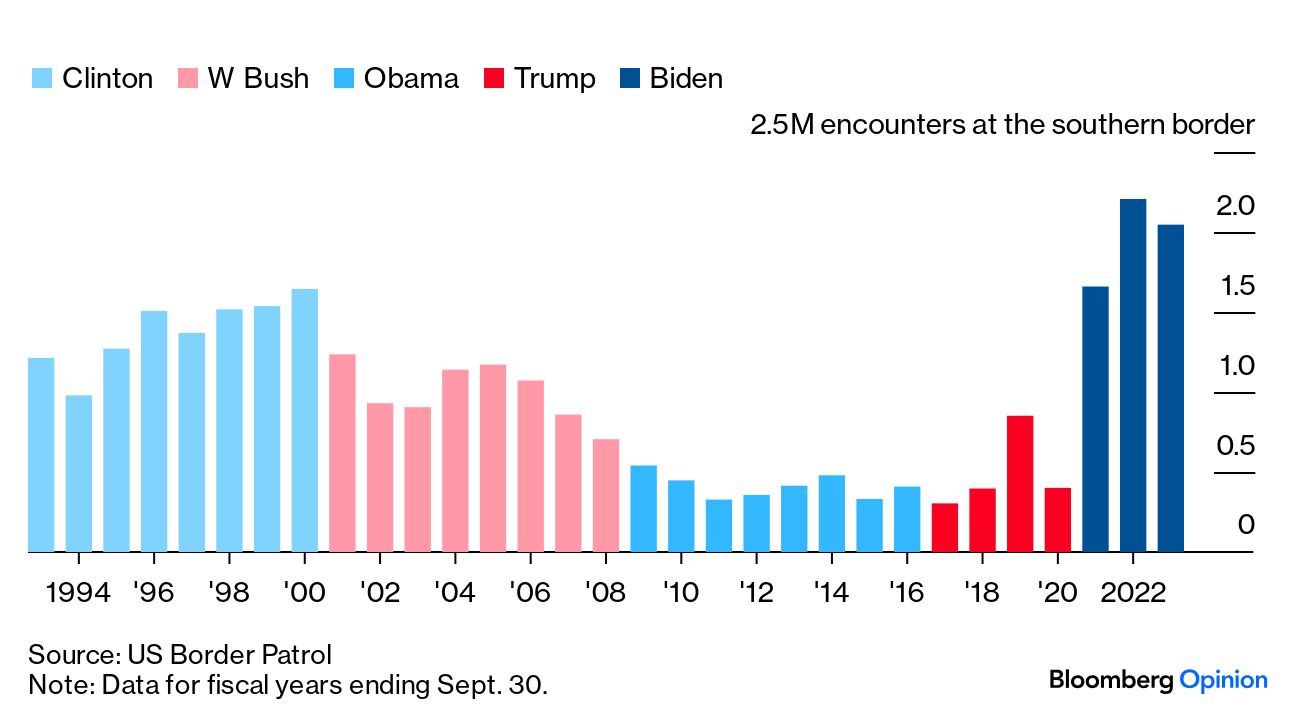
Border encounters between ports of entry are near a record high as Republicans derail bipartisan legislation in the Senate
 James Gibney
The number of encounters between southwestern ports of entry declined slightly in fiscal 2023 from 2022’s record of 2.2 million, but still outstripped any other year. And if you include the “inadmissible arrivals” processed, the 2.48 million total is greater.
It’s no wonder immigration was voters’ top concern, and that Biden’s ratings on the issue are so low.
Southern border encounters
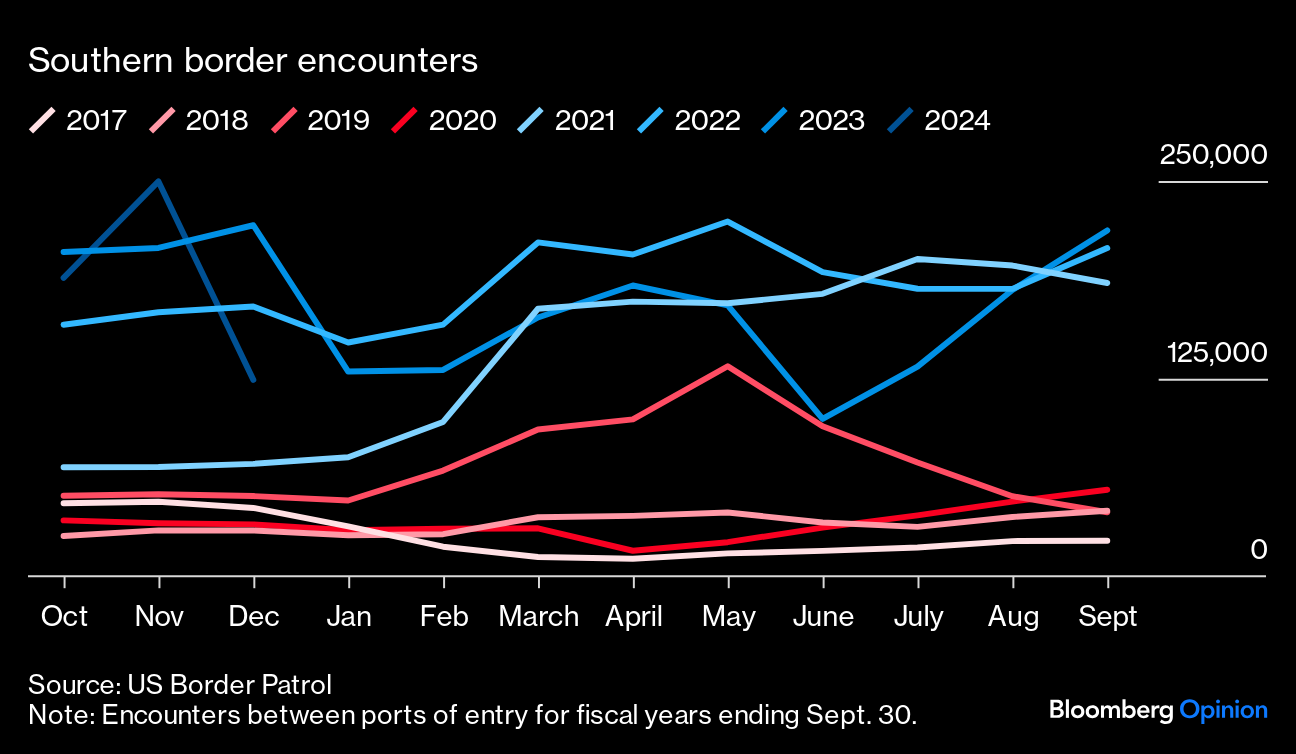
But one factor often gets lost: Most of the “encounters” in recent years are with people seeking to claim asylum, not necessarily to vanish into the US. And only a small proportion of those who do seek to slip in undetected succeed, thanks to more rigorous enforcement. The US lacks the capacity to process asylum and immigration cases in a timely manner. The more than 6.3 million total encounters at the southern border since Biden took office have resulted in more than 2.4 million migrants allowed into the country.
And for the first time, more than half of irregular arrivals came from beyond Mexico and northern Central America. Venezuela tops the list of “historically atypical” source countries, which also include Colombia, Ecuador, China and India. Family encounters have also surged.
It’s not as if Biden has been sitting on his hands; he’s issued well over 500 executive actions on immigration. But rules lack the sticking power of laws, and they don’t come with the resources needed to execute them properly. Under Trump’s sway, a recalcitrant Republican majority in the House of Representatives effectively derailed bipartisan reform legislation that was making its way through the Senate. Until that logjam is broken, the US immigration system and the border it defends will remain a disaster beyond repair.
Millions signed up for health care
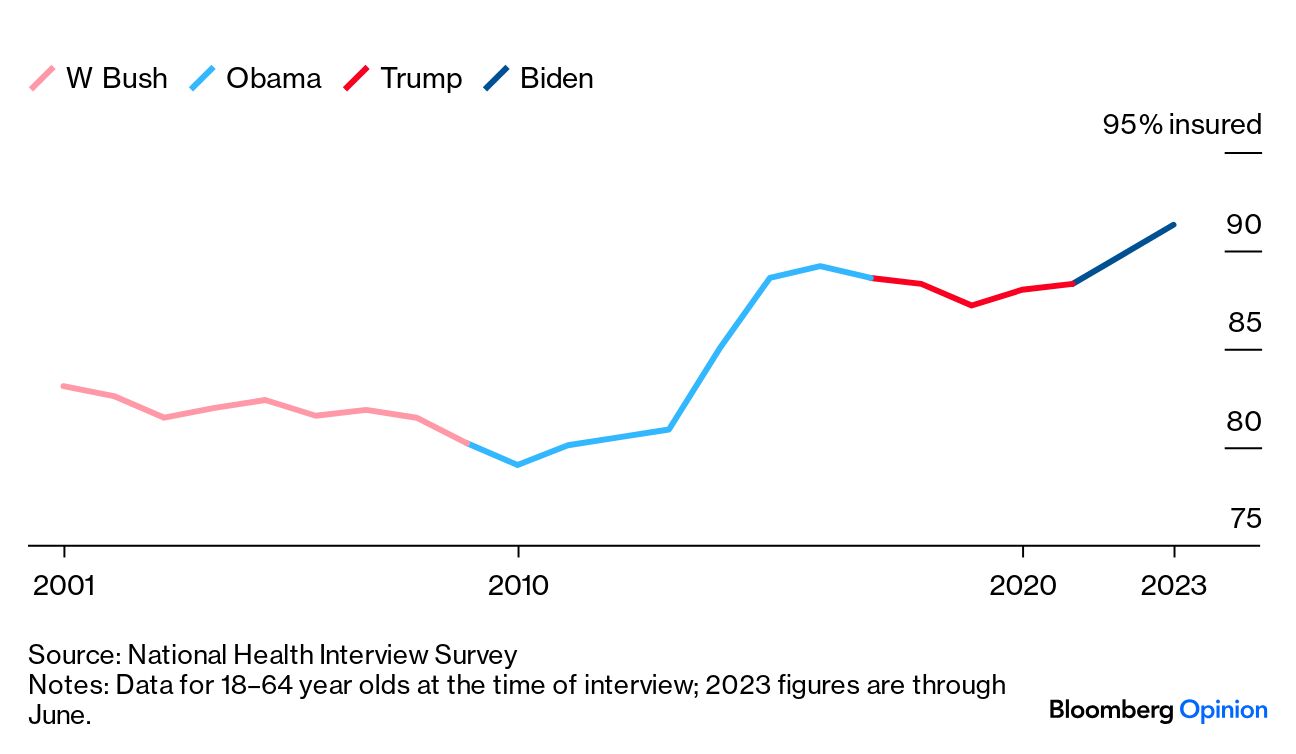
Taking the number of uninsured Americans to an all-time low
 Lisa Jarvis
Access to affordable health care is Biden’s crowning achievement. The number of uninsured Americans hit an all-time low of 7.2% in the second quarter of 2023, while the number of people who signed up for an Obamacare plan for 2024 surged to 21.3 million.
At the start of Biden’s term, about 12 million Americans had health insurance through Obamacare, or more formally, the Affordable Care Act — and that level hadn’t changed much since 2015, two years after the public marketplaces opened. When the ACA passed in 2010, 22.3% of working-age people were uninsured compared with just 10.4% now.
Health insurance status

There is a caveat. Some of the voracious appetite for marketplace plans in 2023 likely came from the millions of people who lost access to public insurance last year. The end of pandemic-era rules that allowed Americans to stay on Medicaid without renewing their paperwork pushed out some 16.4 million people, including more than 3.2 million kids, according to the health policy nonprofit KFF.
But policymakers positioned the ACA marketplaces to absorb some of these folks. Subsidies made it easier for people to afford marketplace plans, and the administration increased funding for people trained to help the public find the right insurance fit.
Many of the new enrollees live in Republican strongholds such as West Virginia and Louisiana, where sign-ups increased 80% and 76%, respectively. Texas and Florida each saw enrollment increases of roughly a million people as well.
Salary increases are outpacing inflation
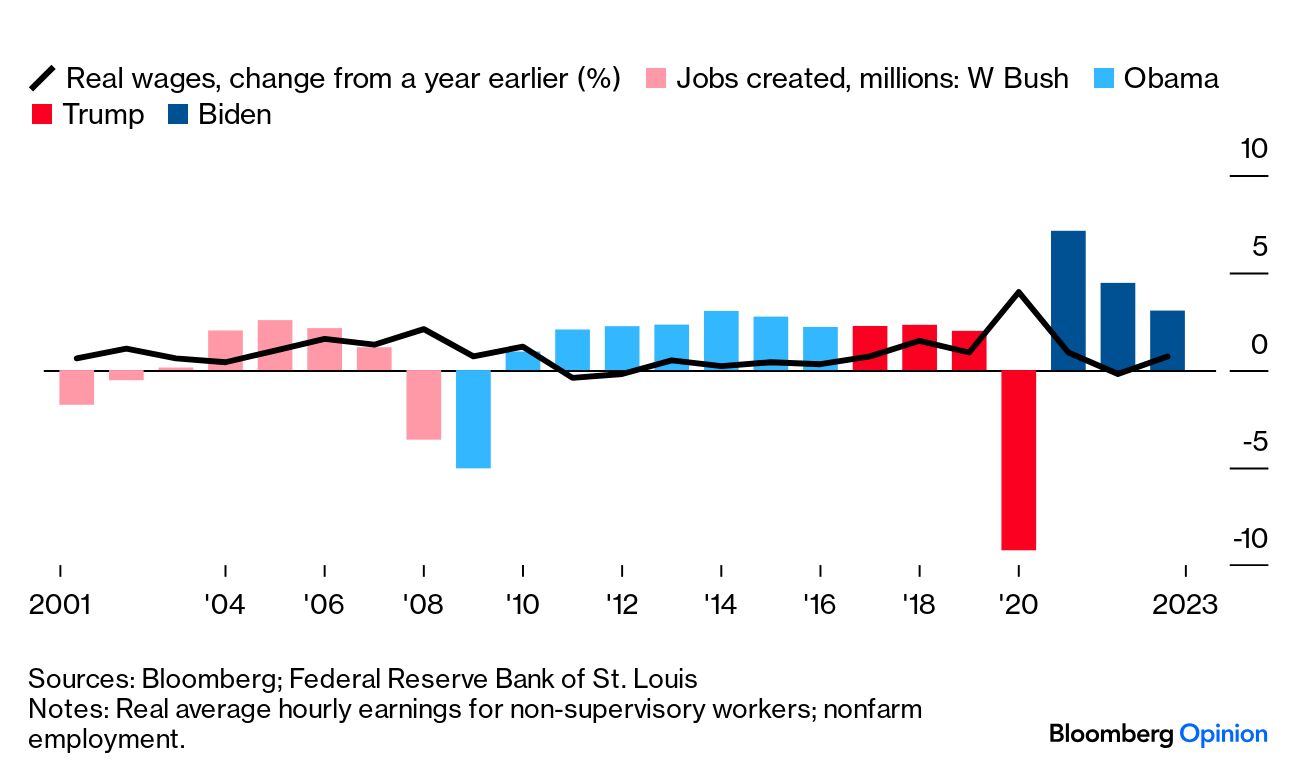
Job growth in Biden’s first three years outperformed any previous president
 Karl W. Smith
Biden may have finally found the labor market’s sweet spot. The economy added 14.8 million jobs over the first three years of his term, more than any president in US history over the same period. What’s more, unemployment has held below 4% for the longest stretch since the 1960s. Yet many workers have been dissatisfied as soaring inflation wiped out wage gains and then some in 2022. Last year, though, income increases began to outpace price increases.
Pay and work
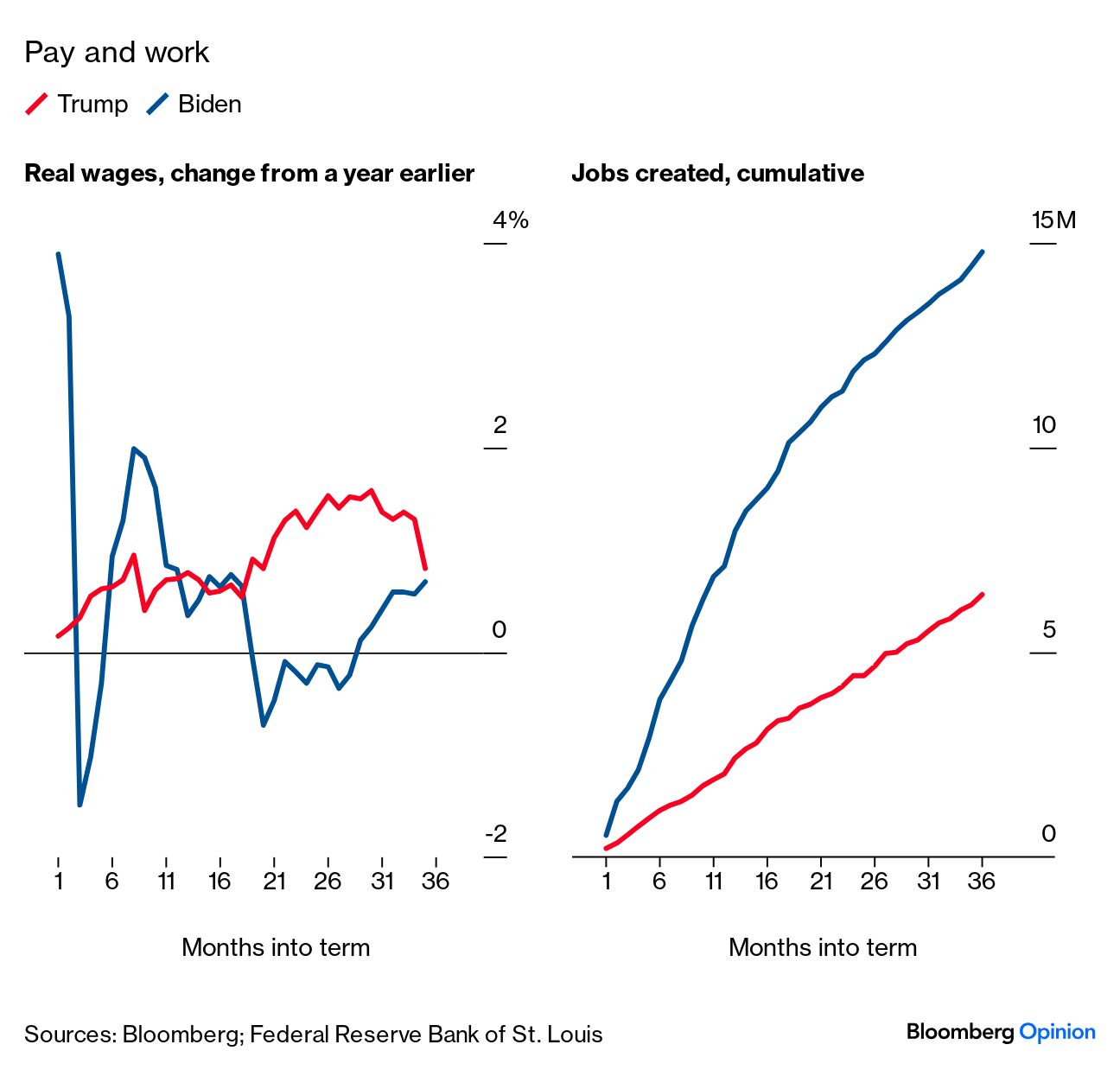
Biden neither deserves full blame for the high inflation nor full credit for the rebound in real wages. Nevertheless, the strong labor market bears the imprint of White House policies such as the American Rescue Plan, the infrastructure act, the CHIPs act and the ill-named Inflation Reduction Act. Although some economists say these contributed to faster inflation, they also fueled hiring.
Real wages may turn from a headwind for Biden into a tailwind this election year if current trends persist — and they just might. According to the median estimate of economists surveyed by Bloomberg News, the unemployment rate will rise modestly this year, to 4%, well below the 5.9% average of the two decades prior to the pandemic. Average hourly earnings are expected to grow 3.8%, exceeding the 2.2% forecasted inflation rate. What’s more, voters seem to be taking note given the recent recovery in consumer sentiment.
The cost of living is going down
The rapid disinflation under Biden is unmatched in modern history
 Matthew A. Winkler
America’s cost of living, which surged to a four-decade high during Biden’s first two years, is poised to return to its pre-pandemic level this year — when family wealth across income groups is more robust than at any point in the new century.
Consumer and expected inflation
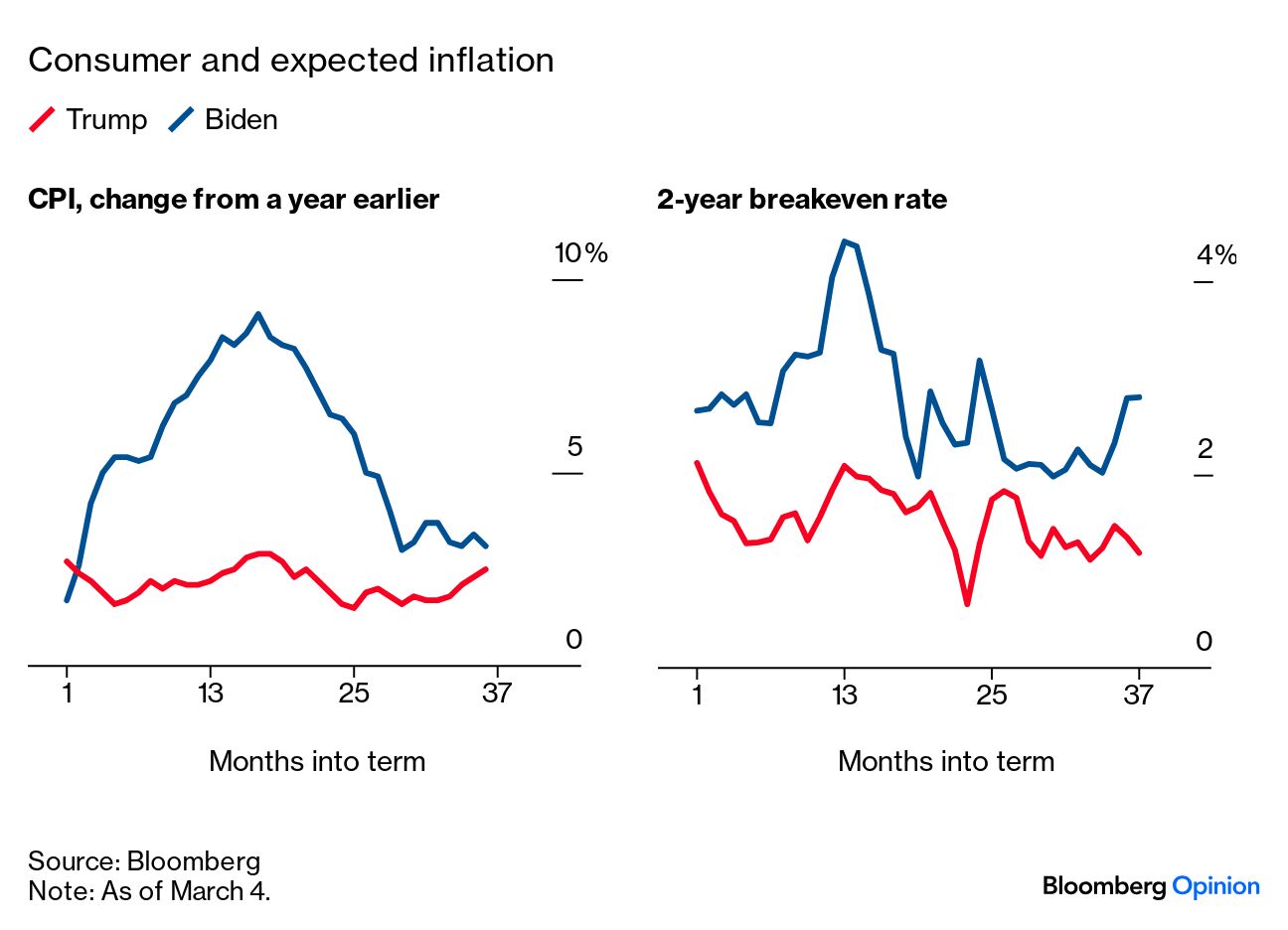
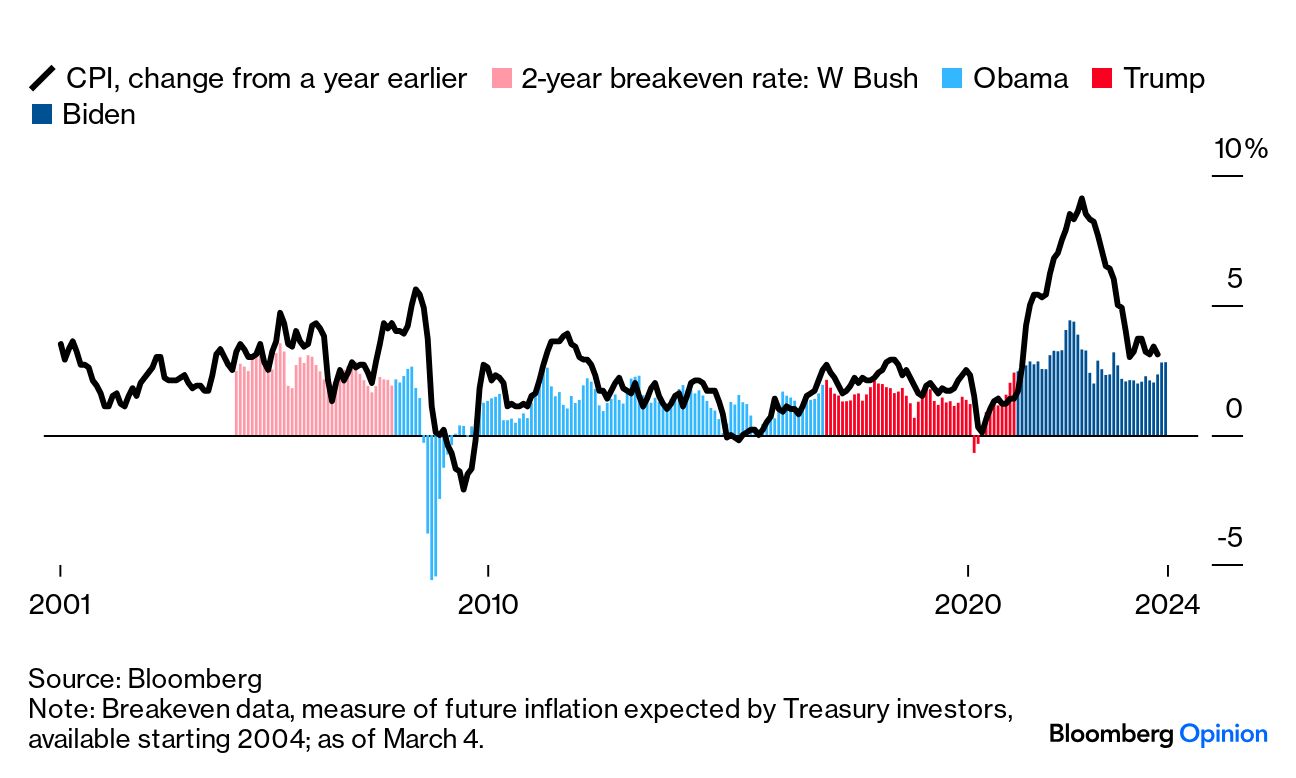
Inflation was supposedly undermining “Bidenomics” when the consumer price index peaked at 9.1% in 2022, according to prevailing media narratives featuring many prominent economists. The CPI has since plummeted at an unprecedented rate to 3.1%. The resulting disinflation — occurring while gross domestic product expanded 3.2% last quarter — is unmatched in modern history and the opposite of the 1970s, when inflation took eight years and five months to subside to 3%.
Even as the Federal Reserve rapidly raised interest rates in 2022 and through mid-2023, some $30 trillion of US government securities — the daily reference of global investor preferences — showed that the inflation spike was little more than a consequence of supply chain disruptions and pandemic shortages.
In June 2022, many feared inflation was out of control. But the market for swaps, or derivatives, tied to inflation accurately anticipated CPI to the nearest decimal every month during the course of the year, according to data compiled by Bloomberg. It’s now signaling 3.1% inflation by July and 2.3% in November. The breakeven rate showing traders’ expectations for average inflation in the next two years at 2.8% is 60 basis points lower than a year ago.
The good news for Biden is that while prices remain elevated, voters are starting to realize — just like Wall Street — that big price increases are over.
Green spending is booming, but it’s still not enough
The goal of net-zero emissions by 2050 requires $1 trillion in transition investment now
 Liam Denning
Long after Biden departs the White House, his climate policies will be judged on the glacial metrics of emissions and temperatures. For now, it’s all about how much money is being spent. On that measure, he has sparked a revolution.
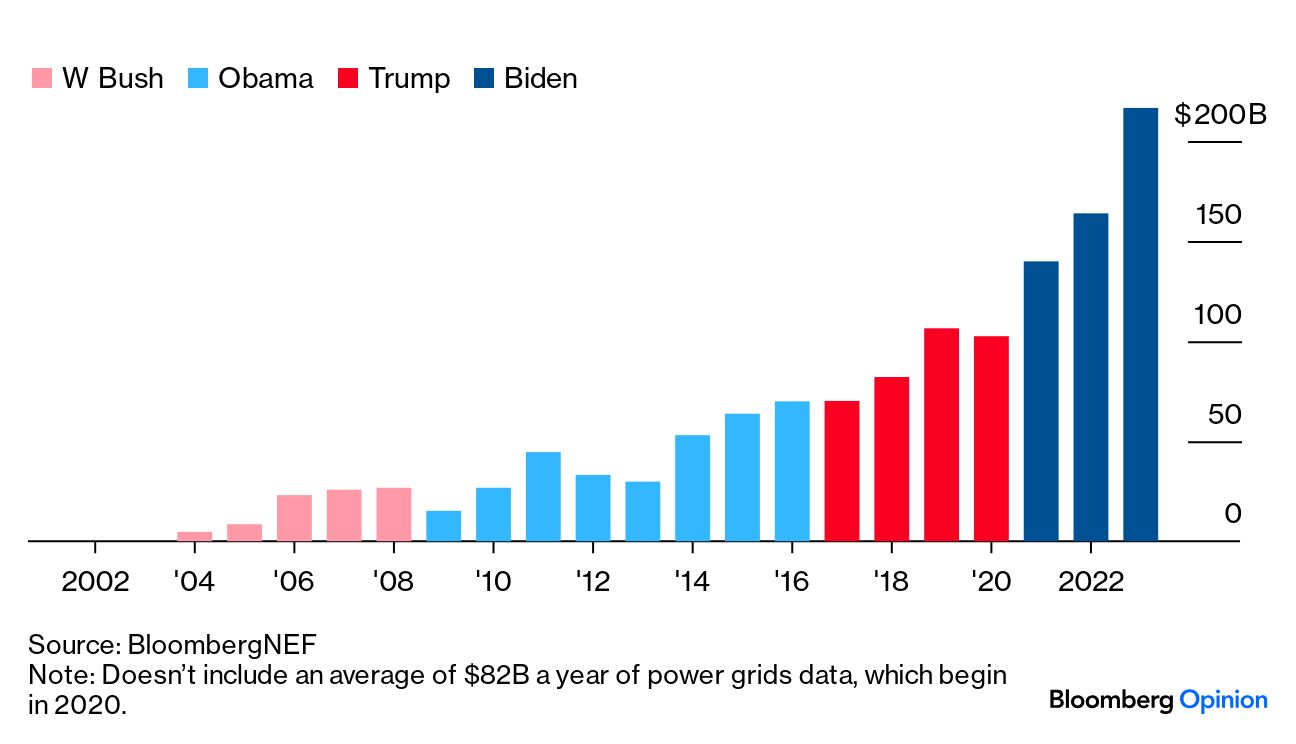
US energy transition spending topped $303 billion last year, according to BloombergNEF. That’s a record and two-thirds higher than before Biden entered office. Excluding power-grid projects, which enable but don’t serve only zero-emissions energy, spending exceeded $200 billion, more than double 2020 levels.
Transition investments

Investments are concentrated in two of the more obvious beneficiaries of the Inflation Reduction Act’s subsidies: electric vehicles and renewable energy. Spending on EVs over the past three years was roughly double that of the prior decade, while the number for energy storage projects last year was nine times the 2020 level.
Full marks for a fast start, but set against the ultimate ambition, it is only that: To reach net-zero emissions by 2050, annual US transition investment should be more than $1 trillion, now, according to BloombergNEF. Moreover, hosing more money can’t solve everything, such as a lack of lighter, affordable EV models, bottlenecks in expanding the power grid, or inflation and higher interest rates (which it exacerbates).
It also exacerbates, but maybe counters somewhat, the problem of implacable Republican opposition. Trump denounces green energy, sometimes in bizarre terms. On that front, the fact that most green dollars are flowing into red districts and states, teeing up tension between GOP ideology and jobs, offers an insurance policy of sorts for the IRA were the presidency to change hands.
Families are richer than ever
Net worth has climbed under Biden, sentiment needs to catch up
 Robert Burgess
American households are wealthier and in better financial shape than ever before by almost any measure. Even with a bear market in stocks in 2022 and elevated inflation, Federal Reserve data show household net worth rose to a record $156.2 trillion at the end of the fourth quarter of 2023, from $131.4 trillion at the end of 2020. The stock market, where more than half of all households are invested, has surged. And as Bloomberg Opinion contributor Claudia Sahm has pointed out, household debt burdens are near historic lows.
Household wealth

Yet the consensus is that the economy is a negative for Biden because consumer sentiment measures remain below their pre-pandemic levels. Observers say this reflects the toll of inflation, which has left everyday items such as groceries costing much more than before the onset of Covid-19. Then there’s housing, which is the least affordable on record, keeping potential homeowners from buying, and making current homeowners feel trapped.
Are Americans really that sour on the economy? Perhaps not. Surveys show that when people are asked about their personal financial situation — and not just their views on the economy — an overwhelming majority say it is either good or excellent.
If we’ve learned anything during the pandemic era it is that surveys are not very reliable indicators. Case in point: consumer spending, which has consistently risen more than forecast. Better to watch what Americans do rather than what they say.
Inequality is narrowing
A rise in real wages for lower-income workers is bridging the gap

 Allison Schrager
Preliminary data suggest that inequality continued to narrow in 2023. Even better, the improvement — unlike during Biden’s first two years — was due to rising real wages, at least for some Americans: Lower-income workers saw gains, while median and higher earners saw barely any increase at all, after accounting for inflation.
Income gap
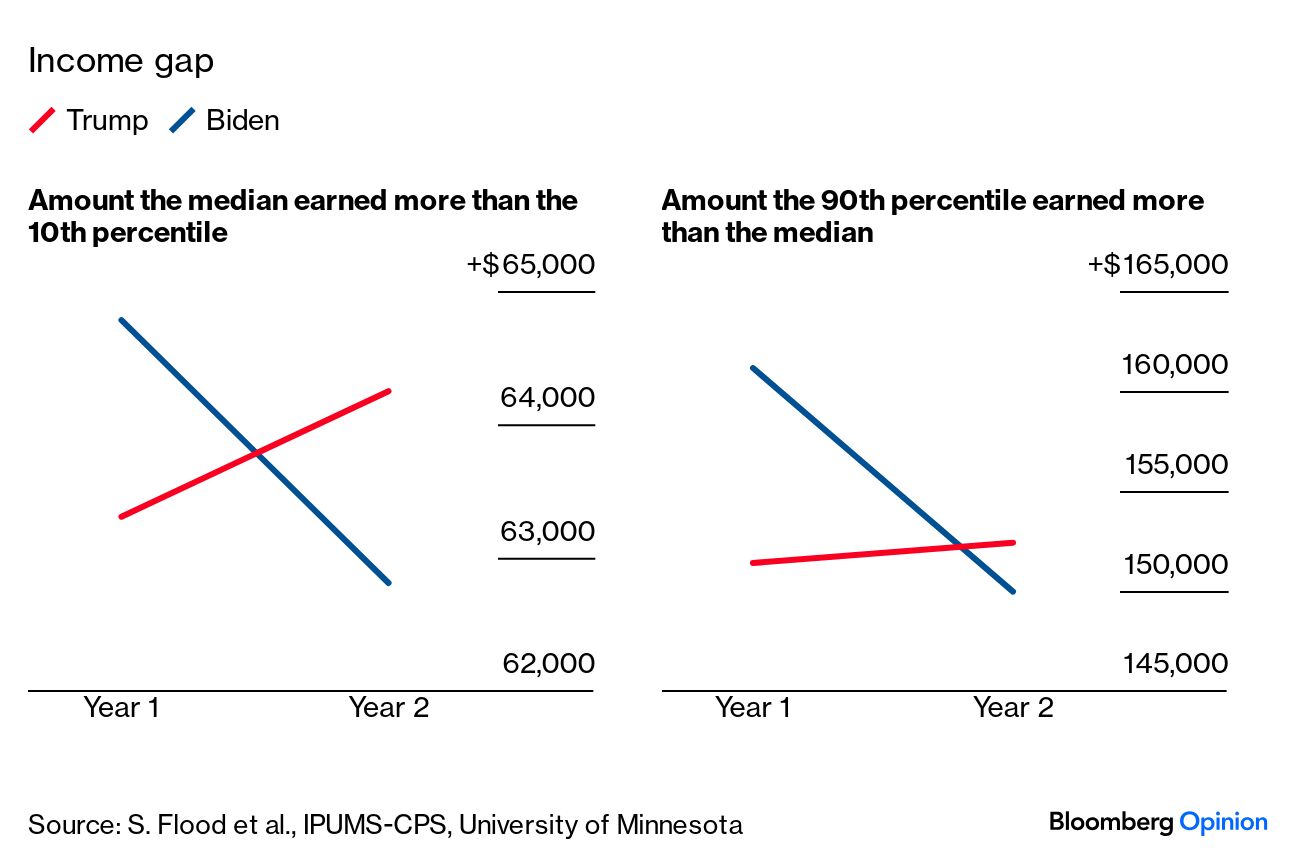
In 2021 and 2022, inequality also fell. But that was in an economy where real wages were declining for all income groups. They just fell less for the bottom 10% (about 2%) than for the top 10% (about 7%). The final numbers on annual wages for 2023 will not be available until after Americans have decided whether to give Biden four more years or return Trump to office.
What’s happened to wages over the last four presidencies is largely a function of the overall economic environment. Everyone did worse during the tenure of George W. Bush because of the Great Recession. Wages grew for the median and top 10% under Barack Obama as the world recovered from the financial crisis, but the bottom 10% saw real wages fall.
The only administration that presided over positive wage growth for all income groups was Trump’s. Still, inequality also increased during his administration, as higher earners saw wages grow more quickly than the bottom 10%.
When it comes to wages, Biden will have a hard time improving on Trump’s record. When it comes to income inequality, however, he has a good chance.
The equity market is roaring
While bonds are a weak spot
 Jonathan Levin
For a supposedly unpopular president, the US stock market sure seems to like Biden.
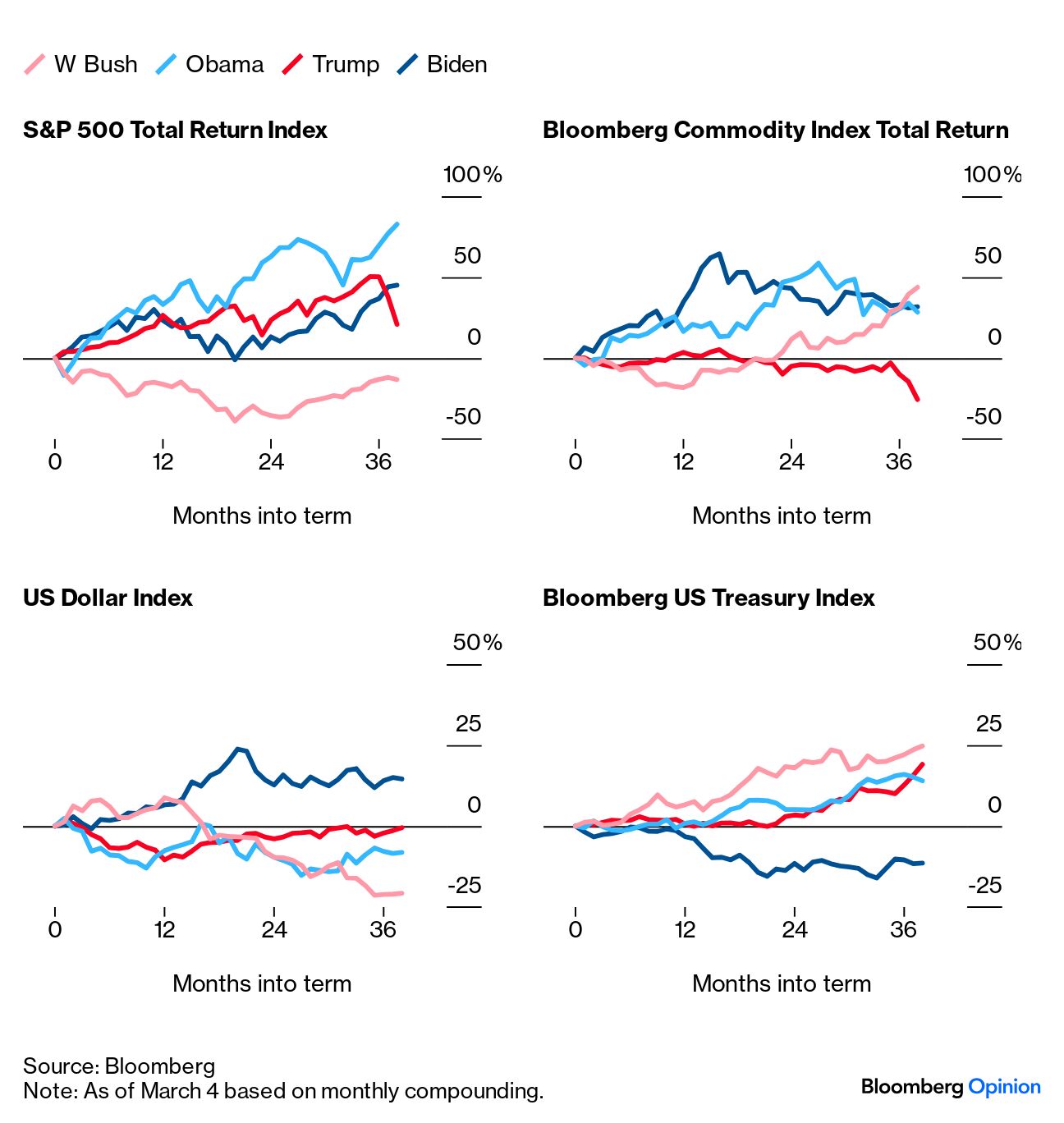
Since his inauguration, the S&P 500 Index has returned about 45%, more than double the total returns of the rest of the world’s developed-market equities. That still leaves a lot of ground to cover if he’s going to match Trump’s full-term performance, but in some ways he was dealt a more challenging macroeconomic hand. Trump’s corporate tax breaks also helped. Meanwhile, the mighty dollar has continued to defy predictions about America’s declining status in the world, strengthening against most major global currencies over the past three years.
Performance

The main blemish on Biden’s performance is found in the bond market. US Treasuries have lost about 11% since he took office, a reflection of the surge in inflation that marred his first two years. In this context, commodity gains can be seen as a bad thing, feeding consumer prices and, therefore, the need for policymakers to raise interest rates. Some investors undoubtedly benefited, but high borrowing costs have hurt the president among, for instance, would-be mortgagors locked out of homeownership.
The good news is that ebbing inflation has allowed the Fed to begin contemplating easier policy, helping mortgage rates retreat from 2023’s highs. By the time Biden leaves office, the bond market probably won’t look quite as ugly as it does today.
Violent crimes, especially homicides, have fallen
Biden has encouraged states to use stimulus money on law enforcement
 Justin Fox
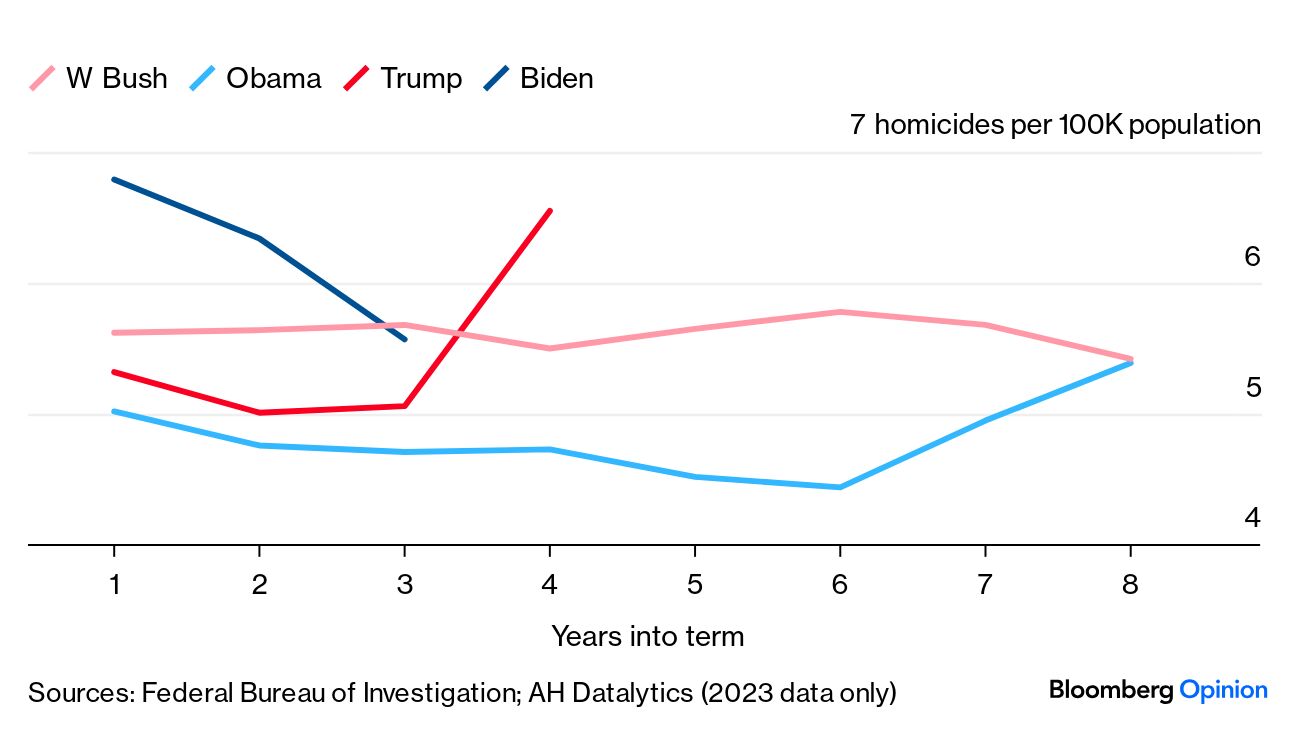
The US was in the midst of its worst spasm of violence in decades when Biden took office, with the homicide rate rising 29% in 2020. It rose again slightly in 2021, but started to fall that autumn. There was a slight year-over-year decline in 2022, then an 11.8% drop last year — the sharpest on record — according to estimates by AH Datalytics.
Homicide rate
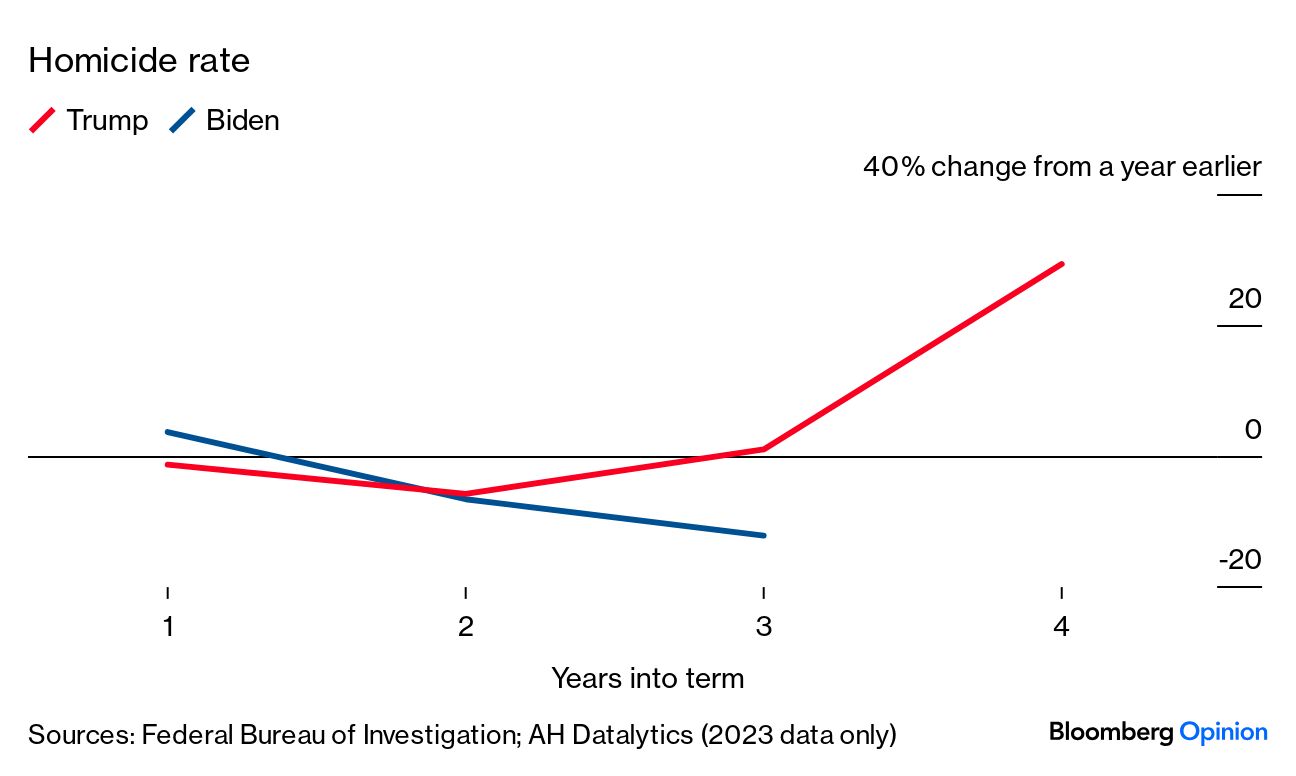
Other violent crimes have followed a more complicated trajectory; some fell early in the pandemic because so few people were on the streets to commit crimes against. But overall violent crime was also down in 2023, with the FBI reporting an 8.2% nationwide drop over the first nine months and the Major Cities Chiefs Association a 2.6% full-year decline among its members. In the cities and large suburban counties that belong to the latter group, that leaves violent crime still higher than before the pandemic, but in the FBI data it looks as if 2023’s US violent crime rate will be the lowest since 1969.
How much credit does Biden deserve for this? If you believe increased funding for police reduces crime (and I do, with some caveats), definitely some. Biden’s 2021 stimulus bill included an unprecedented $350 billion for state and local governments, which he strongly encouraged them to spend on law enforcement.
“We should all agree the answer is not to defund the police,” Biden said in his 2022 State of the Union address. “It’s to fund the police. Fund them. Fund them. Fund them with the resources and training — resources and training they need to protect our communities.”
Biden is a successful president. Will that matter?
Despite economic gains, the president’s approval ratings are dismal
 Nia-Malika Henderson
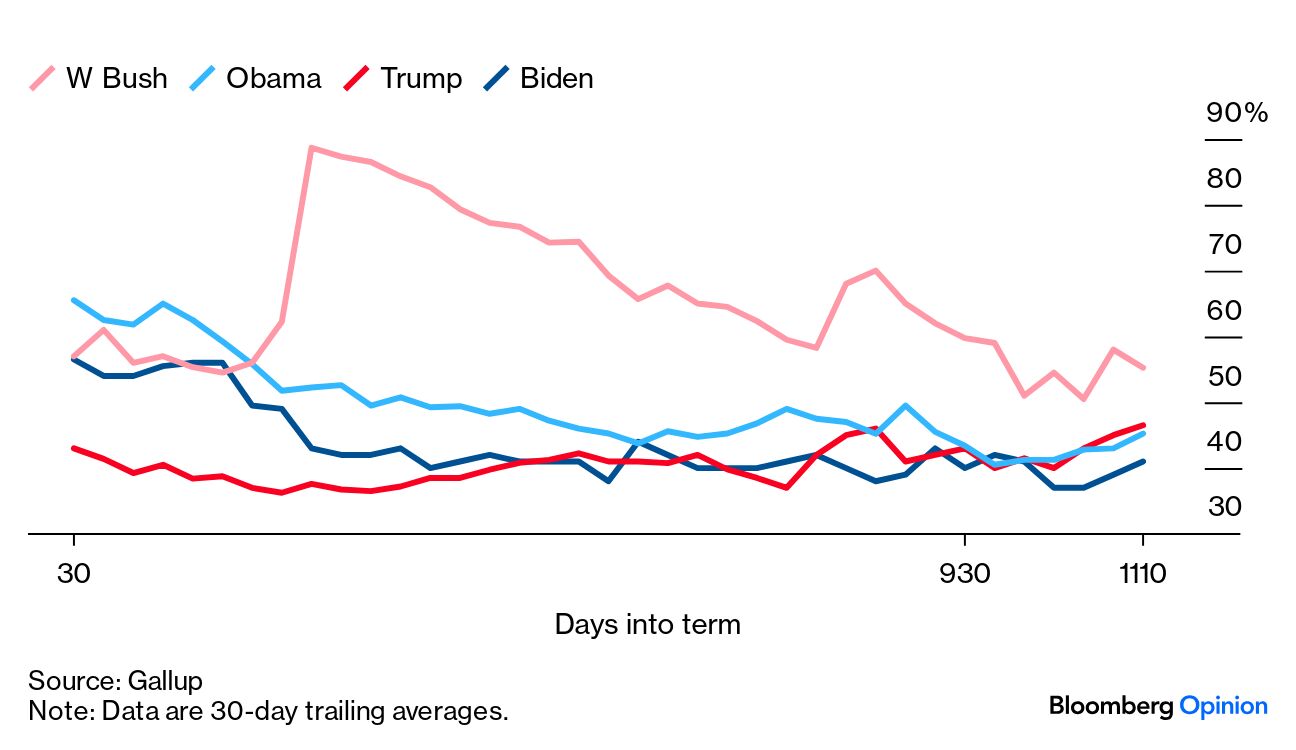
Biden is an unpopular president. Even as the unemployment rate ticked down, the stock market soared and consumer sentiment trended upward, his approval numbers have stayed near historical lows.
No sitting president with a similar approval rating — 38% according to Gallup — has ever gotten reelected. At the same point in Trump’s bid for re-election in 2020, the former president had an approval rating of 47%. Nine months (and tens of thousands of Covid deaths) later, he was defeated by Biden.
Job approval

Given his standing among voters, Biden can only be seen as a weak incumbent. While anything can happen between now and election day, his approval numbers have remained in the high 30s and low 40s for much of the last year. Those numbers are a proxy for how people feel about his handling of the big issues — the economy, immigration and foreign policy — but concerns about his age also loom large. According to a New York Times/Siena poll, 73% of registered voters say Biden is too old to be an effective president, including 56% of Democrats.
Obviously, he will not get any younger as he runs for office, but as the 2024 matchup comes into fuller view — i.e. with Trump the presumptive nominee — voters could start to see Biden in a more positive light. As Biden says, he would prefer voters to compare him to the alternative, rather than the almighty. And in that light, his poll numbers might matter less.
(Updates charts and first paragraph of the household wealth section with fourth-quarter data.)