How Japan Ignored Climate Critics and Built a Global Natural Gas Empire
Japan’s championing of gas minted it a $14 billion profit last year, while entrenching dependence on a fossil fuel as experts urge a faster shift to renewables.
日本語版: 世界に君臨する「ガス帝国」日本、エネルギーシフトの現実路線に軸足
Every six hours, somewhere in the world, a shipment of liquefied natural gas controlled by a Japanese company leaves a port. The vessels — giant, floating thermoses that keep the fuel super-chilled — cross the globe, destined for pipelines in energy-hungry countries in every hemisphere.
These tankers, which handle a quarter of all LNG shipments, are only the tip of Japan’s increasingly dominant gas empire. With the enthusiastic backing of the government, corporate Japan now offers a complete package for countries looking to replace aging, and near-unfinanceable, coal power stations with gas: Its engineering firms will provide technology and parts, its utilities some fuel, and the banks will offer financing.
Japan’s Gas Empire
Sources: Bloomberg; VesselsValue
Note: The map shows voyages of LNG vessels with Japanese companies as beneficial owner or partial owner from March to May 2024.
Japan’s support for the natural gas industry has fueled the rapid expansion of the $250 billion LNG market over the last half-century. And while the US and other exporters continue to benefit from that growth, Japan, with few gas reserves of its own, has made itself indispensable at every link in the supply chain.
“The industry just simply couldn’t be where it is without Japan,” said Peter Coleman, who led Australia’s top LNG exporter Woodside Energy Group Ltd. until 2021. “They were out there trying to diversify into new markets and bring new markets in.”
Major Japanese companies netted at least $14 billion in profit from their gas-related businesses in the fiscal year that ended in March, according to Bloomberg calculations, roughly equal to the combined profits of the country’s top consumer electronics makers.
Source: Data compiled by Bloomberg
Notes: Analysis focused on publicly traded companies in Japan. Companies whose gas-related profits cannot be estimated are not shown.
Like other proponents of natural gas, Japan’s political and corporate leaders say the fuel has a critical role to play in the fight against climate change: It can supplant coal, which is dirtier, while renewable energy sources are still being expanded. But environmentalists warn there are long-term consequences, and rather than serving as a temporary bridge to clean energy, gas will become as entrenched as coal once was. What’s more, new satellite observations suggest that the gas industry generates much more methane than reported — and can pose a greater immediate threat to the climate than coal.
Those arguments have largely been ignored. At last year’s United Nations climate conference, the world’s governments essentially endorsed gas, acknowledging the role of unnamed “transitional fuels” even while promising to move away from fossil fuels. The US, the world’s top supplier, is set to double LNG exports this decade; Germany is building more gas power plants after closing its nuclear reactors.
Japan has remained a supporter, keen to ensure sufficient supplies for the domestic market and to help meet the rising needs of emerging economies, which are also critical markets for domestic companies. An industry-backed think tank last year called for $7 trillion of new investment in gas to help meet that growing demand. “We need to realize a pragmatic transition by supporting gas,” said Manabu Kato, an official from the Energy Solutions Finance Department at the Japan Bank for International Cooperation. For some countries, like India, “gas is still needed beyond 2050.”
Japanese Companies Dominate the LNG Industry
Sources: Bloomberg; Company filings
Fukushima’s Role
Japan’s current enthusiasm for LNG dates to the 2011 Fukushima disaster, which shut down 54 nuclear reactors. Without other domestic sources of energy, its utilities hastily signed decades-long LNG contracts and invested in facilities from the US to Australia.
But by 2015, sooner than expected, Japan began to restart reactors and rapidly roll out renewables, while power demand languished, leaving the country with a surplus of gas. Utilities and trading houses began looking to sell their oversupply abroad and set up trading desks in Singapore and London.
They were joined by Japanese manufacturers and utilities looking for new markets to sell turbines or build pipeline networks, places like Thailand, Vietnam, the Philippines, Bangladesh and India, where power demand was rising.
Switching to LNG or adding new capacity is very expensive, and to defray the costs for strapped economies, Japan’s government offered financing for significant investment in new supply, import terminals and other infrastructure. In all, Japan’s public institutions have made nearly $40 billion in loans for LNG export facilities since 2012, according to analysis by environmental group Oil Change International. JBIC, Japan’s public financier, has been one of the world’s biggest lenders to gas since the 2016 Paris Agreement; since March, it’s loaned over $1 billion to support an LNG project in Australia, a gas field in Vietnam and Japanese-made turbines for a gas power project in Mexico.
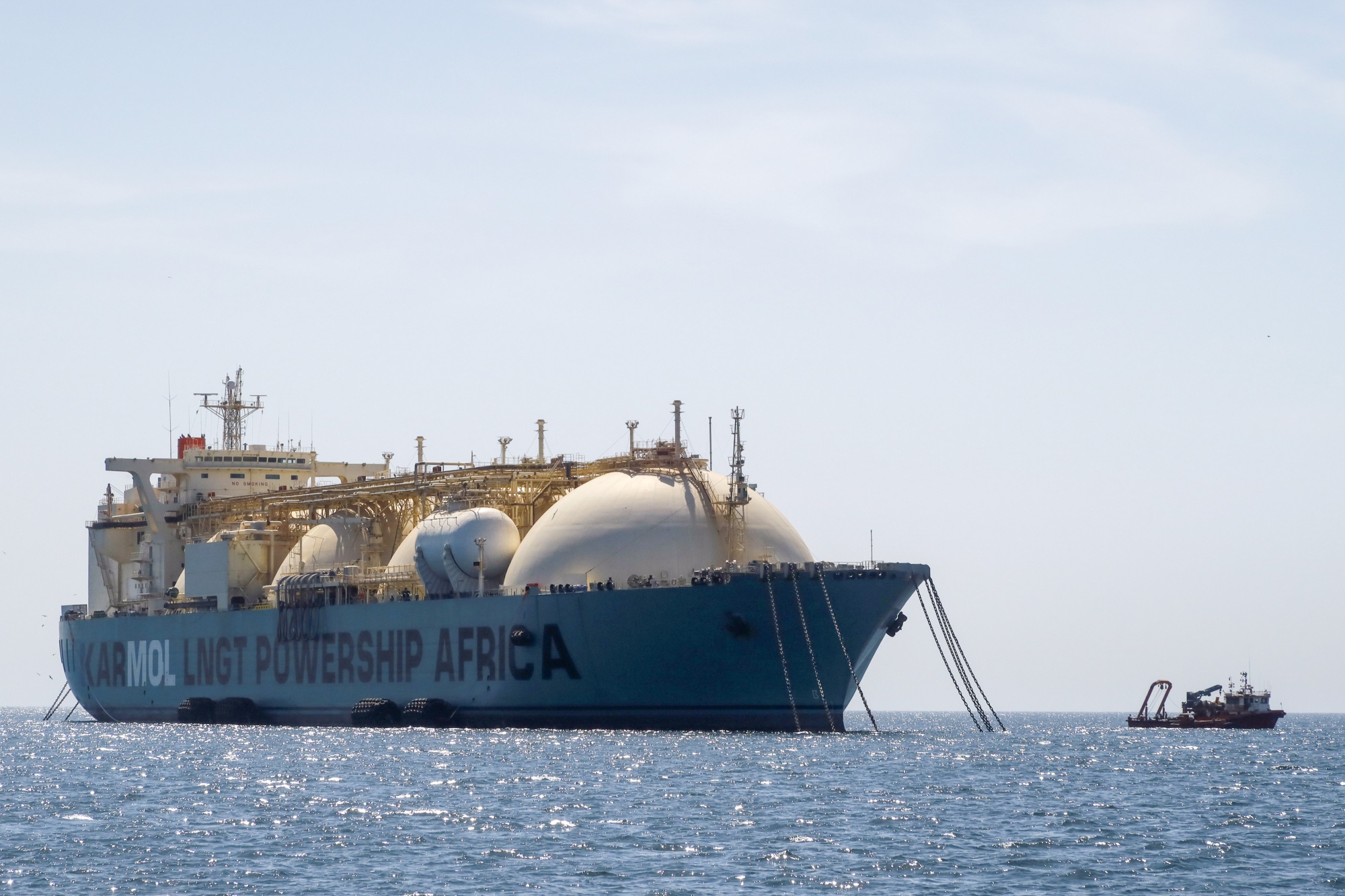
The Karmol LNGT Powership Africa floating storage and regasification unit off the Port of Dakar received a loan from JBIC and MUFG Bank. Photographer: Damian Lemański/Bloomberg
JBIC supports projects that contribute to Japanese energy security, the Paris agreement and global climate goals, Kato says. And replacing coal with gas would reduce CO2 emissions for countries like India or Indonesia, as has been the case in the US over the past two decades.
Private lenders have followed, filling gaps left in the market by the exit of banks that have cut their funding to fossil fuels.
“There is a trend in western banks to stop funding LNG projects because it’s still fossil fuel,” Helle Kristoffersen, president of Asia at TotalEnergies SE, an LNG producer, said at a conference in Tokyo in June. “Japanese banks are much more pragmatic,” she added.
Beyond loans, a policy change allowed the state-owned Japan Organization for Metals and Energy Security to invest directly in projects that had nothing to do with domestic supply – a radical about-face considering its long mandate to secure resources for Japan. It now hosts regular retreats for government officials from emerging economies. The itinerary features a crash-course in the fundamentals of LNG, plus some sightseeing in Kyoto.
Source: Data compiled by Bloomberg
For Japanese firms, it’s been highly lucrative. Mitsubishi Heavy Industries makes one out of every three gas turbines and wants to gain share; it forecasts its revenue will rise over the next three years to a record 5.7 trillion yen ($35 billion) on rising global power demand. Mitsubishi Corp., a top trading house, derived more than one-fifth of its 2023 profits from the natural gas business. Mitsui OSK, already the world’s biggest owner of LNG vessels, aims to increase its fleet by 50%; Nippon Steel, Japan’s largest steelmaker, has new deals to supply pipes.
“From upstream to downstream, Japanese entities are deeply entrenched in the gas commodity chain, exerting influence at every level,” said Mia Watanabe, a campaigner at the advocacy group Oil Change International. “The critical role of Japanese government and corporate leaders in the global expansion of gas and LNG cannot be overstated.”
Energy Security or Export Drive?
To voters at home, Japan sold its agenda on energy security grounds. To ensure ample supplies, local companies sign long-term contracts for a certain amount of volume, Masahiro Naka, deputy director of the Energy Resources Development Division at the Ministry of Economy, Trade and Industry. “If it’s not needed, then they need to sell it to other countries,” he said. And by encouraging LNG adoption elsewhere in the region, it means there will always be eager buyers.
When Russia invaded Ukraine, record-high global gas prices seemed to validate the strategy. There wasn’t enough gas for everyone, and some nations — particularly developing ones — grappled with shortages. As the Group of Seven committed to ending investment in fossil fuels, negotiators from Japan and Germany lobbied for a loophole for gas.
And Japanese firms are increasing their investments overseas. Jera Co., the nation’s top power producer bought a $1.4 billion stake in Australia’s latest LNG project and has signed supply deals with an upcoming US plant for shipments that will likely be sold to Europe. Mitsui & Co. bought into a gas field that will feed Vietnam, a shale project in the US, and received a share in the UAE’s new LNG export plant.
Currently, Japan uses about two-thirds of the LNG it buys and resells the remaining third abroad. METI’s Naka said Japan is aiming to cut imports by about 15% by 2030 from last year’s level, though that also depends on new demand for data centers and other uncertainties. Government officials and industry argue that maintaining LNG supplies enables the country to stay flexible. Plus, any retreat could benefit China, which recently became the world’s biggest LNG buyer. Chinese importers for the first time this year will have more long-term LNG contracts than Japan and are quickly expanding trading operations. Mainland shipyards are racking up orders for new LNG vessels.
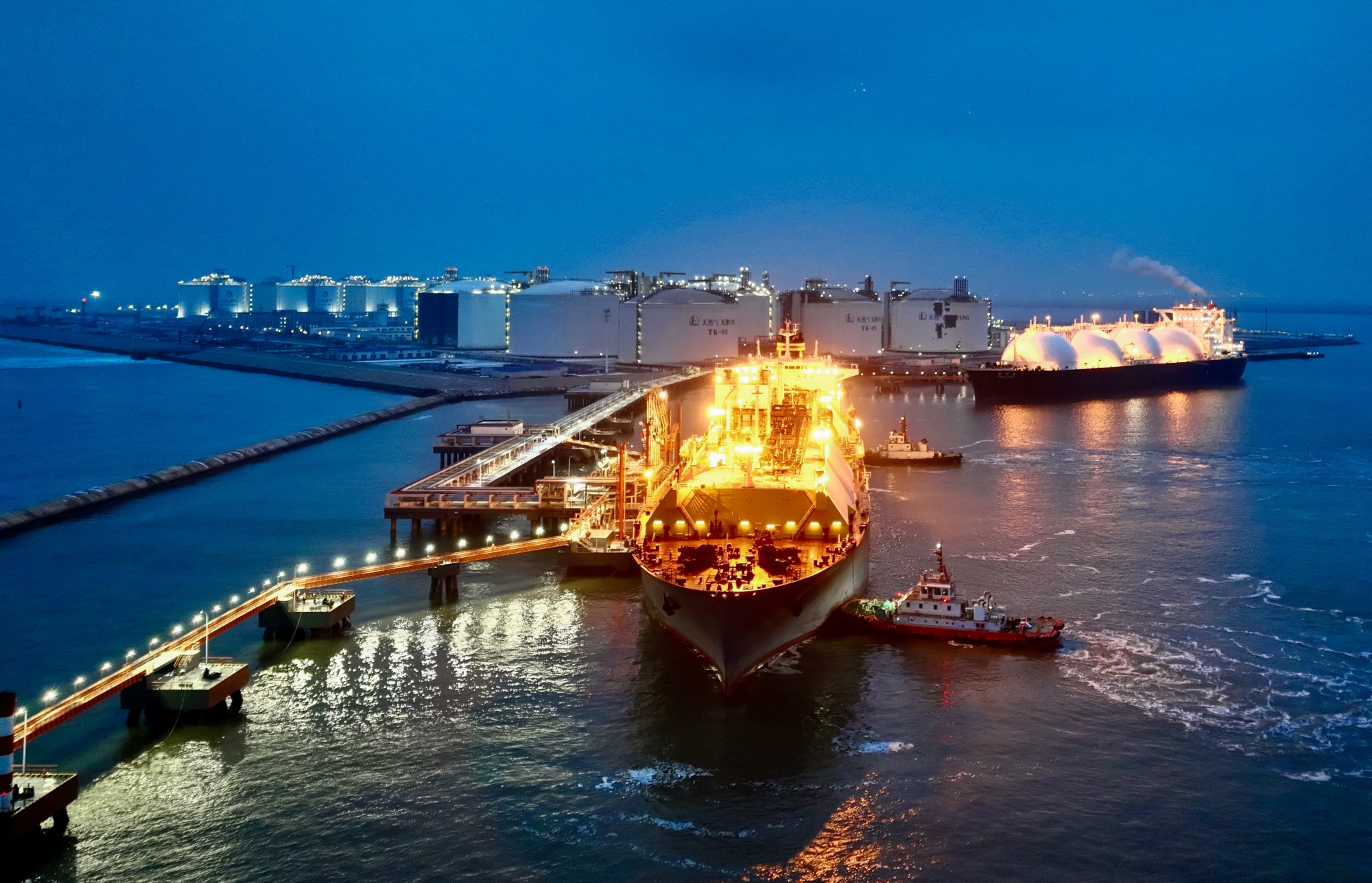
China’s first two-berth LNG terminal in Tianjin, in December 2023. Photographer: VCG/Getty Images
There’s also the climate impact of Japan’s strategy to promote LNG to consider. Switching from more polluting coal to gas in developed economies — as has happened in the US — is seen as a benefit, as it reduces emissions. In developing nations, including the Southeast Asia region regarded as a potential driver of future gas demand, LNG won’t necessarily displace dirtier fuels, meaning its use could risk adding to the burden of pollution or divert investment away from cleaner energy sources.
Read More: Is Natural Gas a Fossil Fuel Trap or Transition Fuel?: QuickTake
There’s also increasing debate over the extent to which LNG is a cleaner alternative to coal, and on its role as an intermediate option as nations switch from existing power systems to renewables. To reach global net zero goals, “there is little to no room for gas to act as a transition fuel,” the International Energy Agency said in a November report.
Japan’s government doesn’t publish an outlook on how its commitment to gas will affect global emissions, but its industry-funded think tank does.
The Institute of Energy Economics, Japan, sees global emissions dropping 56% by 2050 from 2021 under its most ambitious forecast. Under this view, gas demand rapidly grows in Southeast Asia — a key market for Japanese gas companies — which will underpin global consumption. “LNG and natural gas can complement renewable energy development without hindering it,” the organization said in a statement.
Their outlook still has global CO2 pollution at around 14.7 billion tons by midcentury, far higher than the level needed to limit warming and halt the catastrophic affects of climate change.
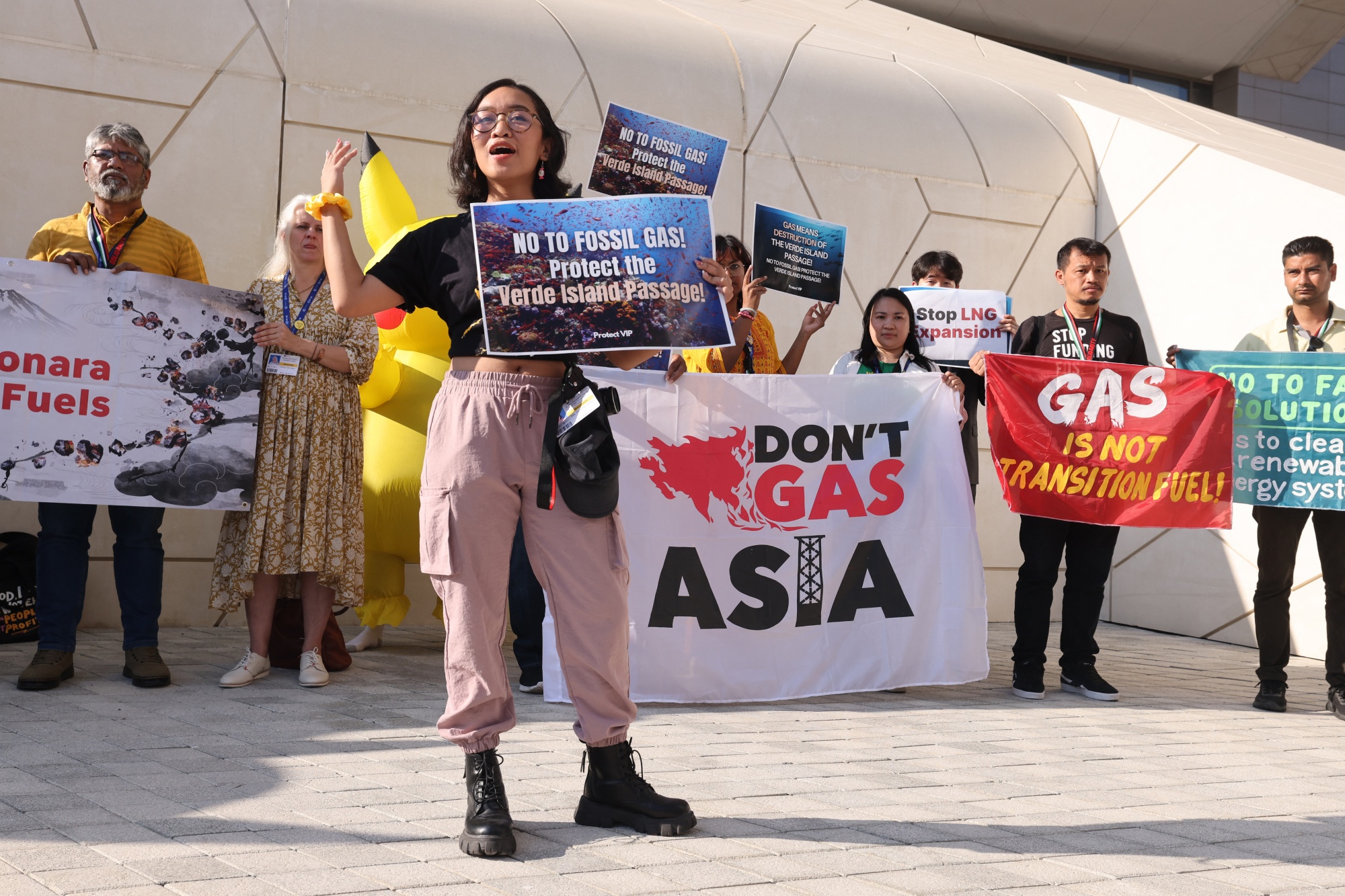
Activists at the COP28 in Dubai, in December 2023. Photographer: Karim Sahib/AFP/Getty Images
Shinichi Kihara, the country’s Director-General for Energy and Environmental Policy, likes to tell how, at UN climate conference in 2022, he was confronted by a person dressed as a Tyrannosaurus rex — Japan had been named “Fossil of the Day,” a distinction given by environmentalists to highlight climate laggards.
Not the least bit offended, Kihara asked to take a picture together and reiterated Japan’s conviction that its energy strategy is a positive force for development across Asia. The goals of “emission reduction, economic growth and energy security” have to be achieved simultaneously, he said at a conference in June. “We do not sacrifice one for the others.”