Politics
Le Pen’s Support Surges in Nearly Every City, Town and Village in France
Support for far-right politician Marine Le Pen and her National Rally party increased since 2017 in 98.6% of France’s municipalities in the first round of a snap election called earlier in June, according to Bloomberg analysis of data from France’s Interior Ministry.
In a legislative election that has already seen the highest turnout in first-round voting since the 1997 ballot, Le Pen’s party and allies doubled their score or more in 83.3% of these areas, and the most in the departments of Paris, Haute-Corse, Cantal and Lozère. In two-thirds of municipalities in those four departments, the National Rally had a score below 10% in the 2017 election.
Far Right Gains Traction Under Macron’s Presidency
Municipalities that recorded an increased change in vote share for Le Pen's party and allies between the 2017 and 2024 legislative elections.
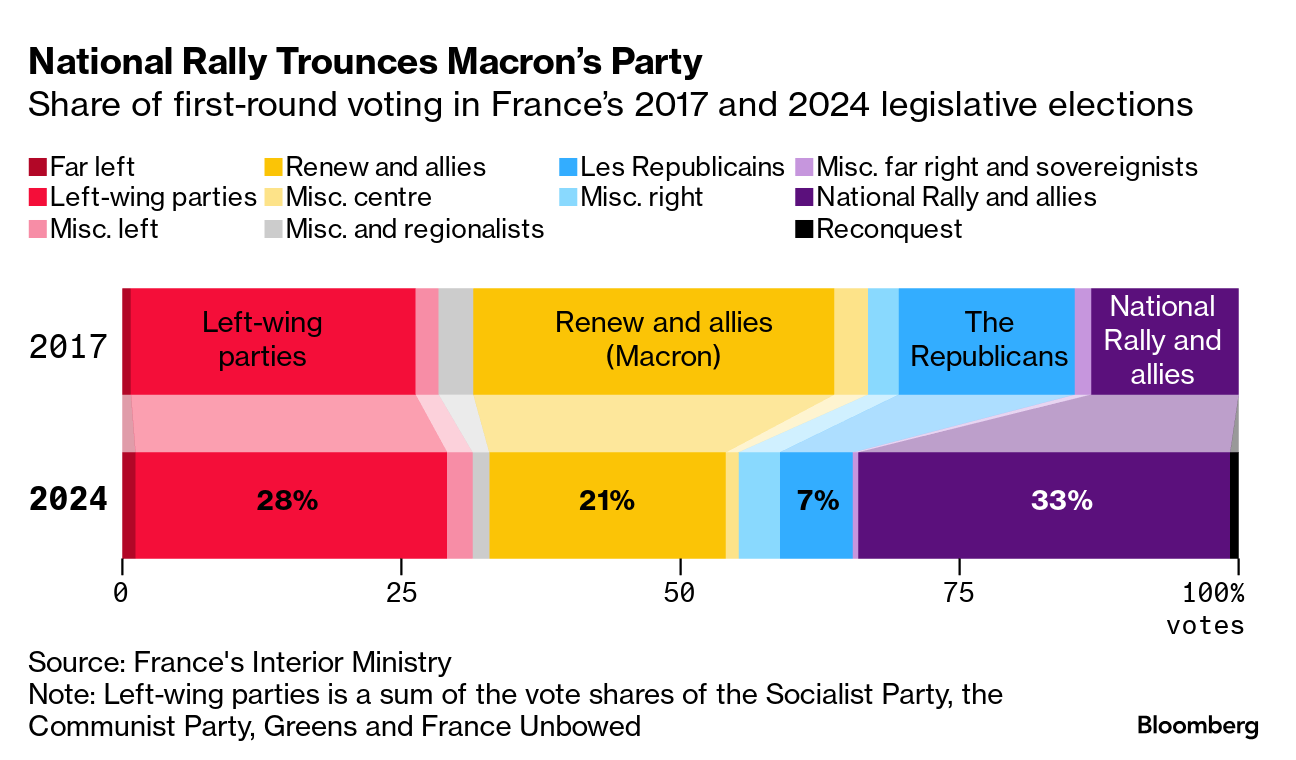
In France, the share of voters’ backing the far right has increased significantly since Emmanuel Macron was elected president in 2017. The National Rally lost ground in only 1.4% of France’s municipalities during the first round of the snap election, and got 20 percentage points more votes nationwide compared to a similar election in 2017. Le Pen’s party is ahead of the New Popular Front, an alliance of left-wing parties, that received 28% of the votes. Macron’s party, Renew, and its allies obtained only 21.3% of the votes.
National Rally Trounces Macron’s Party
Share of first-round voting in France’s 2017 and 2024 legislative elections
Seventy-six candidates have been elected in the first round, receiving over 50% of valid votes and 25% of the registered electorate. In the other 501 constituencies, all candidates whose vote count exceeds 12.5% of registered voters qualify for the second round, which will take place on Sunday July 7.
Due to the high turnout, 306 constituencies are expected to have three-way runoffs, with both the leftist New Popular Front and Macron’s Renew facing the National Rally or its allies in 226 of them. In 2022, there were only eight three-way runoffs.
In the following days, some candidates coming in third place may drop out in order to block the National Rally from gaining seats. Macron and left-wing party leaders have already announced they would consider pulling candidates where they placed third.
This election will determine the 577 representatives of the lower house of the French Parliament, the National Assembly, and takes place after Macron dissolved the Assembly on June 9 following his party’s poor performance in the European Parliament election. Le Pen’s National Rally won 32% of the votes then while Macron’s party lagged far behind with only 15%.
The last president to dissolve the National Assembly was Jacques Chirac, back in 1997. Chirac’s centre-right party was beaten by an alliance of left-wing parties in the ensuing snap election, which led to a political cohabitation with Socialist Prime Minister Lionel Jospin until the end of Chirac’s first mandate.