Jobs Offering Flexible Working Are Getting Rarer in the UK
Reed Recruitment data suggests bringing people back into the jobs market could be hard
UK employers are scaling back on advertising jobs that offer flexible schedules, reining in part-time and remote work from peaks seen in the pandemic.
An analysis of data for England from Reed Recruitment provided to Bloomberg suggests a decline in workplace flexibility could undermine the recent increase in the number of hours women were willing to work. It also poses problems for the government’s effort to bring more inactive people back into the workforce to ease tightness in the labor market.
“Flexible” job postings were down 4% in February from 2022, after stagnating close to pre-Covid levels for the last couple of years, the Reed data shows. Vacancies mentioning “flexible hours” or “part time” positions fell by about 40% since 2022 and are now below levels seen during lockdowns.
“We were in a quite extreme situation a couple of years ago, we probably moved toward too much flexibility while organizations didn’t have the infrastructure to make that effective,” Christin Owings, senior partner at BCG, said in an interview. “We are now moving in the other direction.”
Employers now are becoming stricter about both when and where people work. “Work from home” jobs declined by a third since 2022, although they’re still up three-fold compared to 2019. At the same time, “hybrid” postings have doubled over the last two years, after rising exponentially since Covid. More employers are mandating in-person days and sometimes paying a premium for those required to be in the office.
UK Employers Are Scaling Back Flexibility Post-Covid
Index, 100 = 2019 levels
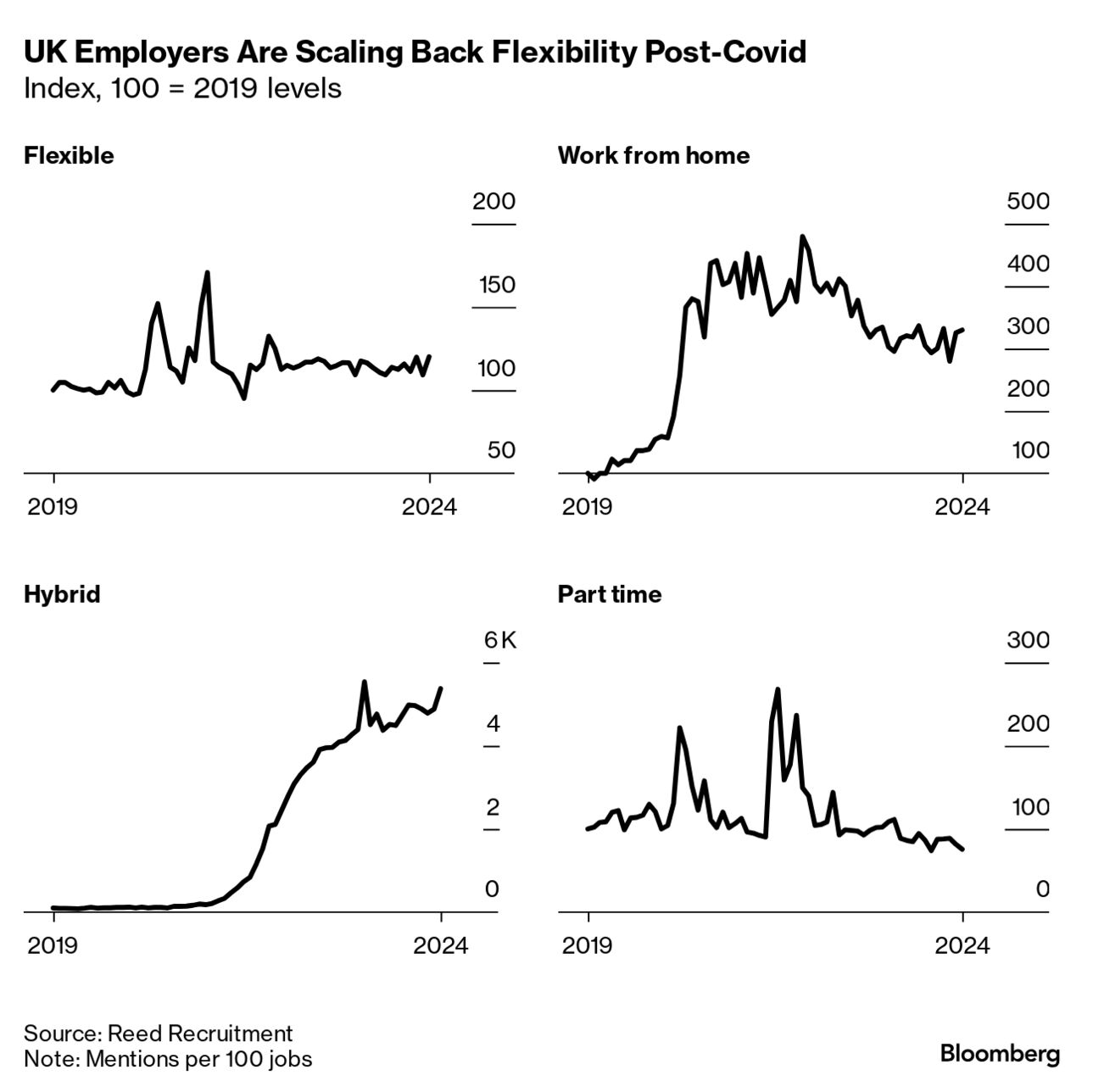
There’s also been a general drop in vacancies of all kinds. That indicates companies are wary about hiring in what economists anticipate will be another year of near stagnation for the UK economy. While the pressure from interest rates and the cost-of-living crisis is expected to ease, analysts expect only a marginal pick-up from the tepid 0.1% growth across the economy in 2023.
Signs of weakness may embolden the Bank of England to reduce interest rates later this year. A cooling labor market would help keep down inflation, which at 3.2% remains well above the central bank’s target 2%. Policy makers led by Governor Andrew Bailey have said they need to see lower wage growth before they can cut borrowing costs.
Reed’s figures were supported by a new survey by the Recruitment & Employment Confederation and KPMG. It showed a weakening jobs market, including the slowest increase in starting salaries for almost three years in February. Its gauge of vacancies also showed permanent vacancies falling at the fastest rate in just over three years as demand for staff dwindles.
“Executives tell me they are ready to invest and grow — including taking on new staff — yet the reality is they’re being held back by the prospect of weak demand,” said Jon Holt, chief executive of KPMG in the UK.
James Reed, chairman of the recruitment firm that bears his name, said it’s unlikely that employers will offer the sort of flexibility that opened up during lockdown. That, he said, “may pose barriers to the UK’s efforts to reintegrate inactive individuals into the workforce. It could restrict options for those seeking to balance work with other responsibilities, such as care-giving or long-term health issues.”
Older Workers Tend to Want More Flexibility Regardless of Gender
Share of UK positions that were remote or hybrid, 2023

Britain’s labor market has yet to recover the size it reached before the pandemic. More than 500,000 people dropped out of work, and many haven’t returned. That’s fed upward pressure on wages and prices, limiting the ability of the economy to expand and leaving the Bank of England on guard against inflation.
Employment experts say part-time and flexible-hour jobs are key to luring people back to work with the promise of schedules that better fit their needs. For example, Zurich Insurance Group AG said its number of part-time hires has almost quadrupled since 2019, when it started advertising all roles as “flexible, part time or jobshare.”
“For many organizations, there is a view that if they offer working from home this is sufficient and additional flexible working arrangements aren’t necessary,” said Jasmine Kelland, a professor at Plymouth University. “However for many families, this isn’t the answer and wider flexible working options are still vital.”
UK workers are now able to ask for flexible working from their first day on the job, according to the Flexible Working Act, which came into effect on April 6. But just asking doesn’t ensure a happy outcome for workers. Employers can decline based on the needs of the business.
“Flexible” jobs only made up 16.5% of total vacancies advertised on Reed Recruitment in February 2024, up just a few points since 2019. Scaling that back even further could complicate efforts to improve the inactivity rate.“When we work is a really important dimension,” Owings from BCG said. “The opportunity to move away from nine-to-five allows people to have more flexibility around childcare or other things that they feel are really important.”
Women are the main winners of Covid-era working patterns, which enabled them to better balance home and office responsibilities. Female workers are now spending about 5% more time on the job than before the pandemic, while men are clocking fewer hours, according to data from the Office for National Statistics.
Women would also be the main losers of a crackdown on flexibility. Mothers working full-time are 2 1/2 times more likely than fathers to ask for flexible working after parental leave, according to recent research by Pregnant Then Screwed. However, the report found that 2-in-5 mothers said their flexible working request was declined.
“A lack of access to really good quality, flexible and part-time job opportunities was essentially holding women back in their careers,” Steve Collinson, chief people officer at Zurich UK, said in an interview. “We have no plans to reverse our approach to flexibility. We think it gives us access to a labor force that just wouldn’t ordinarily think about applying to roles in financial services.”
It’s not just women. A separate report from Linkedin showed that older generations, regardless of gender, tend to work in remote or hybrid jobs, although the effect is more pronounced for women.
UK Jobs Started Mentioning Menopause, Paternity in Recent Years
Mentions in job postings

At Zurich UK, the number of female part-time hires increased almost four times since 2019, while male part-time hires and promotions across genders also shot up. And, in addition to paternity leave, advisory Baker Tilly is encouraging all UK employees to take sabbaticals later in life to spend time with their children when they are a bit older, according to CEO Francesca Lagerberg.
A battle for talent and the pandemic blurring office and home also prompted employers to expand benefits included in job postings. There was a jump over the past two years for mentions of “menopause,” considered taboo only a few years ago, or “childcare vouchers. Meanwhile, “paternity” references increased more rapidly than those of “maternity,” Reed data show.
This is also a way to signal to younger employees that the company is committed to retaining workers across their life cycle, according to BCG’s Owings. Yet without flexibility, these efforts will do little to help working families, Kelland said.
“Flexibility can underpin all of these policies,” Collins said. “We’ve got examples of people who work part time because they care for their parents in the same way that traditionally it would’ve been about caring for young children — or people who just want a different kind of life.”
More On Bloomberg