Starship Explosion Shows Just How Far SpaceX Is From the Moon
For a few moments on Thursday morning, Elon Musk’s SpaceX gave the world a glimpse into what the future of space travel could look like as its Starship rocket lifted off into hazy Texas skies. The giant vehicle’s explosion just four minutes after launch showed how far there still is to go before the company’s biggest ambitions — transporting people to the moon and beyond — might be reality.
SpaceX’s engineers are still sorting through exactly what went wrong with the uncrewed vehicle. Mid-climb, a few of the 33 Raptor engines appeared to flame out. Within three minutes of liftoff, the Super Heavy booster was supposed to separate, but that never occurred. Instead Starship began to spin wildly, tumbling through the sky. Then, the vehicle exploded, which SpaceX later said was triggered on purpose with flight-termination commands sent to both the rocket and booster.
Read more: SpaceX Says It Blew Up Starship Rocket After Engine Mishap
Though the test launch ended prematurely, SpaceX did notch some big wins. This was the first time that the booster — the large cylindrical fuel tank that contains the propellant needed to break free of Earth’s gravity — actually flew in the air. And SpaceX still collected valuable in-flight data that the company will be able to apply to its next test flight of the launch system.
“Congrats SpaceX team on an exciting test launch,” Musk said on Twitter. “Learned a lot for the next test launch in a few months.”
Rarely does a commercial rocket achieve a fully successful flight during its inaugural launch, and SpaceX itself suffered three losses of its very first rocket, the Falcon 1, before it finally achieved orbit on its fourth attempt.
But the inability of the Starship to separate from its booster, one of the very first steps to getting the vehicle ready for prime time, highlights the challenges ahead for Musk’s grandiose plan for Starship to open up space to human travel. The ultimate goal — making the vehicle capable of carrying people and cargo to the moon and beyond — will likely take years and perhaps billions of dollars to achieve, requiring advances in engineering the world has never before seen.
For crewed flights, SpaceX will need to demonstrate that Starship can return to Earth intact and land. The company still needs to develop a life-support system capable of providing oxygen, water and everything else a person needs to survive. Perhaps the biggest challenge is figuring out how to refuel Starship in outer space, a feat that will involve launching the cosmic equivalent of a gas station into orbit, sending up a fleet of tankers to shuttle the chemical propellants, and then perfecting a method that will work in microgravity to transfer the fuel into the passenger vehicle.
None of this will be easy, but Musk has said the fully reusable craft will be capable of making multiple trips back-to-back, drastically reducing the cost of getting to orbit and providing a reliable pathway to deep space that hasn’t existed before.
The US government is deeply invested in its success: the National Aeronautics and Space Administration has committed at least $2.9 billion to help develop Starship into a vehicle that can carry the agency’s astronauts to the lunar surface for its ambitious Artemis program, which seeks to return humans to the moon for the first time in half a century. Beyond that, Starship is destined to be a key player in SpaceX’s ultimate aspiration: settling the nearby Solar System and commercializing space.
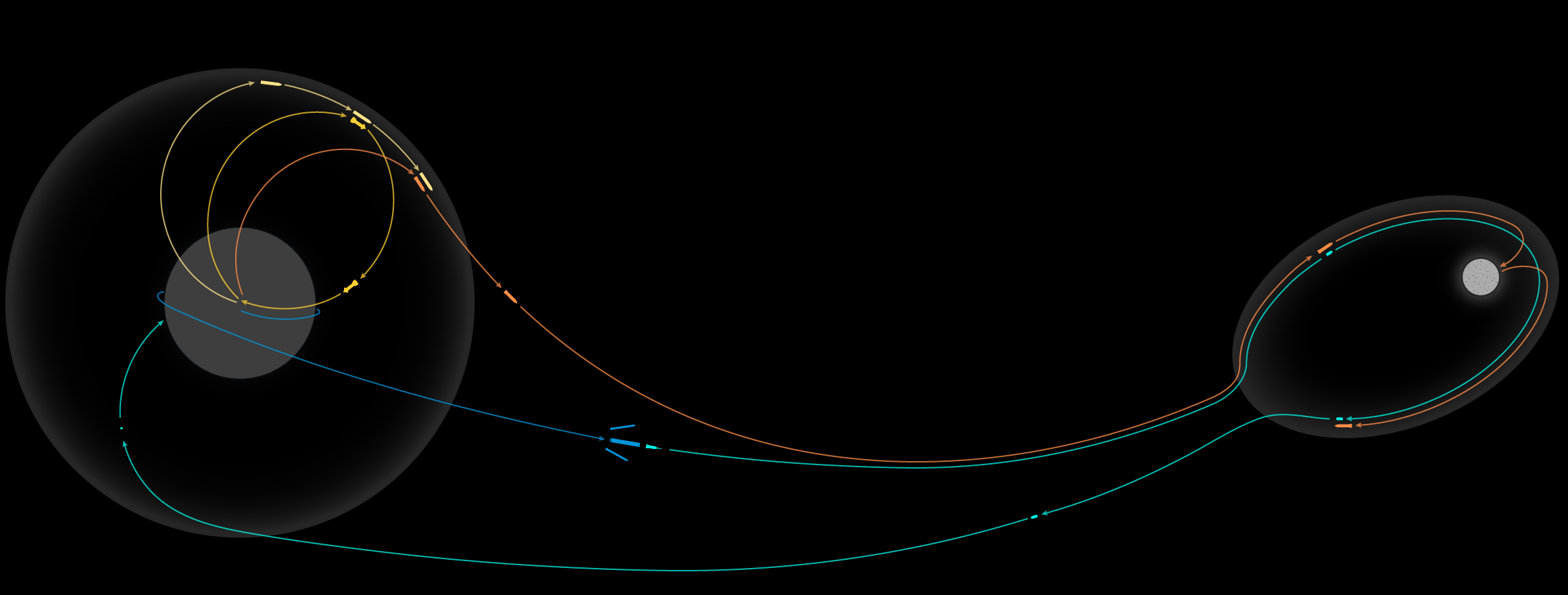
How SpaceX Plans to Send Humans to the Moon
1.
SpaceX’s Propellant Depot Starship launches
and parks in Earth orbit
2.
Tanker Starships get sent on multiple
trips to transfer fuel to the Depot
6.
Orion docks to HLS Starship
in the moon’s orbit. Two
astronauts transfer
to the HLS
3.
Human Landing System
Starship (HLS) docks
with Depot and refuels
4.
HLS Starship performs a
trans-lunar injection burn
and heads to the moon
Earth’s
Orbit
7.
HLS lands on
the moon with
the two astronauts
Tankers return
and are reused
in future trips
5.
Nasa launches Space Launch System
(SLS) and four astronauts depart for
the moon in the Orion spacecraft
Near Rectilinear
Halo Orbit
10.
Orion enters Earth’s
atmosphere and the
four astronauts land
by parachutes in
the ocean
8.
HLS Starship lifts off
from moon and docks
with Orion. The
moonwalkers transfer
from HLS to Orion
9.
Orion heads
back to Earth

Earth’s
Orbit
1.
SpaceX’s Propellant Depot Starship launches
and parks in Earth orbit
2.
Tanker Starships get sent on multiple
trips to transfer fuel to the Depot
3.
Human Landing System
Starship (HLS) docks
with Depot and refuels
10.
Orion enters Earth’s
atmosphere and the
four astronauts land
by parachutes in
the ocean
Tankers return
and are reused
in future trips
4.
HLS Starship performs a
trans-lunar injection burn
and heads to the moon
5.
Nasa launches Space Launch System
(SLS) and four astronauts depart for
the moon in the Orion spacecraft
6.
Orion docks to HLS Starship
in the moon’s orbit. Two
astronauts transfer
to the HLS
9.
Orion heads
back to Earth
Near Rectilinear
Halo Orbit
7.
HLS lands on the
moon with the
two astronauts
8.
HLS Starship lifts off
from moon and docks
with Orion. The
moonwalkers transfer
from HLS to Orion

Earth’s
Orbit
1.
SpaceX’s Propellant Depot
Starship launches and
parks in Earth orbit
2.
Tanker Starships get sent on
multiple trips to transfer fuel
to the Depot
10.
Orion enters Earth’s
atmosphere and the
four astronauts land
by parachutes in
the ocean
Tankers return
and are reused
in future trips
3.
Human Landing System
Starship (HLS) docks
with Depot and refuels
4.
HLS Starship performs a
trans-lunar injection burn
and heads to the moon
5.
Nasa launches Space Launch System
(SLS) and four astronauts depart for
the moon in the Orion spacecraft
9.
Orion heads
back to Earth
6.
Orion docks to
HLS Starship
in the moon’s orbit.
Two astronauts
transfer to the HLS
Near Rectilinear
Halo Orbit
7.
HLS lands on the
moon with the
two astronauts
8.
HLS Starship lifts off
from moon and docks
with Orion. The
moonwalkers transfer
from HLS to Orion

1.
SpaceX’s
Propellant
Depot
Starship
launches and
parks in
Earth’s orbit
Earth’s
Orbit
2.
Tanker
Starships get
sent on
multiple trips
to transfer fuel
to the Depot
3.
Human
Landing System
Starship (HLS) docks
with Depot and refuels
4.
HLS Starship performs a
trans-lunar injection burn
and heads to the moon
5.
Nasa launches Space Launch System
(SLS) and four astronauts depart for
the moon in the Orion spacecraft
Orion docks to
HLS Starship
in the moon’s orbit.
Two astronauts
transfer to the HLS
6.
Orion heads
back to Earth
9.
Near
Rectilinear
Halo Orbit
7.
HLS Starship
lifts off from moon
and docks with
Orion. The
moonwalkers transfer
from HLS to Orion
8.
HLS lands
on the moon
with the two
astronauts
“Congrats to SpaceX on Starship’s first integrated flight test,” Bill Nelson, the head of NASA, said in a Tweet after Thursday’s launch. “Every great achievement throughout history has demanded some level of calculated risk, because with great risk comes great reward.”
What comes next for Starship is also a test for Musk himself. The outspoken billionaire became a celebrity and one of the world’s richest people as he built Tesla Inc. into the biggest maker of electric vehicles globally. But more recently his reputation suffered amid a chaotic acquisition of Twitter Inc. and subsequent spikes in hate speech and other unsavory content on the platform that alienated some of his former supporters. By turning SpaceX into the most prolific US launch provider and the only American company capable of sending astronauts to the International Space Station, Musk has already proved he can outperform his billionaire peers in the industry — notably Richard Branson and Jeff Bezos. Ensuring that Starship reaches its full potential would put him in a new league of his own.
SpaceX is “an agent of change for the space industry as a whole,” said Caleb Henry, the director of research at Quilty Analytics, a space consulting company. “Starship is their chance to rewrite the narrative around launch.”

Tip of Texas
SpaceX has already made incredible strides with its Falcon 9 workhorse rocket, used to launch satellites, cargo and people to space, but this marked the first attempt to launch a vehicle that one day may be capable of carrying humans to other worlds. Plus, Starship is designed to be fully reusable; only part of the Falcon 9 rocket can return to Earth after launch.
It’s hard to estimate how much SpaceX has spent on Starship and how much more it might cost to fulfill his ambitions. Musk said in 2018 that he expected total development costs wouldn’t exceed $10 billion, although he hasn’t updated the forecast and the company doesn’t publicly release any financial information. When asked during a Twitter audio discussion this week how much SpaceX has spent on Starship’s development, Musk didn’t directly respond.
“It doesn’t really actually matter what this particular vehicle cost,” Musk said. “If you’ve got, say, a soap factory, what did your first bar of soap cost? Well, $10 million. But that’s not actually what the bar of soap costs, because what matters is what does it cost at volume production.” He says his goal is to get costs down to $2 million per flight.
It’s also unclear when any of the developmental milestones might come to fruition. NASA has said its goal is to use Starship to land people on the moon in 2025, and wealthy tourists have already put down deposits on joy rides around the moon. SpaceX has blown through plenty of Starship deadlines in the past — the first passenger flight was supposed to take place as early as this year, and that doesn’t seem likely. The company didn’t respond to a request for comment about its expenses or its intended timelines.
Filling Up The Tank
Once Starship proves it can achieve orbit, SpaceX plans to use the craft as its primary vehicle for getting everything into space. That will begin with SpaceX’s much larger, next-generation Starlink satellites, designed to increase capacity for the company’s internet-from-space initiative.
But to get people deep into space — as well as to the moon, Mars and eventually back to Earth — SpaceX needs to come up with a way to refuel the spaceship when it’s in orbit.
One of Starship’s defining characteristics is that it’s massive: At almost 400 feet from tip to bottom, it’s more than twice as long as the space shuttles NASA launched before that program ended in 2011. The vehicle is on track to be the most powerful rocket in the history of human spaceflight. But that means that just to get to orbit, it gobbles up a lot of propellant. And it needs even more to break free of Earth’s gravity, travel to the moon, and then make it back.
So, trips will require pit stops, akin to a car having to fill up at gasoline stations. Refueling a rocket like this in microgravity has never been done before, and the super-cold propellants being used pose some big challenges.
SpaceX is still in very early development on this aspect of Starship’s design, having spent most of its efforts simply getting to the launchpad.
The company has conceded it will be a difficult hurdle.

“Refilling is for sure a challenge,” SpaceX Chief Operating Officer Gwynne Shotwell said at an industry conference in Washington in February. “Getting this beast to orbit has been a challenge, will continue to be a challenge until we do it reliably. But I think refueling is probably the next big — if you think about purely technology — challenge.”
For Starship to fuel up mid-trip, SpaceX envisions building three variants of the craft. The first will be for propellant storage — it launches and gets parked in low Earth orbit. The next is a tanker, which will carry propellant to the depot. It’s possible that SpaceX will need more than a dozen tankers to transport enough propellant to fuel a trip to the moon and back, but NASA and SpaceX haven’t released a firm number.
Once the Starship fuel depot is sufficiently full, it would be time to launch the third Starship variant: the one with humans. It needs to be outfitted with a cabin for the crew and passengers, plus a life-support system. This Starship will dock with the fuel depot and fill up its tanks for the long journey ahead.
Cryogenic Propellant
Filling up the tanks won’t be as simple as pumping gas. Starship’s fuel is composed of two extremely cold propellants: liquid oxygen and liquid methane. They must be kept at negative 260 degrees F to negative 300 degrees F to stay liquid and function as needed. If they get too hot, they’ll turn into gas and boil off.
The space environment doesn’t make it easy to keep the propellant cool. As the depot orbits the Earth, it will spend half its time in the cold dark and half in direct sunlight. The vehicle will need proper insulation on the inside, shielding on the outside and refrigeration to combat the heat. To avoid a potentially catastrophic pressure buildup, there also needs to be robust valving to vent the propellant that inevitably does boil away.
SpaceX will also need to transfer these extremely cold liquids from the tankers to the depot and then to the craft carrying humans. Just the act of moving the propellants from one tank to another causes them to heat up. And engineers have never worked with these propellants at such scale in a weightlessness before.
“There’s a lot we don’t know for sure,” Lauren Ameen, deputy project manager of the cryogenic fluid management portfolio office at NASA, said in an interview. “A lot of the fluid physics — the fundamental fluid physics — of transferring cryogenic propellant in space is not understood quite yet.”
So far, in-space experiments with transferring and storing similar propellants have occurred at a very small scale on the International Space Station. What SpaceX is envisioning for its propellant storage and transfer is much more complex.
The first step will be for SpaceX to demonstrate it can transfer propellant from one Starship to another. As for when that will be, it’s still unclear.
“It will probably be no earlier than six months after a successful flight test,” said Lisa Watson-Morgan, NASA’s program manager for the human landing system in the Artemis program. “But it could be longer.”
The Long To-Do List
With enough money and engineering knowhow, it’s possible SpaceX can overcome the long list of challenges standing between the test launch and its biggest ambitions. Critics who have long doubted that the company could pull off what seemed like insurmountable feats have often been proved wrong. For its part, NASA still thinks it’s possible Starship will get to the moon by 2025.
“I definitely have confidence that NASA and SpaceX will get there,” Watson-Morgan says. “I think that ‘25 is a challenge. It is doable.”
But first, Starship will need to prove that it can reach space in one piece.
Related ticker:
711339Z US (Space Exploration Technologies Corp)