The Worst Covid Strategy Was Not Picking One
The lessons of the pandemic are clearer in a global comparison.
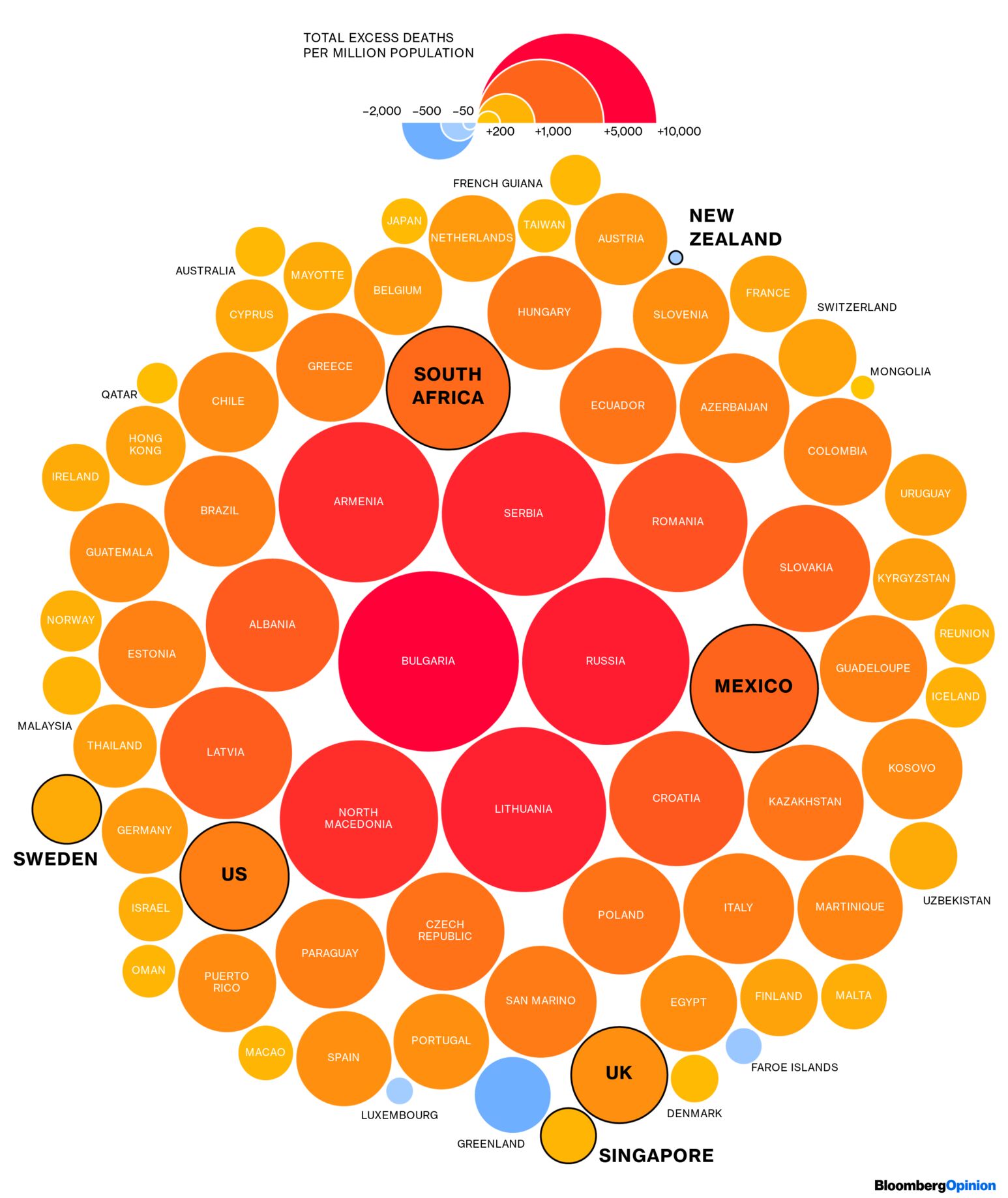
Three years after the World Health Organization declared Covid-19 to be a pandemic, we finally have reason to celebrate: Global deaths from the virus have dipped below 1,000 people per day for the first time since March 2020. But with almost 7 million dead, we must figure out a way to do better next time. And there will be a next time.
Bloomberg Opinion assessed countries by excess deaths, a measure of actual deaths compared to expected deaths during a given period. It’s considered the most objective metric, because it doesn’t rely on access to tests (which might be unequal) or judgment calls (did Covid really kill this person, or was it a heart attack?).
Then we distilled the list down to seven with strong lessons for the next pandemic.
New Zealand fared the best, teaching us that geographical advantages matter, but so does clear, consistent leadership.
Singapore showed that deciding when to end successful restrictions is never an obvious call.
Sweden proved that shoring up wealth, health and social infrastructure before an outbreak can significantly lower the human cost of pursuing a more relaxed strategy.
The UK made clear that a good vaccine rollout gives a lot of wiggle room for missteps.
In the US, the staggering toll is a reminder that all the wealth and vaccines in the world cannot save lives in a nation fractured by politics.
South Africa trusted wealthy nations to fulfill their vaccine promises — and paid dearly when they didn’t.
Mexico ended up with a struggling economy and a high death toll, showing that “lives vs. economy” was often a false choice.
Maybe the biggest lesson of all: Every policy choice involves trade-offs. No one “wins” a pandemic.
New Zealand
Decisiveness saved the most lives
 David Fickling
If you wanted an image of how New Zealand’s Covid pandemic differed from the rest of the world, it would be hard to beat the scene on the night of the country’s Oct. 17, 2020, election.
Most of the world was still under lockdowns as the virus gathered pace for its winter surge: Madrid was preparing to begin curfews, and in the US a presidential debate was canceled as President Donald Trump recovered from infection. But in New Zealand, the threat had receded so far that Prime Minister Jacinda Ardern’s partner handed out finger bowls of barbecued snacks to unmasked media awaiting the election results.
“We will get through this together, but only if we stick together,” Ardern had said in a March 2020 speech announcing some of the toughest lockdown measures in the world.
That aggressive approach appeared to pay off after two months of isolation eliminated local transmission. Only a handful of countries matched New Zealand’s achievement of reporting negative excess deaths during 2020 and 2021, according to a 2022 analysis published in the Lancet, a medical journal. Lockdown measures meant the country skipped its usual winter influenza season. Combined with other behavioral changes, that meant fewer people died than in typical years.
Geographical good fortune played its part. The other negative-excess-death nations — such as Australia, Iceland, Singapore and Taiwan — tend to be affluent, highly urbanized and surrounded by sea. Air and sea ports are easier to shutter than road and rail links. New Zealand’s borders remained largely closed for two years. About 40% of tourist arrivals normally come from Australia, which also escaped the worst of the pandemic.
The severe lockdown came at a cost, however. By halting migration, New Zealand shuttered a tourism industry that brings in about 19% of the country’s export revenues, far higher than the 7.9% or so in France and Italy and 9.5% in the US. Supporting an economy under such a severe lockdown meant that government debt increased faster than in almost any other developed economy, rising 43% in local-currency terms compared to a 15% jump in the UK and 5.4% in Japan.
Borrowing More
New Zealand’s government debt soared early in Covid

A robust economic rebound and a backdrop of fiscal caution has helped to keep that sum low relative to the size of the economy. Even so, Covid has left harmful after-effects. Most notable among them has been a rise in emigration. While borders were closed between March 2021 and October 2022, emigrants outnumbered immigrants by 215,571, equivalent to about 7.5% of the country’s labor force.
That has tightened the labor market and contributed to inflation, now at its highest level since 1990 — a major factor in the economic pain that ate away at Ardern’s popularity before her retirement in January. Her successor, Chris Hipkins, will need to show that he’s addressing that ahead of elections due in October.
New Zealand made its isolation from the world the cornerstone of its success against Covid. It may end up its Achilles’ heel as well.
Singapore
The lockdown worked, but reopening was a roller coaster
 Daniel Moss
Singapore has come out of the Covid-19 pandemic looking pretty good. But it had so much going for it — wealth, infrastructure, good hospitals, a powerful state sector — that perhaps it wasn’t unexpected. Yet from the perspective of one living here, the path to re-opening was arduous.
Despite its highly effective inoculation campaign, Singapore had its share of misfires, false dawns and mixed messages not easily captured in metrics. In this, the nation had plenty of company. But few places enjoyed Singapore’s pre-Covid reputation for administrative excellence.
Muscular decisions were made fairly early in the pandemic. Early on, Singapore got the big things right. Our lockdown, known locally as “circuit breaker,” lasted two months. There was also an effective contact-tracing app, border closures and an impressive mass vaccination effort. “You are not going for fine-tuning, you’re not going for precise numbers, you just want to lay down a barrage, a major operation to just tamp it down,” Prime Minister Lee Hsien Loong told Straits Times journalists for the book In this Together: Singapore’s Covid-19 Story. “Do big, right things, never mind the small optimizations. When that’s under control, then we can think about tuning it, making sure we are not paying more of an opportunity cost than we should.”
It was those subsequent recalibrations that proved hardest. A merry-go-round of partial openings and qualified closings marked 2021. From May through August, the rules kept changing, affecting whether you could dine out and with how many people — even where you could work. The public began to wonder if the government was truly committed to living with Covid.
Singapore Was Stricter for Longer
Singapore held on to tight restrictions for longer compared with New Zealand, which imposed and relaxed its rules more dramatically

That October, Lee gave a major speech affirming that Singapore could never be shut off from the world. By then, about 80% of the population was fully vaccinated. Controls steadily loosened for vaccinated folks — and tightened for those without shots.
The stop-start response to infections that characterized the months before Lee’s Oct. 9, 2021, intervention gave way to a more orderly approach, albeit a very cautious one. Travel abroad remained very problematic until late 2021.
The strictest curbs weren’t in the rearview mirror until mid-2022. It was March before groups of 10 were permitted to gather, residents could unmask outdoors, and alcohol could again be sold after 10:30 p.m. It wasn’t until April that officials dropped pre-flight Covid tests for travelers, curbs on the number of people who could work in offices, and no longer required folks to check in with the government contact-tracing app.
Today, the republic is reveling in a post-Covid world of talent influx, soaring property prices, and insatiable demand for tables at nightclubs and spots at international schools. Singapore has become Asia’s destination of choice. The country is portrayed as having had a good war. But up close, the picture was far more nuanced. Even in a republic with a reputation for technocratic excellence, reopening was quite messy.
Sweden
Pandemic preparation paid off, especially for young people
 Andreas Kluth
In terms of Covid policy, Sweden was the anti-lockdown exception.
Unusual among comparable countries, Sweden never shuttered its kindergartens, elementaries or middle schools — and only briefly kept older students out of classrooms. It also refrained from most other restrictions, generally opting for recommendations over prohibitions.
This Swedish “experiment” was controversial, to say the least. So how did the Swedes fare?
Quite well, overall. Excess deaths in the first wave of SARS-CoV-2 initially surged, especially among older people, whereas they stayed largely flat in neighboring Norway and Denmark. But the Swedes changed their behavior and rode out subsequent waves as well as anybody. In later stages of the pandemic, their excess mortality was worse than those of their Scandinavian neighbors but still significantly lower than the rest of Europe’s.
During the early pandemic, international media often described Sweden’s policy as a lunge for “herd immunity.” The Swedes took umbrage at that characterization. They too were trying to “flatten the curve” of hospital admissions and disease. It’s just that they decided to stick to pandemic plans they had drawn up before Covid, with influenza in mind.
The gist of those plans was twofold. First, the government decided to trust in individual Swedes to voluntarily behave responsibly — by quarantining when sick, working from home and keeping apart whenever possible. (I recall a Swedish friend joking that “We’re Swedish: We socially distance even in normal times.”) So they mingled less. And as soon as vaccines became available, most got their shots.
The second aspect of Sweden’s approach was to take a holistic view of the public-health crisis, by recognizing that Covid was one risk among many, from financial loss to interrupted learning to mental illness.
On some of those measures, Sweden has objectively fared better than countries that prescribed lockdowns. Its young people are doing especially well compared to those of other nations.
According to an analysis of 15 countries, youngsters on average lost a third of a year’s worth of learning during the pandemic. Unsurprisingly, kids from poor households suffered most. By contrast, a different paper found that Swedish students showed no learning gaps in literacy at all (math skills weren’t part of the study). Nor did the pandemic exacerbate the deficits of less-well-off children.
Swedish Children Kept Learning Through Covid
Average reading comprehension scores increased for Swedish third-graders

The evidence on mental health tells a similar story. An analysis of 11 countries that had lockdowns and school closures shows that depression and anxiety increased dramatically among young people. By contrast, a study of Swedish university students found negligible effects on depression, and even small improvements in anxiety and stress.
The Swedish experience offers lessons for the next pandemic. Public health is a value, but so is education and the right to self-determination. Treating people as mature and responsible citizens paid off for Sweden. And other nations saw it. As the pandemic entered its second and third year, ever more countries gradually — and without calling it that — “became Swedish.”
UK
A fast vaccine rollout overcame a multitude of sins
 Therese Raphael
The publication of a trove of WhatsApp messages sent by former Health Secretary Matt Hancock, leaked by the journalist he trusted to ghostwrite his book, has reopened a seething debate about Covid in the UK: Did Britain’s leaders flub it?
It’s not the pandemic narrative former Prime Minister Boris Johnson told. He was fond of calling the UK’s vaccine rollout “world-beating” — and it’s a rare case where the reality mostly matched the boast. Britain became the first country in the world to approve an mRNA Covid vaccine for emergency use and had one of the fastest rollouts in the world. The UK’s vaccine taskforce, led by venture capitalist Kate Bingham, sourced vaccines that would be available quickly and then signed contracts for large quantities of them.
There were setbacks along the way, but I’d place the early procurement, approval and distribution of vaccines on the plus side of the pandemic response ledger. Another plus: the UK’s excellent genomic sequencing system, led by microbiologist Sharon Peacock, which helped authorities identify new variants.
Jabs Relieved Pressure on NHS
High vaccination rates kept the UK’s health system from becoming overwhelmed

But as the uproar over the Hancock messages attests, the minus side of the ledger contains a rather longer list. In 2020, before vaccines were available, the UK had one of the highest rates of excess deaths in the world. That reflected costly mistakes. Johnson vacillated before calling the first lockdown, letting infections spread. Care homes, the location of 45% of all excess deaths in England and Wales, were initially left unprotected. Despite some worthy efforts, the UK’s £37 billion test-and-trace system was largely seen as scattershot, inconsistent and confusing.
The response was complicated in Britain by a number of increased risk factors, such as the UK having one of the highest rates of obesity in the developed world. The lack of a well-funded social-care system meant another vulnerable group, the elderly, was even more exposed.
More important, the perennially underfunded National Health Service entered the pandemic with relatively fewer beds, doctors, nurses and scanning machines than its peers, presenting major capacity constraints. That contributed to Britain having one of the largest increases in health expenditure during the pandemic. And Covid has left the NHS with a massive backlog and overcrowded emergency departments.
One of the big lessons is that preparation matters. A report from the UK Public Accounts Committee concluded the government was caught flat-footed. The slow-moving public inquiry should help in understanding more about the effectiveness of its non-pharmacological interventions, like lockdowns, masking and school closures. Different policy blends were used at different times, and enforcement and compliance also varied. School closures have led to worrying learning loss that has longer-term consequences. Would better preparation have led to earlier, less costly interventions? Almost certainly.
Britain ultimately ranks roughly in the middle of the pack for excess deaths, which suggests that the overall mix of measures, over time, was not as disastrous as many thought. It can thank its jab strategy for that, but the country should have done better.
US
Politics weren’t just divisive; they cost lives
 Faye Flam
A 2019 report on the Global Health Security Index ranked the US the best country in the world for all aspects of pandemic preparedness, including “rapid response to and mitigation.” After three years of Covid, however, the US has suffered far more deaths per capita than any similarly wealthy country.
It wasn’t for lack of sacrifice. “We were at this persistent level of misery for a year,” said Sam Scarpino, a professor at Northeastern University. The US response was “quite disruptive, but actually not that effective.” Other countries imposed more intense restrictions for shorter periods of time, while we burdened people and businesses with uncertainty and lack of an exit strategy.
During the first year of the pandemic, our excess deaths were comparable to European countries. Australia, New Zealand and much of Asia did far better during this period by deploying testing and contact tracing early. In the spring of 2020, South Korea was testing at a rate 100 times higher than the US.
“I think all data show that a lot of people died who probably didn’t have to die, which is really tragic,” said Thomas Hale, a professor of global public policy at Oxford University.
It was in the months after the vaccines were made available to the general public — June 2021 to March 2022 — that our death counts started to shoot above those of our European counterparts. The US suffered three times as many excess deaths as the UK, more than four times as many as Sweden and 28 times as many as New Zealand.
We had a lower vaccine uptake than these other countries — but that wasn’t the whole problem. Hale said other countries did a better job of getting the vaccine to the most vulnerable people. Here in the US, the vaccine was free, but many unvaccinated people died because they didn’t trust the public health system. That becomes particularly clear when we look at the much higher rate of excess deaths in the least-vaccinated US states.
Death Tolls Lower With Jabs
Covid caused the most damage after vaccines were available in areas with the lowest vaccination rates

Some of that distrust was sown by illogical, poorly explained rules and bungled testing during the first part of the pandemic, as well as extreme political polarization.
We also started out in poorer health than comparably wealthy countries. A striking graph in Scientific American showed that pandemic death rates could be predicted by a country’s life expectancy going in. Norway, Sweden and Denmark lost little or no life expectancy, while Americans lost nearly three years. The most shocking decline was for Native Americans, who fell from an already low 72 to around 65.
The next pandemic could be very different. It might spread in a different way and pose the greatest risk to different people. But some lessons will always apply. Decades of risk-communication research shows people respond best to messages that are clear, consistent, honest and well-reasoned. And the US should lessen our health disparities — helping all Americans get access to decent health care, better food and a healthier environment.
South Africa
The promised vaccines came too late
 Lisa Jarvis
South Africa got off to a good start when Covid first appeared — it was among the first to recommend masks and launch a public information campaign around the virus. Scientists there quickly recognized the importance of genomic surveillance, and their vast sequencing efforts helped identify and track new variants.
But the vaccine rollout fell woefully short. South Africa’s government is partly at fault, but most of the blame should fall on rich countries that failed to share doses. South Africa threw its lot in with Covax, a vehicle created to ensure equitable global access to vaccines, and those shots arrived later than anticipated as wealthy nations hoarded resources.
Unlucky timing also played a part. The government’s first vaccine campaign relied on AstraZeneca’s shots, and just as it was being rolled out, a clinical trial came out questioning its effectiveness. Officials suspended the campaign. Distribution of the next round of shots, from Johnson & Johnson, was temporarily paused to review reports of rare blood clots following vaccination.
By May 2021, half of the population in the US and UK had received their first Covid shot, while less than 1% of South Africa had. By July, older people in Israel were getting their first boosters with mRNA shots, while most South Africans had yet to get their first doses procured from Pfizer. During that period, the delta wave roiled South Africa.
Most South Africans Still Aren’t Vaccinated Against Covid
In the race for Covid vaccines, South Africa has never caught up

By the time vaccines were more freely available, many young people had lost interest. A narrative that Covid was no longer dangerous coincided with rampant misinformation about the safety of the vaccines. The South African government did not do a great job combatting that hesitancy.
As a consequence, the government fell far short of its goal of vaccinating 67% of its population by the end of 2021.
The protracted rollout carried a heavy price. As of late February, cumulative excess deaths in South Africa were estimated at 472 people per 100,000, putting it among the bottom 30 countries in the world.
How could this go better next time?
One solution would be for world leaders to commit to more equitable access to vaccines if another pandemic unfolds. The WHO recently released a draft of a pandemic treaty that would earmark 20% of all pandemic-related products for developing countries. Any such arrangement needs to have teeth so that poorer countries aren’t always at the back of the line.
South Africa is also trying to become less reliant on others for help. The WHO is investing in an mRNA vaccine hub in South Africa that will serve as a resource for other low- and middle-income countries. Homegrown vaccines hold huge appeal for Covid and beyond, but the project still needs to surmount high scientific, legal and commercial barriers.
Ultimately, the lesson is one for wealthy nations: During a pandemic, nobody wins when low- and middle-income countries lose.
Mexico
Fiscal prudence failed the neediest
 Eduardo Porter
What happens when you have a decaying public health system, little in the way of a social safety net, and a penny-pinching president bent on dismantling a state he deems irretrievably corrupt? If you then happen to get walloped by a global pandemic, what you get is Mexico’s experience with Covid-19.
For as long as he could, President Andrés Manuel López Obrador acted as if the virus was but a big nothingburger, suggesting that Mexicans who wanted to stay on the safe side arm themselves with some pictures of saints. When the body count started rising, his administration did its best at not counting. And it declined to spend much public money to cushion the blow.
The result: 650,000 excess deaths in the three years since the start of the pandemic, 5,031 per 1 million people, according to Our World in Data. That is the 17th-highest excess death rate in the world, second only to Peru’s 5,474 in Latin America. The United Nations population division reports that the world’s life expectancy fell by 1.7 years, on average, from 2019 to 2021. In Mexico it fell by four, from 74 to 70 years.
Mexican Lives Got Much Shorter During Covid
Life expectancy at birth was higher than the world average for Mexicans before Covid; now it’s lower than the world’s
Public health in Mexico has always been shoddy compared to its peer countries. In 2020, when COVID struck, Mexico’s public funding for health amounted to barely 3.3% of GDP, the lowest among Latin America’s large economies. It had fewer than 1 hospital bed per 1,000 population, half the rate in Chile or Brazil.
In 2020 the new government started to overhaul it, promising something better, less corrupt and cheaper than the system built by the illegitimate governments that preceded it. The overhaul, however, hasn’t worked as advertised.
The share of Mexicans reporting no access to health care nearly doubled in 2020, to 28%.
In the first eight months of 2022, the revamped health system designed for the 60 million-plus Mexicans not served by the formal government safety net recorded 10.5 million visits, according to an analysis by the Baker Institute at Rice University. That’s 29% fewer than in the same period of 2021 and 79% fewer than in 2018, before López Obrador took office.
Mexico may be a poor country, but the problem isn’t exclusively a lack of funds: Through the pandemic, Mexico has maintained a primary fiscal surplus, one of the largest in the world. Even the famed fiscal hawks at the International Monetary Fund called Mexico out for its conservative budgets as the pandemic raged.
This parsimony has not served the Mexican economy, which shrank more and recovered more slowly than the average across Latin America.
Researchers at Tulane University estimated the impact of Covid across Latin America’s four largest economies in 2020. In three of them, the shock to poverty and inequality was significantly offset by expanded social assistance efforts. Not in Mexico. In Mexico, the government let poverty and inequality rip while death did its thing.
(Corrects the marital status of Jacinda Ardern in the second paragraph of the New Zealand section.)